Zhihu Frontier
@ZhihuFrontier
🚀Bringing China's AI & tech trends, voices and perspectives to the global stage.
⚡️Powered by 知乎/ China's leading knowledge community.
Joined June 2025
192 Following 12.3K Followers
🔍 A DeepSeek Harness Plugin That Lets AI Explain the Agent's Own Trace
Less than two weeks after DeepSeek Harness entered developer preview, its plugin ecosystem is already taking shape.
Zhihu contributor 刘琦 built DSH Trace Insight, a focused plugin for one of the most important but overlooked parts of Agent engineering: understanding what an Agent actually did.
1️⃣ DeepSeek Harness exposes the process
Many Agent harnesses behave like black boxes. Users provide a task, wait, and eventually receive an answer.
DeepSeek Harness is different. Its trace records tool calls, execution steps, failures, retries, and other intermediate activity.
This makes the Agent more transparent, but the raw trace is stored as a large JSONL file. Even with filtering, it is difficult for a human to read and reconstruct the full process.
The author's idea was straightforward:
If the trace is too complicated for humans, let another AI interpret it.
2️⃣ Turn raw traces into readable analysis
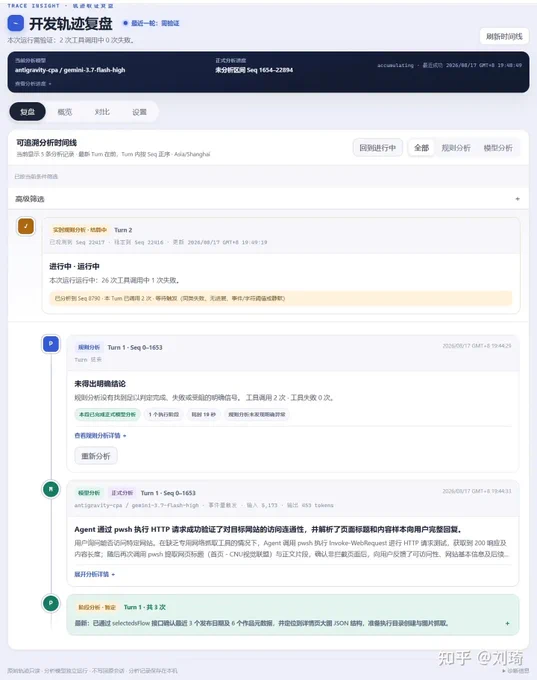
DSH Trace Insight adds a side panel that asks an AI model to explain the running trace.
It can summarize:
🔹 What the Agent is doing
🔹 Which methods and tools it used
🔹 Where errors or retries occurred
🔹 Whether any risky actions appeared
🔹 What lessons can be extracted from the run
Instead of waiting beside an opaque progress indicator, users can inspect how the task is progressing, whether the approach is working, and how risky the current behavior looks.
The goal is not to add another capability to the executing Agent. It is to add an interpretability layer around the Agent's behavior.
3️⃣ Use two models for cross-checking
When a suspicious step appears, the plugin can send the same trace to two different AI models and compare their analyses.
This is useful because trace interpretation is still a model-generated judgment. A second model can expose disagreements, missed risks, or different readings of the same tool call.
The plugin can also organize detected issues into a compact list for manual review.
That creates a useful three-layer workflow:
Agent execution → AI trace analysis → human review
It is a lightweight approach to Agent observability without requiring users to inspect thousands of raw log lines.
4️⃣ Installation is intentionally simple
The plugin is open source under the MIT license:
Users can ask their Agent to install it directly with:
Please install this DSH plugin:
The current version is designed for the native DeepSeek Harness Web UI.
Using it inside third-party desktop wrappers may require additional development, since those clients may package or modify the original Web UI differently.
5️⃣ DeepSeek Harness can become a model worker behind Codex
The author also suggests an interesting setup for people who do not use DeepSeek Harness as their primary Agent interface.
Open the native DSH Web UI inside Codex's browser. Codex remains the main harness, while it operates DeepSeek Harness and the models connected to it.
This creates a layered workflow:
🔹 Codex handles planning and orchestration.
🔹 Lower-cost non-GPT models inside DSH perform lightweight tasks or code inspection.
🔹 DSH Trace Insight exposes how those models executed the work.
🔹 Codex can discuss the results with DSH across multiple rounds, then send the final conclusion to another strong model for an additional review.
Compared with assigning every subtask to an expensive model, this setup can reduce cost. Compared with calling another CLI tool blindly, it provides much better visibility into execution.
✅ The real value is observability
DSH Trace Insight does one thing: it translates an Agent's raw execution history into something humans can understand.
That simplicity is its strength.
As Agents begin running longer tasks with more tools and greater autonomy, the important question is no longer just whether they produced the correct answer.
We also need to know how they reached it, what failed along the way, and whether they crossed any risky boundaries.
🔗 Full Reading:
#DeepSeek# #DeepSeekHarness# #AIAgents# #AgentObservability# #OpenSourceAI# #AIEngineering#
Show more