

Took a while for DeFi to get here, but very cool to see the Magnificent 7 stocks supported as collateral on @aave.
More coming soon.

Fellow Americans, now’s your chance to get access to Aave App 🇺🇸
Very cheap borrow rates on @aave V4's @arc deployment.
Borrow USDC or EURC against cirBTC and WETH at these rates while ya can.

Aave V4 is the fastest growing DeFi protocol in the industry right now.
Matter of time before it becomes the primary hub for onchain credit.


Aave is DeFi's single largest @tether USDT liquidity sink.

Aave App is one of the best savings experiences on the market.
• Easy onboarding
• Free bank deposits/withdrawals
• Earn in real time
• 24/7 compounding
• Global rates
• Balance Protection
• No confusing crypto stuff
And more coming soon.
If you want early access lmk!
Show more

Aave V4 becoming a major liquidity hub for @global_dollar's USDG stablecoin.
Stocks are moving onchain, and Aave will be the main venue for stock-backed loans.
That said, equities stop trading every night and every weekend, and lending markets depend on continuous prices.
So we're working with @LlamaRisk and @chainlink on the solution.
Show more
We just shipped our Aave Insights page for token holders and anyone interested in $AAVE.
More to come soon,
New Aavethena rewards live on @aave V4.
Target APY of 5.25% 👀


Aave metrics are amazing and up only
the house of all credit finance

Aave's USDT dominance is unmatched. The single most important hub for USDT liquidity in DeFi.

Aave V3 is the main venue for USDT0 deposited into DeFi, accounting for 78.6% of the $872.7M total
Fluid follows at 15.0%, while Morpho Blue and Uniswap V3 account for 2.6% and 2.0%
Show more


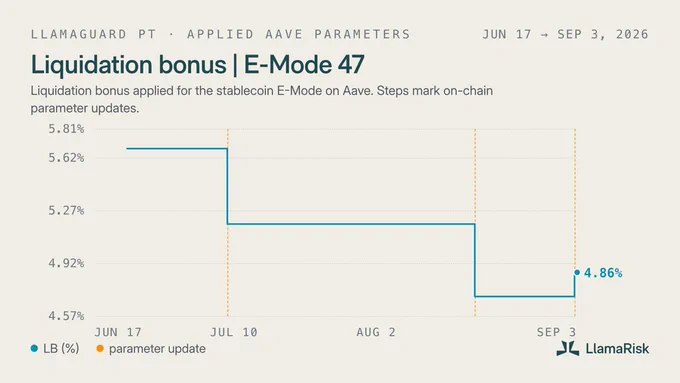
Check out our LlamaGuard PT dashboard, released in tandem with the risk oracle deployment on the @aave v3 PT-srUSDe-22OCT2026 market on Ethereum.
More insights = more power to the users
Just use Aave.
(link in the reply)
Show more



Aave V4 on @avax nears $20 million deposits, reaching new all-time highs week after week.

Big one! $AAVE perpetuals now live on @Kalshi.

Early access to Aave App is underway.
Find a Ghost Pass on X, Instagram, or Telegram to skip the waitlist.
Who needs one?


Hot take: @aave V4 hitting $1B in user deposits this September feels more like when than if 👻












