

AlphaSense
@AlphaSenseInc
Powering the world’s biggest decisions. 7K+ enterprises trust our AI and market intelligence platform to deliver timely insights. (Not investment advice)
522 Following 35.7K Followers
A recent AlphaSense document trend shows mentions of “cash burn” have increased notably across company documents, including earnings transcripts, highlighting growing pressure to prioritize free cash flow and capital discipline in a higher-rate environment.
Show more

Thank you, @FundamentEdge for hosting our CEO and Founder, Jack Kokko, for a packed fireside chat last night on SuperAnalyst and what's actually working in AI-driven research and portfolio management.
A quick thread on what he said 🧵
Show more


$ASML sits at the center of the AI infrastructure buildout, and @AlphaSenseInc channel checks make one thing clear: demand continues to outrun supply in a big way.
EUV system demand is outpacing supply, with lead times stretching toward two years. Demand is increasingly driven by AI, HBM and leading-edge node transitions, with 70-80% of new orders tying back to these applications.
AlphaSense channel checks are tracking these trends across ASML and the broader semicap sector this quarter:
$TSM
Show more

Our CEO & Founder, Jack Kokko kicks things off talking about SuperAnalyst with @FundamentEdge.

Packed house with @FundamentEdge discussing the State of AI Investing with financial leaders.

$NET $FSLY $AKAM The market is focused on GPU spend for AI infrastructure. There's a shift happening one layer over, at the edge and @AlphaSenseInc Channel Checks are picking it up. As AI agents, crawlers and automated M2M traffic multiply, they're hitting security, compute and API layers hard enough to show up as real, incremental budget.
Show more

Every investment firm is racing to deploy AI agents. Few have figured out how far to trust them.
In financial services, that trust question comes down to one test: can an agent's output hold up under audit or in front of a client? The firms getting it right are pinpointing where agents actually change the research process, where full autonomy isn't ready for prime time, and what has to be true of the system around the model before high-stakes decisions can be handed off.
Join Steve Clapham (Behind the Balance Sheet), Andrew Walker (Yet Another Value Podcast), Sarah Hoffman (Director of AI Thought Leadership at AlphaSense), and Ben Collins (Senior Director of Financial Services Solution Marketing at AlphaSense) for a grounded, practitioner-level roundtable on what AI agents actually mean for investment decisions. Register here:
Show more


Where does agentic AI genuinely change investment research, and where does full autonomy fall short?
Excited to join @steveclapham (Behind the Balance Sheet), @AndrewRangeley (@YetAnotherValue), and Ben Collins (@AlphaSenseInc) on Tuesday to discuss the AI agent reality check and what it means for investment decisions.
Show more

AI adoption across APAC is anything but uniform.
Five countries reveal five very different adoption stories:
• Japan, cautious and the least burned by bad output
• Singapore, burdened by search
• South Korea, a steady adopter
• Australia, confident but security-conscious
• New Zealand, facing the steepest foundational barriers
A regional AI strategy can offer shared principles, but priorities, governance, and use cases need to reflect each market.
Read the full analysis:
@AlphaSenseInc
Show more

Doug Petno, Co-President of JPMorganChase and CEO of its Commercial & Investment Bank, will join AlphaSense CEO & Founder Jack Kokko for a conversation on corporate America, global markets and AI.
With more than 35 years at J.P. Morgan, Doug has led businesses through multiple economic cycles, the explosion of private capital, and is driving the bank’s effort to strengthen national security and economic resilience. He and Jack will dig into how CEOs, investors and boards are actually talking about AI and strategic decisions being debated inside today’s boardrooms.
Curious how top leaders are thinking about banking, capital and AI right now? Join us October 5-7 at The Glasshouse in NYC.
⬇️
Show more

🗽 The Signal Room is officially a wrap.
Yesterday we had strategy leads representing finance, life sciences and legal who brought their curiosity and burning questions to The Signal Room, and watched our decision-grade AI work through them live. No scripted demos. Just real questions and real answers.
Our own Katie Rapp opened the day with a look at what's new, including SuperAnalyst and Work Products. @DWeisburd and @cackerso recorded a live episode of the "How I Invest" podcast flanking by the busy NYC streets. Then our product experts ran 1:1 sessions from the early AM through happy hour. Thanks to everyone who showed up ready to test us, not just sit on the sidelines.
We have much more to share and #AlphaSummit# is coming soon!
Show more


Anthropic's Fable 5.1 and OpenAI's GPT-6 Astra both push the frontier, but benchmarking on 198 analyst-level queries shows the biggest gains come from the harness around the model, not the model itself.
Swap in plain vector search and a simple MCP tool and you get stale, non-primary sources. Swap in AlphaSense's decision-grade harness and cost drops 1.9x with better answers grounded in fresh, high-quality sources.
Daniel Campos breaks down what this head-to-head benchmarking reveals about GPT-6 Astra and Fable 5.1, why newer isn't automatically better, and why frontier models need frontier context.
Read the full article:
Show more

Live recording of the How I Invest podcast with @DWeisburd featuring @cackerso, SVP of Product at AlphaSense, on AI and the future of research!
The Signal Room by AlphaSense 👇
Show more


AlphaSense experts view $DELL as well-positioned to capitalize on the ongoing AI infrastructure build-out, with one describing revenue growth in these segments as "astronomical" over the last three years.
Consumer PC demand remains a weak point, but the enterprise sector is seeing strong momentum driven by AI-ready infrastructure, data center modernization and hybrid cloud solutions.
Show more

Interview with an industry expert on why hyperscalers remain the right choice for sensitive workloads ( $AMZN, $MSFT, $GOOGL, $CRWV ):
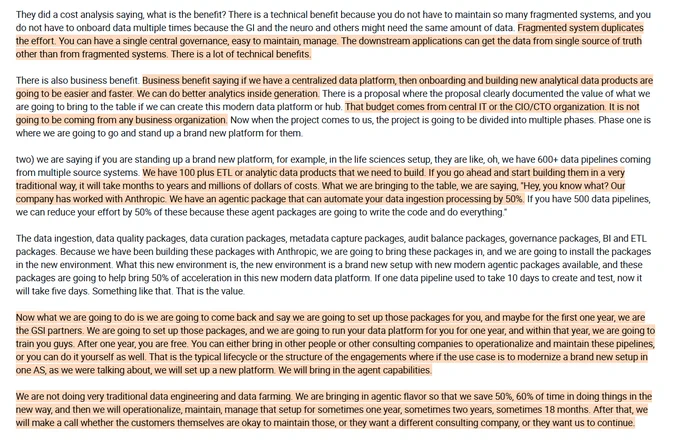
- The expert highlights a new approach to data platform modernization that replaces traditional data engineering with agentic packages built with AI labs, to avoid spending months and millions of dollars building out hundreds of ETL and analytic data products the conventional way. The engagement typically runs one to two years, covering platform setup, installation of agentic packages, and training the client's team, after which the client decides whether to take operations in-house, bring in another partner, or continue the relationship.
- The expert notes that the expected shift toward open source models never materialized. Until now, frontier models with strong reasoning capabilities have consistently outperformed open source alternatives when layered with agents, and the market moved toward agentic adoption rather than fine-tuning.
- On cost, the expert explains that open source models require procuring GPUs, training, deploying, and managing clusters that run 24/7, making the economics only favorable at very high API call volumes that most enterprise use cases have not yet reached, leaving pay-as-you-go frontier models as the more practical choice at current scale.
- Security and compliance present another barrier, with most large organizations having legal and security teams that have not approved open source or Chinese models for use on actual customer data. Frontier models from Anthropic and OpenAI have a clear advantage here as they are natively integrated within major cloud providers like AWS and Azure, making them far easier to clear through enterprise security policies.
- The expert emphasizes that enterprise AI adoption is still in very early stages, with most Fortune 500 companies having done a handful of POCs but very few having actually deployed full-scale agentic solutions in production. Confidence is low, adoption is low, and the expert sees an enormous amount of runway still ahead, both for large enterprises and the broader mid-market.
- The expert believes hyperscalers remain the right choice for sensitive workloads given their established security and data privacy frameworks, while newer neoclouds are being engaged for different, less sensitive types of workflows. The distinction matters because the kind of work being put through neoclouds is significantly different from what runs through hyperscalers, reflecting a practical split based on security requirements rather than performance preferences.
Show more


Get AlphaSense Certified at #AlphaSummit# 2026!
Turn your AlphaSense expertise into a credential. Formalize what you already know, earn a digital badge for LinkedIn and join an exclusive community of power users.
Register for AlphaSummit 2026 and add certification to your itinerary, October 5-7 at The Glasshouse in NYC:
Show more

$ADBE President Anil Chakravarthy says they reiterated full-year guidance of 10.2% growth in ending ARR. Business professionals and consumers should get a tailwind from innovations just announced in Acrobat and Express, while Creative Cloud and Firefly have breakthrough releases planned in the run-up to MAX. Customer experience starts Q4 with a strong pipeline and benefits from seasonality plus recent innovations, giving them confidence heading into the quarter.
Show more

$ORCL CEO Clay McGurk says they delivered 850 megawatts of AI capacity containing more than 300,000 GPUs since the end of Q4, almost 3x what was delivered in all of Q4 and 73% of total capacity delivered last fiscal year. They closed more than $30 billion of additional AI contracts in Q1 without requiring additional capital from Oracle. GPU utilization remains extremely high at 97.9%, and all GPUs that came up for renewal in Q1, most of them four years or older, were renewed or resold at a 20% premium to prior contracts.
Show more

$ORCL CEO Clay McGurk says in a world where demand exceeds supply, prices go up rather than down, but they charge more accordingly so this does not impact gross margins, and previous guidance still holds. He notes that in 12 years at Oracle and his career in infrastructure, demand for server side computing in data centers has only gone up, and the AI use case follows the same pattern but more so, evidenced by capacity renewals achieving prices higher by around 20%.
Show more

$ORCL Earnings:
- Q1 GAAP Earnings per Share up 55% in USD and up 54% in constant currency to $1.56, non-GAAP Earnings per Share up 30% in USD and constant currency to $1.92.
- Record Q1 Total Revenues up 30% in USD and constant currency to $19.3 billion.
- Record Q1 Total Cloud Revenues up 62% in USD & up 61% in constant currency to $11.6 billion.
- Q1 Cloud Infra (IaaS) Revenue up 121% in USD & up 120% in constant currency to $7.4 billion.
- Q1 Cloud Apps (SaaS) Revenue up 10% in USD and constant currency to $4.2 billion.
- Remaining Performance Obligations or RPO up $209 billion year-over-year to $664 billion
Show more












