

Manchurius Hao — Greeks.live 首席赌狗
@AntonLaVay
Nec temere, nec timide. 🇳🇱🇪🇺🇨🇳 能源/科技/BIO/crypto
Coinbase社区合作伙伴:
1.1K Following 34.1K Followers
Love the bottleneck migration framework. I’d push it one step further downstream.
AI is making hypotheses abundant, so scarcity moves into Build and Measure: DNA synthesis, assays, sequencing, wet labs.
If those scale, the next bottleneck is human ground truth, the treatment response, recurrence, longitudinal outcomes.
You can add robots and sequencers quickly; you can’t manufacture five years of patient history overnight.
$TEM / $NTRA / $CAI may capture the next one.
And we should note one thing: this space has actually been quietly positioned in by heavyweights for a long time. $TEM is a favorite of Cathie Wood and been chosen by Pelosi, $NTRA has long been Druckenmiller's top holding.
Show more

AI Drug Discovery Is Becoming a Bottleneck Trade
I get excited when an industry starts going through a real regime change. AI drug discovery (“AIDD”) increasingly looks like one of those moments.
Two things are happening:
1/ Upstream: the frontier AI labs are piling in.
2/ Downstream: The supply chain is clearly moving.
Supply-chain checks suggest the upstream picks-and-shovels of discovery and early preclinical R&D are starting to feel the increase in experimental volume.
DNA → protein → assays → sequencing → automation → preclinical testing
Names across that stack include $TWST , @GenScript , $ILMN , $TXG , lab-automation vendors and CROs.
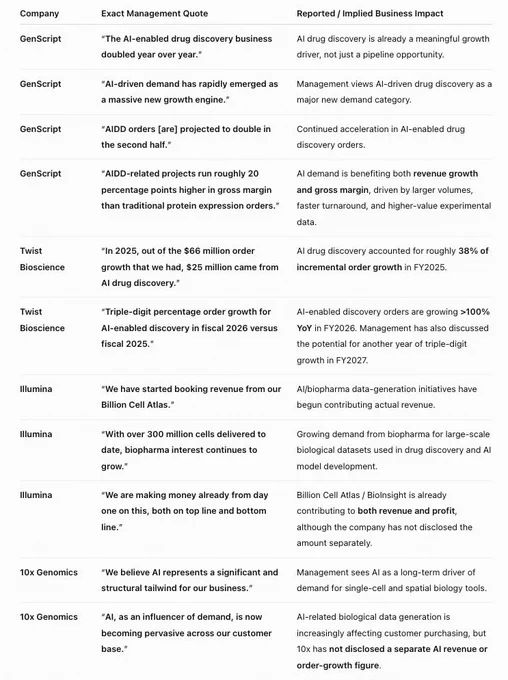
$TWST expects triple-digit percentage growth in AI-enabled drug-discovery orders in FY26, and another year of triple-digit order growth in FY27.
@GenScript's AIDD business doubled YoY in 1H26. Its current platform advertises industrial-scale validation of 4,000+ designs/day, with integrated sequence-to-data workflows. Our channel checks suggest the ramp is moving even faster: roughly 8,000 designs/day currently, with a path toward ~16,000/day by YE26.
---
Why does AI drive more wet-lab demand?
1/ AI makes hypothesis generation almost free → way more shots on goal.
The bottleneck is moving from expert-driven design to biological validation.
2/ AI models need continuous experimental feedback — and both good and bad data are useful.
Traditionally, only the highest-conviction A+ candidates might get pushed into expensive validation. With AI, even the B/C candidates can be valuable because failed experiments generate training data.
@GenScript has said its sequence-to-binding workflow can return data in 4–7 days, and that faster cycle times matter because AI models depend on continuous experimental feedback.
@Anthropic is a clean example. @claudeai designed 1,320 protein binders. @adaptyvbio converted those digital sequences into DNA, expressed the proteins and tested binding. Only 354 actually bound. And the 966 failures are not wasted. They are useful negative labels: what does not express, what does not bind, what has poor affinity. Those results help train the next model iteration.
3/ Wet labs are no longer just making drugs. They are making training data.
$TWST / @GenScript increasingly look like biological data foundries.
$TWST explicitly talks about generating model-ready data from AI-designed sequences. In some workflows, the customer may care less about receiving the physical protein than about getting structured experimental results back into the model.
Traditional drug discovery asks: “Does candidate X work?”
AI drug discovery also asks: “What can this experiment teach the model?”
---
TAM of AIDD
If AI is simply a better R&D tool, the relevant spending pool is the $300–400B of annual global pharma R&D. If AI meaningfully increases the number of viable drug programs, the opportunity is larger because it expands downstream demand for DNA synthesis, protein production, assays, and preclinical work.
Near term, we can also size demand from AI-company spending. If Anthropic reaches $80B of ARR in 2026 and spends just 1% on AIDD, that alone would imply ~$800M of annual investment.
---
Trade setup
This is a trade that could have long legs. It’s hard to really stop working until PhaseI/II results (2028+)
It smells a lot like the bottleneck trade we just saw in semis: GPUs → HBM → networking → power/cooling. In biology, It basically follows the drug discovery process downstream: AI models → designs → DNA/protein → assays → preclinical capacity.
After the upstream picks-and-shovels, animal testing could become the next bottleneck. Monkey prices are already near prior highs and CRO capacity is tight. AIDD pushing more candidates into preclinical development would only add demand.
?? But clinical trials are still the bottleneck?
This is the biggest pushback I keep coming back to. No matter how fast discovery becomes, drugs still need to go through preclinical → Phase I → Phase II → Phase III → approval. You still need patients, time and capital.
But that doesn’t mean the bottleneck trade won’t work. More viable candidates — especially with higher success rates — still means more demand throughout the development process.
And who knows: clinical trials themselves may eventually be optimized by AI.
?? What breaks the trade?
Near term, the picks-and-shovels trade breaks if experimental budgets stop growing, AI-generated designs don’t translate into useful wet-lab hits, or capacity catches up too quickly.
Longer term, the thesis breaks if AI drugs look great in discovery / Phase I but fail at normal rates in Phase II/III. That is why Phase II matters so much.
?? Milestones
Late 2026–2027: first Isomorphic-designed drugs enter human trials; more AI-native programs move into IND-enabling work / tox.
2028–2030: clinical trial results start telling us whether AI-designed drugs actually perform better than conventional drugs.
Calling all the "bottleneck bros". :) @jukan05 @zephyr_z9 @aleabitoreddit @ParadisLabs
+++
More comprehensive analysis:
Show more

Yes, it is bottleneck trade, as I said before:
AI Drug Discovery Is Becoming a Bottleneck Trade
I get excited when an industry starts going through a real regime change. AI drug discovery (“AIDD”) increasingly looks like one of those moments.
Two things are happening:
1/ Upstream: the frontier AI labs are piling in.
2/ Downstream: The supply chain is clearly moving.
Supply-chain checks suggest the upstream picks-and-shovels of discovery and early preclinical R&D are starting to feel the increase in experimental volume.
DNA → protein → assays → sequencing → automation → preclinical testing
Names across that stack include $TWST , @GenScript , $ILMN , $TXG , lab-automation vendors and CROs.
$TWST expects triple-digit percentage growth in AI-enabled drug-discovery orders in FY26, and another year of triple-digit order growth in FY27.
@GenScript's AIDD business doubled YoY in 1H26. Its current platform advertises industrial-scale validation of 4,000+ designs/day, with integrated sequence-to-data workflows. Our channel checks suggest the ramp is moving even faster: roughly 8,000 designs/day currently, with a path toward ~16,000/day by YE26.
---
Why does AI drive more wet-lab demand?
1/ AI makes hypothesis generation almost free → way more shots on goal.
The bottleneck is moving from expert-driven design to biological validation.
2/ AI models need continuous experimental feedback — and both good and bad data are useful.
Traditionally, only the highest-conviction A+ candidates might get pushed into expensive validation. With AI, even the B/C candidates can be valuable because failed experiments generate training data.
@GenScript has said its sequence-to-binding workflow can return data in 4–7 days, and that faster cycle times matter because AI models depend on continuous experimental feedback.
@Anthropic is a clean example. @claudeai designed 1,320 protein binders. @adaptyvbio converted those digital sequences into DNA, expressed the proteins and tested binding. Only 354 actually bound. And the 966 failures are not wasted. They are useful negative labels: what does not express, what does not bind, what has poor affinity. Those results help train the next model iteration.
3/ Wet labs are no longer just making drugs. They are making training data.
$TWST / @GenScript increasingly look like biological data foundries.
$TWST explicitly talks about generating model-ready data from AI-designed sequences. In some workflows, the customer may care less about receiving the physical protein than about getting structured experimental results back into the model.
Traditional drug discovery asks: “Does candidate X work?”
AI drug discovery also asks: “What can this experiment teach the model?”
---
TAM of AIDD
If AI is simply a better R&D tool, the relevant spending pool is the $300–400B of annual global pharma R&D. If AI meaningfully increases the number of viable drug programs, the opportunity is larger because it expands downstream demand for DNA synthesis, protein production, assays, and preclinical work.
Near term, we can also size demand from AI-company spending. If Anthropic reaches $80B of ARR in 2026 and spends just 1% on AIDD, that alone would imply ~$800M of annual investment.
---
Trade setup
This is a trade that could have long legs. It’s hard to really stop working until PhaseI/II results (2028+)
It smells a lot like the bottleneck trade we just saw in semis: GPUs → HBM → networking → power/cooling. In biology, It basically follows the drug discovery process downstream: AI models → designs → DNA/protein → assays → preclinical capacity.
After the upstream picks-and-shovels, animal testing could become the next bottleneck. Monkey prices are already near prior highs and CRO capacity is tight. AIDD pushing more candidates into preclinical development would only add demand.
?? But clinical trials are still the bottleneck?
This is the biggest pushback I keep coming back to. No matter how fast discovery becomes, drugs still need to go through preclinical → Phase I → Phase II → Phase III → approval. You still need patients, time and capital.
But that doesn’t mean the bottleneck trade won’t work. More viable candidates — especially with higher success rates — still means more demand throughout the development process.
And who knows: clinical trials themselves may eventually be optimized by AI.
?? What breaks the trade?
Near term, the picks-and-shovels trade breaks if experimental budgets stop growing, AI-generated designs don’t translate into useful wet-lab hits, or capacity catches up too quickly.
Longer term, the thesis breaks if AI drugs look great in discovery / Phase I but fail at normal rates in Phase II/III. That is why Phase II matters so much.
?? Milestones
Late 2026–2027: first Isomorphic-designed drugs enter human trials; more AI-native programs move into IND-enabling work / tox.
2028–2030: clinical trial results start telling us whether AI-designed drugs actually perform better than conventional drugs.
Calling all the "bottleneck bros". :) @jukan05 @zephyr_z9 @aleabitoreddit @ParadisLabs
+++
More comprehensive analysis:
Show more
I am gradually beginning to understand Russia.

Президент Південної Кореї чомусь про наші інтереси не дуже думає, коли зброю не продає і санкції проти Росії не вводить тому що в них свої інтереси. А ми повинні мовчати про північно корейських солдат полонених, які їм передаємо, тому що його опозиція критикує.⬇️
Show more
I think “Trump fed the AI trade 100x leverage” overstates the policy effect.
Trump clearly accelerated permitting, deregulation and AI infrastructure buildout, but the industrial-policy foundation was already there under Biden — CHIPS Act subsidies, TSMC/Intel/Samsung fabs, and Biden’s Jan-2025 EO already put federal land, power and expedited permitting behind frontier AI data centers.
But Trump’s macro impact has bearish for everything. The Iran war/energy shock, alongside tariffs, helped turn an active Fed easing cycle into the first rate hike in three years. We went from three consecutive cuts in late 2025 to a hike yesterday.
Show more

@AntonLaVay I think the problem is Trump has been feeding AI trade 100x leverage but if Dem take back power it could reduce the leverage and ai names will get a very big discount before finding out it is actually fine aka deleveraging
Show more
You yourself acknowledged that this is a supply shock; when faced with a supply shortage, you either suppress demand or drive up prices (i.e., inflation)
right? A fundamental principle: supply and demand are two sides of the same coin.
If supply increases while demand remains constant, deflation occurs;
if supply decreases while demand remains constant, inflation occurs.
so what is the problem with the Fed suppressing demand?
Besides, historically, the initial wave of most inflationary episodes has been driven by supply shocks.
Show more
You yourself acknowledged that this is a supply shock; when faced with a supply shortage, you either suppress demand or drive up prices (i.e., inflation)
right? A fundamental principle: supply and demand are two sides of the same coin.
If supply increases while demand remains constant, deflation occurs;
if supply decreases while demand remains constant, inflation occurs.
so what is the problem with the Fed suppressing demand?
Besides, historically, the initial wave of most inflationary episodes has been driven by supply shocks.
Show more
The meme is funny, but it attacks a straw man.
Nobody thinks a rate hike can reopen Hormuz or create more oil.
Monetary policy cannot fix the first-round supply shock. Its job is to stop that shock from becoming persistent, economy-wide inflation through demand, wages, pricing behavior and expectations.
“This is supply-side inflation” is an argument for fiscal, energy, government and monetary policy to work together — not an argument for the Fed to do nothing.
The fact that the Fed cannot produce oil does not mean it should accommodate unlimited nominal demand against a constrained supply base.
Show more

@divram_ai I think you are right if you think he is a reasonable person.
My opinion is he just talked about nonsense, as inflation is from supply side and not going to be suppressed by just hiking rates unless destroy the demand aggressively.
@agnostoxxx has a very good meme to mock him.
Show more

This is partisan framing, not serious AI analysis.
Biden literally signed an EO to accelerate frontier-AI data centers on federal land, backed by new power infrastructure. His policy wasn’t “don’t build” — it was “build, but don’t dump the grid costs on households.”
And look at the actual data-center states:
Democratic VA: make data centers pay their own transmission costs.
Democratic PA: bring your own power / pay for incremental capacity.
Republican TX: pay your own grid costs, conserve water, protect residential rates.
The bipartisan trend is obvious: build AI, but make hyperscalers internalize the infrastructure costs.
“Dems win = bad for AI” is politics pretending to be a trade thesis.
Show more
$pltr
save my dog life.
吼吼,看评论区,大家对于CAPEX的担忧这么重呀,那不如来 $aapl 和 $pltr 一起当家人。












