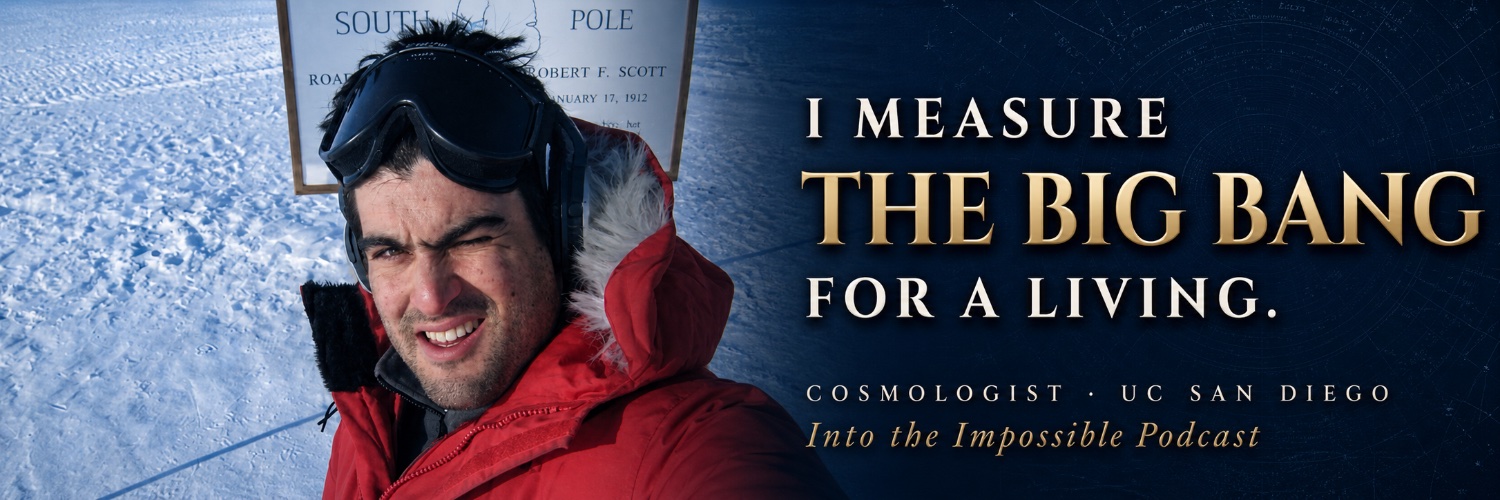

Prof. Brian Keating
@Briankeating
Every great scientist is a storyteller.
I interview Nobel winners on @Into_Impossible🎙️
Cosmologist & Chancellor's Professor @UCSanDiego
133 Following 57.4K Followers
Richard Dawkins (@RichardDawkins) at Carnegie Hall, and I get to sit across from him
Genes and the Meaning of Life
October 20 | 7:00 PM | Carnegie Hall
Fifty years ago, a 35-year-old zoologist gave us the gene's eye view, the word "meme," and a book that rearranged how we think about life itself. Now Richard Dawkins takes the Carnegie Hall stage for the first time, and I'll be in the chair beside him.
We'll go past the greatest hits: his new work on the "genetic book of the dead," the idea that every creature is a readable archive of the worlds its ancestors survived. And a question I keep turning over: could our own genes be a giant colony of cooperating viruses?
Get your tickets here -
Show more

OpenAI’s Navier–Stokes Claim: Is This What AGI Looks Like? | Emad Mostaque
Did OpenAI just solve Navier–Stokes—and what would that actually mean for AGI? @EMostaque joins me LIVE now to examine the claimed breakthrough, what would count as a verified solution, and whether AI solving a major mathematical problem changes the debate about intelligence—or control.
Show more
Elon, here is no known finite “volume of the Universe” to count in Planck cubes. The Universe may be spatially infinite.
But even if finite, it’s expanding and its global topology and total volume are unknown. So you cannot define a maximum physically relevant number of digits of π.
(Also there’s nothing special about the Planck length. It’s just a combination of constants like the Planck mass, which is about the mass of a flea’s egg, not some magical quantity that sets the bound on masses generally)
Show more
Elon, here is no known finite “volume of the Universe” to count in Planck cubes. The Universe may be spatially infinite.
But even if finite, it’s expanding and its global topology and total volume are unknown. So you cannot define a maximum physically relevant number of digits of π.
(Also there’s nothing special about the Planck length. It’s just a combination of constants like the Planck mass, which is about the mass of a flea’s egg, not some magical quantity that sets the bound on masses generally)
Show more

I’m sick of it.
While I must confess to having poured more than a few buckets into the AI doom reservoir, enough is enough.
If you’re as saturated with the AI Apocalypse as I am, this clip from my conversation with Yann LeCun (@ylecun) is a powerful antidote.
I don’t agree with him on everything. That’s the point.
But what can you say to refute him? cc @romanyam @EMostaque @tegmark
Show more

Reality Check:
Surfing should really be called 'paddling & waiting'
Golfing should really be called 'walking & searching'
Writing should really be called 'sitting & editing'
I’m sick of it.
While I must confess to having poured more than a few buckets into the AI doom reservoir, enough is enough.
If you’re as saturated with the AI Apocalypse as I am, this clip from my conversation with Yann LeCun (@ylecun) is a powerful antidote.
I don’t agree with him on everything. That’s the point.
But what can you say to refute him? cc @romanyam @EMostaque @tegmark
Show more
David Hilbert said “If I were to awaken after having slept for a thousand years, my first question would be: Has the Riemann hypothesis been proven?"
What would YOUR first question be? 👇

Nobody at Nvidia was worth mentioning, but TIME selected the publisher of the New York Times as one the 100 most important people in AI. Bernie Sanders also made the list of "innovators, leaders, and thinkers reshaping our world through groundbreaking advances in artificial intelligence."
Show more


Fermilab’s @ScottDodelson on Cosmology’s Crisis
Timestamps:
0:00 None of it has been found in a lab. How many free passes do we get?
0:44 Dodelson helped build Lambda-CDM. His dream is to kill it.
2:10 10 years. One prediction. Two and a half sigma off.
5:42 "You're in charge" - what mentorship in science actually looks like
6:56 April 24, 1992: cosmology stopped being speculation
9:48 Geoff Burbidge went to his grave a steady-state believer
11:04 What a neutrino is and why it barely interacts with anything
12:36 Brian told Neil deGrasse Tyson we already detected dark matter
18:08 How ordinary neutrinos may have become dark matter
23:24 Lambda-CDM predicts Manhattan's density 13.7 billion years later
26:42 Two and a half sigma: technically a 1% chance the theory is right
28:04 Neptune was dark matter. Vulcan wasn't. Which one are we in now?
31:20 Dark matter, inflation, dark energy: none found in a lab
36:46 If both cracks are the same crack, Lambda-CDM is finished
Show more

David Hilbert said “If I were to awaken after having slept for a thousand years, my first question would be: Has the Riemann hypothesis been proven?"
What would YOUR first question be? 👇
@MerriamWebster The well-known 1964–1965 Cosmic Microwave Background discovery, replete with pigeon droppings at Holmdel—filthy, accidental, and Nobel-bound—still exceeds our wildest cosmic expectations.
Show more
@MerriamWebster The well-known 1964–1965 Cosmic Microwave Background discovery, replete with pigeon droppings at Holmdel—filthy, accidental, and Nobel-bound—still exceeds our wildest cosmic expectations.
Show more
I’m an experimental physicist who’s spent 30 years calibrating scientific instruments.
In 2012, I invented a technique called ‘self-calibration’ of the polarization angle of Cosmic Microwave Background telescopes that’s still used to this day.
Recently I discovered that the word “calibrate” may itself need calibration.
It comes from “caliber,” via French calibre. After that, the trail splits.
The traditional derivation traces it to Arabic qālib, “mold” or “form,” possibly through Syriac to a Greek word for a shoemaker’s last, the foot-shaped form used to make a shoe.
Which is wonderfully appropriate. Long before SI units, human bodies supplied our standards of length. The foot. The cubit, or amah, based on the forearm of the Pharaoh.
But there is a rival etymology.
Calibre may instead come from Medieval Latin qua libra, “of what weight?”, from libra, the balance or scales.
Look again:
ca-LIBRA-te.
After three decades in experimental physics, I find it slightly alarming that even the word for checking a measurement against a standard comes with an error budget. cc: @MerriamWebster
Show more
A fridge magnet stops working above a certain temperature. That same phase transition is why AI works at all, according to my @UCSDPhySci colleague Nigel Goldenfeld, when a trillion parameters on tiny data should just be fitting noise.
His group did the calculation. Nobody else had.
Show more
I’m an experimental physicist who’s spent 30 years calibrating scientific instruments.
In 2012, I invented a technique called ‘self-calibration’ of the polarization angle of Cosmic Microwave Background telescopes that’s still used to this day.
Recently I discovered that the word “calibrate” may itself need calibration.
It comes from “caliber,” via French calibre. After that, the trail splits.
The traditional derivation traces it to Arabic qālib, “mold” or “form,” possibly through Syriac to a Greek word for a shoemaker’s last, the foot-shaped form used to make a shoe.
Which is wonderfully appropriate. Long before SI units, human bodies supplied our standards of length. The foot. The cubit, or amah, based on the forearm of the Pharaoh.
But there is a rival etymology.
Calibre may instead come from Medieval Latin qua libra, “of what weight?”, from libra, the balance or scales.
Look again:
ca-LIBRA-te.
After three decades in experimental physics, I find it slightly alarming that even the word for checking a measurement against a standard comes with an error budget. cc: @MerriamWebster
Show more
A fridge magnet stops working above a certain temperature. That same phase transition is why AI works at all, according to my @UCSDPhySci colleague Nigel Goldenfeld, when a trillion parameters on tiny data should just be fitting noise.
His group did the calculation. Nobody else had.
Show more












