

ScienceInFocus
@SciInFocus
Making science easier to understand, one discovery at a time.
1 Following 15.5K Followers
That gray fuzz on your shelf is a rainforest.
Zoom in far enough and dust stops being dust. It turns into pollen grains, textile fibers, plant hairs, insect scales, and flakes of your own shed skin, all tangled together like some absurd underwater reef.
The colors aren't real, by the way. Electron microscopes shoot in grayscale, so scientists paint them in afterward to separate one fragment from another.
Everything in that image came from somewhere. A sweater. A garden. A bug that died in your hallway months ago.
You've been vacuuming up a museum.
Show more


A planet where the ocean never ends: TOI-1452 b could be 22% water by mass.
It sits about 100 light-years away in the constellation Draco, flagged by NASA's TESS satellite and confirmed with follow-up from an observatory in Quebec. Charles Cadieux and his team at the Université de Montréal announced it in 2022.
Roughly 70% wider than Earth. Close to five times the mass.
Density is what sold the ocean. Too light to be bare rock, too heavy to be a gas puffball, and the numbers land right where a staggeringly deep global sea would put them. It circles a small red dwarf every 11 days, tight, but that star burns cool enough for liquid water to survive.
Waves from pole to pole, with nothing to break against.
Show more

$20,000. That's the entire build cost of a yacht that never needs a drop of fuel.
A guy in Finland laid solar panels across the deck, wired the whole thing up, and pushed off.
More than 3,000 nautical miles later, he still hasn't bought diesel.
Think about what that actually buys you. No fuel stops, no range anxiety in open water, no engine bill waiting at the next marina. The sun tops him up while he moves, so the voyage ends when he decides it ends, not when the tank does.
Most people drop twenty grand on a car that loses value sitting in a driveway.
He bought a boat that can keep going
Show more


Totality seen from 36,000 feet.

Doctors watched a woman with late-stage Alzheimer's wake up and start telling stories from her own life. She'd barely said a word in five years.
The patient, a Japanese-American woman in her 80s, had been declining for a decade. For the last five years she communicated mostly in single syllables. She couldn't walk well, couldn't dress herself, couldn't control her bladder. Her family had watched her slip further away every year, the way millions of families do.
Then, under medical supervision and with her caregiver's consent, she was given 5 grams of psilocybin mushrooms. A big dose. She sweated heavily and sank into a deep, sleep-like state.
Around 19 hours later, she woke up and started talking.
Full sentences. Memories from her own life, flowing out for nearly four hours straight. In the days that followed she began recognizing family members again. She dressed herself. She walked more independently, held eye contact, smiled, even cracked jokes. Her bladder control came back. A second, smaller session a month later brought more of the same: humor, emotion, connection.
Now, the honest part. This is one patient. One case report, published in Frontiers in Neuroscience by researchers in Brazil. No brain scans, no standardized cognitive tests, no placebo. The disease itself wasn't reversed, and the gains were temporary. High-dose psilocybin also carries real risks, especially for frail elderly patients, so nobody should try this at home.
But here's why scientists are paying attention anyway. Alzheimer's this advanced was assumed to be a one-way street. This case hints that some of the brain's circuits may still be in there, quiet but not gone, waiting for something to switch the lights back on.
She was never really gone. We just couldn't reach her.
Source: Frontiers in Neuroscience case report by Brazilian neuroscientists, covered by ScienceAlert, The Conversation, and Vice.
Show more

Japan just turned thin air into fuel.
No oil rigs. No drilling. No pipelines stretching across oceans.
Just water, CO₂, and a process that flips combustion on its head.
ENEOS Corporation, Japan's biggest oil refiner, pulled it off at their Yokohama lab.
They built a demo plant that sucks carbon dioxide straight from the atmosphere, splits hydrogen out of water using renewable energy, then fuses them through Fischer-Tropsch synthesis into liquid hydrocarbons.
The result? Real, usable synthetic petroleum.
The kicker: this fuel is "drop-in ready." That means it works in the cars you already drive, the planes already in the sky, the pipelines already in the ground. Zero modifications.
They didn't just brew it in a beaker either. They ran actual vehicles on it. It works.
Think about what that unlocks. Countries with no oil reserves could manufacture their own fuel using nothing but sunlight, wind, and the air around them.
The geopolitical chessboard would flip overnight.
Sectors that electrification can't easily touch, like aviation and heavy shipping, suddenly have a clean fuel path.
There's a catch, though. The process is hungry. The same electricity it takes to brew one liter of synthetic fuel could push an EV about 200 km down the road. ENEOS quietly shelved the project in 2025 because the economics didn't math out yet.
But the science? Proven. The blueprint exists. Someone, somewhere, will crack the cost problem.
And the day they do, the oil map of the planet gets redrawn.
Source: ENEOS Corporation / TheTownHall(.)News
Show more

An 18-year-old just did what billion-dollar water companies couldn't.
Meet Mia Heller.
A high school junior from Warrenton, Virginia who built a water filter in her garage that strips out 95.5% of microplastics from drinking water.
That's better than most government treatment plants, which sit somewhere between 70% and 90%.
Her secret weapon? Ferrofluid. A magnetized liquid made of oil and powder that latches onto microplastic particles. Then a magnet yanks them out. No membranes. No constant filter replacements. No endless maintenance bills.
The ferrofluid even gets recycled, around 87% of it, in a closed loop.
The spark for all of this wasn't a classroom project. It was a local newspaper article warning that her town's tap water was loaded with PFAS and microplastics, and that nobody was coming to fix it.
So she watched her mom swap out filter after filter and thought, there has to be a smarter way.
She built the prototype herself. Tested it with a homemade turbidity sensor. Then walked into the Regeneron International Science and Engineering Fair and walked out with a special award from the Patent and Trademark Office Society.
Up against nearly 1,700 students from 62 countries.
She's now eyeing a household version that sits under your kitchen sink.
The future of clean water might not come from a lab in Silicon Valley. It might come from a teenager's garage in Virginia.
Source: Smithsonian Magazine
Show more

A tiny bee just did what chemotherapy couldn't.
Scientists in Australia discovered that honeybee venom can wipe out 100% of aggressive breast cancer cells in under 60 minutes.
And the healthy cells around them? Barely touched.
The breakthrough came from Dr. Ciara Duffy and her team at the Harry Perkins Institute of Medical Research, working alongside the University of Western Australia.
They tested venom drawn from 312 honeybees and bumblebees across Australia, Ireland, and England.
The target: triple-negative breast cancer and HER2-enriched breast cancer. Two of the deadliest, most stubborn forms of the disease.
The weapon: melittin. The same tiny peptide that makes a bee sting burn.
At one specific dose, melittin tore through cancer cell membranes completely within an hour. Within just 20 minutes, it shut down the chemical signals cancer cells need to grow and multiply.
Bumblebee venom, which lacks melittin, did nothing. Zero effect, even at high concentrations.
Scientists then recreated melittin synthetically in the lab and got almost identical results, meaning no bees need to be harmed to develop the therapy.
Published in the peer-reviewed journal npj Precision Oncology, the findings are still early-stage. Human trials haven't happened yet.
But one thing is clear. Nature has been hiding answers in plain sight all along, sometimes inside the smallest creatures on Earth.
Source: Harry Perkins Institute of Medical Research / npj Precision Oncology (Dr. Ciara Duffy et al.)
Show more

She was bullied for being "different." Now her IQ is higher than Einstein's.
Meet Adhara Pérez Sánchez. 11 years old. From a low-income neighbourhood in Tláhauc, Mexico City.
And quietly outsmarting two of the greatest minds in history.
Her score? 162. Einstein and Hawking both clocked 160.
Diagnosed with autism at age three after her speech regressed, Adhara spent her early years getting picked on at school for being "different." The same brain her classmates mocked had already memorised the entire periodic table and taught itself algebra. Her mum thought she was just bored.
She wasn't bored. She was operating on another level entirely.
By five, she'd finished elementary school. One year later, she had middle school AND high school in the rearview mirror.
Then depression hit. A therapist sent her to the Center for Attention to Talent, where her sky-high IQ was finally discovered. A visit to a doctor's office decorated with Stephen Hawking artwork lit the fuse. The doctor explained who Hawking was, what he did, how he spoke to the universe through a machine.
That was it. Space had her.
Adhara already holds a bachelor's degree in systems engineering from CNCI University. Right now she's deep into a master's in mathematics at the Technological University of Mexico.
The endgame? NASA. Mars. The stars she was practically named after.
She's also chasing her G-tests, the gateway to flying with an agency linked to NASA. If everything lines up, she could be the first autistic person ever to fly a mission, around age 17.
The kid they bullied is heading to space.
Source: IBTimes UK (via Marie Claire Mexico)
Show more

Iceland just lost its last superpower.
For centuries, this frozen island held bragging rights nobody else on Earth could touch.
No mosquitoes. Not one.
That streak just ended.
In October 2025, an insect enthusiast named Björn Hjaltason was out at dusk in Kjós, a glacial valley about 32 km north of Reykjavík. He'd set up a red wine ribbon, basically a sweet-soaked trap, when something strange landed on it.
He knew instantly. This wasn't a fly.
He bagged it. Then caught two more. Two females and one male.
The Natural Science Institute of Iceland confirmed the unthinkable. They were Culiseta annulata, a cold-hardy mosquito species that survives brutal winters by hiding out in basements and outbuildings.
Iceland was officially mosquito country.
The kicker? Scientists say these bugs probably hitched a ride in on freight. And they look more than capable of surviving an Icelandic winter.
That leaves Antarctica as the only place on Earth still mosquito-free.
This species doesn't carry diseases like malaria or dengue. But researchers are sounding the alarm anyway. The Arctic is warming four times faster than the rest of the planet, and entomologists warn that warmer conditions could roll out the welcome mat for nastier species next.
A summer earlier this year sent Icelandic temperatures soaring more than 18°F above normal, a heat spike made 40 times more likely by climate change.
The last untouched corner of the human world just got a new neighbor.
And it bites.
Source: NPR, CNN, Yale E360
Show more

Kids growing up in chaos have the same brain scars as soldiers coming home from war.
Let that sink in.
Neuroscientists studying children raised in unstable households, the constant fighting, the screaming, the neglect, the abuse, found something nobody wanted to see.
Their brains looked like combat veterans.
Same wiring. Same damage. Same survival mode burned into the tissue.
A child who never knew what mood mom would be in. A kid who flinched at footsteps in the hallway. A teenager who learned to read a room before learning to read a book.
Their nervous systems were never resting. They were deployed.
Hypervigilance. Shrunken hippocampus. Overactive amygdala. The exact signature you find in a soldier who spent a year dodging IEDs.
Except these kids weren't in a war zone.
They were just home.
And here's the part that hits hardest, the brain doesn't know the difference between a battlefield and a kitchen full of yelling. Threat is threat. The body keeps the score either way.
So if you grew up walking on eggshells and still feel like you're bracing for something you can't name, you're not broken.
You came back from a war nobody acknowledged.
Show more

She didn't wait for permission. She just gave six paralyzed people their movement back.
Meet Tatiana Coelho de Sampaio.
A Brazilian biologist who spent over 25 years quietly working on something the medical world said was impossible: reversing spinal cord injuries.
Her weapon? A molecule called polylaminin.
It's a lab-made version of a protein the human body produces during embryonic development to help neurons "talk" to each other. After birth, it nearly vanishes. Sampaio figured out how to recreate it from human placenta proteins and apply it directly to damaged spinal cords.
The result?
Nerves start rebuilding their broken communication lines. Connections that were considered permanently severed begin firing again.
She leads the Extracellular Matrix Biology Lab at UFRJ (Federal University of Rio de Janeiro), and her team partnered with Brazilian pharmaceutical company Cristália to turn the research into a real drug.
Six paraplegic patients in the experimental phase.
Partial movement returned. Some regained sensation. One quadriplegic man, Bruno Drummond de Freitas, paralyzed after a 2018 car accident, was treated almost immediately after his injury under an academic clinical study.
The patent alone took 18 years to register.
She's 59. Avoids social media. Sleeps six hours a night. Raises an orphan from Maranhão. When asked why she stays off the internet, she said she prefers real life.
Now the project sits with Anvisa, Brazil's health regulator, waiting on approval to expand human trials.
The scientific community is already whispering one phrase around her name: Nobel Prize.
While the world argued, she rebuilt spines.
Source: Peq42 / brazilcore(.)com / ensaiosclinicos(.)gov(.)br
Show more

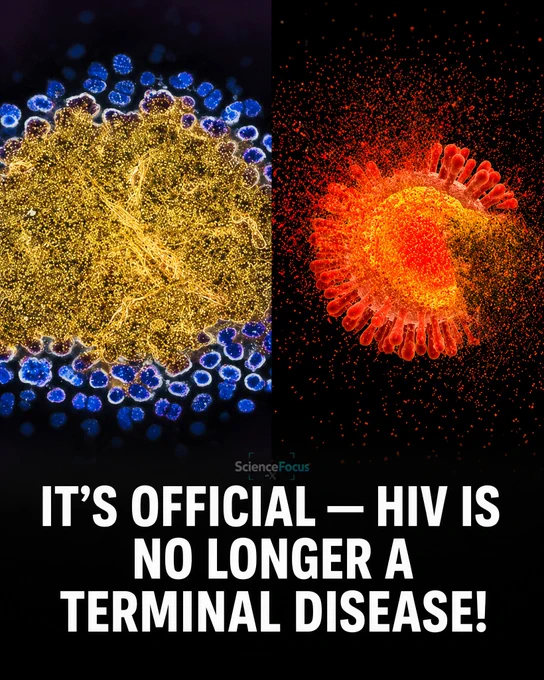
HIV just got dethroned.
What was once a death sentence is now something millions live with — quietly, normally, for decades.
Modern antiretroviral therapy has flipped the script. People diagnosed today, who take their meds consistently, can expect a near-normal lifespan. The virus stays buried. Undetectable. Untransmittable.
Let that sink in.
A diagnosis that wiped out a generation in the 80s and 90s is now a manageable condition — closer to diabetes than to doom.
And the science isn't stopping there.
Gilead's once-daily single-tablet BIC/LEN regimen is under FDA priority review with a decision expected August 27, 2026. One pill. Once a day. That's it.
At CROI 2026 in Denver, the RIO cure trial showed over half of participants kept their viral load undetectable for more than 20 weeks after stopping treatment entirely. Two have been off meds for over a year.
A 62-year-old Canadian man — now known as the Toronto patient — was announced likely cured in April 2026 after a stem cell transplant.
Yale researchers cracked open a hidden mechanism called circHIV that could become the next major drug target. Case Western turned the immune system's own Natural Killer cells into HIV-hunting weapons. Oxford is using broadly neutralising antibodies to keep the virus in check long after pills are gone.
The hunt for a full, scalable cure is no longer science fiction. It's a research pipeline with real names, real patients, and real timelines.
HIV used to mean counting the years you had left.
Now it means living them.
Source: Aidsmap (CROI 2026), Gilead Sciences, amfAR, Weill Cornell Medicine, Yale News, Case Western Reserve University
Show more
They literally 3D-printed an eyeball. And the blind guy can see again.
Not a chip. Not a sensor. A full living human eye — retina, cornea, lens, optic nerve — built layer by layer in a printer.
Bioengineers at KAIST in South Korea pulled it off.
The whole thing took 6 hours to print. Living retinal cells stacked in precise layers with their own blood vessels. A hydrogel lens that auto-focuses.
Biocompatible polymers shaping the white of the eye. And an optic nerve scaffold designed to guide fresh nerve growth straight to the brain.
Then they put it inside a 31-year-old man who lost his sight 7 years ago in an industrial accident.
Three weeks later, his brain started decoding the signals.
He's now seeing at 20/60. Reading. Recognising faces. Naming colours.
This is the first time a complex organ made of multiple tissue types has been printed AND successfully wired into the human nervous system.
Science fiction quietly clocked out. Science just clocked in.
Show more












