

Adrian Morris
@_Adrian
Nerd/Techie Fighting A.I & $BTC FUD | $BTC ≠ Crypto | A.I. Super-User | Member: @TNorth | Contributor: @Roxom // @BitcoinForCorps | Data-Driven Analysis
500 Following 31.6K Followers
Digital Credit Snapshot since inception:
Each Offering $STRK | $STRF | $STRD | $STRC | $SATA would have protected your capital vs $BTC, and paid you a dividend, with lower volatility.
The financialization of $BTC will bring in hundreds of Billions in capital over time.
Show more

Another fantastic conversation with @OneChairPod
We discuss $MSTR and $STRC buybacks with this important question as the backdrop:
Can @Strategy out-engineer the market?

Did Strategy spend over $1 BILLION on $STRC buybacks… for virtually no measurable impact on price?
@_Adrian from @TNorth is back, challenging some of the biggest narratives in Bitcoin Treasuries and Digital Credit.
And his research raises some uncomfortable questions.
We went deep into:
→ $STRC buybacks: Why their impact on price becomes statistically indistinguishable from zero once other market factors are accounted for.
→ Daily dividends: Is Strategy $MSTR overengineering $STRC without addressing what actually drives its price?
→ USD reserves: Does holding billions in cash really make Digital Credit safer, or are we seeing diminishing returns?
→ Strive $ASST: Are $SATA's investor protections and disciplined USD reserve strategy really giving it an edge over $STRC?
→ $STRC vs. $SATA: Why Bitcoin, parent equities, and the broader Digital Credit market are the real drivers of price action.
→ Market intervention: Are Strategy's buybacks signaling weakness rather than strength to the market?
→ Bitcoin Treasury KPIs: Why BTC Yield, amplification ratios, and Bitcoin per share don't necessarily translate into investor returns.
→ The future of $MSTR: Why the common equity ATM could remain Strategy's most powerful capital-raising engine.
But here's what makes this conversation particularly interesting.
Despite being critical of Strategy's recent financial engineering, Adrian remains extremely bullish on its long-term future.
One of our most analytically rigorous deep dives into Bitcoin Treasuries and Digital Credit yet.
00:00 Intro: Adrian Morris Returns to One Chair Podcast
01:21 STRC vs. SATA: Why Is Strive Losing Its Edge?
04:01 Do Daily Dividends Actually Help STRC Trade at Par?
07:11 True North Research: What Really Drives STRC's Price?
14:55 Are Strategy's Buybacks Delivering Diminishing Returns?
18:26 Does Strategy's USD Reserve Actually Support STRC?
22:23 STRC vs. SATA: How Much Cash Reserve Is Enough?
28:48 Would Stronger Investor Protections Fix STRC?
34:18 Daily vs. Semi-Monthly Dividends: Is Strategy Overengineering STRC?
38:54 Is Strategy Listening Too Much to Bitcoin Twitter/X?
43:35 Should Strategy Copy Strive's Podcast and Media Strategy?
48:20 Why Strategy Needs More Data-Driven Investor Communication
50:26 Did Strategy Ignore the Warning Signs in STRC Buybacks?
53:56 Why MSTR's Common Stock ATM Could Dominate the Next Decade
01:00:51 Could Strategy Become a Bitcoin and AI Powerhouse?
01:01:55 Where to Find Adrian Morris and True North Research
Watch the full episode 👇
Show more

$BTC: The Corn wants to pop...

I agree with @GrafYves. Over the window I tested in my @TNorth research paper, buybacks didn't explain the price recovery in $STRC.
From the paper's summary: “...All Strategy preferreds rebounded between June 26 and July 17, before the first disclosed repurchase, and there were no reported repurchases of $STRK | $STRF | $STRD at all. Evidence supports the view that the recovery was part of a broader repricing already underway across the Digital Credit complex, and repurchase execution may not have been necessary… The open question is not whether Strategy can keep buying, but whether they should, and how much organic demand remains once they stop.”
Show more


Unpopular opinion: $STRC might benefit from less engineering, not more.
Between the upcoming shift to daily dividends, $STRC buybacks, and a substantial USD reserve, there's increasingly complex machinery behind a product designed to trade around $100.
The ultimate innovation might not be adding more mechanisms.
It might be figuring out which ones we can do without.
Show more
After binge-watching Season 1, I'm in to Season 2: MobLand is hands down my new favorite show.

$ASST | $SATA: @Strive Digital Credit keeps humming along.
From inception through 10-2-26 $SATA has been less volatile than $BTC, protected capital, and paid out every dividend.
Assuming $10,000 invested over the same period:
$SATA w/DRIP - $12,190.18 [+21.90%]
$SATA No DRIP - $12,083.85 [+20.84%]
$BTC - $7,974.17 [-20.26%]
Show more

$STRC | $SATA: "Or could it be that the markets are very complex with many many factors driving price action on any given day, week, or time period having very little to do with those two variables?"
You don't say....
Show more


After today’s selloff:
$STRC closed at $99.45
$SATA closed at $98.82
If daily dividends and a 1% higher dividend rate was the pricing difference between the products…
Can someone please explain the discrepancy today?
Or could it be that the markets are very complex with many many factors driving price action on any given day, week, or time period having very little to do with those two variables?
Show more
$STRC: Despite the narratives, @Strategy Digital Credit is working as intended.
From inception through 10-2-26 $STRC has outperformed $BTC, operating as a lower volatility, dividend paying vehicle.
Assuming $10,000 invested over the same period:
$STRC w/DRIP - $12,022.35 [+20.22%]
$STRC No DRIP - $11,887.30 [+18.87%]
$BTC - $7,171.75 [-28.28%]
Show more

OK fine... Maybe $90K $BTC isn't in play 😂
I have buys set ¯\_(ツ)_/¯

We are slowly building out a repository of research @TNorth
In the coming months, expect to find additional deep dives on $MSTR | $ASST, the Digital Credit Complex, $BTC and more.
We want to set the standard for quality. All signal, no noise.
Show more

Reference-grade analysis of digital credit instruments, Bitcoin treasury strategy, and risk frameworks.
Built for allocators, treasurers, and institutional investors.
All free. All open access.
Show more

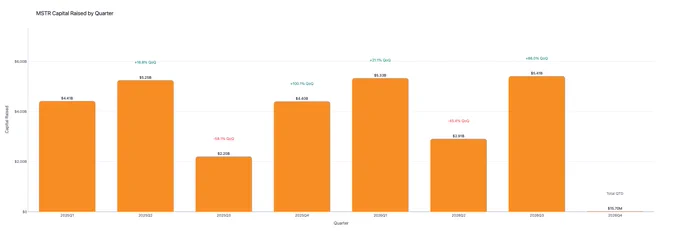
$MSTR: Across the first 3 quarters this year, @Strategy raised over $13.65 billion in capital via common equity (excluding preferred equity issuance) - during a Bear Market.
Imagine the potential scale of execution, with 5 equity engines firing, in a real $BTC Bull-Run…
Show more
$BTC Technical Analysis: algo's are doing algo things trying to prevent $BTC from doing a thing. $90K still in play.

$BTC | $MSTR: @Strategy has had ~$103.23B in trading volume over the last six weeks.
As of 10-02-2026, the $MSTR price is holding, but trading participation has cooled:
EoW 08-28: ~$21.25B traded | ~165.7M shares [+9.1%]
EoW 09-04: ~$17.92B traded | ~133.8M shares [-15.6%]
EoW 09-11: ~$9.57B traded | ~71.3M shares [-46.6%]
EoW 09-18: ~$18.94B traded | ~137.3M shares [+98.0%]
EoW 09-25: ~$20.17B traded | ~122.5M shares [+6.5%]
EoW 10-02: ~$15.37B traded | ~97.1M shares [-23.8%]
Note: “EoW” - [End of Week] “WoW” - [Week Over Week]
This past week, the metrics I'm watching more closely are price vs. participation: $MSTR closed at $160.01, up [0.9%] from 9-25; however, share volume fell [20.7%]. The previous week (ending 9-25) saw higher dollar volume amid lower share turnover, but this most recent week, both turnover and dollar volume fell.
The weekly VWAP (Volume Weighted Average Price) also dropped [3.9%], from $164.74 to $158.31, which adds context to the decline in total dollar volume despite the higher close on Friday 10-2.
My Read: The potential re-acceleration noted EoW 9-18 seems to be losing steam in participation terms; yes, share price is holding up, but fewer shares are changing hands for a second consecutive week. This suggests cooling engagement, not an impending price correction.
What we need to see would be a) increased participation in terms of share turnover in tandem with b) price showing resiliency or upside movement.
The market uses $MSTR (and other BTC-TCs) as vehicles for forward pricing expectations on $BTC; as the orange coin goes, so goes the capital stack(s). Some of this recent cooling could reflect the market expressing trepidation around $BTC through $MSTR.
Show more

$MSTR: It's simple, stick to the plan and buy $BTC


As BTC-TCs, both @Strategy | @Strive rely on robust capital markets access to scale the Treasury Model.
Through Digital Credit, they’ve opened additional capital-raising channels and, in my view, created a new asset class. The resulting preferred securities now trade as their own cohort | block in a secondary market, adjacent to $BTC and their “parent equities”, not separate from them.
My research at True North examines $STRC through that lens: buybacks, market structure, and the transmission channels connecting the offering to the wider complex.
This connection shows up in the data - the following results are from a broader analysis of all five preferred offerings: $STRK | $STRF | $STRD | $STRC | $SATA - using their price histories since inception and rolling attribution models built on matched trading sessions.
The results below are from a 9-4-26 snapshot of that larger analysis: a 60-session window spanning 6-11-26 through 9-4-26, covering the selloff, the pre-buyback rebound, and the buyback execution period.
Within that window, a model built on orthogonal (uncorrelated) factors explained 74.65% of daily price return variance in $STRC. The three largest allocations, expressed as shares of that explained variance, were:
a] Other (Non-STRC) Preferreds: ~44.7%
b] MSTR (ex-BTC): ~39.2%
c] BTC: ~15.7%
Read the full analysis here:
Show more
$STRC | Buybacks vs Trading Activity (Part 2)
10 weeks later, through 9-27, Strategy has spent ~$1.28B on $STRC buybacks, retiring obligations on 13.27M shares. Over the ongoing buyback window, that spending is equivalent to ~19.42% of dollar trading volume. Strategy has no doubt provided a substantial bid, but how much of the rebound can (or should) be attributed to it?
Between 6-26 and 7-17 (before the first reported purchases), $STRC had already rebounded [14.38%], $BTC gained [7.47%], and $MSTR rose [15.24%]. The other Strategy preferreds also recovered: $STRK [+14.76%], $STRF [+13.91%], and $STRD [+12.21%].
Since 7-17, through the 9-30 close, $BTC has gained another [30.33%] and $MSTR [61.40%] with $STRC gaining [16.48%] from $85.29 to $99.35. Over that same window, $STRK gained [20.14%], $STRD [21.00%], and $STRF [7.68%]. The other Strategy prefs did this with no intervention and no buybacks.
To be fair, the other prefs are different instruments, with different risks, so this isn’t an apples-to-apples comparison. Nonetheless, this context makes a buyback driven $STRC recovery difficult to defend.
My Read: The driving force is the broader recovery across $BTC, $MSTR, and Strategy’s capital structure; claims that credit the $STRC rebound to the buybacks are comforting narratives. After over $1B spent, I also think that the market is trading Strategy’s buyback intervention itself, rather than $STRC.
Once market sentiment shifted early this summer and $BTC dropped below $60K, the capital structure fell with it. The “x-factor” with $STRC was leverage, which IMO accelerated and worsened the unwind from par.
TL/DR: $STRC has the biggest footprint, is designed to have lower volatility than $BTC, and thus is slower to move. Leverage takes it down on an elevator; the Capital Structure takes it back up with the stairs.
My original question still remains: will $STRC sustain healthy trading near par when Strategy’s intervention steps back? This will tell us a great deal about how the market is forward-pricing $BTC near term and will test market demand for Strategy Digital Credit.
Show more

$BTC | $MSTR | $ASST: This will be my energy all October

It's always a good thing when the CEO of a company gives off diamond handed degen vibes. When $BTC truly makes a turn $ASST | $MSTR are going to have all the FUD-sters and Bears SICK. I'll be ready with the memes...
Show more
One of the ways I think of Bitcoin | BIP-110 boils down to this:
We get spam in our email inboxes every day. I think most would like to avoid it.
But we make the decision on how to mark | filter that spam into trash. This isn't done by a unilateral rule change that decides what to filter, without our input.
One path represents individual choice; the other represents implementing censorship via code.
As @adam3us noted, the Internet (and Bitcoin) are supposed to be ungovernable systems. We can’t (effectively) stop spam via intrusive protocol changes, but that’s why mechanisms like fees exist.
Show more












