Don Pettit
@astro_Pettit
NASA Astronaut. Photographer. Scientist. Inventor.
489 Following 187K Followers
I have spent 23 years documenting the global LED transition of city lighting from space.
Across my 4 missions to the ISS, I have photographed every major city on Earth, building a data set of the gradual replacement of sodium vapor lighting with LEDs.
The warmer, yellow-orange of gas discharge lamps has been phased out worldwide to multi-colored LEDs, citing energy savings and environmental reasons.
Widespread adoption has markedly changed the way our cities look from orbit, and as many have pointed out, how they feel to those on the ground!
Here is a collection of the most striking before-and-after photos I have observed:
Show more


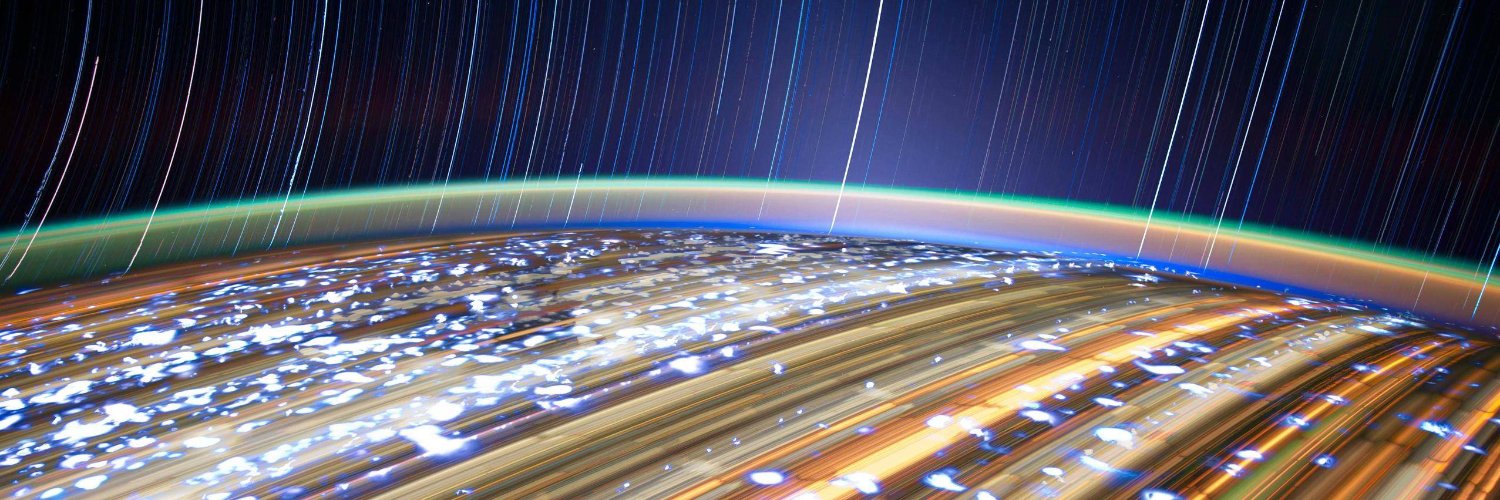
Star trails from the ISS! Lots of cool physics to see in these. Stars moving as thin lines in the direction of our orbital path but forming arcs to the left of our velocity vector. Lightning flashes making purple spots into the time history. City lights streak by. A faint red glow is seen as part of our upper atmosphere. Surreal!
Show more

Orbiting over wavy green auroras! Moments like these are some of the most surreal in spaceflight. What a view!

Timelapse of the ISS Optimal Propellent Maneuver (OPM)! We use this to reorient station's attitude in preparation for docking events. This one occurred over some magnificent Mediterranean city lights!
Show more

Star trails above and below Madagascar, photographed together from the ISS and Earth in collaboration with National Geographic's @BabakTafreshi.

Many have asked how this photo was made. This is my explanation.
The ISS rotates about its pitch axis as it orbits Earth at 17,000mph to keep its nadir view constant. Because of this long exposure photography turns stars into arced lines.
Sidereal clock drives on Earth match the planet's rotation to see stars clearly. I knew one designed for space could do this too.
So a camera mount was custom built at @RITtigers to rotate once every 90 minutes using a 60 to 90 toothed gear system, cancelling out the orbital motion of ISS and allowing the capture of distant stars as fixed points!
In essence, it is a a rotational coil spring powered analog star tracker. It was machined out of aluminum and is entirely mechanical to bypass NASA's strict electrical requirements for cargo. We had to get creative!
After Expedition 72 it was safely returned to Earth and is to be displayed at RIT. Which I am pleased to say because a similar barn door tracker I made from spare parts on Expedition 6 for nighttime city photography was destroyed in an atmospheric trash disposal!
Photography is an important part of sharing the journey to new frontiers for all people of Earth!
Show more

I finally have all 1.2 million raw image files from my latest mission to ISS! Here is a sample of one of my favorite Milky Way photos, taken from the Cupola with Nikon Z9, Arri Zeiss 15mm lens, T1.8 with custom sidereal drive that cancelled out star motion relative to our orbit.
Show more

Good fun talking space photography with @vast! The Haven-1 station's domed window will be well-suited to Earth and space observation. Great views for a new generation of explorers!
Show more












