

BuccoCapital Bloke
@buccocapital
Tweeting about tech and gabagool
1.2K Following 191.1K Followers
I find it significant that the most AI-pilled people I know use AI for basically everything…except for writing
It’s remarkably consistent. Why? Because to write is to think. And outsourcing your critical thinking to AI is intellectual suicide
Show more
There’s a long list of billionaires who literally became billionaires by building companies to such a massive scale that they are able to be the low cost provider of services. The literal entire purpose of the business is to lower your bill!
You are familiar with the canonical examples. Bezos and Amazon. Walton and Walmart. Sinegal and CostCo. Shit. Rockefeller. Henry Ford.
And then you have a whole class of billionaires who built digital platforms that took what used to be thousands and thousands in annual spend and bundled it into an unbelievably cheap subscription. Daniel Ek and Spotify. Reed Hastings and Netflix. Not to mention Google! That’s all free!
IKEA! Zara!
I could keep going. You get the idea and this point. Regardless of how you feel about the eventual concentration of wealth that comes from building these services, it is ignorant at best (I won’t discuss the worst) to claim that consumers never benefit
Show more
Reddit call was absolutely fascinating. Everyone should listen to it as a bellwether for where the internet is going
- AI Mode is increasingly default Google experience
- AI Mode provides rich info and data in line, less incentive to leave search
- AI Mose incentivizes dialog, Google wants to keep you engaged to serve more ads at each turn
- Google will milk search for as much revenue as possible as they transition from a search company to a cloud service and chip company
- As traffic from humans becomes more scarce this will put Google in an increasingly adversarial position to the rest of the internet
- This is a massive headwind to all media type companies who are not destinations
- This is a massive headwind to all content-driven go-to-market motions especially in the SMB. You have seen companies like HubSpot and get crushed by this funnel collapse
We are entering the end game - a knife fight for the remaining and dwindling volume of human traffic on the internet
Show more

I have finally cracked how to use twitter for investing
I have a private list of “investors” who say stuff like “second derivative” and “sequential deccel” and “rate of change”
These are, bar none, the dumbest people on the app. They like the same stocks at the top and hate the same ones at the bottom
I wait for these people to say that a stock can’t work, and then I wait a little bit longer just to make sure they’re done vomiting. And then I buy it
Show more
Tech support is an amazing use case for AI. You are not special. Your question is not hard. It has already been asked. It is already documented. Almost all of the shitty AI support experiences are bad implementations. Tier 1 tech support won’t be a job in a few years
Show more

Literally my first ever experience dealing with AI customer service just now. Shocked I never experienced it in the wild till now. It worked fine.
Long flight tomorrow. What’s the best podcast, article or essay that you’ve read recently?
I’m rereading “The Rise and Fall of American Growth” and found this passage to be quite thought-provoking when it comes to AI.
Will AI be looked back on by historians as a “Great Invention?” I think so!
Will rising income inequality (or our attempts to resolve it) cancel it out (or worse)? I don’t know, but it’s looking like it will be front and center in the next election
——
This book is based on an important idea having innumerable implications:
“Economic growth is not a steady process that creates economic advance at a regular pace, century after century. Instead, progress occurs much more rapidly in some times than in others. There was virtually no economic growth for millennia until 1770, only slow growth in the transition century before 1870, remarkably rapid growth in the century ending in 1970, and slower growth since then. Our central thesis is that some inventions are more important than others, and that the revolutionary century after the Civil War was made possible by a unique clustering, in the late nineteenth century, of what we will call the
"Great Inventions."
However, any consideration of U.S. economic progress in the future must look beyond innovation to contemplate the headwinds that are blowing like a gale to slow down the vessel of progress. Chief among these headwinds is the rise of inequality that since 1970 has steadily directed an ever larger share of the fruits of the American growth machine to the top of the income distribution.”
Show more

I very very very strongly disagree and think that AI adoption in the enterprise beyond coding is basically at the starting line

Everyone uses AI by now. Senior leaders are vibecoding apps. They've adopted claude. They're finding workflows to automate. Folks have their own claws. AI capex is keeping the S&P afloat. Corporate America's geared up.
It's all very much mainstream. We're not so early anymore.
Show more
“Man everyone is freaking out about Anthropic saying these models are conscious I better go read that article”
First sentence of article
“To be clear,” Christopher Olah told me, “we don’t know if A.I. models are conscious.”
Oh. Ok.
Show more
“AI spend FALLS for the 12th time in my chart that keeps going up and to the right” is a more accurate but less interesting title
The token optimization talk from executives is so funny to me because it exposes four realities of white collar labor
Companies almost never know:
1. Who are their *actual* top performers
2. The right metrics
3. What their employees do all day
4. Which tasks drive value
If you know these things the right number of tokens is roughly unlimited tokens.
AI just exposes that you have no idea who should be firing them and what they should be firing them at
Show more
It might seem like people in tech and investing have lost their minds. And in some sense that is true. But a lot of the behavior is rational in some sense, even if it’s not “honorable”
Why is it happening now? Yes, some people have AI psychosis. But something deeper is happening
In life, there are two types of games. Single turn and multi turn games. Single turn, or one-shot, games are just what they sound like. One turn and the game is over. No more turns.
Multi turn, or sequential, games have multiple turns. Which means history, reputation, and consequences for your actions have a large impact. You expect to see the players on the board multiple times in the future
Most things in the game of life are multi turn. Careers are long. Investments take time to come to fruition, and you will want to redeploy the capital
But when the stakes get high enough, people start to squint at the board and see that they can end the game in one turn. Or at least they think they can.
I’ve talked a lot about how AI is the big one. So it’s not crazy to me that some people are looking at the board and thinking there might be only one turn left, and they are just going for it.
Show more
Someone get eyes on Tae Kim NOW for everyone’s safety

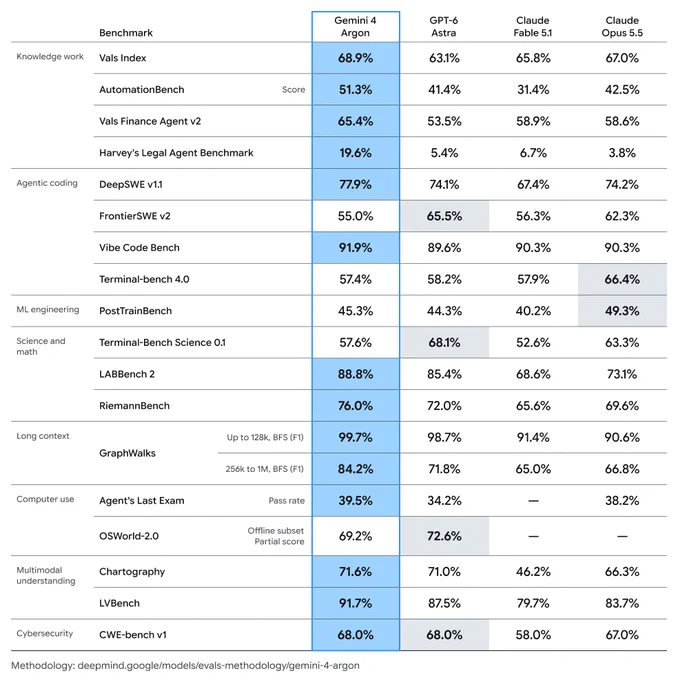
Introducing Gemini 4 Argon – our new frontier model.
It’s built for complex workflows across coding, enterprise knowledge work, and cybersecurity defense – rolling out today to a set of trusted testers through our Fairwind Program.
Show more
Consumer-facing companies should really be scared of agents. It’s incredible how much money they make treating their customers like absolute dirt. Trying to get support, cancel, compare prices etc etc is a humiliation ritual, and agents completely eliminate it all. Hallelujah
Show more
-65%. Thanks for playing

Agentic losers are now down 30 days in a row. If we learned anything from software it’s that these types of moves can go down 180 days in a row. Or more. Logic is out the window here
But not a bad idea to start sharpening your pencil
Show more
The current barrier to greater AI diffusion isn’t model capability. In my eyes, the barrier is three things (in order):
1. Most people don’t understand what AI can do
2. They need to fundamentally think differently about their life and work
3. Human preference. Even if AI can do the thing, people still want to do it (like shopping)
Each layer is a more rigid barrier. First, someone must be motivated to understand.
Then, they have to build a habit of flipping their thinking to a more AI-forward way. They need to consider how they would deconstruct and assign out work as if they were a manager. They need to understand abstract capabilities and apply them to their own use cases, or understand what previous use cases were uneconomical that are now available.
Then they need to want to assign that task out to AI in the first place
All of this leads me to believe that we are still incredibly early. It will take 3-5 years for the middle of the curve to even understand today’s AI capabilities and change their mindset to put this technology to work on their behalf. And by then we will be much more advanced.
The technological capability isn’t the blocker. It’s our understanding, creativity, and preferences that will determine the pace of diffusion
Show more
Amazon cuts off Muse.
While I am bullish Meta and Muse, I think many people are overlooking the digital knife fight that’s about to occur
Nobody wants to get commoditized or layered here. Let the games begin
Show more

Can’t stop thinking about the term “post-economic”
I fear it has wormed itself deep into the crevices of my brain, never to be dislodged
I increasingly love this take from @ericvishria
We are seeing such an explosion of capabilities and innovation that I think it’s quite likely it all works











