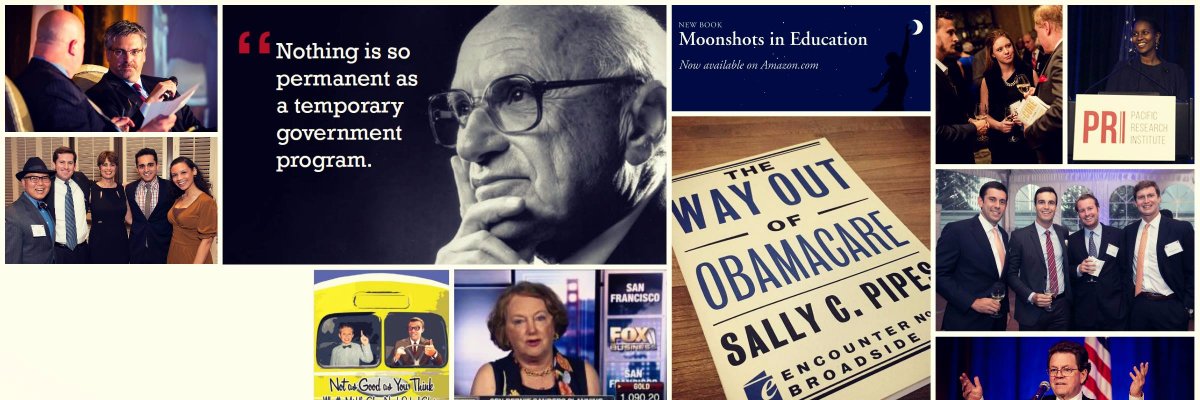

Sally Pipes
@sallypipes
President, CEO, Thomas W. Smith Fellow in Health Care Policy @PacificResearch. Author: The World's Medicine Chest
3.9K Following 8.5K Followers

America's innovation leadership depends on more than strong science--it depends on policies that help discoveries reach the marketplace like the Bayh-Dole Act. Learn more from @PacificResearch's @sallypipes on IP Protection Matters!
Show more


"Healthcare affordability will be a defining issue as Republicans make their case for retaining control of Congress. Hospital price transparency gives them more than a campaign talking point," writes PRI's @SallyPipes.
Show more
DYK: "All-or-nothing" hospital contracts force insurers to include every facility in a health system — even hospitals they might otherwise exclude over price or quality.
Patients should not be trapped in overpriced networks.
Show more

A tax on employing Medicaid beneficiaries sends employers a clear message: low-income workers come with an added government charge. That is terrible policy for anyone trying to enter the workforce or escape poverty.
Show more

In May, I warned that California's Gilead lawsuit could kill tomorrow's cures. The California Supreme Court has now rejected its dangerous premise: that drugmakers should be punished for allegedly failing to innovate quickly enough. This is a major victory for future patients.
Show more

A major victory for patients: The California Supreme Court just ruled that drugmakers cannot be sued simply for failing to develop a future medicine sooner. In doing so, the court recognized that drug development is an extraordinarily complex process — not something that should be judged years later through speculative lawsuits.
Show more

A White House report estimates that eliminating restrictive hospital contracts could save roughly $4,100 per inpatient admission in affected markets.
Read more:
The best long-term way to reduce Medicaid dependence is to help people find work, earn more, and advance. Taxing companies for employing Medicaid beneficiaries makes every step up the ladder harder.
Show more

GLP-1s can do far more than lower the number on a scale. Evidence shows benefits for cardiovascular risk, sleep apnea, and kidney health. Medicare should evaluate these medicines by the disease burden they may prevent.
Show more

Three types of hospital contracts are quietly driving up costs:
1) Anti-steering blocks cheaper recommendations.
2) Anti-tiering blocks lower copays for better-value care.
3) “All-or-nothing” forces insurers to take every hospital in a system.
Patients deserve real competition.
Show more
California keeps expanding its Medicaid rolls without ensuring enough doctors are available to treat patients. As a result, some Medi-Cal patients wait six to nine months just to see a gastroenterologist. An insurance card means little when no appointment is available.
Show more

Companies do not simply absorb a new tax on workers enrolled in Medicaid. They hire fewer people. Cut hours. Automate jobs. Raise prices. The burden lands on the low-income Americans lawmakers claim to help.
Read more:
Show more

GLP-1 medicines have transformed obesity care. Patients in major trials lost an average of 15% of their body weight or more using GLP-1s. Medicare policy should reflect that medical progress.
Show more
Hospital prices have more than tripled since 2000. One reason: dominant health systems use hidden contract terms to block insurers from steering patients toward lower-cost care. Patients pay more when hospitals can avoid competing.
Show more
DYK: California revoked more than 280 hospice licenses in two years and investigated hundreds more providers.
Medi-Cal fraud is no longer a collection of isolated scandals. It's a warning that California built a massive program without the oversight needed to protect it.
Show more

When states tax companies for employing Medicaid beneficiaries, businesses will automate jobs, reduce hours, slow hiring, or favor other applicants. Low-income workers will pay the real price.
Show more

Medicare has long paid for heart attacks, strokes, diabetes, kidney disease, and hospital stays linked to obesity — while excluding medicines designed to treat obesity. The GLP-1 Bridge program brings some common sense to federal health policy.
Show more
New Jersey passed a law to charge employers up to $725 for every worker — or worker's dependent — enrolled in Medicaid. That essentially puts a price tag on hiring low-income Americans. The result will be that businesses simply hire fewer of them.
Show more

Fake hospices. Stolen identities. Improper payments. California's Medicaid program has become so large and complicated that it has become a prime target for organized fraud. Unfortunately, patients and taxpayers are left with the bill.
Read more:
Show more

This month, the Trump administration launched the Medicare GLP-1 Bridge, giving eligible beneficiaries access to certain anti-obesity medicines for $50 a month. That is a meaningful step toward treating obesity before its complications become far costlier.
Show more












