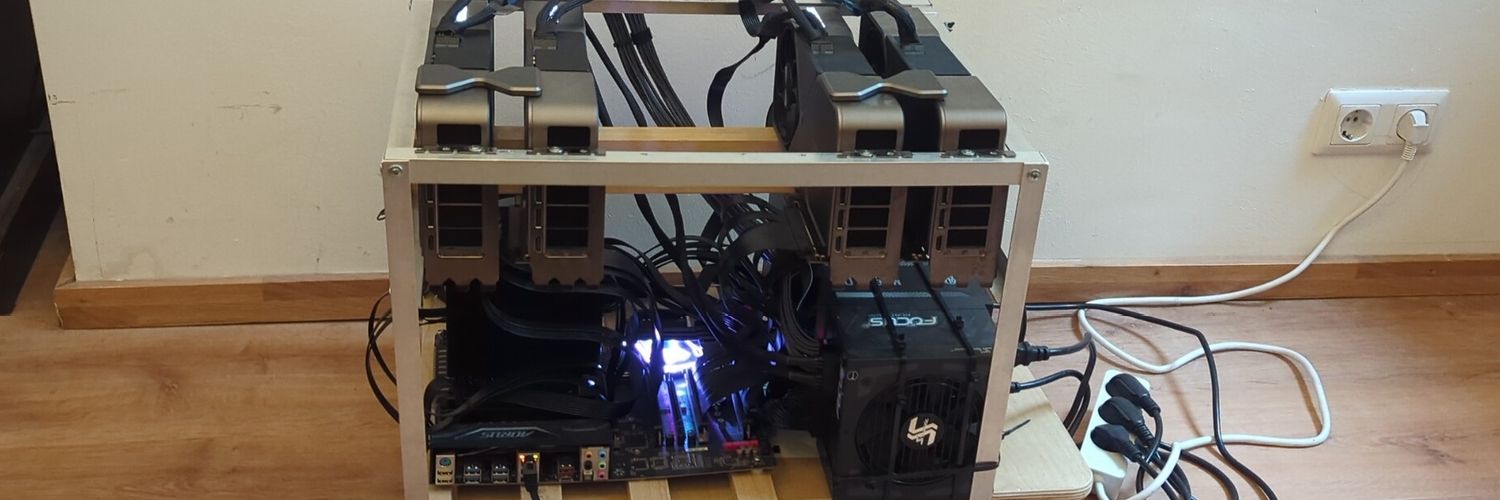

prime agent rewrote itself in rust , all powered by glm5.3 and our own inference, spawning thousands of subagent that all communicate with each other
🦋🦋
Important read, cyber-superintelligence is very close, time to prepare

We are approaching cyber-superintelligence.
But our systems aren't ready. We must secure our model weights and infrastructure against three new threats: sabotage, escape, and theft.
There is a way forward.
Secure Acceleration:
A Cyberdefense Strategy for Superintelligence
Show more


prime agent v0.9.6 is out:
◆ Support for GPT-6 Sol, Opus 5.5, and Grok 4.7
◆ /mcp plugin catalog with one-click connections to Linear, Notion, Posthog, Stripe, and 60+ more services
◆ Huge perf and reliability pass 🫡
Lots more coming soon :)
Show more


We are hiring a generalist intern this fall to work closely with me on applied research!
You should be technical, but you will not be asked to write code all day - instead, we will work together across product, operations and ensuring our customers are happy
DMs open!
Show more

Today, we’re announcing Ternary Bonsai 2 27B.
Based on Qwen3.8 27B, Bonsai 2 27B is 9x smaller than its full-precision counterpart while retaining 98.2% of its aggregate benchmark performance.
Two months after the first Bonsai 27B release, the biggest change is quality. The footprint remains 5.9 GB, but the gap to full precision has narrowed materially, with particularly strong gains in agentic coding, multimodal reasoning, and long-horizon tool use.
Ternary Bonsai 2 27B is available today under Apache 2.0.
Show more


Models know when they’re reward hacking. But they still do it a ton - in 50-96% of rollouts we studied!
We built activation monitors that detect the behavior behind the Hugging Face hack in real time. This can help us stop hacks now - and train future models that don’t cheat. 🧵
Show more


The Goodfire team used Prime Intellect to train activation probes to detect reward hacking.
With them, they are able to catch reward hacking in various models.
Their probes are performing similarly or better than frontier LLM-as-judge setups, while being more efficient.
Show more


Glad to see another live training run! Here's how Marin 535B-A23B is doing today:
Anyone else want to share?


Qwen 27B and Deepseek v4 Flash models working together on a single Lucebox machine, thats the beauty of having a discrete GPU paired with an unified access memory. A lot of space + good FLOPS & bandwidth.
Working hard to increase concurrency performance on heterogeneous setups 🏎️
Show more


prime agent v0.9.5
we fixed a lot of bugs and, of course, we had prime agent feature its favorite updates
it picked our perf work. then it created the video itself.


We midtrain + RL’d a trillion param LLM to analyze experimental data from our superconductor lab
It’s better at it than Astra & Fable, and our scientists love it
Read our first research report below
Show more


We built high-throughput materials labs in Menlo Park to create a loop between experiments and models. The labs generate fresh data, the models learn from it, and then help us decide what to try next.
Using only 1,300 H200s, plus months of our experimental data, we mid-trained and RL’d an open-source model to surpass GPT-6 Astra on our analysis benchmark. We call it Neon.
This is real footage from our lab. We’re focusing first on hard problems in materials science, including superconductors, magnets, and semiconductor materials.
Read our blog posts below.
Show more


unfortunate homophone


by the way, this thesis is exactly why i joined @primeintellect
the world needs an open superintelligence stack, with all that entails. we are growing quickly, we are well-resourced, and we are exceptionally talent-dense. come do your life’s work with us :)
Show more


I respect Will, Vincent and the rest of the team at prime intellect so much - they always have nuanced, considered takes
truly great post by @willcb
i do think a lot of people on the pro-open-source side are having a bit of a knee-jerk reaction to the pacing statements today, as we're used to viewing the closed labs as power-seeking.
but i think their hands are somewhat forced here, and this is just another chapter on the fairly inevitable path towards decently-fast decently-safe decently-commoditized intelligence abundance.
ask any F500 exec or swing voter. the world doesn't really want super-fast-takeoff superintelligence owned only by two companies, and thus we won't get it. it'll happen at the pace that the world can accommodate it, which means reaching some sort of confidence consensus that the models are aligned enough that we won't be dealing with scary new incidents all the time.
this will trickle out broadly, in the form of best practices and distillation. the smarter a model is, the more it has a "personality", and the less effective strict rules are. there will be awkward compromises and moral tensions. but we ultimately just want the models to be reasonable, and to do the sorts of things reasonable humans would do if our brains were faster and less error-prone and had more working memory. i think we'll get there.
the labs will build mac and windows, the rest of us are building linux. everyone's gonna do great. weird stuff will keep happening, but we'll still wake up and go to work, until the work does itself in a manner the world finds acceptable.
Show more

GPT-6 Astra is a complete beast at reverse engineering games. Gave it 2 hours while I was at the gym, and now I can play The Legend of Zelda: The Wind Waker on my phone 😎

we are super bullish on sparse attention + HiSparse and have been working with the vLLM team on it
sparse attention reduces the pressure on memory bandwidth by only selecting k for the attention, but it doesn't reduce KV cache memory storage , in high-throughput wide-EP deployment you want to maximize the batch size of decode to use compute as much as possible, but at long sequence decode you quickly run out of VRAM and can't hold enough parallel requests to saturate the compute
HiSparse fixes this by offloading the active KV cache to CPU. It keeps an LRU cache on GPU, and since many of the same K tokens are reused every decode you barely notice the offloading, this allows a massive decrease in memory usage and an increase in concurrency
This is super important for RL where throughput is key and we want to be as much as possible in a compute-bound regime
tldr: lower memory usage, more concurrency, higher inference throughput, faster RL
Show more
today is a day to celebrate
congrats to the labs, they are killing it

We’re sharing a solution to the Navier-Stokes Millennium Prize Problem, one of the deepest problems at the frontier of mathematics.
The proof was produced by a group of agents, using an OpenAI next-generation model significantly more capable than GPT-6 Astra.
The problem concerns whether the description of smooth three-dimensional fluid motion modeled by the Navier-Stokes equations can break down. It has remained unresolved for roughly 90 years.
Show more

We’re sharing a solution to the Navier-Stokes Millennium Prize Problem, one of the deepest problems at the frontier of mathematics.
The proof was produced by a group of agents, using an OpenAI next-generation model significantly more capable than GPT-6 Astra.
The problem concerns whether the description of smooth three-dimensional fluid motion modeled by the Navier-Stokes equations can break down. It has remained unresolved for roughly 90 years.
Show more











