

Sovra – The Identity Stack
@sovraio
All the tech you need to have a single identity across every service and institution.
124 Following 472 Followers
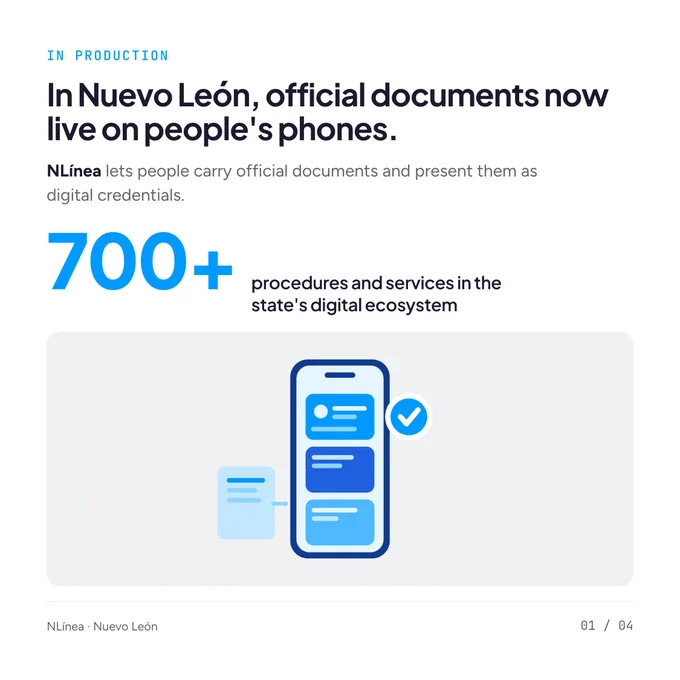
🇲🇽 In Nuevo León, NLínea already lets people carry official documents on their phones and present them as digital credentials, within a state ecosystem of more than 700 procedures and services.
Birth certificates, permits and contracts move from the Expediente Único into each person's wallet. From there they can be presented to another agency, a bank or a university, which can check who issued the document, that it is authentic and that it is still valid, without going back to the system that produced it.
Behind that simple gesture are SovraGov, SovraID, SovraWallet and Propia, the public trust layer we built with @class_lambda and @alignedlayer, all running on SovraChain.
The launch is the first step. What comes next is for those documents to be accepted in more and more places.
The full story is in The Identity Brief 👇
Show more


Over the past months, Sovra, @class_lambda and @alignedlayer have been working together on Propia, a public protocol for verifiable digital credentials.
Propia starts from a simple premise: trust established by one institution should be reusable by others, without requiring shared databases or dependence on a private intermediary.
This has become increasingly relevant as AI agents begin to participate in everyday operations. They submit requests, exchange information, authorize transactions and interact with other agents. These interactions need a reliable way to establish who an agent represents, what it is authorized to do and whether the claims it presents remain valid.
Rebuilding that verification process within every organization is costly and creates isolated systems. A shared protocol allows credentials to be issued once and independently verified wherever they are needed, including by machines acting on someone’s behalf.
For institutions, this means fewer repeated checks, fewer custom integrations and lower operating costs. As more institutions participate, more credentials can be reused and the protocol becomes more useful for everyone.
We believe this infrastructure should be open and collectively governed. Today, we are publishing the whitepaper as a public proposal and inviting others to discuss it, improve it and build on it.
Show more











