
Ian Cinnamon
@IanCinnamon
CEO & Co-Founder @Apex_Spacecraft (explore the galaxy w us: Founded Synapse (acq @palantirtech) & superlabs (acq @zynga). #LongLA#
826 Following 3.1K Followers
Apex is The Spacecraft Platform Company.
For most of space history, progress was measured in firsts. First satellite. First human in space. First Moon landing. The next era will be measured in rate: how fast you can deploy, replenish, and refresh the infrastructure everything else depends on.
That’s the New Space Race.
Winning it takes constellations: many satellites working together as systems. And constellations require two industrial capabilities: launch and spacecraft platforms.
Launch is ready enough. Platforms are not. Apex exists to remove that bottleneck.
Show more


Meet Amanda Mosinski, AI&T Technician III at Apex!
Amanda brings over a decade of hands-on manufacturing experience to Apex. She kicked off her career machining V8 and V6 Turbo engines at Toyota Motor Manufacturing before making the leap into aerospace at Blue Origin. She began her time at Blue Origin running vibe testing, thermal and cryogenic testing, and proof/flow testing, then moved into final assembly and integration for the BE-4 rocket engines, where she supported hot fire testing at MSFC 4670. When she stumbled on an opportunity at Apex, she couldn’t turn it down, driving 2,000 miles from Alabama to California to join the team.
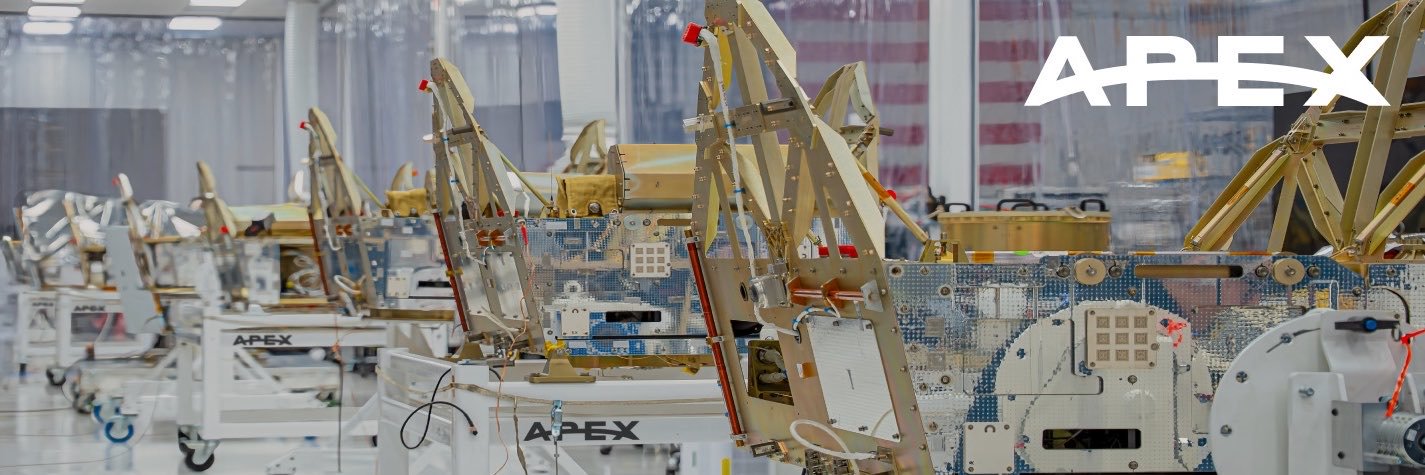
Today, Amanda works as an Assembly, Integration & Test (AI&T) Technician supporting bus builds from base deck to finished, flight-ready spacecraft. Technicians like Amanda are the backbone of Apex’s mass-manufacturing strategy, executing the mechanical assembly, integration, and testing that transforms components into complete satellite platforms. Their work on the line is what ensures Apex hits rate, meets customer demand, and delivers mission success in orbit.
Learn more about Amanda here:
Want to build flight hardware alongside Amanda and Apex’s team of highly skilled technicians? Check out our open production roles:
Show more


Very proud of the @Apex_Satellites team. Test, launch, learn, repeat at extraordinary speed. 🇺🇸🚀💪
The recent Transporter-17 launch was a big day for Apex.
We put four Apex spacecraft into orbit: three customer-owned Aries platforms and one Apex-owned testbed Nova platform.
All three Aries spacecraft are operating nominally, and commissioning continues ahead of schedule. These buses represent a major milestone for our customers, who are using them to support critical missions. We’re excited to reveal more details on those missions in the coming months.
The Nova testbed platform performed as planned through its early mission: it separated cleanly from the launch vehicle, powered on, booted the flight computer, deployed both solar arrays successfully, and entered a GNC-controlled safe state before transitioning into a hold state, awaiting first contact. Unfortunately, we have not yet established communications with the test spacecraft. The Apex team is working to understand the issue and establish communications with Nova.
The very purpose of Nova’s pathfinder mission is to surface issues and prove out vehicle performance before our customer missions. Apex is already set to launch the second Nova testbed platform in the coming months, before flying any customer missions. This rapid mission cadence enables Apex’s risk-on approach for rapidly developing and testing pathfinder satellite platforms to ensure customer-owned platforms maintain 100% on-orbit success.
This is the Apex way: to develop new platforms at unprecedented speed, Apex intentionally accepts higher risk on initial self-funded flights of testbed vehicles to prove out design and performance. Once these systems fly successfully in orbit, our customers are ready to fly them with confidence. For our customers’ spacecraft, reliability is everything, and we treat it that way.
The next Nova is already in production, with our launch coming up in just a matter of months. We will apply learnings from this first mission, make the necessary changes for increased reliability, and fly again before any Nova customer mission.
We are immensely proud of the Apex team for the three customer-owned Aries platforms now operating successfully in orbit, and thankful to our partners for their continued support. We will share more updates on all four spacecraft as we confirm additional information.
(Thanks to our friends @vantortech for the great NEI shots of Nova!)
Show more


What is a satellite platform, and why does it matter for the future of space?
Apex Co-Founder & CEO @IanCinnamon joined @suffiyanmalikk on @WeThe_Builders at @RonaldReagan's National Economic Forum to dig into the thesis behind Apex, how productized platforms allow for faster, more scalable production – and what that means for Apex's customers.
Full episode here:
Show more

The real CEO of @Apex_Satellites is finally revealed!
New pod alert: Apex CEO & Co-Founder @IanCinnamon sat down with @itsmoislam of @payloadspace a few weeks back to unpack why the biggest bottleneck in space is no longer launch; it's the spacecraft itself.
After Ian sold his first company to Palantir, he and now Co-Founder Max Benassi saw the problem up close: rockets were getting cheaper and payloads more capable, but satellite buses were still being built as bespoke engineering projects.
Apex's answer was simple in theory, incredibly difficult in practice: turn spacecraft into products.
Four years in, Apex is delivering standardized platforms for critical commercial and national security missions, and making good on the promise to bring true productization to the satellite industry.
In the episode, Ian digs into:
– Why spacecraft should be products, not one-off programs
– Whether the bus market is underbuilt or heading toward oversupply
– How Apex approaches manufacturing, vertical integration, and scale
– Why bigger satellites may make more sense in a world of cheap launch
– The capital strategy behind Apex's rapid growth
Link to the full episode ⤵️
Show more


NEW: Ian Cinnamon (@IanCinnamon) on Building a $2.3B Satellite Manufacturing Campus, @PalantirTech Alumni & The Apex Space Thesis
Ian is the Cofounder and CEO of Apex Space. He was previously at @zynga and Palantir (after selling his company). He joined Palantir after selling his weapon detection company to them which had gotten impacted by covid since all live events came to a halt for ~1 year. Interestingly, my final year project in electrical engineering was also weapon detection using Computer Vision - which I take no credit for since my teammates did the work, I even back then thought I could just support on the BD/research side since my dad was working in the security administration function.
He is the second member of the Palantir founder mafia on the show to have started a billion dollar company. The first was @CobiBGantz. Both backed by friends of the show at @xyz_vc.
The company was valued at $2.3 billion as of their most recent fundraise which was led by Glade Brook and Washington Harbor. Their early investors include @a16z, XYZ Ventures and @p72vc, all friends of the show.
We talked about his idea maze and choosing the right thing to work on in the middle of the crypto-craze in 2022, in that time he joined @villageglobal as an EIR to figure out what he wanted to pursue. I am a big fan of exploration and taking your time to decide what you want to go all-in on. Recently discussed the importance of this on the show with @alitamaseb (GP at @DCVC and author of SuperFounders) as well, he conducted thorough research on billion dollar founders and companies and one of the things that is common is the fact that billion dollar founders take time to decide what they want to pursue. Another example that comes to mind is @qasar of @AppliedInt who took ~2 years before he locked in the idea for Applied Intuition. Matt Angle at Paradromics was in his PhD and was thinking about it for ~4 years or more before starting the company. Brandon Sorbom at Commonwealth Fusion Systems also spent an ample amount of time working on the idea including at first starting a nonprofit dedicated to research before doing it as a startup.
Special edition of our show from @RonaldReagan National Economic Forum.
@danrothschild @ImChauncey @davidu @markpinc @BaijuBhatt @8vc @CRV @saarsaar @morgangress @pronounced_kyle
Timestamps
00:00 - Introduction
01:22 - Moving from software and AI to the space industry
02:12 - Using computer vision to protect public safety
04:37 - Learning from the flat, fast-moving culture at Palantir
07:54 - Deciding to build the last company I would ever start
09:59 - How SpaceX made rocket launch reliable and frequent
12:10 - Stepping away to incubate a new kind of satellite business
13:56 - Building the Ford Model T of the satellite world
15:15 - What is a satellite platform?
16:43 - Partnering with Northrop Grumman for missile defense
19:12 - Understanding how much room is actually left up in space
21:19 - Choosing the right altitude based on what a satellite does
24:13 - Shifting space tech from custom crafts to a volume game
27:25 - How factory automation helps America win the current space race
29:46 - Closing
Show more


I don't invest in space stocks because I cover space companies, or pretend to understand irrational market moves. But the idea that a space company stock would fall after an abort, which actually saved the rocket shows the company's procedures work as intended, is pretty dumb.
Show more

VALLEY OF DEPTH: @IanCinnamon, CEO of @Apex_Satellites on the origin of the company.
"Building the physical satellite that we do here at Apex is pretty freaking hard. And the reason it's hard is satellites are these bespoke exquisite systems that are basically redesigned around a specific payload every time...
And if you're redesigning that every time, that's all this new nonrecurring engineering. It's really slow. So my idea was like very, you know, I would argue naive at the time.
I was like, why can't we just do it like a software company where engineers design a set product and then we go have a production line, go build the same thing over and over again at scale."
Show more

Why is a satellite like a race car?
@FortuneMagazine's @agarfinks has the answer in her recent piece on Apex’s partnership with @ToyotaRacingUSA.
Leveraging the same precision manufacturing practices used to craft world-class racing engines, Toyota is helping Apex scale by mass-producing precision-machined parts for our Apex satellite platforms.
“We have to think about manufacturing from the perspective of not just how we build something, but how we build it when we’re factoring in all the variables that matter—quality, speed of production, and affordability,” said @IanCinnamon. “Too often we say, ‘Oh, we can build a bunch.’ Well, how long does it take? Or, ‘We can build them really cheap.’ Okay, but are they high-quality? We need to find the middle ground between those core elements. And if we can do that, the U.S. manufacturing base can really fall into its stride.”
Read the full story here:
Show more

Apex is proud to supply its Nova platform to @LoftOrbital, expanding their off-the-shelf portfolio for future customer missions requiring increased size, weight, and power (SWaP). These missions include proliferated, power-hungry national security applications such as advanced sensing, high-throughput communications, and missile warning/tracking.
Under the agreement, Apex will deliver up to 10 Nova platforms, with the first scheduled for delivery later this year.
Link to full story here:
Show more

Valley of Depth this week with @IanCinnamon of @Apex_Satellites took an unexpected turn.
Introducing Aries, the shortest-tenured CEO of Apex 👇

Nova-1 is set to deploy from @SpaceX's Transporter-17 just after midnight tonight.
As the first Nova in orbit, Nova-1 will serve as a flying testbed, proving out the Nova platform architecture and the vertically integrated tech stack (power, avionics, solar, flight software) that will underpin all future Apex platforms.
Nova mission success has been divided into three discrete phases, each with a clearly defined set of objectives that will help prove Nova’s readiness as a true constellation workhorse.
Phase 1: Minimum Viable Product
Establish communications and confirm power-positivity. Platform is healthy in orbit.
Phase 2: Crossing the Threshold
Continue platform commissioning. Power on payloads and downlink data.
Phase 3: Fully Operational Space Platform
Complete platform commissioning. Begin Project Shadow commissioning and mission ops.
Pushing the Limit
Following Project Shadow, Apex will continue testing the limits of Nova’s performance on orbit.
Stay tuned for more mission updates over the next several weeks.
Show more

Our very first Nova platform is on the pad, waiting to make history. When the Nova development program began, we were a team of less than 100 — today, we're nearly 400-strong, building Aries vehicles at rate and scaling production of Nova as we speak.
At @Apex_Satellites, we do something pretty rare in this industry - we execute on what we say we're going to do. I don't believe in overpromising and underdelivering.
We set an ambitious timeline to get Nova in space, and tonight we will hit it - that's a testament to who our team is and how dedicated they are to their craft.
Together we are changing how satellite platforms are built and creating a company that will fundamentally transform the U.S. space industrial base.
To every engineer, technician, operator, and builder who got us here: thank you. This is your launch.
Go Nova! Go Apex!
Show more

At @Apex_Satellites, we are proud to support America's most critical space programs ensuring safety and security for the next 250. Happy birthday, America.


Always great catching up with @IanCinnamon
Apex will win

Love having @cantos on our cap table!

We have two exciting announcements today as Cantos turns 10…
First, we closed our new fund earlier this year. Canto IV is a $70M fund purpose-built to lead pre-seed and seed rounds. We oversubscribed, wanting to keep it right-sized for being a founder's most aligned first partner.
Second, we launched our new look with help from our friends at @asimov_co! Cantos is so-named as an ode to epic poems, where grand stories are written in "cantos" rather than chapters. We view founders as the protagonists of today's epics and seek to back those whose deeds become the stuff of legend. Our new website is a testament to the scale of their ambitions, with visions from a future they will have shaped.
Resonat in Æternum 🖋️
Show more


.@IanCinnamon started as @markpinc's tech assistant:
"Ian was a star recruit."
Ian was put on the Poker team, but within 1-2 quarters, they marked him as "low-value, low-potential."
"The team said, 'He's too entrepreneurial.'"
"I talked to Ian. He said, 'They're doing dumb ideas.'"
" So I plucked him out early, much earlier than I would normally, and made him my tech assistant."
Show more


BREAKING: Mark Pincus (@markpinc) on How to Build Billion-Dollar Products
"Your # 1 job as a founder is to be right."
"F*ck scale."
"Don't be a fake CEO."
Mark founded Zynga in 2007, grew FarmVille + Words With Friends to 1B+ users in 4 years, & sold the company to Take-Two for $12.7B. Before that he was an early investor in Facebook & Twitter. Across 10 companies, he's spent 30 years learning how to build products people love.
Now he's put it into "Life at the Speed of Play," aka the "Product Maker Bible"
His goal: something you can reread in 10 years & still use, the way he rereads Peter Thiel's Zero to One.
We went deep on the framework:
- Your product instinct is right ~95% of the time, but your specific idea is wrong at least 75% of the time. The whole job is separating the two & k*lling your B+ idea to find the A.
- Proven Better New: copy what already works, make it objectively better, then add one new bet.
- 40,000 games launched in the App Store last year. 0% held a top 25 spot. Why products win on day 365 retention, not virality.. lessons from @nikitabier & more
- Why he's an AI maximalist who still calls consumer AI un-investable, & thinks today's $2-5T companies become $10-20T companies.
𝐓𝐈𝐌𝐄𝐒𝐓𝐀𝐌𝐏𝐒
(00:00) Mark Pincus, Chairman & Founder at Zynga
(01:07) Why it took so long to write the book
(01:52) Why the book starts with Elon
(07:29) How frustration becomes market research
(08:16) The gap between Airbnb and hotels
(09:14) Why people don't want flight attendants on private jets
(13:13) The goal behind Life at the Speed of Play
(15:07) The instincts vs. ideas framework
(21:01) Do instincts improve with experience?
(22:49) A framework for building winning products
(29:38) Becoming a student of yourself
(31:16) Finding great ideas in overlooked products
(34:39) Why AI makes building easier & winning harder
(39:17) Cracking Zynga's record-setting retention
(44:59) What Mark looks for in startups
(50:42) Jeff Bezos' boldest decision
(53:03) What happens when founders realize they're wrong
(59:37) How Mark found talent others overlooked
(1:06:58) Don't be a fake CEO
(1:12:15) Inside Silicon Valley's early days
(1:14:58) Why he funded Friendster & Napster as "experiments"
(1:17:00) The 'think weekend' with Thiel, Zuckerberg, Reid Hoffman & Sean Parker
(1:18:58) Launching Zynga when nobody believed him
(1:21:42) Why Mark is an AI maximalist
Show more


We’re hiring a Hard Tech Investment Associate @UpfrontVC !!
I’ve never been more convinced about what’s being built here. The physical backbone of this country is getting rebuilt. We’re looking for someone sharp, high agency, and wired into the LA scene to join us.
Show more












