

Mark
@MRRydon
Cofounder @AethirCloud | Building global GPU infrastructure for AI | Here for AI, GPUs, inference economics, power and the money behind the compute
2.3K Following 335.6K Followers
Something worth more discussion for anyone who compares AI chips on FLOP/s.
Epoch's new Inference Performance Index puts a GB300 at about 25x an H100's inference capacity per chip on agentic workloads. On 8-bit FLOP/s the gap is only 2.5x, so the spec sheet understates it by about 10x.
The difference is memory bandwidth and chip-to-chip communication. When an agent is holding a long context and streaming tokens, those can matter more than raw arithmetic.
Google's new TPU 8i Max is built around the same point. It doubles the HBM bandwidth of TPU 8i, because once dozens of agents work across a codebase at once, memory bandwidth becomes the bottleneck.
The newest racks add far more agent capacity than their FLOP/s headline suggests. If you're sizing the buildout for agents, count how many requests each rack can serve at once, and the case for the newest systems gets a lot stronger
Show more


Things we got before GTA 6
• ChatGPT and Claude
• AI won gold at the International Math Olympiad
• Erdős problems open since 1970, solved by AI
• Fermat's Last Theorem formalised in 30 hours
• AI solved protein folding
• RSI
• Consumer AI agents
• Nvidia at $5T
• H100s, then B200s, then GB300s
• Starlink
• Rockets that land themselves
• Flying cars you can preorder
Rockstar shipped one game while the rest of us rebuilt the entire compute stack
Show more
A few things from the Claude Fable 5.2 launch that tell you where compute demand is heading.
1/ One Anthropic engineer gave it an empty folder and asked for an operating system. It coordinated over 1,000 subagents working around the clock for eight days, and the OS boots on a laptop.
2/ A team of 1,000 Fable agents formalised Fermat's Last Theorem in 30 hours. Anthropic's first attempt took 11 days.
3/ Over 90% of the changes merged into Anthropic's core codebase are now written by Claude.
4/ Fast mode runs up to 2.5x faster at double the token price. Speed is now something teams pay extra for.
The unit of work is turning into a thousand agents running for days, and every one of them is burning inference the whole time.
Doesn't look like demand for compute is slowing down anytime soon. I think most people still underestimate how much inference this kind of work is going to need
Show more


The claim that data centers are a large drain on the nation's water does not hold up. Its just false.
In 2024, large U.S. data centers consumed an estimated 19–23 billion gallons on site (Han et al., 2026). For scale, that’s about 4% of the 532 billion gallons U.S. golf courses applied for irrigation that same year (GCSAA, 2025).
The golf figure includes recycled water, and the data-center figure covers on-site consumption only.
There are so many false statements about data centers that, given better knowledge, must be labeled as lies.
Show more


Banks arguably has the best vision for the future
Not sure whether you want to be really big or really small software in this scenario

my spidey senses are telling me the labs are, as we speak, using unguardrailed versions of their unreleased models to systematically reverse-engineer ALL of the internet’s software, apps, and games, then feeding the reconstructed source code straight into their training pipelines while simultaneously building guardrails to ladder-pull the rest of us
Show more

it’s actually insane to think how when elon was 31 he made $180 million from the sale of PayPal and he could have just bought a private island and spent the rest of his life in peace, without having to work another day
instead he sacrificed basically everything trying to build the future. failed multiple times, almost went completely broke, but he kept going, spending the last 20 years building reusable rockets, electric cars, global satellite internet, AI, brain interfaces. basically the whole infrastructure for the future of civilization
just to end up in a world where people are publicly calling for his execution, and getting applauded for it
you don’t even have to like him to realize how completely fucking backwards the world has become
Show more

it's a great time for the contrarian bet

I don't think data centers stop getting built. I think emboldened leaders demand:
-No NDAs/Full process transparency
-Paying full cost of infra/electric (and subsidizing everyone else's)
-Actual consideration for quality of life concerns
-Big $$ involvement in local communities
And the builders will positively JUMP to agree to it all. New leaders deliver a win for everyone while being "tough on tech" and the whole system keep turning -- in a way that's frankly better and more sustainable.
Show more
A lot of AI hardware stocks got sold yesterday on worries about a data centre slowdown. Korea's export numbers tell a very different story.
Korea shipped $56.4B of semiconductors in October, up 259% on a year ago. That's nearly half of everything the country exported last month.
Most of it is memory, at about $50B. Computer exports, driven by AI servers and server SSDs, were up 497% to $5.85B.
Prices and volumes both stayed high as big tech keeps spending to stay ahead in AI. Total exports hit $115.3B, and Korea now expects to pass $1 trillion for the year sometime this month.
This is the closest thing we have to a live read on AI hardware demand. It lands on the 1st of every month, weeks before anyone's earnings call.
Stocks can have a rough day for all sorts of reasons. The chips are still shipping at record pace, and I don't see a slowdown anywhere in these numbers
Show more


Dylan Patel says CoreWeave will not sell you compute for six months and Nebius makes you prepay a full year upfront or six months at a "ridiculous price"
“The key thing here is who actually can deliver on compute. We did ClusterMAX, which is ranking all the clouds. There’s 323 providers that we’ve tracked, 77 that we actually reviewed, and 19 that we gave medallions to.”
“What that means is CoreWeave and Nebius are the best providers in our view. CoreWeave will not sell you compute for the next six months. They’re sold out. Nebius will make you prepay a full year upfront or six months upfront at some ridiculous price, but that’s the only way you can get compute from those guys.”
“Oracle and Google are really good as well. Google’s been moving up. The first ClusterMAX, they were bronze, and then they moved up and up and up.”
________
Source and full breakdown of his presentation:
Show more

Coding agents broke OpenAI's Git.
Codex sped up their engineers so much that by the end of last year the monorepo couldn't keep up. Slow pushes, failed merges, and reliability at times below 90%.
The work multiplies. One engineer now has several changes heading to CI at once, and every push sets off more jobs fetching the same code.
So they built a new Git backend called Pando. It went from kick-off to production in 10 weeks, designed by one engineer and written by teams of agents. Median push latency is down nearly 80%, and it now serves close to a petabyte of Git data a day.
This is what agents do to infrastructure. Every agent is another worker pushing code, running tests and pulling data, and all of that lands on storage, networks and CPUs as well as GPUs.
OpenAI hit the wall first because they use agents more than almost anyone, so at least the rest of us know what's coming. Every company that rolls out agents at scale is going to need a lot more infrastructure under them than it planned for
Show more


Anthropic spent $5.0B on short-term compute in Q3 alone.
That's the line in the new S-1 I keep coming back to.
Anthropic books most of its compute on multi-year deals, 12 to 18 months before it's available. When demand runs past that plan, it buys short-term capacity, and that capacity costs significantly more.
So in the quarter revenue hit $17.0B, demand ran far enough past what they'd booked that they paid up for $5.0B of extra compute. Along with a $2.0B non-cash charge, that's what swung them to a $567M operating loss after a $974M operating profit in Q2.
And it's going to keep happening. They expect to use more short-term compute in the near term.
The bears will call this a margin problem. To me it's the clearest demand signal in the whole filing.
It also tells you where the next dollar goes. The biggest buyers of compute are already running past their long-term plans, and every provider with GPUs live today is part of the answer
Show more


Marvell is buying Lumentum, the laser company, in an all-stock deal that values it at about $115B.
In my opinion this is the clearest sign yet that the next bottleneck in AI clusters is connectivity.
Lumentum makes the lasers and optical parts that move data between GPUs. Marvell makes the chips on the electrical side. Put them in one company and you can design the whole path a signal takes, from inside the chip package out to the next data centre.
Marvell's own deck shows why. Data moving between data centres is the 1x baseline. Inside a rack it's 100x. Inside the package it's 1000x. Every step closer to the GPU needs far more bandwidth, and that's where optics are heading next.
They put the combined market at $550B by 2030.
Nobody pays $115B for lasers unless they expect clusters to keep getting bigger for years. I think the links between GPUs are about to matter as much as the GPUs themselves
Show more


Who Hedges a GPU?
@ShanuMathew93 breaks it down well here. Jump now runs a compute desk, and a neocloud renting out B300s at around $7.56 an hour can buy protection that pays out if the rate drops to $4. Susquehanna is seeing the same interest from data centres and private neoclouds, and some of them want it to help land financing.
This is how every serious commodity grows up. Oil producers hedge, airlines hedge fuel, and now GPU owners can lock in a floor. A floor on rental revenue makes a cluster easier to lend against, and cheaper debt means more clusters get built.
That B300 rate is up about 56% this year. The operators asking for these hedges are using them to get their financing signed faster, and I'm very bullish on what that does for the buildout
Show more


Becoming more ways to hedge or take a view on AI beyond equities and CDS. The WSJ reports Jump has launched a compute desk, trading price gaps across providers and structuring OTC derivatives.
An illustrative structure: a neocloud buys a put on GPU rental rates. The article cites B300 rentals at ~$7.56/GPU-hour; Jump could agree to buy compute at $4/hour if prices fall below that level, or settle in cash. That protects the provider against a collapse in rental revenue below the strike.
Susquehanna is also fielding interest in compute-index puts from data centers and private neoclouds. Some want the protection to help secure financing from lenders.
Alongside planned compute futures, this is starting to become a market. Hearing more trading firms are getting involved.
Show more

Who Checks the GPUs Behind the Loan?
Private credit has lent a lot against GPUs. Those loans are getting securitized now, and whoever buys the bonds will want proof the chips exist and actually perform.
It's already happening. Stonebriar priced an $869M equipment ABS in October with GPU loans making up about 15% of the pool. Wingspire's $407M deal, roughly a fifth GPU loans, was 5x oversubscribed. Lambda's $926M term loan, secured by the GPU servers it funds and an NVIDIA take or pay contract, got a Baa2 from Moody's.
What lenders are really underwriting is the contract and the operator. Serial numbers, live telemetry and a creditworthy customer paying every month are how you prove a GPU exists and works.
Securitization is what happens when an asset class becomes normal. The operators with clean data and real customers will end up with the cheapest money in this market
Show more


The neocloud boom is the most exciting thing happening in AI infrastructure right now, and it's also where the gap between talking and building is widest
Every week I see another team announce they're "becoming a cloud". Some raised for a different idea and found that GPU capacity is the thing customers are actually paying for. Rental rates keep moving up, demand keeps outrunning supply and the capital is there, so it makes sense that people are jumping in
What a lot of new entrants learn the hard way is that the business barely lives in the GPUs. You can wire money for hardware in an afternoon. Then you need power that's actually contracted, a site with the right cooling, networking that holds up under real training loads, and a crew that can get all of it live on the exact date you promised your customer
That ready for service date is everything. A customer who signed for capacity in March has a model to train, a product to ship and their own investors to answer to. If you slip by two months, you've pushed their whole roadmap back
So the providers who win this cycle look a bit boring from the outside. They've brought clusters online before. They know the local electrician by name. They plan for the transformer arriving late and the permit taking longer than it should. They treat a delivery date like a promise to someone else's business
That's also what lenders and customers will pay up for. Plenty of buyers want to work with smaller and more flexible providers because the big clouds can't always give them the capacity, the timing or the price they need. That demand is real and it keeps growing. What they need is confidence that the capacity will actually show up
The long tail of compute providers is here to stay and it's healthy for the whole market. Over the next couple of years the ones who execute will pull way ahead, and the teams who can bring a cluster online on time, every time, are going to be worth their weight in gold
At Aethir we spend a lot of time on exactly this, because getting the compute to show up is the whole job
If you're building in this space, go hire the people who've done it before. They're the scarcest resource in AI right now
Show more
One update on the SpaceX GPU lease I walked through last week.
Fitch looked at the $40B commitment and left SpaceX at BBB+, because that compute was already in its forecast. It's treating the deal like any other equipment lease.
The numbers underneath are the part that got me. SpaceX had 1.7 GW of nameplate compute at the end of September, up from 0.6 GW a year earlier. Fitch's rating case assumes an average of 5 GW next year and 9.5 GW in 2028.
When a ratings agency models a near 6x jump in compute in about two years and keeps the rating where it was, I think the question of whether AI compute is financeable is settled. The next one is how fast everyone else copies the structure
Show more
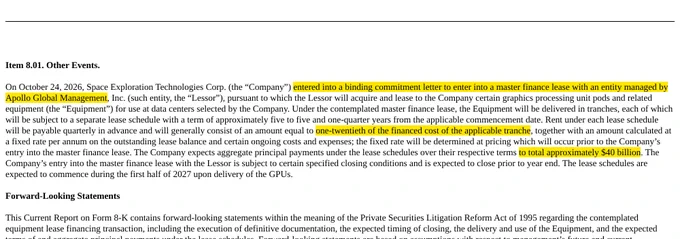
A lot of people ask me how a GPU finance lease works. SpaceX just signed the biggest GPU financing ever, about $40B with Apollo, so here it is step by step from SpaceX's own 8-K.
Step 1: the lender buys the GPUs. An Apollo-managed entity will buy NVIDIA Vera Rubin GPU pods and lease them to SpaceX for data centers SpaceX picks. SpaceX pays back the full cost over the lease, so it's really buying them on credit.
Step 2: the GPUs arrive in tranches. Each tranche gets its own lease of about 5 to 5.25 years, starting when it's delivered. The first are expected in the first half of 2027.
Step 3: SpaceX pays rent every quarter, in advance. Each payment is one-twentieth of that tranche's cost, plus fixed-rate interest on what's still owed. Twenty quarters is five years, so each tranche is fully paid off by the end of its lease. Across all tranches that's about $40B of principal, roughly $2B a quarter once everything is running.
Step 4: the money comes from the biggest pools of capital out there. Apollo leads, Goldman Sachs structured it, and BlackRock, Goldman Sachs Asset Management and KKR-advised accounts are anchors.
So why lease when you could pay cash? SpaceX's CFO says it's seeing payback periods of less than a year on its AI infrastructure. If a GPU pays for itself inside a year, spreading the cost over five keeps cash free to build faster.
And it's already spreading. The same day, Bank of America, Blackstone, Citi and Morgan Stanley put together a $63B vehicle that will buy Broadcom's custom AI chips and lease them to Anthropic.
The part I find most interesting is what the lenders signed up for. They're comfortable being paid back over five years, which says a lot about how long they expect these chips to keep earning. What is clear is that the biggest credit investors now treat AI compute as financeable infrastructure, and I think that's what keeps the buildout funded.
Show more

Gavin's right to see ROI on AI in these FT charts.
The three industries leaning hardest into AI (information, professional services and finance) went from a 2.2% productivity trend to 5.0% since 2022. The rest of the economy went from 0.9% to 1.4%.
The chart I keep staring at is the first one. In AI-adopting sectors, US output per worker breaks away from its 2012 to 2019 trend right after ChatGPT. The UK, Canada, France and Germany stay close to trend.
The counterargument is that this is just America's flexible labour market doing what it always does. I think the simpler explanation is that the US is where the AI spend lands first, and Gavin's point that America is 72% of Anthropic's revenue fits that.
If the first real productivity data shows up exactly where the tools get used most, it's hard to argue the buildout is running ahead of demand. I'd love to see the same cut by company size next
Show more


Hard for me to look at these charts from the FT, especially the first one, and not see some evidence of “ROI on AI.”
Seems like a productivity surge post-Covid era overhiring that began to reverse before ChatGPT came out and then resumed its upward trend after ChatGPT.
Especially given the @a16z data on revenue per employee at their portfolio companies and the @EPBResearch data showing that the 3 industries that have most heavily adopted AI have gone from 2.2% productivity growth to 5% productivity growth.
And makes sense that it is showing up in the US first - America is 72% of Anthropic revenue vs. 50%ish at most application software companies.
Great stuff from @jburnmurdoch even if I disagree with his conclusion.
Show more











