

Morgan Stanley Derivatives
@MgnStnlyDerivs
We partner with institutions, funds, and individuals to solve complex investment challenges with original thinking and proprietary technology.
0 Following 13.3K Followers
Thursday, November 5th, was a day of extremes:
•US long/short Hedge Fund net leverage declined by 5% day over day, the 5th largest single-day decline since 2010. Net leverage is now in the bottom decile since 2010.^
•Long/short fund active gross flow since June has amounted to a -10.7% reduction relative to their gross market value at the end of June, the most in at least 10 years.^
•Hedge Funds are now underweight AI stocks* relative to market cap weights, but AI is still a very large percent of absolute exposures at 32%.^
•Levered ETFs had the largest amount to sell on data going back to 2007, bringing $57bn of US equity supply.
•Retail selling of US equities in the first 90 minutes, based on MS QDS estimates using public data, was the second largest going back to 2016.
•Equities are now starting to trade in a more correlated fashion, often signaling that risk reduction is broadening out.
^Sourced from MS Prime Brokerage.
*AI stocks defined as the constituents of the MSXXAI Index, made up of AI tech beneficiaries, AI power names, and key hyperscalers
Show more


Today’s equity selloff is expected to create significant supply.
Levered ETF rebalancing today should create $52bn of US equity for sale if prices at November 5th, 1pm, hold through the close on MS QDS estimates – that’s second only to the $55bn sold on June 5th, 2026. Semiconductors will bear the brunt of that supply, where there should be $21bn for sale, with NASDAQ 100 seeing another $15bn for sale.
Show more

Yesterday we highlighted that the volatility market was pricing a small potential move in the S&P 500. The index ended up 1.6% on Nov 4th, well beyond the 1.2% move implied by the volatility market.
The Momentum factor* fell more than 6%, placing in the bottom 1% of all daily returns in at least a decade. Prior winners fell almost as much as prior losers rallied. Semiconductors fell below July lows while Consumer Discretionary outperformed Energy by over 9%.
Remarkably, the Beta factor* is down almost 3% despite the sharp rally in equities. This comes on the back of its worst month in 15 years, with Beta falling 22% in October.
YTD stats are striking. Beta is down 11% and Momentum 14%, while the S&P 500 is up 12%.
The simultaneous selloff in Beta and Momentum has echoes of July, but the drivers are different.
July was the worst month for Momentum in 15 years, driven by a positioning unwind as investors sold prior winners. October was the worst month for Beta in 15 years, driven by a broader macro shock as tightening financial conditions punished high-volatility stocks.
* Morgan Stanley Institutional Equity Division is measuring Momentum here as the performance difference between the top 200 outperformers vs. the bottom 200 underperformers of the Russell 3000 over the past 12 months with a 1-month lag. Beta is measured as the performance difference between the top 15% of liquid Russell 3000 members based on 6 and 24-month betas and the bottom 15% on the same metric.
Show more

Implied volatility markets are not pricing midterm results to be a big event.
The forward volatility market is implying just a ~1.2% move in the S&P 500 Index tomorrow. That’s below what was implied one day ahead of 3 of the last 4 midterm elections. And it’s below what the S&P 500 realized after the 2018 and 2022 elections.
Show more

Today marks only the 2nd day this year that retail investors have been net sellers.
MS QDS estimates, based on public data, that retail investors sold $1.4bn of US equities today — their first net sale since April. This is after retail has bought more than $1 trillion of ETFs and stocks YTD.
Show more

Corporates are coming to the rescue in European equities this fall.
European Equity volumes have seen the largest Sep/Oct dropoff since at least 2012 as market participants’ appetite for EU Equities drops.
But at the same time, corporates have rarely been as active buying their own stock: Sep was the 2nd largest month ever for EU buybacks ($28bn vs. a YTD average of $22bn, 2Y average of $18bn per month). M&A activity in European underliers is also the highest since at least 2015 – the market is on track for deals proposed/completed in 2026 to reach ~$300bn.
Show more


The unwind in Hedge Fund equity exposures this year has been the biggest since at least 2017.
Active de-grossing (reduction in long + short positions) by global hedge funds has now hit over 8% of total gross exposure since June, according to the Morgan Stanley Prime Brokerage Content team.
This has taken gross leverage for US long/short funds down to the 10th percentile versus the last year.
Show more

“The next generation of market leaders may not be today's largest companies. Smaller, more nimble businesses could have an advantage in adopting new technologies and reshaping entire industries.”
- @jvisserlabs | Head of AI Macro Nexus Research, 22V Research
These market dynamics were top of mind at @MorganStanley's Custom Baskets & Equity Derivatives Symposium on October 15, where more than 100 attendees gathered to hear from industry experts on the evolving landscape of thematic investing and tailored approaches to managing risk.
Show more


Join Morgan Stanley Institutional Derivatives and @RIAChannel on October 23 at 2 PM ET to explore institutional capabilities for RIAs and Family Offices.
Topics include concentrated stock strategies, thematic investing, QIS and tail-risk hedging.
Register:
Show more

At Morgan Stanley Equity Derivatives, deep, trusted, long-standing partnerships with the world's top investors are the hallmark of what we do.
Iliana Bouzali, Global Head of Derivatives Distribution and Structuring, sits down with legendary investor Stan Druckenmiller at the TomorrowX Summit on November 17-18 in Austin to explore macro, markets, the thinking behind the trades, and what the future may hold.
Show more

Taking the stage at @TomorrowXSummit: Stan Druckenmiller (@standuquesne), Chief Executive Officer of Duquesne Family Office, and Iliana Bouzali (@ilianabouzali), Global Head of Derivatives at Morgan Stanley (@MorganStanley) $MS.
November 17-18 at the Moody Center in Austin. Hosted with @GavinSBaker and @atreidesmgmt, @antoniogracias and Valor Equity Partners, @rbiscardi and @iconnections_io.
Registration link below.
Show more

In an AI world, the most valuable investing skill will be … “creativity." Justin Lubell of @Citadel talks conviction and the role of human judgment. Watch his full Break the Playbook conversation with @MorganStanley Derivatives.
Show more
The goal is “intellectual conviction as opposed to emotional conviction.”
@Citadel’s Justin Lubell joins Break the Playbook to discuss finding top talent, backing ideas with intellectual conviction, and why investing remains a deeply human business.
Watch the trailer:
Show more

Earnings season is here – will micro dynamics drive bigger moves? Options aren't pricing it. Across the Russell 1000, options price an average earnings move of 4.9% vs. 5.9% realized over the past 2 years. That gap is the widest since 1Q24 earnings season, with similar pricing across all sectors.
Show more


The rally in S&P 500 has the index hitting the peak dealer gamma wall of $24bn near 7845 in spot, per MS QDS.
But much of that dealer long gamma expires today. Absent new customer supply, that stabilizing force gets smaller, leaving the market freer to move.
Show more
What happens when you give RIAs access to Morgan Stanley’s Institutional capabilities? They unlock new UHNW growth potential. Over 40 RIA firms, including IEQ Capital, Corient and Mariner explored what’s possible with Morgan Stanley IP at this year’s Integrated Firm Summit for RIAs and Family Offices.
@RIAChannel
Show more

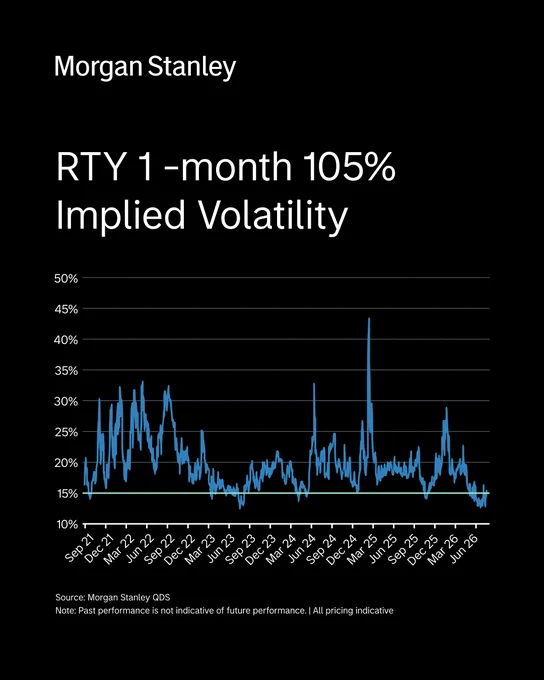
Oil is setting the direction of stocks – and the equity market isn’t priced for a rally in the event oil moves lower, at least in small caps: short exposure in Russell 2000 stocks is just off the highs, and 1-month 105% implied volatility on the Russell 2000 is in the 12th 5Y percentile.
Show more


Watch @davidein’s full conversation for Break the Playbook, a series from @MorganStanley Derivatives with investors who challenge conventional thinking. David talks everything from how he plays poker, the signal from macro and fiscal risks, the future of AI and more.
Show more
From poker investing lessons, to what he's changed his mind about, how he invests in AI, and the personality trait that has made (and lost) him the most money, @davidein and Iliana Bouzali cover a lot of ground in the next episode of Morgan Stanley Derivatives' Break the Playbook series. Full interview coming soon.
Show more

Watch @RickRieder's full conversation for Break the Playbook, a series from @MorganStanley Derivatives with investors who challenge conventional thinking. Rick discusses how he uses derivatives, lessons from past cycles, and why today is the most exciting market of his career.
Show more











