

Aethir
@AethirCloud
Powering the Future of AI. Building Decentralised Cloud Compute Infrastructure.
202 Following 673K Followers
The Aethir tokenomics update is live: the ATH burn dashboard is live, along with the first daily burns.
Each burn is funded by a share of the network fees customers pay to book compute.
In weak markets, the floating network fee falls and the burned share rises. It can never exceed Cloud Host rewards.
Every completed burn is publicly verifiable: daily, monthly, and cumulative totals plus full transaction history.
The full announcement, burn dashboard, and burn contract are below👇
Show more

The Anthropic S-1 is the first filing to price what it costs an AI lab to outrun its compute plan.
Q3: $5B of short-term compute, bought above multi-year rates. Compute rose to 58% of revenue, and the quarter swung to a $567M operating loss.
Labs book compute 12-18 months ahead. When revenue grows ~47% in one quarter, the gap gets filled at short-term prices.
Aethir runs 430K+ GPU containers in 94 countries, with 48-hour provisioning for selected GPU types.
ACCELERATE plans to build mid-sized data center capacity against signed demand.
Read our new blog to learn all the details👇
Show more

Chris Miglino, @AxeCompute's CEO, gave @Benzinga an exclusive interview on the outlook for AI infrastructure investment.

Axe Compute ($AGPU) CEO Chris Miglino spoke exclusively with @Benzinga on why AI infrastructure investment remains strong despite political shifts.
“I remain extremely bullish on AI infrastructure spending, regardless of the election outcome.”
Full article:
Show more


A GPU-hour is now a major industrial input, yet the market still has no reference price.
Buyers instead get vendor list prices that move without warning.
A single vendor’s price list reflects one company’s margin target, not a functioning market.
Aethir’s decentralized GPU cloud aggregates capacity across many independent operators, which is what real price discovery requires: multiple sellers, visible utilization, and a rate shaped by actual supply.
Show more

Aethir's co-founder, @MRRydon, dived into the future of compute demand and the growing need for accessible AI inference.

A few things from the Claude Fable 5.2 launch that tell you where compute demand is heading.
1/ One Anthropic engineer gave it an empty folder and asked for an operating system. It coordinated over 1,000 subagents working around the clock for eight days, and the OS boots on a laptop.
2/ A team of 1,000 Fable agents formalised Fermat's Last Theorem in 30 hours. Anthropic's first attempt took 11 days.
3/ Over 90% of the changes merged into Anthropic's core codebase are now written by Claude.
4/ Fast mode runs up to 2.5x faster at double the token price. Speed is now something teams pay extra for.
The unit of work is turning into a thousand agents running for days, and every one of them is burning inference the whole time.
Doesn't look like demand for compute is slowing down anytime soon. I think most people still underestimate how much inference this kind of work is going to need
Show more


An enterprise GPU fleet that sits idle between internal jobs is capital doing nothing.
Selling that capacity alone, to whatever buyer happens to show up, rarely covers the cost of finding one.
Aethir aggregates enterprise demand across 200+ locations in 94 countries into one pool, backed by 2+ billion compute hours delivered.
A Cloud Host joining that pool trades a scattered, occasional buyer for standing access to demand it could never reach alone.
Aggregation turns downtime into a revenue line instead of a sunk cost.
Show more

CoreWeave reported about 1.5 GW of active power at the end of Q2 2026, compared with roughly 3.7 GW contracted.
That is one of the strongest operators in the sector, and more than half of its contracted power was still waiting to run.
Across AI infrastructure, the headline number and the rentable number keep drifting apart, and buyers end up planning against the wrong one.
Aethir ACCELERATE is measured on capacity that goes live: We plan to deploy mid-sized sites designed to move from site selection to running B300 and GB300 clusters in months.
Count what runs.
Show more

A credit squeeze could make GPU access more expensive while making it harder to bring new GPU online
@SemiAnalysis_ sees tighter financing supporting rents. If that holds, existing players gain pricing power while new sites struggle to fund
Show more

We think tighter GPU financing is more likely to support rents than create a compute glut, because it slows new deployments while demand remains tight. (1/3)🧵

Hardware stocks sold off on data centre slowdown fears. Korea's chip exports tell the other story: demand is still expanding.
When the forecast swings, buyers need GPUs that are ready now. That's the gap Aethir fills.
Show more
A lot of AI hardware stocks got sold yesterday on worries about a data centre slowdown. Korea's export numbers tell a very different story.
Korea shipped $56.4B of semiconductors in October, up 259% on a year ago. That's nearly half of everything the country exported last month.
Most of it is memory, at about $50B. Computer exports, driven by AI servers and server SSDs, were up 497% to $5.85B.
Prices and volumes both stayed high as big tech keeps spending to stay ahead in AI. Total exports hit $115.3B, and Korea now expects to pass $1 trillion for the year sometime this month.
This is the closest thing we have to a live read on AI hardware demand. It lands on the 1st of every month, weeks before anyone's earnings call.
Stocks can have a rough day for all sorts of reasons. The chips are still shipping at record pace, and I don't see a slowdown anywhere in these numbers
Show more

The AI market is nervous about overbuilding and about who carries the financing risk.
So how do GPUs actually get paid for?🧵

A single-region GPU provider is a single point of failure for every agent that depends on it. When that region has a bad day, every workload pinned there has a bad day too.
Aethir spreads execution across 200+ locations in 94 countries, with real-time latency-based routing and automatic failover backed by a 99.99% uptime SLA.
Distributed placement gives a stateful agent somewhere else to land the moment one facility stumbles.
That resilience is built into how requests get routed from the first call, not bolted on after an outage.
Show more

What is a neocloud?
It's the GPU-first cloud that AI demand built, and it now carries a market worth more than $25B a year.
This is how it works🧵

Go-live is when a GPU cluster starts costing money, not making it.
A fully costed cluster breaks even somewhere between 55% and 65% once you account for three-year depreciation.
Depreciation runs from the day hardware arrives, and enterprise Kubernetes clusters average 5% GPU utilization, while Aethir’s GPU network runs at a constant 95%+ utilization rate.
Aethir ACCELERATE plans to build out data centers exclusively when demand is present, instead of searching for clients after the buildout is finished.
The ramp is the number nobody reports👇
Show more

How do GPUs actually get paid for? Mostly by the customer who signs.
On recent IREN 3-year contracts, prepayments covered 45-55% of GPU capex.
Investment-grade debt at ~6% took the Microsoft deal to 96% funded, with a ~2-year payback.
The biggest lenders agree.
SpaceX just signed a ~$40B GPU finance lease with Apollo, repaid over ~5 years.
Aethir ACCELERATE plans compute buildouts where demand already exists: mid-sized B300 and GB300 sites in the US and Europe, placed where Aethir already has demand.
Read our new blog to learn more👇
Show more

Buying GPUs is the easy part. Getting a cluster live on the date a customer was promised is the real job.
That's what Aethir is built around: compute that actually shows up, ready for training and inference.
Show more
The neocloud boom is the most exciting thing happening in AI infrastructure right now, and it's also where the gap between talking and building is widest
Every week I see another team announce they're "becoming a cloud". Some raised for a different idea and found that GPU capacity is the thing customers are actually paying for. Rental rates keep moving up, demand keeps outrunning supply and the capital is there, so it makes sense that people are jumping in
What a lot of new entrants learn the hard way is that the business barely lives in the GPUs. You can wire money for hardware in an afternoon. Then you need power that's actually contracted, a site with the right cooling, networking that holds up under real training loads, and a crew that can get all of it live on the exact date you promised your customer
That ready for service date is everything. A customer who signed for capacity in March has a model to train, a product to ship and their own investors to answer to. If you slip by two months, you've pushed their whole roadmap back
So the providers who win this cycle look a bit boring from the outside. They've brought clusters online before. They know the local electrician by name. They plan for the transformer arriving late and the permit taking longer than it should. They treat a delivery date like a promise to someone else's business
That's also what lenders and customers will pay up for. Plenty of buyers want to work with smaller and more flexible providers because the big clouds can't always give them the capacity, the timing or the price they need. That demand is real and it keeps growing. What they need is confidence that the capacity will actually show up
The long tail of compute providers is here to stay and it's healthy for the whole market. Over the next couple of years the ones who execute will pull way ahead, and the teams who can bring a cluster online on time, every time, are going to be worth their weight in gold
At Aethir we spend a lot of time on exactly this, because getting the compute to show up is the whole job
If you're building in this space, go hire the people who've done it before. They're the scarcest resource in AI right now
Show more
The neocloud boom is the most exciting thing happening in AI infrastructure right now, and it's also where the gap between talking and building is widest
Every week I see another team announce they're "becoming a cloud". Some raised for a different idea and found that GPU capacity is the thing customers are actually paying for. Rental rates keep moving up, demand keeps outrunning supply and the capital is there, so it makes sense that people are jumping in
What a lot of new entrants learn the hard way is that the business barely lives in the GPUs. You can wire money for hardware in an afternoon. Then you need power that's actually contracted, a site with the right cooling, networking that holds up under real training loads, and a crew that can get all of it live on the exact date you promised your customer
That ready for service date is everything. A customer who signed for capacity in March has a model to train, a product to ship and their own investors to answer to. If you slip by two months, you've pushed their whole roadmap back
So the providers who win this cycle look a bit boring from the outside. They've brought clusters online before. They know the local electrician by name. They plan for the transformer arriving late and the permit taking longer than it should. They treat a delivery date like a promise to someone else's business
That's also what lenders and customers will pay up for. Plenty of buyers want to work with smaller and more flexible providers because the big clouds can't always give them the capacity, the timing or the price they need. That demand is real and it keeps growing. What they need is confidence that the capacity will actually show up
The long tail of compute providers is here to stay and it's healthy for the whole market. Over the next couple of years the ones who execute will pull way ahead, and the teams who can bring a cluster online on time, every time, are going to be worth their weight in gold
At Aethir we spend a lot of time on exactly this, because getting the compute to show up is the whole job
If you're building in this space, go hire the people who've done it before. They're the scarcest resource in AI right now
Show more
Gartner sized the AI-optimized IaaS market at $42.2 billion for 2026, up 96.4% from $21.5 billion in 2025.
Inside that number, inference accounts for $23 billion against $19 billion for training, and inference share climbs to 59% in 2027.
The industry spent three years building for training and is now spending on serving.
Inference is continuous, latency-sensitive, and geographically distributed by nature.
Aethir's network was designed around exactly those three properties.
Show more

One update on the SpaceX GPU lease I walked through last week.
Fitch looked at the $40B commitment and left SpaceX at BBB+, because that compute was already in its forecast. It's treating the deal like any other equipment lease.
The numbers underneath are the part that got me. SpaceX had 1.7 GW of nameplate compute at the end of September, up from 0.6 GW a year earlier. Fitch's rating case assumes an average of 5 GW next year and 9.5 GW in 2028.
When a ratings agency models a near 6x jump in compute in about two years and keeps the rating where it was, I think the question of whether AI compute is financeable is settled. The next one is how fast everyone else copies the structure
Show more
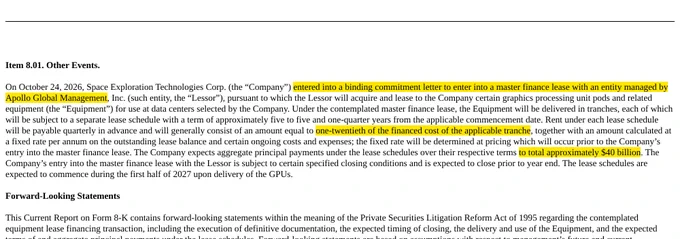
A lot of people ask me how a GPU finance lease works. SpaceX just signed the biggest GPU financing ever, about $40B with Apollo, so here it is step by step from SpaceX's own 8-K.
Step 1: the lender buys the GPUs. An Apollo-managed entity will buy NVIDIA Vera Rubin GPU pods and lease them to SpaceX for data centers SpaceX picks. SpaceX pays back the full cost over the lease, so it's really buying them on credit.
Step 2: the GPUs arrive in tranches. Each tranche gets its own lease of about 5 to 5.25 years, starting when it's delivered. The first are expected in the first half of 2027.
Step 3: SpaceX pays rent every quarter, in advance. Each payment is one-twentieth of that tranche's cost, plus fixed-rate interest on what's still owed. Twenty quarters is five years, so each tranche is fully paid off by the end of its lease. Across all tranches that's about $40B of principal, roughly $2B a quarter once everything is running.
Step 4: the money comes from the biggest pools of capital out there. Apollo leads, Goldman Sachs structured it, and BlackRock, Goldman Sachs Asset Management and KKR-advised accounts are anchors.
So why lease when you could pay cash? SpaceX's CFO says it's seeing payback periods of less than a year on its AI infrastructure. If a GPU pays for itself inside a year, spreading the cost over five keeps cash free to build faster.
And it's already spreading. The same day, Bank of America, Blackstone, Citi and Morgan Stanley put together a $63B vehicle that will buy Broadcom's custom AI chips and lease them to Anthropic.
The part I find most interesting is what the lenders signed up for. They're comfortable being paid back over five years, which says a lot about how long they expect these chips to keep earning. What is clear is that the biggest credit investors now treat AI compute as financeable infrastructure, and I think that's what keeps the buildout funded.
Show more

Jensen Huang said, "Agents think, reason, iterate, use tools, and as a result consume an enormous amount of tokens."
He's describing the exact problem Aethir addresses by combining our decentralized GPU cloud spread across 200+ locations and our ACCELERATE neocloud program, which plans to build mid-sized data centers across the US and EU.
Deploy GPUs and keep inference close to where compute demand is.
Show more

A measurement study published in March put a number on something practitioners have felt for a while.
Chain-of-thought prompting lifted accuracy sharply on hard tasks, and raised energy per answer by 120 to 150 times.
Majority voting added 72% to 177% for much smaller gains. Same deployment, same question, two orders of magnitude apart in compute consumed.
Any capacity plan that assumes a fixed cost per query is now wrong by default, sometimes by a hundredfold. The variance is in how the model thinks.
Show more












