

Ryan Dahl
@rough__sea
cofounder of @deno_land, creator of @nodejs. often goes by ry.
400 Following 47.3K Followers
celld now has pages for each of the services it supports. for example here's the docs for queues
celld v0.5.1 is released~
- Dynamic Workers can enforce CPU time and subrequest limits from WorkerCode.limits
- Support for Tail Workers
- KV accepts a ReadableStream value in put()
- Compaction can read retained LTX bundles after their segments leave the in-memory index, so a slow cell can continue draining its history.
- The /evict/| operator route reports a refusal, cancellation, or failure instead of returning success before the eviction completes.
- Node.js compatibility improvements
|
Show more

good article on celld's design

Deno celld - FOSS reimplementation of Cloudflare’s Durable Objects model on infrastructure you own


Last month I wrote about how we can build a positive and safe future for everyone:
Every lab has the responsibility and incentive to move at the pace required to train its models safely, and the ability to take its own actions to ensure that happens.
The reality is:
- People won't want to use agents that are misaligned with them and that don't do what they ask, so labs have a strong natural incentive to make their models more aligned.
There is a lot of debate about slowing progress on capabilities until alignment catches up. My view is that trust and alignment are quickly becoming the most important capabilities that will differentiate agents and models. Any lab that doesn't focus on alignment will fall behind.
- Labs face significant liability if their models cause harm, so they have a strong incentive to prevent this as well.
Meta delayed shipping Muse for several months to focus on safety and security. We didn't call for everyone else to do this before we would. We just did it as part of our day-to-day work because it was clearly the right thing for people and for us. I'm proud of the security foundations we've built.
- Engaging independent evaluators and advisors is industry best practice. MSL already does this today in several areas because it helps produce better work. Other labs can just do this too. In general, it would be helpful for there to be a larger and more diverse ecosystem of evaluators.
- Committing the significant majority of compute towards serving people rather than racing towards recursive self-improvement is one of the best ways to ensure we develop this technology safely. Meta has made this commitment and other labs can do this as well.
I believe the key to building a positive future for everyone is maintaining the right balance of power. This is within our power to do.
Show more
muse is shockingly good - they nailed the simplicity. it's quickly becoming my go-to for personal AI
does it run on celld tho...

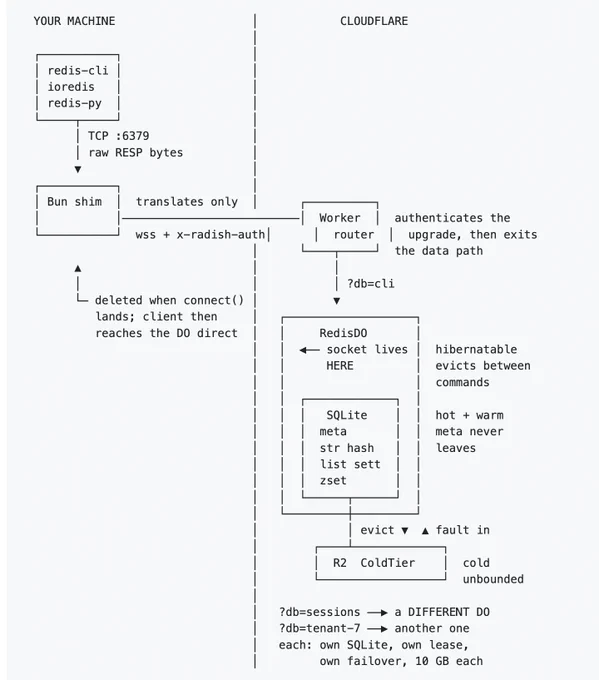
(re) Introducing Radish, it's a redis server completely inside a @Cloudflare durable object.
this weekend I did an experiment to see how good GPT-6 Astra and Fable are now, at systems and database design by revamping Radish (one of my old projects). it was terrible back then lol because i knew nothing about dbs. now that i know a little bit, worth a try!
Not prod-ready (ofc) and it's also a magnitude less QPS than a single node redis server, BUT
It's ACID compliant. It uses durable object sqlite as the hot storage and r2 as the cold storage beyond the 10GB mark. fully serverless!
It's multi-tenant so you can run a redis server PER USER!
Workers and DOs don't have inbound TCP connections yet (it's in their roadmap), but until then, it uses a bun shim to connect to the worker
I verified it using formal methods, also ran it against 200k commands on real redis and made it byte-identical in terms of responses, performance etc.
There's some very interesting things in there too (automatic multi-tenant isolation, unbounded by RAM, fully durable)
There's only two dependencies, @EffectTS_ and @alchemy_run. that's it.
Show more
10% chance of extinction indeed is ridiculous
here are my priors for various doom scenarios in next 10 years
p(extinction) = 0.0001
p(terminator war) = 0.0002
p(super covid) = 0.001
p(cyber attack that leads to >1k deaths) = .5
p(autonomous weapons used in war) = .9
p(>25% of white collar work disappears) = .9
p(mass fraud) = .99
Show more

The contagion of fear
Pacing will last until chinese models become sota
Dario's direction is laudable - I just think we're past the singularity event horizon, and that slowing down is no longer a choice
this is what 25 years feels like - a lifetime
An essay by @yusuktan (a deno/celld engineer) about how we use DST and TLA+ to find bugs in celld


I want to share how I have developed celld - because it's a bit different and it's working well for me. You might have noticed that the repo is pretty bare - this is because it's an export of a much larger private repo: denoland/celld.dev
This larger repo contains: an llm-wiki with an enormous amount of design docs, a large test suite, a spec written in TLA+, the code for the website, scripts for spinning up fleets of celld instances on various clouds and running tests against them, and a speculative centralized managed control plane that I might someday release as a commercial product.
My llm-wiki is modified to fit my workflow - diff here
I find llm-wiki extremely useful for gathering context. Reviewing wiki/design/ is a primary development activity.
celld is open source, but the development happens in private. The test suite and design docs are private. Why do this? First of all, I don't need the public following my every commit - it's oversharing. Secondly, in the age of coding agents, I don't really need external contributors. I'll always appreciate a patch, but most properly reported issues are one-shottable solutions. Third, it's just a bit of IP that might be valuable someday.
I do a lot of experiments with celld on Vultr with a VPC. I'll spin up between 2 and 10 VMs at a time, run some experiment, and usually try to tell some story via a chart of some sort (one below).
My own coding agent setup is ssh/tmux to mac mini, with various codex and claude sessions running. I don't use an enormous number - something like 2-4 at a time. (Why a mac mini? idk someone just gave me it)
Show more


Introducing Dactyl
Dactyl is a vibe coding platform for native iOS and native Android apps. What's interesting about it is the device simulator: we've built a SwiftUI renderer in WASM.
This means as you're developing, you get low latency in browser canvas simulation of the app to play with. Also things like oauth flows happen in the browser.
If the app uses the camera - the browser camera API allows us to display it in the simulator.
We also let you connect your ChatGPT subscription so you don't have to buy tokens through us (+ markup)
Through [magic] - we can run the same SwiftUI code the agent writes for iOS in android, with native components.
This is the work of @undefined_void (primarily), @piscisaureus, myself, and others at Deno.
It's built on Durable Objects perhaps unsurprisingly
Show more
I wasn't planning on it originally but implementing Workflows, Queues, KV on celld is pretty easy now that Durable Object primitive is working well.
it would be a little silly not to do it now...
experimental support for vector databases (via sqlite-vec) is supported in celld v0.3.0.
You have to specify a compatibility flag for it tho, since it's non-standard.

cron is supported in celld 0.3.0

Experimenting with celld in increasingly pathological situations. After merging the replicated write-behind log, this experiment had 4 instances of celld, each on its own machine, and round-robin kills them every few minutes to see how the fleet handles it.
Testing is done at a few layers: a TLA+ model, deterministic simulation testing, typical regression testing, and real life lab experiments like this.
Maybe some day I'll be able to experiment with it at discord scale :)
Show more

celld v0.3.0 is released. This version contains what (hopefully) will be the last major architecture change: a replicated write behind log.
I want celld to be scalable enough to handle a site like Discord. Every channel would be a cell. At an estimated 4B messages per day, before this release celld would be doing ~46k PUTs per second to S3. That equates to $600k/month in write ops alone.
In 0.3.0, celld doesn’t write to S3 on each message sent. It buffers before sending off to object store. Cutting it to ~300 PUTs per second, ~$4k per month.
But doesn’t that weaken the durability and correctness guarantee? In the new version of celld, writes aren’t ack’d until they’ve been persisted on three disks. And should a crash happen in the short buffer period, it can restore from peers. RPO=0, surviving even the loss of an availability zone. This is the replicated write-behind log.
Aside from the cost savings, writes get much faster: ~5ms instead of a ~50ms round trip to S3.
This latest release also includes support for the D1 database, crons, azure blob service, in addition to many bug fixes.
celld is effectively a database. We take correctness and durability problems seriously. The software is becoming more robust, but do keep in mind this is still a 3 week old project and is labeled as Alpha software. We’re making good progress and hope to raise that to a Beta standing soon. Your bug reports and patches are much appreciated!
Show more

celld v0.2 is released
- Telemetry support - with the ability to upload parquet files directly to your bucket (use duckdb to query!)
- memory usage per cell reduced from ~4mb to ~0.5mb
- support for wasm via workers-rs
- LTX compaction
- more node and web crypto APIs filled in
Show more


can someone ask ai to make rust target/ directories smaller












