
twyne
@twynexyz
Double your leverage on Aave | by tapping credit from others
14 Following 2.6K Followers

We wrapped up the evening with a panel featuring Open House founders, moderated by @hummusonrails.
Thanks to @xLiquida, @twynexyz, and @Saffron for sharing what they’re building, key lessons from scaling an early-stage startup, and advice for builders joining the upcoming Founder House Singapore.
One theme came up repeatedly - great products are built faster when founders have access to the right mentorship and support.
Show more


Can we use System One models for DeFi risk management? 🤖
Some of the recent Jev demos inspired me to point one at a workflow we use at @twynexyz.
When we want to understand the protocol's risk under different market conditions and parameters, we run an agent-based model. We let a bunch of simulated borrowers and credit LPs loose in the system and watch what breaks, and when. Seeing where and how it fails helps us make better calls on the core mechanics and on parameters like interest rates and liquidation thresholds.
Traditionally, these agents run on simple heuristics or hand-coded probability distributions: a fixed price expectation, some sensitivity to rates, a static risk appetite, a timer for how often they check their portfolio. It's cheap to compute and gives us some signal, but it's far from how people actually behave.
Real users aren't rational robots. They get scared, they get greedy, they copy their peers, they overreact to news and change strategy halfway through. Encoding that with explicit math gets messy fast.
So what if we described user archetypes in plain language instead, like "risk-averse borrower who watches sentiment" or "high-leverage borrower who reacts to macro news", and let a System One model make the calls? Agents could act on much richer context: what their peers are doing, their broader goals, even market-moving headlines. That could surface emergent behavior and feedback loops that are hard to encode by hand but could break the system in the real world.
For this first experiment I used @fastinoAI's GLiNER2.5-Decide, running locally on my MacBook Pro. It isn't trained for this kind of task, but it was good enough for a proof of concept.
In the video, three agents start with identical ETH vaults and ride the same synthetic rally and reversal. Same model, only the persona prompt differs.
Show more

@strata_markets PT-srUSDe offers 6.62% fixed APY through 22 October.
Lock in the current PT yield while it’s available. Use Twyne to increase your exposure.

New @strata_markets vaults are live on the @aave integration.
Use PT-srUSDe-22OCT2026 as collateral to borrow USDC or USDT, alongside the existing USDe pair.


Up to 11% APY on looping srUSDe with @pendle_fi and @aave.
Fixed rate on top. First-loss capital underneath. Plenty of available liquidity.

srUSDe is the protected exposure to Ethena yields, with multiple ways to maximize APY via @pendle_fi.
Loop PT-srUSDe on @aave for up to 20% APY.
srUSDe market has the deepest liquidity on pendle for USDe looping.
Delegated credit via @twynexyz extends that to up to 42% APY.
Fixed rate on top. First-loss capital underneath.
Show more


@twynexyz Tranche it. Fix it. Loop it.
62 days of PT-srUSDe / USDe loop at max leverage
Leverage: 11.57x -> 24.45x
Average APY: 14.45% -> 26.15%

Agree, loop on @aave. And if you use certain assets like PT-srUSDe, this entire class of problem disappears.
What happened this morning on morpho:
> 19 loopers liquidated.
> not because reUSD broke, it never moved.
So, @pendle_fi documents two ways to price a PT.
> A linear discount curve, which its docs mark recommended for money markets and collateral pricing.
> Or a TWAP on the PT's own market price, listed for integrations that need a live market read.
This market used the second, on a pool thin enough to push. Result?
> $320k of YT buys over nine minutes moved the mark ~2.8%.
> $37m of collateral seized, $946k paid in liquidation bonuses.
> The price was most of the way back within the hour.
> The loops were already gone.
Aave takes the first path, and doesn't read the PT's own market price.
> It prices the PT as a zero coupon bond: a linear discount decaying to par at maturity, on top of the underlying feed, with a ceiling fixed in the contract at deployment.
> No trade, at any size, touches your mark.
Take PT-srUSDe-22oct2026 as the case study.
> Discount rate 3.77%, ceiling 10.22%.
> With 57 days left, the deepest the oracle can mark you down is ~1%.
> Buffer at max borrow: 2.14%. $250m of USDe sits borrowable behind it, 9.9x max leverage, 37.72% max looping APY today.
Why PT-srUSDe you ask anon?
> @ethena runs the one of the most diversified yield engine onchain: basis trade, institutional lending, defi lending, rwa.
> srUSDe is the senior claim, junior capital takes first loss.
> Currently there's about $7.5M in junior sitting below senior
> That seniority is priced: 10.22% ceiling against 12.27% on PT-sUSDe, 93.36% threshold against 92.65%, same maturity.
> Fixed rate on top. First-loss capital underneath.
@LidoFinance's EarnUSD already runs this loop, extended through @twynexyz's delegated credit.
Show more

Checkout the blog article from @theRZLT to understand how Twyne's pushing the lending frontier!


The Lido EarnUSD Vault uses the @twynexyz leverage layer to securely double leverage on USD-denominated deposits across @aave, @pendle_fi and @ethena.
Transparent, efficient looping.
Show more

There's so much untapped potential to the interoperable nature of defi and one of the great teams tackling it. Huge congrats to @taulantxx and the team
Credit in lending markets is stuck with whoever deposited collateral. Half of the market has idle credit, the other half is in need of credit.
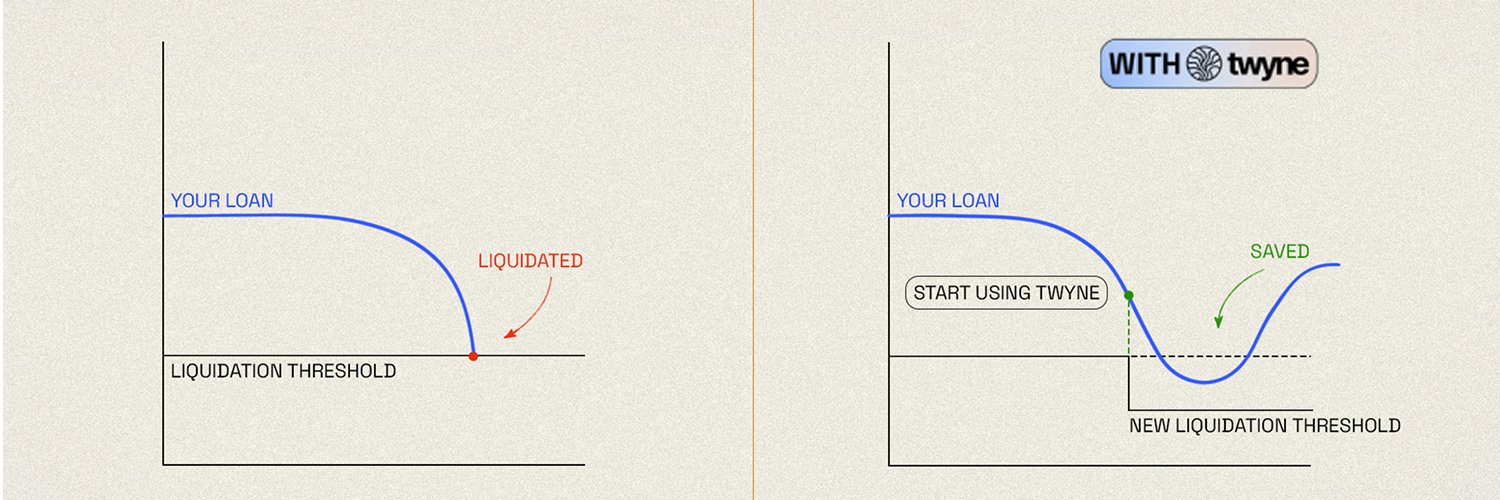
Proud to announce our seed round, co-led by @cyberfund and @etherealvc, to build the Credit Delegation Layer that connects them!
Show more

Reached $15M in deposits!
@strata_markets' PT-srUSDe loops are on fire!
- Creditors are earning: 6.09% APY
- Loopers are earning: 27.4% APY












