

Coreweave’s CRISIS is a GPU pricing problem.
$CRWV fell 23.7% this week asthe cost of insuring its debt hit a record (cc @amitisinvesting), implying roughly a 60% chance of default within five years.
But looking at the underlying assets and contracts, it's clear that the business of GPU financing is fundamentally uncertain. (1/)
Show more

Grind never stops

I pulled the fastest growing startups on X by follower growth over last 90 days:

Free alpha for compute buyers and sellers

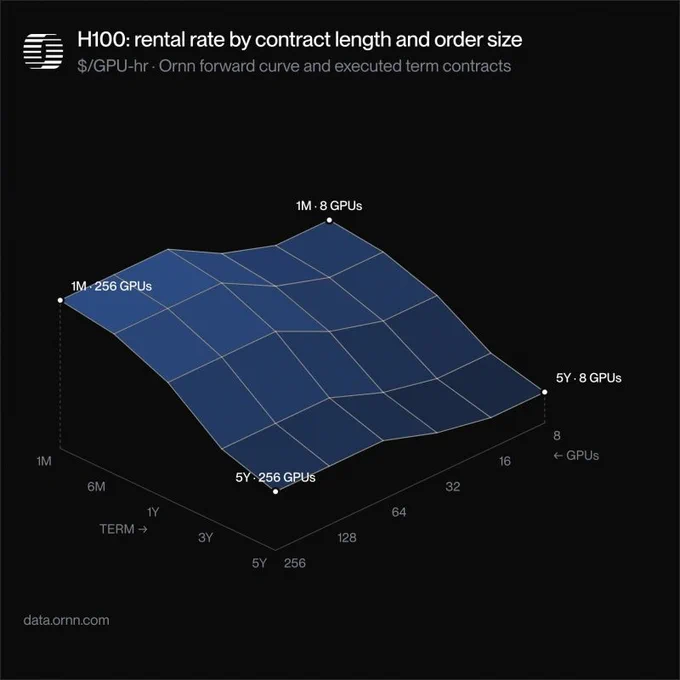
Using transaction data from long-term contracts, @OrnnExchange has modeled a price surface for GPU rentals as a function of order size and contract length.
The data shows a positive correlation between price and GPU capacity size, and an inverse correlation between price and contract length.
Now, what's the underlying reasons behind these trends?
1/ Small orders are filled from leftover capacity. As a result, sellers may discount it to maximize utilization.
2/ Big buyers are buying scarcity. A request for >1k H100s, etc clustered together has only a few vendors to choose from.
See the numbers at and rent your capacity at
Show more

The case for compute markets and compute indices begins with a growing imbalance: the ambition to scale AI depends on enormous commitments of capital, while the people financing that expansion face extreme market uncertainty.
Building lasting AI infrastructure requires a better way to understand, price, and share that risk.
Compute has become a strategic resource. Access to it shapes who can develop advanced AI, bring new products to market, and compete on a global stage. For companies and nations alike, securing reliable compute capacity is increasingly tied to economic opportunity and technological independence.
The opportunity we are attacking is building the market infrastructure that allows more people to participate in AI’s expansion with confidence. That means giving a developer greater visibility into future compute costs, an operator a stronger basis for planning capacity, and a financier a clearer understanding of the exposure they are taking on.
We have an opportunity to make the economics of compute more transparent and its risks more manageable. Doing so will support the next generation of AI infrastructure.
Show more
It's actually insane how fast Elon gets these clusters running.
Anotr 220K GB300s will be fully operational next week. Even according to Jensen Colossus 1 went from the first rack on the floor to training in 19 days.
They were told 24 months.
This one might be even quicker.
Show more


@minchoi Colossus 1 is 150k H100, 50k H200 and 30k GB200.
Colossus 2 is 110k GB200 and 440k GB300.
Another 220k GB300 will be fully operational next week and another 220k in November. If we get lucky, yet another 220k GB300 by late December.
Show more
Can the rental price of GPUs predict stock prices?
Ornn's A100 GPU rental index has led Astera Labs's stock price by about 5 weeks.
- The index's 20-day moves line up with ALAB's 20-day moves 25 trading days later (r = 0.74).
- Moved forward 5 weeks, the index tracks ALAB's price at r = 0.87 after removing the shared upward trend.
- It holds across the year, and it holds even after stripping out the chip sector's own moves or NVDA's.
Astera Labs makes the connectivity chips inside AI servers. GPU rental prices show how tight AI capacity is right now. The companies that sell into AI server build-outs are priced on that tightness after it shows up in orders.
Ornn prices compute where it actually trades. The signal shows up here before it shows up anywhere else.
Show more


Ornn's B200 Rental Index has reached an all time high.
B200s on-demand rentals are now transacting at an average price of $7.88 per GPU hour.


Neo-clouds will literally print money.
$NBIS’s on-demand price for H100s was $2.95/hour at the beginning of the year, and it’ll be $4.50/hour from October 1.
A 50% increase in just 9 months.
This will likely be reflected in long-term pricing as well. We could see long-term prices go from $10 billion per GW to maybe $20 billion.
It makes sense, as short-term, large-scale pricing is around $40 billion per GW.
Either short-term prices will come down, or long-term will go up.
The latter is more likely given the supply constraints.
Show more

Pretty clear that GPU depreciation schedules are too aggressive.
> $ORCL added more than 300,000 GPUs in Q1
> Utilization is at 97.9%
> Renewed capacity is priced 20% above the old contracts for 4+ year old GPUs
Not sure what other narrative is possible besides insatiable demand...
Show more

Oracle: “GPU utilization remains extremely high at 97.9% in Q1.”
$ORCL $NVDA $CRWV

This is compute commodification in a nutshell
Great post that explains how inference providers are the gas refineries of the 21st century.
Nscale’s S-1 highlights one of the biggest problems in compute.
Most of their $103.4B pipeline is wrapped up as future deployments. This means that value won’t accrue in the application layer for another decade.
> 461,000 GPUs active or contracted
> about 25,000 active today
> Weighted-average contract: 5.7 years.
Show more

Ornn's compute data is now available via MCP on both Claude and ChatGPT.
Accurate live GPU compute pricing is now more accessible than ever, only through Ornn.


At this point, inference is turning AI capacity into a distributed power market.
OpenAI and Anthropic are shopping for 20-30 MW sites because inference can be spread across locations that would never support a frontier training run.
That raises the value of smaller powered sites and makes hardware redeployability more important than campus scale.
> modular DCs
> distributed grid
> lower effective latency
Show more

OPENAI & ANTHROPIC HUNT FOR 20-30 MW AI CAPACITY IN UK, NORDICS
OpenAI and Anthropic are looking at smaller compute deployments across the U.K. and Nordics, with similar discussions also taking place in the U.S., per CNBC.
Anthropic has explored 20-30 MW deals in the U.K. and Nordic region, while OpenAI has been looking at opportunities in the Nordics.
The move would complement their much larger multi-hundred-MW and gigawatt projects by giving both labs faster access to powered capacity that can come online sooner.
These smaller clusters are particularly useful for inference, where AI workloads can be spread across multiple sites instead of relying on one massive tightly connected training facility.
That shift is becoming more important as more compute moves from training models to serving them in production.
JLL expects inference to overtake training as a share of data center capacity in 2027 and reach 37% of global workloads by 2030.
Anthropic already has a roughly $45B deal with Nscale for about 460 MW in West Virginia, while OpenAI has committed to several multi-GW Stargate projects across the U.S.
Source: CNBC
Show more


$NBIS's new rates sit 4 to 49 percent above what those chips rent for on OCPI, H200 closest at $5.40 against $5.19 and H100 widest at $4.50 against $3.03.
B300 has no rental price on the index, and the forward curve prices it at $7.45 one month out against a $9.50 list.
Show more
Anything that crypto did, compute can do better.
Crypto exchanges, crypto wallets and cryptocurrencies will be eventually replaced with compute exchanges, compute/token wallets, and compute as a currency.
Establishing the rails for compute today should be priority #1#.
Show more


Live rental prices, by accelerator:
B200 $7.09
H200 $5.40
H100 $2.72
RTX PRO 6000 $1.50
A100 $1.05
RTX 5090 $0.68
Each GPU is a separate market with its own supply and demand.
An hour of B200 costs 10.4 times an hour of RTX 5090.
See more:
Show more


Source: AI assistant Instinct seeks to raise $1B at a $10B valuation, up from $2.25B less than a month ago; Sequoia and Benchmark are in talks to lead the round (@pauvalida / The Information)
(Visit Techmeme dot com for the link and full context!)
Show more

Today we’re launching Keythorn.
AI isn’t just thinking anymore. It’s moving money, talking to customers, and taking action. Every new agent brings new risk.
The future runs on AI. We’re building the insurance for it.
Meet @TryKeythorn ↓
Show more

The same regulatory body that is supposed to act as a check and balance is somehow only incentivized to allow more unrestricted growth
This movie will win an Oscar

I have conducted an audit of Anthropic's finances.
What I have found is so shocking that I am calling for a Congressional investigation.
Anthropic is not just seeking regulatory capture.
It has built a regulatory capture machine that cannot be turned off.
Structural financial incentives make it impossible for Anthropic -- I call it the Anthropic Network -- to turn off its own AI doom cycle.
It starts with METR.
Dario Amodei proposes "third-party evaluators" to assess the risk of Anthropic's models.
He proposes METR for this purpose.
But METR is financially dependent on the Anthropic's success -- specifically, on the explosive growth of more than $7 billion dollars in Anthropic stock.
Dustin Moskovitz invested this stock into Good Ventures Foundation, where it represents the majority of that organization's portfolio.
And GVF is the overwhelming funder of the entire Anthropic Network ecosystem.
This stock was worth $500 million early last year.
It is worth more than $7.7 billion just ~16 months later.
METR -- and all of those building a career its parent organizations -- cannot afford to disrupt that growth.
Because if Anthropic goes under, many of the organizations that fund METR go under as well.
But if Anthropic succeeds, METR and its parent organizations become more richly financed to regulate AI -- something those at METR want very much.
The "third-party evaluator" is not "third-party" at all.
The evaluator is on Anthropic's payroll.
If this were the end of it, that's bad.
But that isn't all.
The same organizations that fund METR also fund the many organizations, such as the Tarbell Center, that promote AI Doom.
The Tarbell Center publishes AI Doom articles in The Verge, Science, LA Times, The Dispatch, TIME, and others.
They are selling the problem, and then selling the solution to the problem -- from the same money pile: Anthropic's.
All of these organizations are financially dependent on the same exploding $7 billion money pile.
As Anthropic grows more and more powerful, its AI Doom Machine grows better and better financed -- louder and louder.
Meanwhile, the regulatory regime seeded in METR grows larger to solve the increasingly loud -- now hysterical -- problem of AI Doom that the Anthropic Network itself created.
From this standpoint, as Anthropic becomes more powerful, AI might be getting scarier, sure -- but the positive feedback loop also becomes more deafening -- independent of objective facts.
This itself is an objective fact.
The deafening AI Doom is part of an business model, that, as it expands, so too does the AI Doom messaging -- there is simply more money to do it.
But the problem also goes in the other direction:
If Anthropic dies, the Regulatory Regime and the AI Doom Machine are crippled or die.
Neither METR nor Tarbell nor the other organizations in the Anthropic Network can allow that to happen.
Hence, neither METR or the AI Doom Machine can be trusted to provide independent assessments of Anthropic's models or AI more broadly.
They simply are not organizations independent of Anthropic.
And Anthropic cannot detach itself from METR or Tarbell or countless other safety orgs (not shown here), either, because they drive hype for the models and the possibility of eventual regulatory capture, and Anthropic will not give that up willingly.
What's more, the people at all of these organizations are all the same ecosystem, the same community. They just shuffle between organizations.
The Anthropic Network is therefore, so long as it is successful, locked into a self-amplifying feedback loop inside an ideological monoculture.
And that feedback loop is winning.
That's what Jacob Coxon is.
China is keeping messaging tight. That is why optimism for AI is so high in China.
America has Anthropic: a massive company pushing anti-AI propaganda at a state level.
Anthropic will either create hysteria until American AI slows down and China wins, or it will create fractures throughout American society with severe political consequences.
Ironically, because of the structural financial incentives underpinning the Anthropic Network, it has become the same kind of self-amplifying virus that it fantasizes AI to become in the future -- while hiding its tracks just as carefully.
It is the mirror of the same AI virus that it hypothesizes to consume America.
Anthropic's business model, models itself after the very thing it claims to fear.
Except Anthropic's ideology infects humans, not computers.
Congress must investigate.
Evidence and Github in next post.
Then some supplementary figures.
Show more












