Search results for TradingPsychology
TradingPsychology community
One keyword maps to one global community path.
People
Not Found
Tweets including TradingPsychology

The New Edge in Trading Psychology: How AI Is Your Greatest Ally: #TradingPsychology# #TraderMindset# #TradingDiscipline# #PerformanceMindset# #xBratAI#

Work-Life Balance: Preventing Burnout in the Trading World, see how: #TradingPsychology# #TraderMindset# #TradingDiscipline# #PerformanceMindset# #xBratAI#

The New Edge in Trading Psychology: How AI Is Your Greatest Ally: #TradingPsychology# #TraderMindset# #TradingDiscipline# #PerformanceMindset# #xBratAI#

Letting Runners Run in Futures Trading: Mastering the Psychology and Process, read full article: #TradingPsychology# #TraderMindset# #TradingDiscipline# #PerformanceMindset# #xBratAI#
Show more


Want to know the ultimate test of a trader?
Hint: It isn’t how much you make when the market is easy. It’s what you do after a devastating loss that completely defines your career. [02:39]
This month, one of our top trading desks at SMB Capital took a tough loss. They were long a position when an unexpected, intervening event dropped out of nowhere and hammered the stock.
The damage? Down over $3 million. [00:13]
In prop trading, that plunges a desk straight into what we call "the hole" [00:13]. Before these guys see another dollar of payout, they have to grind back every single dollar of those millions just to get back to flat [00:23].
Bad beats happen. Losses happen. It flat-out sucks, you feel it right in the pit of your stomach, and the pain lingers [02:32].
It is what you do after the loss that matters—not the loss. [09:10] The $3M deficit matters very little in the long run compared to how the team and its individual contributors respond right now [02:49].
In our latest video, I broke down the exact 6-step blueprint this elite desk is using to climb out of their hole [03:26]:
1. Run a Forensic AAR (After Action Report): Stripping emotion from P&L [03:42]. The team leader didn't bury the loss in a large pepperoni pizza and a bottle of red wine [04:47]. He delivered a candid, constructive autopsy: owning his mistakes, analyzing hedge execution, and praising the quick-thinking put purchases that saved another $2M in damage [04:20].
2. Collaborate Across the Desk: As Ray Dalio observed, viewing the market through one pair of eyes means missing critical information [05:04]. On our desk, an impressive junior 7-figure producer respectfully pushed back on the star's self-critique, arguing the entry add was technically sound and purely hit by an exogenous intervening shock [05:32]. That open debate is where real edge compounds [06:01].
3. Bring the Trade to the Firm Crucible: The desk brought the trade to partners, risk managers, and mentors like @theonelanceb [06:13]. Risk reviewed limits, senior partners coordinated tech solutions for faster news execution, and coaches challenged the floor [06:23]. A painful rip becomes rocket fuel when your entire firm has your back [06:50].
4. Chip Away with One Good Trade: As Market Wizard Marty Schwartz famously said, greatness isn't hitting home runs; it's stringing together singles and doubles [07:02]. No desperate YOLO swings. The team leader set the tone: "I am just going to chip away at these losses." One Good Trade. And then One Good Trade. And then One Good Trade [07:25].
5. Grounded Veteran Optimism: As Colin Powell noted, "Perpetual optimism is a force multiplier." [07:49] The senior leader reminded the desk that drawdowns are temporary, he's clawed out of every hole before, and each slump made him a better trader [08:09]. Veteran leadership eliminates panic [08:26].
6. Game Plan High-Conviction Catalysts: Don't predict—anticipate [08:37]. The team mapped out high-opportunity environments ahead (like the Anthropic IPO and potential Q4 momentum) to deploy asymmetric risk when the setup aligns [08:48].
The market will knock you down, but your career isn't defined by the brutal blow—it is defined by the grit, discipline, and character you display when you stand back up.
It is what you do after the loss that matters.
#DayTrading# #PropTrading# #SMBCapital# #TradingPsychology# #OneGoodTrade#
How to Recover from a big loss (as quickly as possible) via @YouTube
Show more
In our latest video masterclass👇, I pulled back the curtain on the 12 Keys to Becoming One Great Trader.
Watching our prop desk at SMB Capital develop homegrown 7- and 8-figure traders from scratch since 2005 taught us one undeniable truth: Market Wizards aren’t born—they are built, brick by brick.
1. Love the Game: You can’t fake an obsession. On our desk, guys talk trading on the way to the gym, over breakfast, and all day long. Max will talk trading through nine innings at a Yankees game. If you don’t genuinely love the craft, you will never survive against the people who do.
2. One Good Trade: Stop obsessing over daily P&L. Before you ever touch the keys, learn how to construct an asymmetric risk-to-reward trade in a Stock in Play with a real catalyst. One Good Trade. And then One Good Trade. And then One Good Trade.
3. Study & Build Real Edge: Saying "I like breakouts" isn’t an edge—it’s just a sentence. As Dan G tells our interns every summer: go find who is making money on the desk and study what they do.
4. Run Unshakeable Daily Best Practices: Amateurs wing it; pros run a structured daily process. Run your pre-market game plans, complete your PlayBook, log your Daily Report Card (DRC), and backtest relentlessly.
5. Culture: Figuring out computerized markets alone takes years longer and costs a fortune in "tuition"—otherwise said: painful, avoidable trading losses. Surround yourself with traders who hold higher standards than you do.
6. Collaborate Relentlessly: Our top trading pod pulled in ~$50M in 2025 because they trade as an integrated team pod. They game plan A+ setups together, hold each other accountable, and check blind spots. Collaboration expands your P&L exponentially.
7. Be Bionic: You cannot track modern markets manually. Build custom scanners, scripts, alerts, and leverage AI workflows to play more offense.
8. Bring Your Best "You" to the Screen: You can’t extract millions from the market with brain fog and an exhausted body. Sleep, nutrition, workouts, and mindfulness aren’t lifestyle luxuries—they are non-negotiable risk management tools.
9. Patience: Everyone wants an 8-figure year on Day 30. One of our all-time top producers didn't hit his stride until Year 3, and last year he posted his third 8-figure year. Give yourself the runway to become One Great Trader.
10. Trading Psychology: This is so misunderstood, and we explain how in the video.
11. Resources: Talent and ambition alone aren't enough. Elite performers need buying power to scale, dedicated coaching, proprietary tech, and senior traders in their corner.
12. Talent: You can’t play running back in the NFL without elite speed and strength. In active discretionary trading, raw cognitive horsepower matters. Your job is to maximize whatever natural processing speed you possess.
You can write your own Market Wizard story with these 12 keys👇—and become One Great Trader 👊!
#OneGreatTrader# #OneGoodTrade# #DayTrading# #PropTrading# #SMBCapital# #TradingPsychology#
One Great Trader: The 12 Keys to Market Greatness via @YouTube
Show more

STOP SETTING SMALL TRADING GOALS!
Want to know the most dangerous mistake ambitious developing traders make when setting career goals?
Hint: It isn’t aiming too high. It’s setting the bar way too low.
Let me share a story from our prop desk.
During a recent monthly review with Team Max, one of our traders announced his numbers: he pulled in $1 million in net trading profits in August.
When he first sat on the desk, his lifelong dream was to make $1 million in a year. Last month, he did it in 21 trading days.
Max had an even better month, and I wanted to get his reaction to his monster performance.
After the meeting, I reached out to Max directly on Gchat:
Me: "You ever think when you were starting you would make 2m plus in a month?"
Max: "Def not lol"
A couple of years back, we actually kicked around the idea of publicly tracking Max for the trading community to see if he could break $1M in a month. At the time, he hadn't broken this level yet. We ended up scrapping the project as we were worried it would focus on the wrong things. Fast forward to today: Max cleared over a couple of million dollars last month alone and is heading into his second consecutive 8-figure year. For him now, a million-dollar month isn't even close to the benchmark he aims for.
Yet during that exact same review, a couple of our younger traders who made solid six figures were lamenting their month. They felt dejected comparing their numbers to the seven-figure producers on the desk. Three years into their careers, an outcome that would stun 99% of independent traders felt unsatisfying to them.
That psychology reveals a critical truth about trader development:
Arbitrary P&L Goals are Self-limiting: When you fixate on a dollar target early in your career, you anchor your ceiling to who you are today—with your current limited skills, risk tolerance, and PlayBook.
The Process Multiplier: When you double down and triple down on your daily process, build technology, trade alongside elite traders, collaborate, and push size on your A+ setups, your growth becomes exponential. Your early career goals end up looking comically small in the rearview mirror.
Happy, But Never Satisfied: As Chris Mullin, former NBA Hall-of-Famer, used to say, and as we preach to our desk constantly. Even after pulling millions out of the market, this desk spent the meeting dissecting where they left money on the table: leaving 25% on the Bitcoin breakout, breaking down what worked on MRNA, and focusing on pumping the brakes during low-opportunity tape.
Trading can be a tough game at the start, but the upside is limitless when you stop capping your potential.
Don't let arbitrary dollar targets limit what you can accomplish. Double down on your process, surround yourself with peers who raise your standards, pump the brakes during slow markets, and aggressively press your A+ setups.
Your ceiling is far higher than your wildest imagination.
#Trading# #DayTrading# #SMBCapital# #PropTrading# #TradingPsychology#
Show more


One of the most important elements in trading psychology is resilience. The ability to not only absorb loss but gain from it is a hallmark of peak performers: @basso_tom @InvestorsLive @TomHougaard
Show more


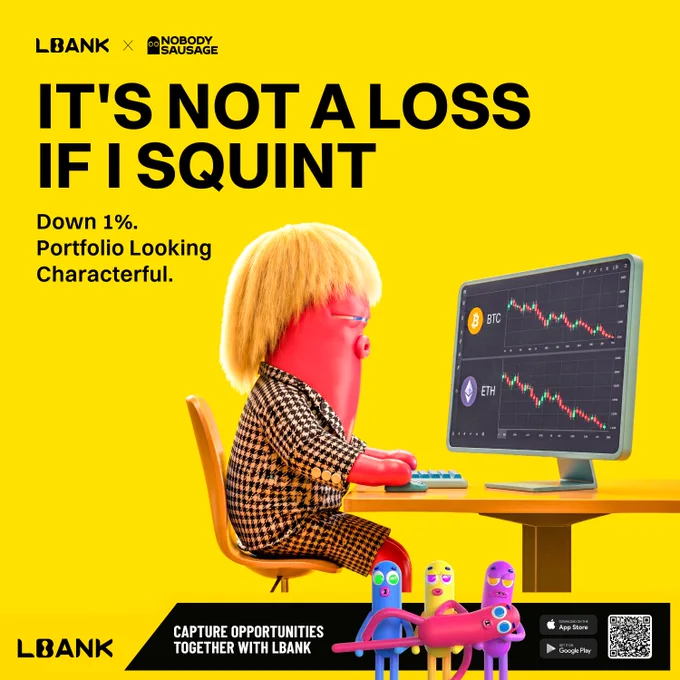
Red portfolio.
Positive mindset.
That’s basically advanced trading psychology 😭👇
#LBank# #LBankxNobodySausage#

Video popped up on my feed:
“You’re not profitable because of what you do outside of trading.”
Lads, the psychology slop genre has gone too far.
I can put a Buddhist monk in front of a terminal - he’s generally not gonna make any money.
You need some sort of edge, strategy that’s +EV, or even a broad idea of a market effect that you’re trying to monetise.
There has to be a sensible foundation for the actual trades you take, and then ‘psychology’ can help with reducing unforced errors.
Most of the trading psychology stuff is cope; it allows you to focus on breathing exercises instead of confronting that your clicking is completely random.
Show more