Search results for aiengineer
aiengineer community
One keyword maps to one global community path.
People
Not Found
Tweets including aiengineer

I'm in San Francisco this week for the AI Engineer World's Fair 2026, presenting drft at the Startup Battle.
drft is the judgment layer for revenue: dependable decisions for your sales team today, and for the agents running revenue tomorrow.
We're also hosting Agentic After Hours with @theaievangelist and @buildifyclub , an evening for founders, operators, GTM and revenue leaders, and AI builders to get into it: agents, sales, and where revenue teams go next. Drinks and food on us.
📆 July 1, 2026 ⏱️ 3:30 to 7:00 PM 📍 San Francisco (venue shared on registration)
Capacity is limited and registration needs approval, so grab a spot early 👇
If you're at the Fair, come find me. I'd love to show you what we're building and hear what you're working on.
#AIEngineerWorldsFair# #AIAgents# #RevenueOps# #Sales#
@nikhilsapra_ @buidloor
Show more


🔍 A DeepSeek Harness Plugin That Lets AI Explain the Agent's Own Trace
Less than two weeks after DeepSeek Harness entered developer preview, its plugin ecosystem is already taking shape.
Zhihu contributor 刘琦 built DSH Trace Insight, a focused plugin for one of the most important but overlooked parts of Agent engineering: understanding what an Agent actually did.
1️⃣ DeepSeek Harness exposes the process
Many Agent harnesses behave like black boxes. Users provide a task, wait, and eventually receive an answer.
DeepSeek Harness is different. Its trace records tool calls, execution steps, failures, retries, and other intermediate activity.
This makes the Agent more transparent, but the raw trace is stored as a large JSONL file. Even with filtering, it is difficult for a human to read and reconstruct the full process.
The author's idea was straightforward:
If the trace is too complicated for humans, let another AI interpret it.
2️⃣ Turn raw traces into readable analysis
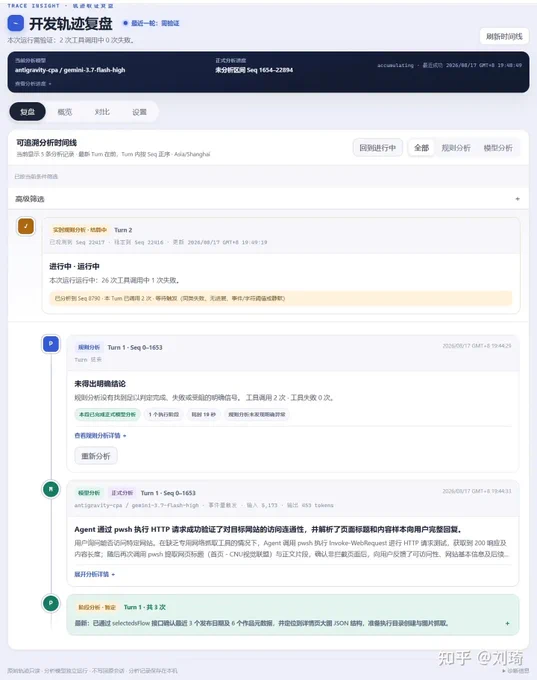
DSH Trace Insight adds a side panel that asks an AI model to explain the running trace.
It can summarize:
🔹 What the Agent is doing
🔹 Which methods and tools it used
🔹 Where errors or retries occurred
🔹 Whether any risky actions appeared
🔹 What lessons can be extracted from the run
Instead of waiting beside an opaque progress indicator, users can inspect how the task is progressing, whether the approach is working, and how risky the current behavior looks.
The goal is not to add another capability to the executing Agent. It is to add an interpretability layer around the Agent's behavior.
3️⃣ Use two models for cross-checking
When a suspicious step appears, the plugin can send the same trace to two different AI models and compare their analyses.
This is useful because trace interpretation is still a model-generated judgment. A second model can expose disagreements, missed risks, or different readings of the same tool call.
The plugin can also organize detected issues into a compact list for manual review.
That creates a useful three-layer workflow:
Agent execution → AI trace analysis → human review
It is a lightweight approach to Agent observability without requiring users to inspect thousands of raw log lines.
4️⃣ Installation is intentionally simple
The plugin is open source under the MIT license:
Users can ask their Agent to install it directly with:
Please install this DSH plugin:
The current version is designed for the native DeepSeek Harness Web UI.
Using it inside third-party desktop wrappers may require additional development, since those clients may package or modify the original Web UI differently.
5️⃣ DeepSeek Harness can become a model worker behind Codex
The author also suggests an interesting setup for people who do not use DeepSeek Harness as their primary Agent interface.
Open the native DSH Web UI inside Codex's browser. Codex remains the main harness, while it operates DeepSeek Harness and the models connected to it.
This creates a layered workflow:
🔹 Codex handles planning and orchestration.
🔹 Lower-cost non-GPT models inside DSH perform lightweight tasks or code inspection.
🔹 DSH Trace Insight exposes how those models executed the work.
🔹 Codex can discuss the results with DSH across multiple rounds, then send the final conclusion to another strong model for an additional review.
Compared with assigning every subtask to an expensive model, this setup can reduce cost. Compared with calling another CLI tool blindly, it provides much better visibility into execution.
✅ The real value is observability
DSH Trace Insight does one thing: it translates an Agent's raw execution history into something humans can understand.
That simplicity is its strength.
As Agents begin running longer tasks with more tools and greater autonomy, the important question is no longer just whether they produced the correct answer.
We also need to know how they reached it, what failed along the way, and whether they crossed any risky boundaries.
🔗 Full Reading:
#DeepSeek# #DeepSeekHarness# #AIAgents# #AgentObservability# #OpenSourceAI# #AIEngineering#
Show more




TL;DR: Same Claude Opus, no harness → $9 outcome in 20 minutes. Same model, full harness → $200 working product in 6 hours. This open-source curriculum teaches why — systematically.
learn-harness-engineering
"The model is smart. The harness makes it reliable." — 14 lectures and 8 projects covering harness engineering for AI coding agents. ⭐️ 13.7k
Key points
🔧 5 subsystems form the harness skeleton
· Instructions: AGENTS.md and structured guidance make the repo the single source of truth
· State: claude-progress.md + git history enable multi-session continuity
· Verification: tests, lint, E2E pipelines prevent false completion claims
· Scope: explicit completion criteria enforce one-feature-at-a-time progress
· Session Lifecycle: init → implement → verify → commit → handoff as a structured protocol
📚 Progressive learning path
From fundamentals (seeing the problem, structuring repos) to advanced patterns (automated loops, graph-based workflows, Human-in-the-Loop). A shared Electron knowledge-base app provides hands-on practice at every stage.
⚡ Instantly applicable to existing projects
Copy AGENTS.md, and feature_list.json from the template library into any project root for immediate structured context and scope constraints. The zero-dependency diagnoses harness quality on the spot.
🌐 Current frontier harness designs included
Breakdowns of Pi, Claude Code, Codex, and DeepSeek harness architectures (added August 2026), plus loop and graph engineering lectures with templates (July 2026) — the course continuously reflects real-world practice.
The shift from "prompt the agent better" to "design the environment for reliability" is what 13.7k engineers are endorsing here.
#CodingAgent# #AIEngineering#
Show more

✍️ Now that AI can write hundreds of syntactically valid lines per second, the developer's job has shifted from "writing" to "reading and verifying." That shift changes what we should want from a programming language.
Why Go is an Ideal Language for AI-Assisted Software Engineering
🔍 Overview
Google's Go team makes the case for Go as the ideal language for the AI-assisted development era. As the bottleneck moves from code generation to review and verification, the language properties that matter most have flipped — readability and maintainability win over writability and expressiveness.
⚠️ The Problems Being Solved
・LLMs frequently hallucinate type mismatches and non-existent properties
・Dynamically typed languages (e.g. Python) only catch these errors at runtime
・AI-generated code often pulls in stale packages or vulnerable dependencies
・Repeated refactoring passes degrade accuracy (~95% first-pass, declining)
🛠 How Go Addresses Each
・gofmt enforces uniform formatting — AI output is always syntactically predictable
・Static typing + fast compilation: rejects errors instantly, orders of magnitude faster than Java, C#, or Rust
・govulncheck: low-noise vulnerability scanning targeted only at invoked symbols
・Native fuzz testing: continuous discovery of boundary-condition bugs
・15 years of strict backward compatibility: Go 1.0 code runs unchanged today
📌 The Counterintuitive Conclusion
"As developers write less code, language choice becomes more critical." Absorbing AI's high-velocity output safely requires deterministic guardrails — and Go was designed for exactly that.
#Golang# #AIEngineering#
Show more

🚀 An ebook that takes FastAPI from your first endpoint all the way to production-scale AI systems — going deep on LLM/RAG serving, with interview questions at the end of every chapter.
Title: FastAPI for AI Engineers: From First Endpoint to Production-Scale AI Systems
URL:
🚀 Overview
A practical guide (First Edition, 2026, by AI Engineering Insider) for AI engineers serving ML models and LLM/RAG systems in production with Python. It spans 10 chapters and 100 interview questions, woven with real-incident case studies and cost-model sidebars.
❓ Challenges Solved
・Building a model is one skill; serving it safely as a scalable production API is another
・LLM/RAG serving has its own hard parts — streaming, guardrails, cost control
The book reframes FastAPI as "the de facto serving layer for AI and ML systems."
💡 Structure & Tech Covered
・Foundations: ASGI/WSGI, Uvicorn, OpenAPI, and Pydantic v2 schema separation and validation
・Implementation: idempotency, meaningful status codes, pagination, and the Router→Service→Repository clean architecture
・DB/Security: SQLAlchemy/SQLModel/Alembic, N+1, pool sizing, JWT, BOLA defense, OWASP API Top 10
・Async: "never block the event loop," def vs async def, and httpx retries/circuit breakers
🎯 The Core (Ch.9: AI/RAG/LLM)
・Load model weights once in lifespan; offload CPU inference to a thread
・An LLM gateway centralizing auth, prompts, guardrails, and cost metering, with SSE token streaming
・Build RAG with embeddings + a vector DB (start with pgvector); validate output with Pydantic, then retry on failure
・Enforce max_tokens as a "spending limit" via the type system
📊 Highlights
・Practice-first, learning from real incidents (Netflix, Stripe, GitLab, Optus, Air Canada)
・Ch.10 covers Gunicorn+Uvicorn, K8s liveness/readiness, the three pillars of observability (p99 vs p50), and SLO-based alerting
#FastAPI# #AIEngineering#
Show more

AI Engineer Paris is one week away!
A huge thank you to all our incredible sponsors for making this special event possible: @nvidia @FactoryAI @sentry @CockroachDB @SonarSource @NotionHQ @SierraPlatform @Cloudflare @neo4j @daytonaio @qdrant_engine @modal @langfuse and more!
Show more

AI Engineer Code Summit is headed home to San Francisco on Nov 10-12, presented by @GoogleDeepMind and supported by @g2i_ai
Bringing together hand-selected engineers, technical leaders, researchers, and power users building the next generation of AI-powered software development for 3 days of deep technical conversation and hands-on learning.
Early bird tickets are available for a limited time!
CFP applications and sponsorship opportunities are open at
Show more


At AI Engineer Paris today
Be warned, I have grown a beard and I am 188cm tall
So if you see someone who kind of looks like Matt Pocock, that's me

DeepSeek AI engineer slams Anthropic, OpenAI over ‘pacing’ calls, invokes Nazi Germany

🚀 AI Engineer Paris is back! Join 1,000 AI engineers, CTOs & VPs of AI on Sept 23–24 for 65+ technical talks and hands-on workshops.
🔥 Speakers are live! Dive into the lineup on
🎫 <100 Regular Bird tickets left. Grab yours before they're gone.
Show more
