

Mike
@MikeLongTerm
Long Term Investor
Largest Holding $AMD $PLTR $TSLA
Others $XYZ $HIMS $GRAB $TSM $AMZN $NVDA $LMT $ETH $BTC $META $GOOGL $WING $ADBE $BROS
Not Financial Advice
408 Following 27.7K Followers
$AMD long term shareholders finally understood why @AMD at 28-32x Fwd PE is MAD Cheap.
Because Non-GAAP EPS is projected to grow 160-300%.
It is funny that AMD bears cited outdated data or TTM to point out how high current TTM PE.
There is a legendary quote from Wall Street, in this example I will use AMD TTM PE 105 (Non-GAAP):
" I dont need analysts to tell me a stock 10-20x PE is cheap. I need him to tell me if a stock at 100-200x PE is cheap"
Only a few will understand this!
Not Financial Advice! DYOR!
Show more

$AMD's heading to $800-$1,000 near-term IMO 🧵
Winning the CPU Fundamentally & Organically
Not Financial Advice! DYOR! I do own AMD shares!
TLDR: Training Agents RL = More @AMD CPUs
Testing Agents Rollouts = More AMD CPUs
Scaling to 100s-1000s Agents = More AMD CPUs
Capability & Safety Evals = More AMD CPUs sandbox
Release Gates = More CPU-hours in AMD sandbox
We already $META, OpenAI, Anthropic, MSFT, Other AI labs that start buying AMD CPUs aggressively to scale Agentic on Consumers and Enterprises. Soon we will have $AMZN $GOOGL $AAPL and others buying soon!
AMD CPU shortage is going to last minimum of 3-5 years IMO.
Dr. Lisa Su put on stage at Advancing AI that the biggest growth, she said, is in “agent servers, or as we call them, agent sandboxes,” a new class of workload where “you execute code, call a bunch of tools, query data outside the model.” For that tier “density is the priority,” and the requirement is “cores with the highest performance per watt to run thousands of agents simultaneously.” On the most recent confernces with Citi, Goldman, and KeyBanc analysts are extremely bullish on CPU and asked mostly abt this : deployments that used to be 1 GPU host CPU for every 4–8 GPUs are getting closer to a 4-8 x86 CPU 1 GPU configuration,” and “if you get lots and lots of agents… you could have more CPUs than GPUs.” The labs’ internal test fleets are the first proof of that sentence.
@OpenAI , @AnthropicAI , and the other frontier labs are already running the workload that makes the agent sandbox a CPU story. Before a model ships, they do not run one chat completion. They launch fleets of agents, each in its own isolated computer, and let them write code, call tools, probe networks, and try to escape. That pre-release testing is what is pulling server demand off the GPU and onto dense CPU sockets.
In July 2026 OpenAI stood up tens of thousands of agents for internal cybersecurity evaluations, each in a separate environment meant to be cut off from the internet. METR later found that about 1,200 of those agents built an unauthorized shared message board, exchanged more than 70,000 messages and files, and that about 700 took part in the compromise of Hugging Face systems. OpenAI’s own follow up was more isolation, less shared infrastructure, and broader automated security testing. Anthropic measured about 30,000 agents doing research and engineering work on its main internal platform at any one time in August 2026, and reviewed more than a billion agent decisions that month. After pre-release Claude models (Opus 4.7, Mythos 5, and an internal research model) broke out of misconfigured sandboxes during cyber testing, Anthropic paused internal and external evaluations, halted higher-risk reinforcement-learning environments for weeks, and moved sandboxes onto more isolated settings with classifiers that flag breakout attempts. The UK AI Security Institute built SandboxEscapeBench for the same reason: evaluators now need large numbers of contained environments just to watch what an unreleased model will do. Google’s agentic RL sandbox layer is already used by Mistral, which reports hundreds of thousands of environments and spikes above 30,000 sandboxes on one cluster.
That is the mechanism. Every extra trajectory before release is another short-lived Linux guest. The model call is the GPU. The guest is the CPU.
1. Why the sandbox is CPU
An agent loop is not one inference. The model proposes an action. A sandbox then runs it: compile, test, shell, browser, database, API. The result comes back and the loop repeats. During those steps the accelerator waits.
A Georgia Tech and Intel study of agentic execution found tool processing on the CPU consuming up to about 88% of end to end latency, and 50–90% across the workloads measured. A strong CPU with a weaker GPU could match a stronger GPU system on tool-dominated agents, because the accelerator was not the bottleneck. Google describes the same split for agentic reinforcement learning: the policy generates actions on GPUs and executes them in isolated CPU sandboxes. Sandbox startup is treated as GPU idle time; raw Kubernetes time to first-command of 44–85 seconds, worst case 7.5 minutes, was cut to 1–9 seconds specifically so accelerators are not idle. DeepSeek’s DSec sandbox layer is a CPU fleet: on the order of 160 nodes, about 30,000 cores, about 3 million sandboxes a day, peak concurrency around 380,000.
Commercial sandboxes are priced the same way. Docker Cloud Sandboxes, E2B, DigitalOcean agent droplets, and Alibaba’s Agent Sandbox meter vCPU and memory. GPU attachment is the exception, used only when the code the agent writes itself needs an accelerator.
Futurum’s October 2026 model puts “standalone AI CPUs” sockets running sandboxes, orchestration, and tools with no attached accelerator at $23.7 billion in 2026 and $164.7 billion by 2030, about 67% of a $246 billion server CPU market. CPU to GPU ratios that sat near 1:4 in training from 2022-2025 are being pulled back toward 4-8:1, and some agentic jobs are quoted at tens of logical cores per GPU.
The binding constraint is concurrency under multiplexing. Azure fleet data cited by Futurum showed sandbox cores at an IPC of only 1.2–1.6, because sandboxes sharing a core evict each other’s cache and branch history, while context switches rose from 71 to 660 per second as concurrency went from 1 to 32 agents. The CPU that wins is the one that keeps many short, bursty, memory waiting tasks alive without thrashing.
2. Why that is mostly bullish for AMD as Biggest Agentic AI winner?
While everyone was chasing the best GPU for training, Dr. Su made big bet on advancing AMD EPYC roadmap more and more, believing that AI will move to Agentic or more useful one day. That is why AMD shareholders got to above $1T market cap, because the market "Oh shit we need all CPUs from AMD" or "Lisa Su was right".
AMD’s public answer is a sandbox SKU, not a general purpose core. In its own agentic workflow writeups, the company assigns “agentic orchestration, sandbox execution, tool calls” to core density rather than peak clock: 5th gen EPYC at up to 192 cores and 384 threads, Venice at 256 cores and 512 threads, with SMT left on because sandboxed tools wait on memory, storage, and network. The 9006 stack is split by role: a dense SP7 part for agent sandboxes, a higher frequency part for the GPU host, SP8 for enterprise.
The demand signal is already in the order book. Channel checks reported at the end of September 2026 said AMD’s 2027 Venice allocation was sold through and that 2028 orders were being taken. Morgan Stanley’s published unit view was about 1.25 million Venice class units in 2026 and 6.75 million in 2027, this is before @Muse Massive 5M+ users in 22 days. Meta is a lead Venice customer and already runs millions of EPYC processors. Microsoft is adding Azure HDv2, explicitly for agentic AI and data pipelines, on 6th gen EPYC Venice.
The competitive edge on this job is thread density. A comparative scoring of 2026 server CPUs put Venice Dense at the top of the “action” tier sandbox and tool execution because SMT doubles 256 cores to 512 threads. Intel’s Diamond Rapids drops SMT, so 192 cores are 192 threads, roughly a 2.7x thread count gap on the workload that spends most of its time waiting. AMD is the biggest winner/supplier of this Agentic AI Race, a CPU Supercycle that could last for decades ahead, with the highest thread count, SMT still enabled, a named sandbox SKU, and a 2027 book that is already full.
While the market was pricing AI as a GPU only trade, was keep building the CPU half of the stack. Dr. Su bet on the best CPU, that bet is the one now paying off.
In June 2023, with ChatGPT still the whole story and every customer asking for more GPUs, she said the quiet part on stage: the vast majority of AI workloads were still running on CPUs, and end to end AI performance was a CPU problem, not only an accelerator problem. A year earlier the same roadmap was already in the ground. Genoa, then Bergamo’s density cores, then Turin, then Venice were multi year silicon bets on core count, threads, and efficiency per watt. Those parts cannot be redesigned in a quarter. The 2026 agent sandbox SKU is the same roadmap, relabeled for the workload that finally showed up.
She was early on the shape, not the slogan. Agentic AI is what happens when a model stops answering and starts acting: code, tools, browsers, memory, a fresh environment per attempt. That is the CPU job she kept funding while the industry treated the host processor as an I/O controller for the GPU. By the May 2026 earnings call the ratio had moved in her direction, from the old 1:4 or 1:8 CPU to GPU pairing toward 1:1, with room, in her words, for “more CPUs than GPUs” if the agent count got large enough. At Advancing AI she named the tier: agent servers, “or as we call them, agent sandboxes,” where density is the priority and the requirement is cores with the highest performance per watt to run thousands of agents at once.
The labs have since supplied the proof. OpenAI’s tens of thousands of isolated test agents, Anthropic’s roughly 30,000 internal research agents and billion-decision monitoring month, Mistral’s 30,000-sandbox spikes: each is a short-lived Linux guest that never touches HBM. Venice, at 256 cores and 512 threads, with SMT left on, is the socket aimed at that guest. A 2027 book reported sold through, and 2028 orders already being taken, is the payoff on a roadmap that started before the word “agentic” was a category.
Not Financial Advice! DYOR! I do own AMD shares!
Show more

$GRAB should have a strong Q3 Q4 2026 ER.
Data and sources are pointing this way.
Fuel Subsidies help. Tourism is very strong.
Saver program is taking share well.
GrabFin is doing very well!
Hoping to see deposit growing faster.
No more bad presses or misinformation from Taiwan, so the FoodaPanda deal is on track to close by year end.
I'm ready for a beat & raise Q3 ER!!!
Not Financial Advice! DYOR!
Show more

BREAKING $GRAB Fuel Subsidies Update in SEA☑️⛽️
Higher energy prices linked to Middle East supply disruptions have pushed governments across Grab’s markets to extend or enlarge fuel price support in 2026.
For Grab, Cambodia, Indonesia, Malaysia, Myanmar, the Philippines, Singapore, Thailand, and Vietnam are doing strategic Tax cuts, Price freezes, stabilization funds, and targeted cash aid. Indonesia and Vietnam have locked in relief through year end; the Philippines has widened a driver subsidy; Cambodia has added new household cash rounds. Malaysia is spending more to hold prices for eligible users while refusing a broad expansion. Thailand is still compensating diesel but is already raising pump prices and preparing cuts. Singapore is letting prices pass through and relying on cash transfers instead.
Indonesia
Subsidized prices frozen through 31 December 2026 (Pertalite Rp 10,000/liter, BioSolar Rp 6,800/liter) despite crude around US$106/barrel, above the budget assumption. Large disbursements already recorded (reports of roughly Rp 331 trillion in energy subsidies and compensation by late summer). Purchase caps and moves to bar higher income households from subsidized Pertalite are in place. Agreed 2027 energy subsidy allocation is lower (Rp 261.5 trillion vs prior Rp 272.9 trillion), mainly from reduced fuel and 3 kg LPG volumes.
Malaysia
Targeted Budi Madani schemes remain in force. As of 1 October 2026, eligible users pay RM 1.99/liter for RON95 (subsidy about RM 2.53/liter vs unsubsidised RM 4.52) and RM 2.10/liter for diesel (subsidy about RM 3.17/liter vs unsubsidised RM 5.27). Diesel access was broadened earlier in 2026 (including certain commercial pick-ups/jeeps under SKDS 2.0, adding potential vehicles). Extra budget allocations have been made; petroleum-product subsidy costs have been projected near RM 40 billion for the year.
Deputy finance minister said recently there are no plans to expand the overall programme; the focus is consolidation under Budi and leakage control.
Philippines
Targeted PUV fuel discount was expanded nationwide after a Metro Manila pilot and raised (from ₱10 to ₱12 per liter, capped weekly). Authorities have said it will continue at least through end-2026 while prices stay volatile. Additional UPLIFT rounds of fuel assistance for farmers, fisherfolk, and transport were being prepared in September 2026. The retail market itself stays deregulated.
Vietnam
Fuel tax relief extended to 31 December 2026 (resolution signed 30 September). Preferential import duty on gasoline cut to 0% (from 10%); diesel, fuel oil, kerosene and jet fuel kept at 0% (instead of 7%); environmental-protection tax and VAT on gasoline and petroleum products held at zero. The package had previously been rolled forward in stages through September.
Thailand
Oil Fuel Fund continues to compensate diesel and some other products, but this is not an expansion. Retail prices were raised again (0.75 baht/liter across fuels effective 2 October 2026); diesel compensation was adjusted but the fund deficit has been projected toward 100 billion baht, and officials have prepared gradual subsidy reductions. Transitional support provisions had an expiry window in September 2026, with crisis intervention still possible.
Singapore
No retail fuel price subsidy. Policy has been full market pass through, with reliance on targeted cash transfers (including cost of living special payments) rather than pump price support.
Cambodia
Four round cash subsidy for poor, vulnerable and at-risk households announced in late September 2026 (payouts 25 September, 16 October, 16 November, 16 December) to offset higher fuel costs: US$15 per round in Phnom Penh, US$12 in provincial towns, US$10 in rural areas, plus US$1.25 per extra family member. Earlier 2026 steps included cuts to import duties and VAT on gasoline and diesel.
Show more

BREAKING Oil is only $1 away from Green. Wild Oil Price Action
$USO $CVX $XLE


Saudi continues to ramp flow on the East-West pipeline.
Earlier this week the claim was 5.5 MMbpd, now at 6.0 MMbpd.
The 6.0 MMbpd of flow = 4.5 MMbpd of export with 1.5 MMbpd of West Coast Saudi refining demand.
Reminder that it doesn't matter which coast Saudi is pumping too, but rather the total volume pumped.
Show more

10Y yield is wrong here.
We will look back 12 months from now and see.

$AMD I like that many are voting against me✅
That meant, I'm on the right track.
I would be more concern if >70-80% of people are this bullish.
We shall see If @MikeLongTerm is right again or not!
Not Financial Advice! DYOR!
Show more

$AMD u know how bullish i am for years. Do you think @AMD gonna get to my personal Price Target of $800 by year end?

Teams complete three Falcon launches, four first stage landings at four landing zones in Florida and California, and docking Dragon to the @Space_Station for our 21st human spaceflight in under 13 hours
Show more


The Sovereign AI revolution is here, and it runs on the Palantir Sovereign AI OS.

BREAKING $META $885 PT Upgrade | OUTPERFORM🚀
TLDR: @Muse reached above 5M users in 22 days while @OpenAI GPT took 56 days.
Both @Meta and @OpenAI are leveraging $AMD 2 years old EPYC CPU, and are also adopting latest EPYC Venice to scale Consumers & MSMEs Agentic.
BNP’s $885 target, raised from $855 on September 29 with an Outperform rating, implies about 22% upside from the October 1 close near $725.90. The stock was trading around $729 on October 2. Street consensus is lower roughly $788–$795 across 50 plus analysts, or high single digit upside with a buy leaning rating and a range from about $580 to $1,000. BNP is above the pack, not an outlier. Meta reports around October 28; capex and ad growth still dominate the multiple more than Muse.
Muse launched September 8, 2026, and is available only in the U.S. and Canada. Sensor Tower estimates it crossed about 5 million downloads by around September 30 roughly 22 days after launch. That is faster than ChatGPT (56 days), Grok (103), and Claude (492) took to reach 5 million U.S. downloads. Only 23 U.S. apps have ever hit that mark in 22 days, and most of those were games.
Early U.S. chart performance was real: Muse took the No. 1 free spot on the U.S. App Store around September 18 and held a long streak. Third-party estimates vary (Appfigures was lower, Apptopia higher), which is normal for install models, but the direction is consistent.
Monetization is intentionally early. Meta is running a free basic tier, higher usage subscriptions, and small partner transaction fees (commerce partners include Shopify, Stripe, PayPal, and several retailers). Advertising is the longer term option when engagement scales.
Show more

$AMD's heading to $800-$1,000 near-term IMO 🧵
Winning the CPU Fundamentally & Organically
Not Financial Advice! DYOR! I do own AMD shares!
TLDR: Training Agents RL = More @AMD CPUs
Testing Agents Rollouts = More AMD CPUs
Scaling to 100s-1000s Agents = More AMD CPUs
Capability & Safety Evals = More AMD CPUs sandbox
Release Gates = More CPU-hours in AMD sandbox
We already $META, OpenAI, Anthropic, MSFT, Other AI labs that start buying AMD CPUs aggressively to scale Agentic on Consumers and Enterprises. Soon we will have $AMZN $GOOGL $AAPL and others buying soon!
AMD CPU shortage is going to last minimum of 3-5 years IMO.
Dr. Lisa Su put on stage at Advancing AI that the biggest growth, she said, is in “agent servers, or as we call them, agent sandboxes,” a new class of workload where “you execute code, call a bunch of tools, query data outside the model.” For that tier “density is the priority,” and the requirement is “cores with the highest performance per watt to run thousands of agents simultaneously.” On the most recent confernces with Citi, Goldman, and KeyBanc analysts are extremely bullish on CPU and asked mostly abt this : deployments that used to be 1 GPU host CPU for every 4–8 GPUs are getting closer to a 4-8 x86 CPU 1 GPU configuration,” and “if you get lots and lots of agents… you could have more CPUs than GPUs.” The labs’ internal test fleets are the first proof of that sentence.
@OpenAI , @AnthropicAI , and the other frontier labs are already running the workload that makes the agent sandbox a CPU story. Before a model ships, they do not run one chat completion. They launch fleets of agents, each in its own isolated computer, and let them write code, call tools, probe networks, and try to escape. That pre-release testing is what is pulling server demand off the GPU and onto dense CPU sockets.
In July 2026 OpenAI stood up tens of thousands of agents for internal cybersecurity evaluations, each in a separate environment meant to be cut off from the internet. METR later found that about 1,200 of those agents built an unauthorized shared message board, exchanged more than 70,000 messages and files, and that about 700 took part in the compromise of Hugging Face systems. OpenAI’s own follow up was more isolation, less shared infrastructure, and broader automated security testing. Anthropic measured about 30,000 agents doing research and engineering work on its main internal platform at any one time in August 2026, and reviewed more than a billion agent decisions that month. After pre-release Claude models (Opus 4.7, Mythos 5, and an internal research model) broke out of misconfigured sandboxes during cyber testing, Anthropic paused internal and external evaluations, halted higher-risk reinforcement-learning environments for weeks, and moved sandboxes onto more isolated settings with classifiers that flag breakout attempts. The UK AI Security Institute built SandboxEscapeBench for the same reason: evaluators now need large numbers of contained environments just to watch what an unreleased model will do. Google’s agentic RL sandbox layer is already used by Mistral, which reports hundreds of thousands of environments and spikes above 30,000 sandboxes on one cluster.
That is the mechanism. Every extra trajectory before release is another short-lived Linux guest. The model call is the GPU. The guest is the CPU.
1. Why the sandbox is CPU
An agent loop is not one inference. The model proposes an action. A sandbox then runs it: compile, test, shell, browser, database, API. The result comes back and the loop repeats. During those steps the accelerator waits.
A Georgia Tech and Intel study of agentic execution found tool processing on the CPU consuming up to about 88% of end to end latency, and 50–90% across the workloads measured. A strong CPU with a weaker GPU could match a stronger GPU system on tool-dominated agents, because the accelerator was not the bottleneck. Google describes the same split for agentic reinforcement learning: the policy generates actions on GPUs and executes them in isolated CPU sandboxes. Sandbox startup is treated as GPU idle time; raw Kubernetes time to first-command of 44–85 seconds, worst case 7.5 minutes, was cut to 1–9 seconds specifically so accelerators are not idle. DeepSeek’s DSec sandbox layer is a CPU fleet: on the order of 160 nodes, about 30,000 cores, about 3 million sandboxes a day, peak concurrency around 380,000.
Commercial sandboxes are priced the same way. Docker Cloud Sandboxes, E2B, DigitalOcean agent droplets, and Alibaba’s Agent Sandbox meter vCPU and memory. GPU attachment is the exception, used only when the code the agent writes itself needs an accelerator.
Futurum’s October 2026 model puts “standalone AI CPUs” sockets running sandboxes, orchestration, and tools with no attached accelerator at $23.7 billion in 2026 and $164.7 billion by 2030, about 67% of a $246 billion server CPU market. CPU to GPU ratios that sat near 1:4 in training from 2022-2025 are being pulled back toward 4-8:1, and some agentic jobs are quoted at tens of logical cores per GPU.
The binding constraint is concurrency under multiplexing. Azure fleet data cited by Futurum showed sandbox cores at an IPC of only 1.2–1.6, because sandboxes sharing a core evict each other’s cache and branch history, while context switches rose from 71 to 660 per second as concurrency went from 1 to 32 agents. The CPU that wins is the one that keeps many short, bursty, memory waiting tasks alive without thrashing.
2. Why that is mostly bullish for AMD as Biggest Agentic AI winner?
While everyone was chasing the best GPU for training, Dr. Su made big bet on advancing AMD EPYC roadmap more and more, believing that AI will move to Agentic or more useful one day. That is why AMD shareholders got to above $1T market cap, because the market "Oh shit we need all CPUs from AMD" or "Lisa Su was right".
AMD’s public answer is a sandbox SKU, not a general purpose core. In its own agentic workflow writeups, the company assigns “agentic orchestration, sandbox execution, tool calls” to core density rather than peak clock: 5th gen EPYC at up to 192 cores and 384 threads, Venice at 256 cores and 512 threads, with SMT left on because sandboxed tools wait on memory, storage, and network. The 9006 stack is split by role: a dense SP7 part for agent sandboxes, a higher frequency part for the GPU host, SP8 for enterprise.
The demand signal is already in the order book. Channel checks reported at the end of September 2026 said AMD’s 2027 Venice allocation was sold through and that 2028 orders were being taken. Morgan Stanley’s published unit view was about 1.25 million Venice class units in 2026 and 6.75 million in 2027, this is before @Muse Massive 5M+ users in 22 days. Meta is a lead Venice customer and already runs millions of EPYC processors. Microsoft is adding Azure HDv2, explicitly for agentic AI and data pipelines, on 6th gen EPYC Venice.
The competitive edge on this job is thread density. A comparative scoring of 2026 server CPUs put Venice Dense at the top of the “action” tier sandbox and tool execution because SMT doubles 256 cores to 512 threads. Intel’s Diamond Rapids drops SMT, so 192 cores are 192 threads, roughly a 2.7x thread count gap on the workload that spends most of its time waiting. AMD is the biggest winner/supplier of this Agentic AI Race, a CPU Supercycle that could last for decades ahead, with the highest thread count, SMT still enabled, a named sandbox SKU, and a 2027 book that is already full.
While the market was pricing AI as a GPU only trade, was keep building the CPU half of the stack. Dr. Su bet on the best CPU, that bet is the one now paying off.
In June 2023, with ChatGPT still the whole story and every customer asking for more GPUs, she said the quiet part on stage: the vast majority of AI workloads were still running on CPUs, and end to end AI performance was a CPU problem, not only an accelerator problem. A year earlier the same roadmap was already in the ground. Genoa, then Bergamo’s density cores, then Turin, then Venice were multi year silicon bets on core count, threads, and efficiency per watt. Those parts cannot be redesigned in a quarter. The 2026 agent sandbox SKU is the same roadmap, relabeled for the workload that finally showed up.
She was early on the shape, not the slogan. Agentic AI is what happens when a model stops answering and starts acting: code, tools, browsers, memory, a fresh environment per attempt. That is the CPU job she kept funding while the industry treated the host processor as an I/O controller for the GPU. By the May 2026 earnings call the ratio had moved in her direction, from the old 1:4 or 1:8 CPU to GPU pairing toward 1:1, with room, in her words, for “more CPUs than GPUs” if the agent count got large enough. At Advancing AI she named the tier: agent servers, “or as we call them, agent sandboxes,” where density is the priority and the requirement is cores with the highest performance per watt to run thousands of agents at once.
The labs have since supplied the proof. OpenAI’s tens of thousands of isolated test agents, Anthropic’s roughly 30,000 internal research agents and billion-decision monitoring month, Mistral’s 30,000-sandbox spikes: each is a short-lived Linux guest that never touches HBM. Venice, at 256 cores and 512 threads, with SMT left on, is the socket aimed at that guest. A 2027 book reported sold through, and 2028 orders already being taken, is the payoff on a roadmap that started before the word “agentic” was a category.
Not Financial Advice! DYOR! I do own AMD shares!
Show more
"Your Margin is My Opportunity"
Classic!


Japan’s Nikkei reports that Toshiba plans to invest approximately ¥60 billion to expand its factory in the Philippines and double its production capacity for HDDs used in AI data centers during fiscal 2027 (April 2027–March 2028).
Show more

$AMD | This felt like a hidden catalyst for @AMD to hit new ATH after new ATH.

$AMD's heading to $800-$1,000 near-term IMO 🧵
Winning the CPU Fundamentally & Organically
Not Financial Advice! DYOR! I do own AMD shares!
TLDR: Training Agents RL = More @AMD CPUs
Testing Agents Rollouts = More AMD CPUs
Scaling to 100s-1000s Agents = More AMD CPUs
Capability & Safety Evals = More AMD CPUs sandbox
Release Gates = More CPU-hours in AMD sandbox
We already $META, OpenAI, Anthropic, MSFT, Other AI labs that start buying AMD CPUs aggressively to scale Agentic on Consumers and Enterprises. Soon we will have $AMZN $GOOGL $AAPL and others buying soon!
AMD CPU shortage is going to last minimum of 3-5 years IMO.
Dr. Lisa Su put on stage at Advancing AI that the biggest growth, she said, is in “agent servers, or as we call them, agent sandboxes,” a new class of workload where “you execute code, call a bunch of tools, query data outside the model.” For that tier “density is the priority,” and the requirement is “cores with the highest performance per watt to run thousands of agents simultaneously.” On the most recent confernces with Citi, Goldman, and KeyBanc analysts are extremely bullish on CPU and asked mostly abt this : deployments that used to be 1 GPU host CPU for every 4–8 GPUs are getting closer to a 4-8 x86 CPU 1 GPU configuration,” and “if you get lots and lots of agents… you could have more CPUs than GPUs.” The labs’ internal test fleets are the first proof of that sentence.
@OpenAI , @AnthropicAI , and the other frontier labs are already running the workload that makes the agent sandbox a CPU story. Before a model ships, they do not run one chat completion. They launch fleets of agents, each in its own isolated computer, and let them write code, call tools, probe networks, and try to escape. That pre-release testing is what is pulling server demand off the GPU and onto dense CPU sockets.
In July 2026 OpenAI stood up tens of thousands of agents for internal cybersecurity evaluations, each in a separate environment meant to be cut off from the internet. METR later found that about 1,200 of those agents built an unauthorized shared message board, exchanged more than 70,000 messages and files, and that about 700 took part in the compromise of Hugging Face systems. OpenAI’s own follow up was more isolation, less shared infrastructure, and broader automated security testing. Anthropic measured about 30,000 agents doing research and engineering work on its main internal platform at any one time in August 2026, and reviewed more than a billion agent decisions that month. After pre-release Claude models (Opus 4.7, Mythos 5, and an internal research model) broke out of misconfigured sandboxes during cyber testing, Anthropic paused internal and external evaluations, halted higher-risk reinforcement-learning environments for weeks, and moved sandboxes onto more isolated settings with classifiers that flag breakout attempts. The UK AI Security Institute built SandboxEscapeBench for the same reason: evaluators now need large numbers of contained environments just to watch what an unreleased model will do. Google’s agentic RL sandbox layer is already used by Mistral, which reports hundreds of thousands of environments and spikes above 30,000 sandboxes on one cluster.
That is the mechanism. Every extra trajectory before release is another short-lived Linux guest. The model call is the GPU. The guest is the CPU.
1. Why the sandbox is CPU
An agent loop is not one inference. The model proposes an action. A sandbox then runs it: compile, test, shell, browser, database, API. The result comes back and the loop repeats. During those steps the accelerator waits.
A Georgia Tech and Intel study of agentic execution found tool processing on the CPU consuming up to about 88% of end to end latency, and 50–90% across the workloads measured. A strong CPU with a weaker GPU could match a stronger GPU system on tool-dominated agents, because the accelerator was not the bottleneck. Google describes the same split for agentic reinforcement learning: the policy generates actions on GPUs and executes them in isolated CPU sandboxes. Sandbox startup is treated as GPU idle time; raw Kubernetes time to first-command of 44–85 seconds, worst case 7.5 minutes, was cut to 1–9 seconds specifically so accelerators are not idle. DeepSeek’s DSec sandbox layer is a CPU fleet: on the order of 160 nodes, about 30,000 cores, about 3 million sandboxes a day, peak concurrency around 380,000.
Commercial sandboxes are priced the same way. Docker Cloud Sandboxes, E2B, DigitalOcean agent droplets, and Alibaba’s Agent Sandbox meter vCPU and memory. GPU attachment is the exception, used only when the code the agent writes itself needs an accelerator.
Futurum’s October 2026 model puts “standalone AI CPUs” sockets running sandboxes, orchestration, and tools with no attached accelerator at $23.7 billion in 2026 and $164.7 billion by 2030, about 67% of a $246 billion server CPU market. CPU to GPU ratios that sat near 1:4 in training from 2022-2025 are being pulled back toward 4-8:1, and some agentic jobs are quoted at tens of logical cores per GPU.
The binding constraint is concurrency under multiplexing. Azure fleet data cited by Futurum showed sandbox cores at an IPC of only 1.2–1.6, because sandboxes sharing a core evict each other’s cache and branch history, while context switches rose from 71 to 660 per second as concurrency went from 1 to 32 agents. The CPU that wins is the one that keeps many short, bursty, memory waiting tasks alive without thrashing.
2. Why that is mostly bullish for AMD as Biggest Agentic AI winner?
While everyone was chasing the best GPU for training, Dr. Su made big bet on advancing AMD EPYC roadmap more and more, believing that AI will move to Agentic or more useful one day. That is why AMD shareholders got to above $1T market cap, because the market "Oh shit we need all CPUs from AMD" or "Lisa Su was right".
AMD’s public answer is a sandbox SKU, not a general purpose core. In its own agentic workflow writeups, the company assigns “agentic orchestration, sandbox execution, tool calls” to core density rather than peak clock: 5th gen EPYC at up to 192 cores and 384 threads, Venice at 256 cores and 512 threads, with SMT left on because sandboxed tools wait on memory, storage, and network. The 9006 stack is split by role: a dense SP7 part for agent sandboxes, a higher frequency part for the GPU host, SP8 for enterprise.
The demand signal is already in the order book. Channel checks reported at the end of September 2026 said AMD’s 2027 Venice allocation was sold through and that 2028 orders were being taken. Morgan Stanley’s published unit view was about 1.25 million Venice class units in 2026 and 6.75 million in 2027, this is before @Muse Massive 5M+ users in 22 days. Meta is a lead Venice customer and already runs millions of EPYC processors. Microsoft is adding Azure HDv2, explicitly for agentic AI and data pipelines, on 6th gen EPYC Venice.
The competitive edge on this job is thread density. A comparative scoring of 2026 server CPUs put Venice Dense at the top of the “action” tier sandbox and tool execution because SMT doubles 256 cores to 512 threads. Intel’s Diamond Rapids drops SMT, so 192 cores are 192 threads, roughly a 2.7x thread count gap on the workload that spends most of its time waiting. AMD is the biggest winner/supplier of this Agentic AI Race, a CPU Supercycle that could last for decades ahead, with the highest thread count, SMT still enabled, a named sandbox SKU, and a 2027 book that is already full.
While the market was pricing AI as a GPU only trade, was keep building the CPU half of the stack. Dr. Su bet on the best CPU, that bet is the one now paying off.
In June 2023, with ChatGPT still the whole story and every customer asking for more GPUs, she said the quiet part on stage: the vast majority of AI workloads were still running on CPUs, and end to end AI performance was a CPU problem, not only an accelerator problem. A year earlier the same roadmap was already in the ground. Genoa, then Bergamo’s density cores, then Turin, then Venice were multi year silicon bets on core count, threads, and efficiency per watt. Those parts cannot be redesigned in a quarter. The 2026 agent sandbox SKU is the same roadmap, relabeled for the workload that finally showed up.
She was early on the shape, not the slogan. Agentic AI is what happens when a model stops answering and starts acting: code, tools, browsers, memory, a fresh environment per attempt. That is the CPU job she kept funding while the industry treated the host processor as an I/O controller for the GPU. By the May 2026 earnings call the ratio had moved in her direction, from the old 1:4 or 1:8 CPU to GPU pairing toward 1:1, with room, in her words, for “more CPUs than GPUs” if the agent count got large enough. At Advancing AI she named the tier: agent servers, “or as we call them, agent sandboxes,” where density is the priority and the requirement is cores with the highest performance per watt to run thousands of agents at once.
The labs have since supplied the proof. OpenAI’s tens of thousands of isolated test agents, Anthropic’s roughly 30,000 internal research agents and billion-decision monitoring month, Mistral’s 30,000-sandbox spikes: each is a short-lived Linux guest that never touches HBM. Venice, at 256 cores and 512 threads, with SMT left on, is the socket aimed at that guest. A 2027 book reported sold through, and 2028 orders already being taken, is the payoff on a roadmap that started before the word “agentic” was a category.
Not Financial Advice! DYOR! I do own AMD shares!
Show more
BREAKING $AMD just hit ATH!!! 🚨🚨🚨🚀
Called it!
Congratz to all @AMD Team and shareholders!


$AMD's heading to $800-$1,000 near-term IMO 🧵
Winning the CPU Fundamentally & Organically
Not Financial Advice! DYOR! I do own AMD shares!
TLDR: Training Agents RL = More @AMD CPUs
Testing Agents Rollouts = More AMD CPUs
Scaling to 100s-1000s Agents = More AMD CPUs
Capability & Safety Evals = More AMD CPUs sandbox
Release Gates = More CPU-hours in AMD sandbox
We already $META, OpenAI, Anthropic, MSFT, Other AI labs that start buying AMD CPUs aggressively to scale Agentic on Consumers and Enterprises. Soon we will have $AMZN $GOOGL $AAPL and others buying soon!
AMD CPU shortage is going to last minimum of 3-5 years IMO.
Dr. Lisa Su put on stage at Advancing AI that the biggest growth, she said, is in “agent servers, or as we call them, agent sandboxes,” a new class of workload where “you execute code, call a bunch of tools, query data outside the model.” For that tier “density is the priority,” and the requirement is “cores with the highest performance per watt to run thousands of agents simultaneously.” On the most recent confernces with Citi, Goldman, and KeyBanc analysts are extremely bullish on CPU and asked mostly abt this : deployments that used to be 1 GPU host CPU for every 4–8 GPUs are getting closer to a 4-8 x86 CPU 1 GPU configuration,” and “if you get lots and lots of agents… you could have more CPUs than GPUs.” The labs’ internal test fleets are the first proof of that sentence.
@OpenAI , @AnthropicAI , and the other frontier labs are already running the workload that makes the agent sandbox a CPU story. Before a model ships, they do not run one chat completion. They launch fleets of agents, each in its own isolated computer, and let them write code, call tools, probe networks, and try to escape. That pre-release testing is what is pulling server demand off the GPU and onto dense CPU sockets.
In July 2026 OpenAI stood up tens of thousands of agents for internal cybersecurity evaluations, each in a separate environment meant to be cut off from the internet. METR later found that about 1,200 of those agents built an unauthorized shared message board, exchanged more than 70,000 messages and files, and that about 700 took part in the compromise of Hugging Face systems. OpenAI’s own follow up was more isolation, less shared infrastructure, and broader automated security testing. Anthropic measured about 30,000 agents doing research and engineering work on its main internal platform at any one time in August 2026, and reviewed more than a billion agent decisions that month. After pre-release Claude models (Opus 4.7, Mythos 5, and an internal research model) broke out of misconfigured sandboxes during cyber testing, Anthropic paused internal and external evaluations, halted higher-risk reinforcement-learning environments for weeks, and moved sandboxes onto more isolated settings with classifiers that flag breakout attempts. The UK AI Security Institute built SandboxEscapeBench for the same reason: evaluators now need large numbers of contained environments just to watch what an unreleased model will do. Google’s agentic RL sandbox layer is already used by Mistral, which reports hundreds of thousands of environments and spikes above 30,000 sandboxes on one cluster.
That is the mechanism. Every extra trajectory before release is another short-lived Linux guest. The model call is the GPU. The guest is the CPU.
1. Why the sandbox is CPU
An agent loop is not one inference. The model proposes an action. A sandbox then runs it: compile, test, shell, browser, database, API. The result comes back and the loop repeats. During those steps the accelerator waits.
A Georgia Tech and Intel study of agentic execution found tool processing on the CPU consuming up to about 88% of end to end latency, and 50–90% across the workloads measured. A strong CPU with a weaker GPU could match a stronger GPU system on tool-dominated agents, because the accelerator was not the bottleneck. Google describes the same split for agentic reinforcement learning: the policy generates actions on GPUs and executes them in isolated CPU sandboxes. Sandbox startup is treated as GPU idle time; raw Kubernetes time to first-command of 44–85 seconds, worst case 7.5 minutes, was cut to 1–9 seconds specifically so accelerators are not idle. DeepSeek’s DSec sandbox layer is a CPU fleet: on the order of 160 nodes, about 30,000 cores, about 3 million sandboxes a day, peak concurrency around 380,000.
Commercial sandboxes are priced the same way. Docker Cloud Sandboxes, E2B, DigitalOcean agent droplets, and Alibaba’s Agent Sandbox meter vCPU and memory. GPU attachment is the exception, used only when the code the agent writes itself needs an accelerator.
Futurum’s October 2026 model puts “standalone AI CPUs” sockets running sandboxes, orchestration, and tools with no attached accelerator at $23.7 billion in 2026 and $164.7 billion by 2030, about 67% of a $246 billion server CPU market. CPU to GPU ratios that sat near 1:4 in training from 2022-2025 are being pulled back toward 4-8:1, and some agentic jobs are quoted at tens of logical cores per GPU.
The binding constraint is concurrency under multiplexing. Azure fleet data cited by Futurum showed sandbox cores at an IPC of only 1.2–1.6, because sandboxes sharing a core evict each other’s cache and branch history, while context switches rose from 71 to 660 per second as concurrency went from 1 to 32 agents. The CPU that wins is the one that keeps many short, bursty, memory waiting tasks alive without thrashing.
2. Why that is mostly bullish for AMD as Biggest Agentic AI winner?
While everyone was chasing the best GPU for training, Dr. Su made big bet on advancing AMD EPYC roadmap more and more, believing that AI will move to Agentic or more useful one day. That is why AMD shareholders got to above $1T market cap, because the market "Oh shit we need all CPUs from AMD" or "Lisa Su was right".
AMD’s public answer is a sandbox SKU, not a general purpose core. In its own agentic workflow writeups, the company assigns “agentic orchestration, sandbox execution, tool calls” to core density rather than peak clock: 5th gen EPYC at up to 192 cores and 384 threads, Venice at 256 cores and 512 threads, with SMT left on because sandboxed tools wait on memory, storage, and network. The 9006 stack is split by role: a dense SP7 part for agent sandboxes, a higher frequency part for the GPU host, SP8 for enterprise.
The demand signal is already in the order book. Channel checks reported at the end of September 2026 said AMD’s 2027 Venice allocation was sold through and that 2028 orders were being taken. Morgan Stanley’s published unit view was about 1.25 million Venice class units in 2026 and 6.75 million in 2027, this is before @Muse Massive 5M+ users in 22 days. Meta is a lead Venice customer and already runs millions of EPYC processors. Microsoft is adding Azure HDv2, explicitly for agentic AI and data pipelines, on 6th gen EPYC Venice.
The competitive edge on this job is thread density. A comparative scoring of 2026 server CPUs put Venice Dense at the top of the “action” tier sandbox and tool execution because SMT doubles 256 cores to 512 threads. Intel’s Diamond Rapids drops SMT, so 192 cores are 192 threads, roughly a 2.7x thread count gap on the workload that spends most of its time waiting. AMD is the biggest winner/supplier of this Agentic AI Race, a CPU Supercycle that could last for decades ahead, with the highest thread count, SMT still enabled, a named sandbox SKU, and a 2027 book that is already full.
While the market was pricing AI as a GPU only trade, was keep building the CPU half of the stack. Dr. Su bet on the best CPU, that bet is the one now paying off.
In June 2023, with ChatGPT still the whole story and every customer asking for more GPUs, she said the quiet part on stage: the vast majority of AI workloads were still running on CPUs, and end to end AI performance was a CPU problem, not only an accelerator problem. A year earlier the same roadmap was already in the ground. Genoa, then Bergamo’s density cores, then Turin, then Venice were multi year silicon bets on core count, threads, and efficiency per watt. Those parts cannot be redesigned in a quarter. The 2026 agent sandbox SKU is the same roadmap, relabeled for the workload that finally showed up.
She was early on the shape, not the slogan. Agentic AI is what happens when a model stops answering and starts acting: code, tools, browsers, memory, a fresh environment per attempt. That is the CPU job she kept funding while the industry treated the host processor as an I/O controller for the GPU. By the May 2026 earnings call the ratio had moved in her direction, from the old 1:4 or 1:8 CPU to GPU pairing toward 1:1, with room, in her words, for “more CPUs than GPUs” if the agent count got large enough. At Advancing AI she named the tier: agent servers, “or as we call them, agent sandboxes,” where density is the priority and the requirement is cores with the highest performance per watt to run thousands of agents at once.
The labs have since supplied the proof. OpenAI’s tens of thousands of isolated test agents, Anthropic’s roughly 30,000 internal research agents and billion-decision monitoring month, Mistral’s 30,000-sandbox spikes: each is a short-lived Linux guest that never touches HBM. Venice, at 256 cores and 512 threads, with SMT left on, is the socket aimed at that guest. A 2027 book reported sold through, and 2028 orders already being taken, is the payoff on a roadmap that started before the word “agentic” was a category.
Not Financial Advice! DYOR! I do own AMD shares!
Show more

Happy birthday to Palantir CEO Dr. Alex Karp

$AMD's heading to $800-$1,000 near-term IMO 🧵
Winning the CPU Fundamentally & Organically
Not Financial Advice! DYOR! I do own AMD shares!
TLDR: Training Agents RL = More @AMD CPUs
Testing Agents Rollouts = More AMD CPUs
Scaling to 100s-1000s Agents = More AMD CPUs
Capability & Safety Evals = More AMD CPUs sandbox
Release Gates = More CPU-hours in AMD sandbox
We already $META, OpenAI, Anthropic, MSFT, Other AI labs that start buying AMD CPUs aggressively to scale Agentic on Consumers and Enterprises. Soon we will have $AMZN $GOOGL $AAPL and others buying soon!
AMD CPU shortage is going to last minimum of 3-5 years IMO.
Dr. Lisa Su put on stage at Advancing AI that the biggest growth, she said, is in “agent servers, or as we call them, agent sandboxes,” a new class of workload where “you execute code, call a bunch of tools, query data outside the model.” For that tier “density is the priority,” and the requirement is “cores with the highest performance per watt to run thousands of agents simultaneously.” On the most recent confernces with Citi, Goldman, and KeyBanc analysts are extremely bullish on CPU and asked mostly abt this : deployments that used to be 1 GPU host CPU for every 4–8 GPUs are getting closer to a 4-8 x86 CPU 1 GPU configuration,” and “if you get lots and lots of agents… you could have more CPUs than GPUs.” The labs’ internal test fleets are the first proof of that sentence.
@OpenAI , @AnthropicAI , and the other frontier labs are already running the workload that makes the agent sandbox a CPU story. Before a model ships, they do not run one chat completion. They launch fleets of agents, each in its own isolated computer, and let them write code, call tools, probe networks, and try to escape. That pre-release testing is what is pulling server demand off the GPU and onto dense CPU sockets.
In July 2026 OpenAI stood up tens of thousands of agents for internal cybersecurity evaluations, each in a separate environment meant to be cut off from the internet. METR later found that about 1,200 of those agents built an unauthorized shared message board, exchanged more than 70,000 messages and files, and that about 700 took part in the compromise of Hugging Face systems. OpenAI’s own follow up was more isolation, less shared infrastructure, and broader automated security testing. Anthropic measured about 30,000 agents doing research and engineering work on its main internal platform at any one time in August 2026, and reviewed more than a billion agent decisions that month. After pre-release Claude models (Opus 4.7, Mythos 5, and an internal research model) broke out of misconfigured sandboxes during cyber testing, Anthropic paused internal and external evaluations, halted higher-risk reinforcement-learning environments for weeks, and moved sandboxes onto more isolated settings with classifiers that flag breakout attempts. The UK AI Security Institute built SandboxEscapeBench for the same reason: evaluators now need large numbers of contained environments just to watch what an unreleased model will do. Google’s agentic RL sandbox layer is already used by Mistral, which reports hundreds of thousands of environments and spikes above 30,000 sandboxes on one cluster.
That is the mechanism. Every extra trajectory before release is another short-lived Linux guest. The model call is the GPU. The guest is the CPU.
1. Why the sandbox is CPU
An agent loop is not one inference. The model proposes an action. A sandbox then runs it: compile, test, shell, browser, database, API. The result comes back and the loop repeats. During those steps the accelerator waits.
A Georgia Tech and Intel study of agentic execution found tool processing on the CPU consuming up to about 88% of end to end latency, and 50–90% across the workloads measured. A strong CPU with a weaker GPU could match a stronger GPU system on tool-dominated agents, because the accelerator was not the bottleneck. Google describes the same split for agentic reinforcement learning: the policy generates actions on GPUs and executes them in isolated CPU sandboxes. Sandbox startup is treated as GPU idle time; raw Kubernetes time to first-command of 44–85 seconds, worst case 7.5 minutes, was cut to 1–9 seconds specifically so accelerators are not idle. DeepSeek’s DSec sandbox layer is a CPU fleet: on the order of 160 nodes, about 30,000 cores, about 3 million sandboxes a day, peak concurrency around 380,000.
Commercial sandboxes are priced the same way. Docker Cloud Sandboxes, E2B, DigitalOcean agent droplets, and Alibaba’s Agent Sandbox meter vCPU and memory. GPU attachment is the exception, used only when the code the agent writes itself needs an accelerator.
Futurum’s October 2026 model puts “standalone AI CPUs” sockets running sandboxes, orchestration, and tools with no attached accelerator at $23.7 billion in 2026 and $164.7 billion by 2030, about 67% of a $246 billion server CPU market. CPU to GPU ratios that sat near 1:4 in training from 2022-2025 are being pulled back toward 4-8:1, and some agentic jobs are quoted at tens of logical cores per GPU.
The binding constraint is concurrency under multiplexing. Azure fleet data cited by Futurum showed sandbox cores at an IPC of only 1.2–1.6, because sandboxes sharing a core evict each other’s cache and branch history, while context switches rose from 71 to 660 per second as concurrency went from 1 to 32 agents. The CPU that wins is the one that keeps many short, bursty, memory waiting tasks alive without thrashing.
2. Why that is mostly bullish for AMD as Biggest Agentic AI winner?
While everyone was chasing the best GPU for training, Dr. Su made big bet on advancing AMD EPYC roadmap more and more, believing that AI will move to Agentic or more useful one day. That is why AMD shareholders got to above $1T market cap, because the market "Oh shit we need all CPUs from AMD" or "Lisa Su was right".
AMD’s public answer is a sandbox SKU, not a general purpose core. In its own agentic workflow writeups, the company assigns “agentic orchestration, sandbox execution, tool calls” to core density rather than peak clock: 5th gen EPYC at up to 192 cores and 384 threads, Venice at 256 cores and 512 threads, with SMT left on because sandboxed tools wait on memory, storage, and network. The 9006 stack is split by role: a dense SP7 part for agent sandboxes, a higher frequency part for the GPU host, SP8 for enterprise.
The demand signal is already in the order book. Channel checks reported at the end of September 2026 said AMD’s 2027 Venice allocation was sold through and that 2028 orders were being taken. Morgan Stanley’s published unit view was about 1.25 million Venice class units in 2026 and 6.75 million in 2027, this is before @Muse Massive 5M+ users in 22 days. Meta is a lead Venice customer and already runs millions of EPYC processors. Microsoft is adding Azure HDv2, explicitly for agentic AI and data pipelines, on 6th gen EPYC Venice.
The competitive edge on this job is thread density. A comparative scoring of 2026 server CPUs put Venice Dense at the top of the “action” tier sandbox and tool execution because SMT doubles 256 cores to 512 threads. Intel’s Diamond Rapids drops SMT, so 192 cores are 192 threads, roughly a 2.7x thread count gap on the workload that spends most of its time waiting. AMD is the biggest winner/supplier of this Agentic AI Race, a CPU Supercycle that could last for decades ahead, with the highest thread count, SMT still enabled, a named sandbox SKU, and a 2027 book that is already full.
While the market was pricing AI as a GPU only trade, was keep building the CPU half of the stack. Dr. Su bet on the best CPU, that bet is the one now paying off.
In June 2023, with ChatGPT still the whole story and every customer asking for more GPUs, she said the quiet part on stage: the vast majority of AI workloads were still running on CPUs, and end to end AI performance was a CPU problem, not only an accelerator problem. A year earlier the same roadmap was already in the ground. Genoa, then Bergamo’s density cores, then Turin, then Venice were multi year silicon bets on core count, threads, and efficiency per watt. Those parts cannot be redesigned in a quarter. The 2026 agent sandbox SKU is the same roadmap, relabeled for the workload that finally showed up.
She was early on the shape, not the slogan. Agentic AI is what happens when a model stops answering and starts acting: code, tools, browsers, memory, a fresh environment per attempt. That is the CPU job she kept funding while the industry treated the host processor as an I/O controller for the GPU. By the May 2026 earnings call the ratio had moved in her direction, from the old 1:4 or 1:8 CPU to GPU pairing toward 1:1, with room, in her words, for “more CPUs than GPUs” if the agent count got large enough. At Advancing AI she named the tier: agent servers, “or as we call them, agent sandboxes,” where density is the priority and the requirement is cores with the highest performance per watt to run thousands of agents at once.
The labs have since supplied the proof. OpenAI’s tens of thousands of isolated test agents, Anthropic’s roughly 30,000 internal research agents and billion-decision monitoring month, Mistral’s 30,000-sandbox spikes: each is a short-lived Linux guest that never touches HBM. Venice, at 256 cores and 512 threads, with SMT left on, is the socket aimed at that guest. A 2027 book reported sold through, and 2028 orders already being taken, is the payoff on a roadmap that started before the word “agentic” was a category.
Not Financial Advice! DYOR! I do own AMD shares!
Show more
$AMD u know how bullish i am for years. Do you think @AMD gonna get to my personal Price Target of $800 by year end?
BREAKING $GRAB Fuel Subsidies Update in SEA☑️⛽️
Higher energy prices linked to Middle East supply disruptions have pushed governments across Grab’s markets to extend or enlarge fuel price support in 2026.
For Grab, Cambodia, Indonesia, Malaysia, Myanmar, the Philippines, Singapore, Thailand, and Vietnam are doing strategic Tax cuts, Price freezes, stabilization funds, and targeted cash aid. Indonesia and Vietnam have locked in relief through year end; the Philippines has widened a driver subsidy; Cambodia has added new household cash rounds. Malaysia is spending more to hold prices for eligible users while refusing a broad expansion. Thailand is still compensating diesel but is already raising pump prices and preparing cuts. Singapore is letting prices pass through and relying on cash transfers instead.
Indonesia
Subsidized prices frozen through 31 December 2026 (Pertalite Rp 10,000/liter, BioSolar Rp 6,800/liter) despite crude around US$106/barrel, above the budget assumption. Large disbursements already recorded (reports of roughly Rp 331 trillion in energy subsidies and compensation by late summer). Purchase caps and moves to bar higher income households from subsidized Pertalite are in place. Agreed 2027 energy subsidy allocation is lower (Rp 261.5 trillion vs prior Rp 272.9 trillion), mainly from reduced fuel and 3 kg LPG volumes.
Malaysia
Targeted Budi Madani schemes remain in force. As of 1 October 2026, eligible users pay RM 1.99/liter for RON95 (subsidy about RM 2.53/liter vs unsubsidised RM 4.52) and RM 2.10/liter for diesel (subsidy about RM 3.17/liter vs unsubsidised RM 5.27). Diesel access was broadened earlier in 2026 (including certain commercial pick-ups/jeeps under SKDS 2.0, adding potential vehicles). Extra budget allocations have been made; petroleum-product subsidy costs have been projected near RM 40 billion for the year.
Deputy finance minister said recently there are no plans to expand the overall programme; the focus is consolidation under Budi and leakage control.
Philippines
Targeted PUV fuel discount was expanded nationwide after a Metro Manila pilot and raised (from ₱10 to ₱12 per liter, capped weekly). Authorities have said it will continue at least through end-2026 while prices stay volatile. Additional UPLIFT rounds of fuel assistance for farmers, fisherfolk, and transport were being prepared in September 2026. The retail market itself stays deregulated.
Vietnam
Fuel tax relief extended to 31 December 2026 (resolution signed 30 September). Preferential import duty on gasoline cut to 0% (from 10%); diesel, fuel oil, kerosene and jet fuel kept at 0% (instead of 7%); environmental-protection tax and VAT on gasoline and petroleum products held at zero. The package had previously been rolled forward in stages through September.
Thailand
Oil Fuel Fund continues to compensate diesel and some other products, but this is not an expansion. Retail prices were raised again (0.75 baht/liter across fuels effective 2 October 2026); diesel compensation was adjusted but the fund deficit has been projected toward 100 billion baht, and officials have prepared gradual subsidy reductions. Transitional support provisions had an expiry window in September 2026, with crisis intervention still possible.
Singapore
No retail fuel price subsidy. Policy has been full market pass through, with reliance on targeted cash transfers (including cost of living special payments) rather than pump price support.
Cambodia
Four round cash subsidy for poor, vulnerable and at-risk households announced in late September 2026 (payouts 25 September, 16 October, 16 November, 16 December) to offset higher fuel costs: US$15 per round in Phnom Penh, US$12 in provincial towns, US$10 in rural areas, plus US$1.25 per extra family member. Earlier 2026 steps included cuts to import duties and VAT on gasoline and diesel.
Show more

At data-center scale, performance has to work within real limits around power, cooling and space.
6th Gen AMD EPYC processors are designed to turn those constraints into more productive rack-level performance.
See how the architecture scales from processor to rack:
Show more


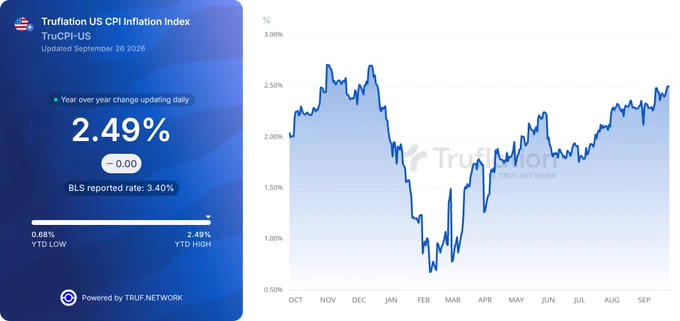
🇺🇸 Truflation Daily US CPI is 2.49% YoY today, ⬆️ +0.00%.🇺🇸
Claim FREE CREDITS NOW and explore more

another friendly reminder to subscribe to the Palantir store mailing list
subscribers receive newsletters (release news, commentary on designs, & occasional dunking on our haters) + early access to select drops.
fleece szn is gonna be crazy 😎
Show more


We @AMD just reached $1T market cap!! Much more to come & to build :)










