
NASA Solar System
@NASASolarSystem
Join us as we explore the worlds of our solar system.
141 Following 3M Followers

Get ready to wave to an asteroid 👋🪨
In 2029, asteroid Apophis will swing by Earth, passing safely about 20,000 miles from the surface. The OSIRIS-APEX mission will meet up with the asteroid shortly after, to map the surface and study its chemical makeup.
Show more


The seasons are changing, and the Harvest Moon is here. 🌕🍂
This is the full Moon that occurs closest to the fall equinox.
Watch for it rising in the east after sunset on Saturday.
Show more

See what the asteroid samples have revealed so far, and learn more about OSIRIS-APEX, the follow-on to OSIRIS-REx, which will study the asteroid Apophis after its rare close encounter with Earth in 2029.
Show more


Stuck the landing!
Three years ago today, the OSIRIS-REx spacecraft released a sample capsule at the edge of Earth’s atmosphere to land perfectly upright in the Utah desert.
The capsule held a record amount of pristinely captured rocks and dust from asteroid Bennu. Scientists have studied the extraterrestrial sample, learning it contains all the ingredients key to life.
Show more

Make your own discoveries about the eighth planet at

Whoomp there it is!
After two astronomers, Urbain Le Verrier and John Couch Adams, independently calculated its predicted location, Johann Gottfried Galle found the planet Neptune 180 years ago on Sept 23, 1846.
In 1989 when Voyager 2 became the first—and so far only—spacecraft to visit Neptune, it took thousands of images of Neptune, its rings, and its moons, including this one.
Show more


Layered beauty 😍
The Arabia Terra region on Mars has deposits that preserve a record of the planet’s ancient climate. The rhythmic nature of the layers could be due to cyclic processes, such as dust storms, perhaps involving groundwater. 1/2
Show more


Depending on your locale, equinoxes can be seen as bearers of longer nights and gloomy weather, or promising beacons of milder temperatures and more sunlight. Today, we mark the autumnal equinox - the official start of fall in the Northern Hemisphere.
🔗
Show more


As of Sept. 22, it's officially fall in the Northern Hemisphere…while spring begins in the Southern Hemisphere. 🍁 🌎 💐
That's the September equinox, when the Sun is directly above Earth's equator and day and night are close to equal in length around the world.
Show more

Sometimes following the water can lead to surprising places💧
A new study of data from Perseverance reveals that rocks in Jezero Crater were shaped by a complex sequence of ancient lakes, groundwater systems, and hydrothermal fluids. 1/2
Show more

We love a Moon appreciation moment 🌎🌓🎉
It’s International Observe the Moon Night! People all over the world are observing the Moon together today, and you’re invited.
Find an event near you, or register to observe on your own or with friends, at
Show more


It's International Observe the Moon Night eve! Have you made plans to join in the fun tomorrow night?🌓👀
Visit the website to find ways to observe, connect with other moon enthusiasts near you, or even host your own event!
Get started:
Show more


14 NASA #SpaceApps# challenges for all interests & skill levels are now live, plus team formation is open!🚀🌍🛰️
Explore topics in agriculture, missions to the Moon and Mars, microgravity combustion, & more from @NASA experts. Choose a challenge & create or join a team today:
Show more

This weekend, people all over the world will observe the Moon together, and you're invited! Join a local or virtual International Observe the Moon Night event, register as an individual observer, or gather your own Moon observing crew.
Get started:
Show more

Sunrise, sunset 🏜️
To mark Curiosity’s 5,000th Martian day on the Red Planet, the rover’s team created this postcard. It combines two panoramas, with blue colors representing images taken in the morning, and yellow colors for the images taken at dusk. 1/2
Show more

The Moon’s got a big new crater! 🕳️
Spotted by NASA’s Lunar Reconnaissance Orbiter, the McGetchin crater formed when a rock as big as a six-story building crashed into the Moon. It’s 141 feet deep and wider than the length of two football fields.🪨💥🌕
Show more

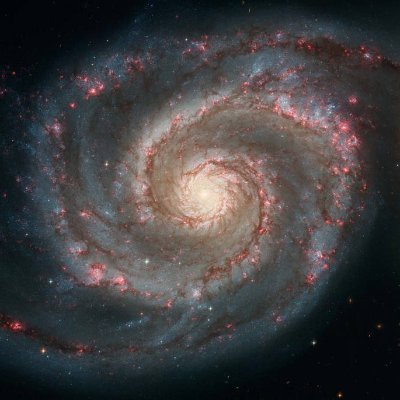
While our Swift satellite was designed to study faraway cosmic explosions, it has also observes nearby icy comets! These rocky snowballs are leftover from the solar system’s formation, and Swift watched one’s spin slow down: #CollectRocksDay#
Show more

@NASAArtemis @astro_reid @NASARoman We know how much @Astro_Reid loves moons, so we showed him a few of our upcoming missions, including Dragonfly — headed for Saturn’s moon Titan — and the Lunar Environment Monitoring Station instrument, which future @NASAArtemis astronauts will deploy on the lunar surface.
Show more


Field-testing a new set of tools for solar system exploration 🌎🪐
In these tests, two rovers and a drone worked together to explore their environment using onboard AI, and researchers assessed the fleet’s ability to act as an independent science team.
Show more


Nature’s coronagraph. 🌙☀️
Here’s a throwback to the 2024 total solar eclipse, when scientists and citizen scientists used this unique opportunity to collect observations of the innermost corona, helping researchers study how heat and energy move through the solar atmosphere.
Show more

Get ready with us to observe the Moon 💅
One more week until International Observe the Moon Night! You’re invited to celebrate our nearest neighbor in space, together with people all over the world.
Find an event near you, or observe on your own:
Show more

What if we could explore the Moon with AI?
Meet the @NASA–@IBM Lunar Foundation Model, a new open‑source AI trained on 17 years of lunar data to map craters, identify geologic features, and even help predict where ice may hide in the Moon’s darkest regions. 🌙
Show more












