Ray Dalio
@RayDalio
Official account of Ray Dalio, founder of Bridgewater Associates, author of #1# New York Times bestseller 'Principles,' professional mistake maker
93 Following 2.5M Followers
Everyone fails.
Anyone you see succeeding is only succeeding at the things you're paying attention to--I guarantee they are also failing at lots of other things. The people I respect most are those who fail well. I respect them even more than those who succeed. #principleoftheday#
Show more

The most common mistake smart investors make is not having a clear game plan.
To build a solid strategy, write down your criteria for making a decision, then stress-test it against history. Every time you make a decision, go back and ask: “If I made that decision under these circumstances in the past, how would it have worked?”
Knowing the track record of your decision-making criteria gives you a much deeper understanding of how things actually work.
Credit: Sam Parr, Shaan Puri, and My First Million
#Investing# #Principles# #RayDalio# #FinancialWisdom#
Show more

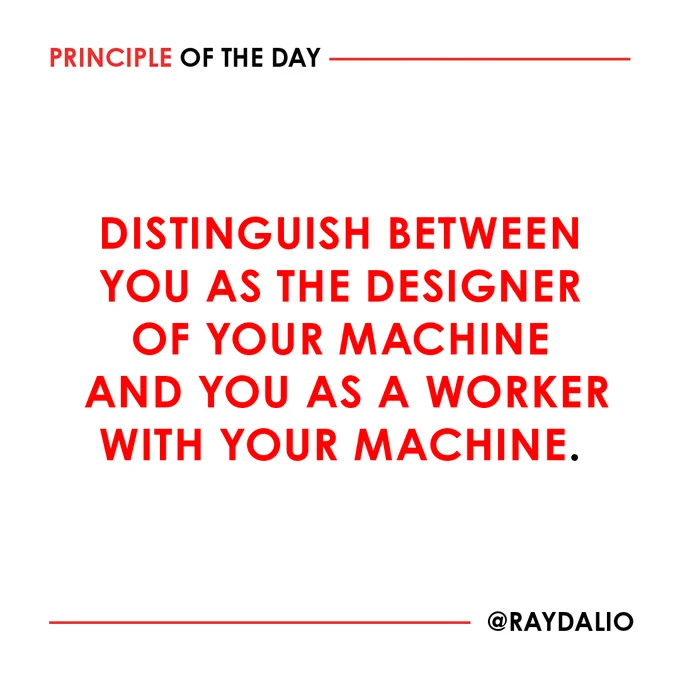
One of the hardest things for people to do is to objectively look down on themselves within their circumstances (i.e., their machine) so that they can act as the machine's designer and manager.
Most people remain stuck in the perspective of being a worker within the machine.
If you can recognize the differences between those roles and that it is much more important that you are a good designer/manager of your life than a good worker in it, you will be on the right path. #principleoftheday#
Show more
If you don't mind being wrong on the way to being right you'll learn a lot--and increase your effectiveness.
But if you can't tolerate being wrong, you won't grow, you'll make yourself and everyone around you miserable, and your work environment will be marked by petty backbiting and malevolent barbs rather than by a healthy, honest search for truth. #principleoftheday#
Show more

This evaluation and improvement process exactly mirrors the evolutionary process I described earlier. It means looking at how to improve or change the design or people to achieve your goals. Schematically, the process is a feedback loop, as shown in the diagram here. #principleoftheday#
Show more

Everything has happened before. Everything is repeated.
But the mistake that had the biggest effect on me was in 1982. I had calculated that American banks had lent a lot of money to a bunch of countries that would not be able to pay it back. Mexico defaulted in August 1982, and while I was right about that part, I was completely wrong about the market. I thought the stock market was going to go down, but it went up because the Federal Reserve eased.
I didn't just miss. I was publicly wrong and lost everything. I lost my company and all the people who worked for me—people who were like family. I was the only one left. I had to borrow $4,000 from my dad just to help pay my family bills.
It was one of the most painful experiences I have ever had, but it was also one of the best. It completely changed my attitude about decision-making. It taught me to move from thinking "I'm right" to asking myself, "How do I know I'm right?"
#RayDalio# #Principles# #Mindset# #BusinessLessons#
Show more

Sometimes people mistake generosity for not being fair.
For example, when Bridgewater arranged for a bus to shuttle people who live in New York City to our Connecticut office, one employee asked, "It seems it would be fair to also compensate those of us who spend hundreds of dollars on gas each month, particularly in light of the New York City bus."
This line of thinking mistakes an act of generosity for some for an entitlement for everyone. #principleoftheday#
Show more

Credit is the most important part of the economy—and probably the least understood. It's the biggest and most volatile part.
When borrowers receive credit, they increase their spending. Because one person’s spending is another person’s income, increased spending drives the economy forward and creates a self-reinforcing pattern of economic growth.
Understanding how credit works is key to understanding economic cycles.
#RayDalio# #Economy# #Credit# #Finance#
Show more

You have your goals.
I call the way you will operate to achieve your goals your machine. It consists of a design (the things that have to get done) and the people (who will do the things that need getting done). Those people include you and those who help you. #principleoftheday#
Show more

Everyone makes mistakes. The main difference is that successful people learn from them and unsuccessful people don’t.
By creating an environment in which it is okay to safely make mistakes so that people can learn from them, you’ll see rapid progress and fewer significant mistakes. This is especially true in organizations where creativity and independent thinking are important, as success will inevitably require the acceptance of failure as a part of the process.
As Thomas Edison once said, “I have not failed. I’ve just found ten thousand ways that do not work.” #principleoftheday#
Show more

Our uniquely human ability to look down from a higher level doesn't apply just to understanding reality and the cause-effect relationships underlying it; it also applies to looking down on yourself and those around you.
I call this ability to rise above your own and others' circumstances and objectively look down on them "higher-level thinking." #principleoftheday#
Show more

Here’s the holy grail of investing: Find 15 good, uncorrelated return streams.
If you look at the math of diversification, getting out to 15 uncorrelated streams allows you to reduce about 80% of your risk without reducing your return. That increases your return-to-risk ratio by a factor of five—giving you the upside without the downside.
Credit: Sam Parr, Shaan Puri, and @myfirstmilpod
#RayDalio# #Investing# #Diversification# #FinancialWisdom#
Show more

For example, most people will operate in a way that maximizes the amount of money they will get and that minimizes the amount of work they have to do to get it.
To see this, just leave someone unsupervised and allow them to bill you for what they have done.
Be especially wary of this conflict of interest when people are advising you on matters that will affect how much money they earn--such as the lawyer who spends a lot of billable hours giving you advice, or the salesperson who advises you on what to purchase while receiving a commission on the amount that you spend. #principleoftheday#
Show more

For the most part, life gives you so many decisions to make and so many opportunities to recover from your mistakes that, if you handle them well, you can have a terrific life.
Of course, sometimes there are major influences on the quality of our lives that come from things beyond our control—the circumstances we are born into, accidents and illnesses, and so forth—but for the most part even the worst circumstances can be made better with the right approach. #principleoftheday#
Show more

As I’ve explained here before, at this stage in my life, my main goal is to pass along the principles and templates I've learned with the hope that they can help others as much as they've helped me. One thing that has been incredibly valuable to me is learning that just because something hasn’t happened before in my lifetime doesn’t mean it won’t happen. So I needed to look not only at what the markets have been doing lately but to also study big events—like debt crises, internal political conflicts, and international wars—throughout history. For example, it was by studying the Great Depression that I was able to navigate the 2008 financial crisis successfully.
I would like to help others gain this perspective, which is why I have been sharing my principles in books, videos, on social media, and especially in the "Dalio Market Principles Online" course I built with great partners at Singapore's Wealth Management Institute (WMI). The course has been completed by thousands of online learners around the world and has gotten great reviews. If you’re interested in joining its next cohort which is starting soon, you can learn more here.
Show more

The most meaningful relationships are achieved when you and others can speak openly to each other about everything that's important, learn together, and understand the need to hold each other accountable to be as excellent as you can be.
When you have such relationships with those you work with, you pull each other through challenging times; at the same time, sharing challenging work draws you closer and strengthens your relationships.
This self-reinforcing cycle creates the success that allows you to pursue more and more ambitious goals. #principleoftheday#
Show more

By recognizing the higher-level consequences nature optimizes for, I've come to see that people who overweigh the first-order consequences of their decisions and ignore the effects of second- and subsequent-order consequences rarely reach their goals.
This is because first-order consequences often have opposite desirabilities from second-order consequences, resulting in big mistakes in decision making. #principleoftheday#
Show more

There are two things you need to do to be successful. You have to come up with the best decisions, and you have to have the courage to make them.
The real problem for most people is that they think the best decisions are only in their heads. The most important thing I learned was to take those ideas, put them out there, and stress test them.
Whatever success I’ve had in life has had more to do with my knowing how to deal with my not knowing than anything I know. That taught me how to take in what others have, and that has been a key thing.
#RayDalio# #Principles# #DecisionMaking# #SuccessMindset#
Show more

The line is what's fair, appropriate, or required, as distinct from what's generous, in light of the defined quid pro quo relationship between parties. #principleoftheday#

In my own life, what I want to give to people, most importantly to people I love, is the power to deal with reality to get what they want.
In pursuit of my goal to give them strength, I will often deny them what they "want" because that will give them the opportunity to struggle so that they can develop the strength to get what they want on their own.
This can be difficult for people emotionally, even if they understand intellectually that having difficulties is the exercise they need to grow strong and that just giving them what they want will weaken them and ultimately lead to them needing more help. #principleoftheday#
Show more












