

Reflection
@reflection_ai
Open intelligence, accessible to all
2 Following 14K Followers
Our open models are designed to support the Genesis Mission by giving the scientists in our national labs the flexibility and sovereignty to work on their own terms. Learn more ⤵️
Welcome @joespeez to the Reflection team, it's great to have you as our VP of Product & Head of Open Source.

BREAKING: Llama lead @joespeez is joining Reflection as VP of Product & Head of Open Source

Reflection is partnering with Shinsegae Group to build a 250-megawatt sovereign AI factory for the Republic of Korea.
Open intelligence. Built on trust between allies. Owned by the nations that need it most.
The future of sovereign AI. Read more in the @WSJ.
Show more

Most approaches to “agentic AI” focus on post-training fixes.
In this conversation, member of our technical staff, @achowdhery argues the bottleneck is pre-training itself. Drawing on her work on PaLM and early Gemini, she explains why next-token prediction breaks down for long-horizon planning -- and how objectives, attention, and training data must evolve to support true agentic behavior.
Show more
Today, we're joined by @achowdhery, member of technical staff at @reflection_ai, to explore the fundamental shifts required to build true agentic AI. While the industry has largely focused on post-training techniques to improve reasoning, Aakanksha draws on her experience leading pre-training efforts for Google’s PaLM and early Gemini models to argue that pre-training itself must be rethought to move beyond static benchmarks. We explore the limitations of next-token prediction for multi-step workflows and examine how attention mechanisms, loss objectives, and training data must evolve to support long-form reasoning and planning. Aakanksha shares insights on the difference between context retrieval and actual reasoning, the importance of "trajectory" training data, and why scaling remains essential for discovering emergent agentic capabilities like error recovery and dynamic tool learning.
🗒️ For the full list of resources for this episode, visit the show notes page:
📖 CHAPTERS
===============================
00:00 - Introduction
02:26 - Reflection
04:54 - Limitations of post-training for building agents
07:31 - Rethinking pre-training in agents
10:51 - Scaling
11:27 - Evolving attention mechanisms for agentic capabilities
12:39 - Memory as a tool
14:13 - Loss objectives and training data
15:50 - Fine-tuning loss in agent performance
19:37 - Training data
21:29 - Augmenting dominant training data source
24:11 - Overcoming challenges in training on synthetic data
25:47 - Benchmarks
30:44 - Scaling laws in large models versus small models
33:20 - Long-form versus short-form reasoning
37:57 - Agent’s ability to recover from failure
40:15 - Hallucinations and failure recovery
43:53 - Tool use in agents
46:38 - Coding agents
48:37 - How researchers can contribute to agentic AI
Show more

Welcome to the team, Brandon!

An update: I have left Meta Superintelligence Labs and joined @reflection_ai in NYC!! Today is my first day.
I started in the Fundamental AI Research (FAIR) lab at Meta, then Facebook, over six (!) years ago as my first job out of the PhD. They were some formative years. The group is full of exceptionally talented people that have profoundly shaped my perspective on life and research. I am grateful for everything we have shared and proud of everything we created together.
I have decided it's time to try to build a startup and new frontier models with Reflection. Superintelligence will be one of the most significant advancements of our lifetimes, resulting in a computational reflection of ourselves. We believe it should be safe, open, and accessible to all. I am excited to be jumping into the post-training and reinforcement learning pipelines to advance capabilities and alignment.
And we are hiring! Please get in touch.
Show more

Come meet some of the Reflection research team and our founders @real_ioannis and @MishaLaskin at our NeurIPS booth.

Welcome to the team @_ghorbani. We’re excited to have you leading the Science of Scaling team.

Hi friends, after three incredible years at OpenAI I am excited to share that I am starting a new chapter at @reflection_ai, where I will be leading the Science of Scaling team.
Our mission is to deepen the scientific understanding of large scale learning and to turn compute into intelligence as efficiently and predictably as possible.
Show more


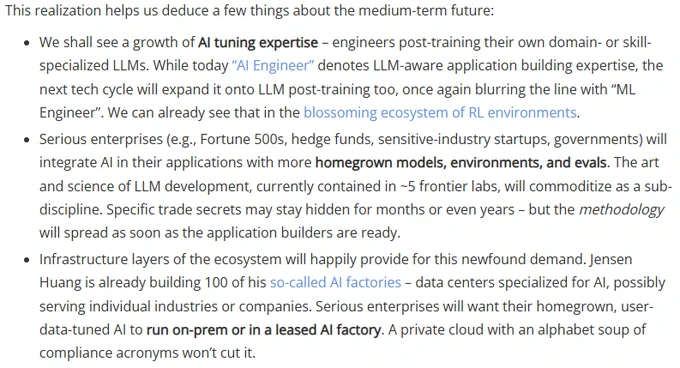
🎉 Next week, I am excited to join @reflection_ai as a Member of Technical Staff to help build the open intelligence ecosystem of the Western world.
It's the most exciting opportunity to help software builders in our time, and will shape many years of AI Engineering in the medium-term before AGI. Not just about Western vs Eastern open models, but more about how AI-driven software will look like in 2030.
I spent some time articulating my thoughts about where we're going as a community and why... which became a whole blog post. Take a look, hope it interests you!
(And if it really does, we are hiring in NYC, SF, and London 😉)
Show more



Good morning. On today’s show:
– @sama (OpenAI)
– @billpeeb (OpenAI)
– @eladgil (Entrepreneur & Investor)
– @dylan522p (SemiAnalysis)
– @rmstein (Google)
– @morganhousel (Collab Fund)
– @MishaLaskin (Reflection AI)
See you on the stream.
Show more

Today on The Information’s TITV:
-CEO of @Qualtrics, @Zserafin, makes $6.75 billion bet on health data
-@MishaLaskin, CEO of @reflection_ai, notches $8 billion valuation for open-source AI
-Co-Founder of AI startup @useplumb, @aarondignan, announces business closure
-E-commerce startups back from the dead | @MikeDuda, Bullish; @anngehan, The Information
-@Yueqi_Yang, Crypto Reporter, on new stable coin law
📺 Tune in at 10 am PT / 1 pm ET on
Show more


Excited to have backed @reflection_ai from the seed. Today’s $2b raise pushes frontier open intelligence, with open models + advanced RL at scale, accessible to all. And most importantly, with @nvidia as their key partner. It’s a big day for open AI. Thanks NYTimes for covering
Show more


Let’s go open-source and open science AI!
RT @ravirajjain: Lightspeed portfolio company @Reflection_AI announced $2B in financing to advance their mission of building frontier open…
Today we're sharing the next phase of Reflection.
We're building frontier open intelligence accessible to all.
We've assembled an extraordinary AI team, built a frontier LLM training stack, and raised $2 billion.
Why Open Intelligence Matters
Technological and scientific progress is driven by values of openness and collaboration.
The internet, Linux, and the protocols and standards that underpin modern computing are all open. This isn't a coincidence. Open software is what gets forked, customized, and embedded into systems worldwide. It's what universities teach, what startups build on, what enterprises deploy.
Open science enables others to learn from the results, be inspired by them, interrogate them, and build upon them in order to push the frontier of human knowledge and scientific advancement. AI got to where it is today through scaling ideas (e.g. self-attention, next token prediction, reinforcement learning) that were shared and published openly.
Now AI is becoming the technology layer that everything else runs on top of. The systems that accelerate scientific research, enhance education, optimize energy usage, supercharge medical diagnoses, and run supply chains will all be built on AI infrastructure.
But the frontier is currently concentrated in closed labs. If this continues, a handful of entities will control the capital, compute, and talent required to build AI, creating a runaway dynamic that locks everyone else out. There's a narrow window to change this trajectory. We need to build open models so capable that they become the obvious choice for users and developers worldwide, ensuring the foundation of intelligence remains open and accessible rather than controlled by a few.
What We've Built
Over the last year, we've been preparing for this mission.
We’ve assembled a team who have pioneered breakthroughs including PaLM, Gemini, AlphaGo, AlphaCode, AlphaProof, and contributed to ChatGPT and Character AI, among many others.
We built something once thought possible only inside the world’s top labs: a large-scale LLM and reinforcement learning platform capable of training massive Mixture-of-Experts (MoEs) models at frontier scale. We saw the effectiveness of our approach first-hand when we applied it to the critical domain of autonomous coding. With this milestone unlocked, we're now bringing these methods to general agentic reasoning.
We've raised significant capital and identified a scalable commercial model that aligns with our open intelligence strategy, ensuring we can continue building and releasing frontier models sustainably. We are now scaling up to build open models that bring together large-scale pretraining and advanced reinforcement learning from the ground up.
Safety and Responsibility
Open intelligence also changes how we think about safety. It enables the broader community to participate in safety research and discourse, rather than leaving critical decisions to a few closed labs. Transparency allows independent researchers to identify risks, develop mitigations, and hold systems accountable in ways that closed development cannot.
But openness also requires confronting the challenges of capable models being widely accessible. We're investing in evaluations to assess capabilities and risks before release, security research to protect against misuse, and responsible deployment standards. We believe the answer to AI safety is not “security through obscurity” but rigorous science conducted in the open, where the global research community can contribute to solutions rather than a handful of companies making decisions behind closed doors.
Join Us
There is a window of opportunity today to build frontier open intelligence, but it is closing and this may be the last. If this mission resonates, join us.
Show more












