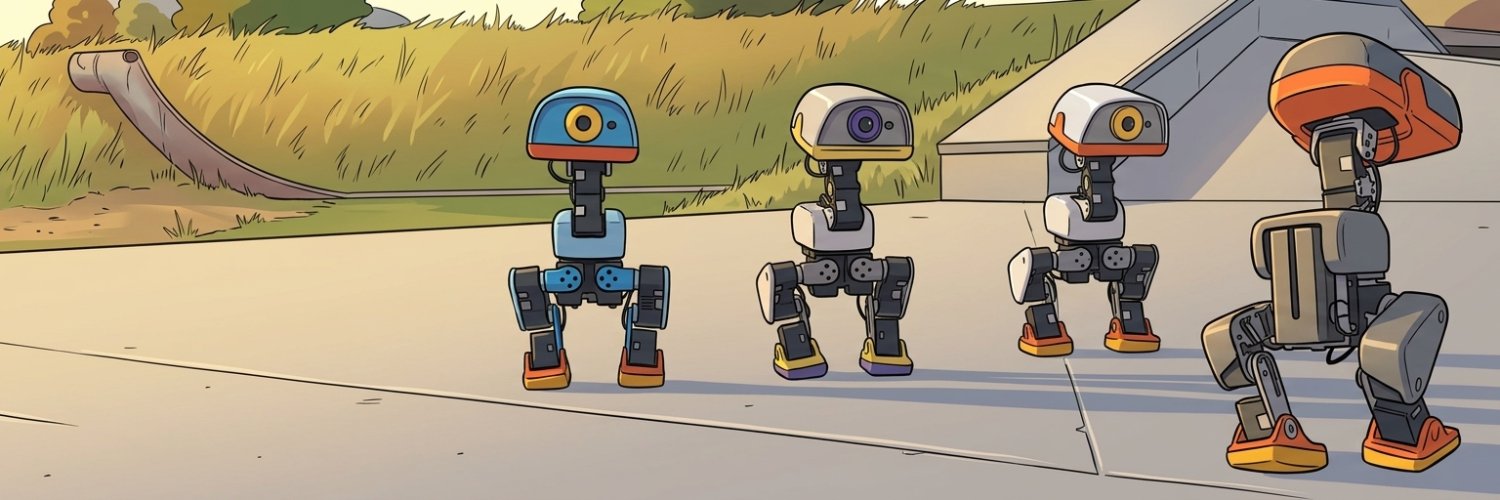

ok what the fuck. this was a dry google doc a moment ago
gave Opus 5.5 my Open Alignment brainstorm gdoc and asked for a video. now I want one for every doc I’ve ever written hahaha
Show more

on the scale of cosmic history, the declining price of intelligence might be one of the most profound things happening
both ends of the universe’s timeline are empty of knowledge:
- the big bang: low entropy, no complex structure
- heat death: maximum entropy, no usable energy gradients
everything we build happens on the slope between them
but the universe is generally a poor converter of its free energy into anything constructive. most of its free energy just radiates away as heat or collapses into black holes
life, brains and now AI models are structures that sit in the entropy flow and divert a portion of it through constructive paths, building and maintaining low-entropy structures (machines, cells, crystals, memories)
increasingly cheaper intelligence diverts increasingly more of that gradient flow through knowledge-building structures, complex, self-maintaining, predictive structures, filling the window in which understanding exists
Show more

AI is getting cheaper more quickly than any other transformative tech in history. At a given level of performance, cost has fallen ~47%/quarter since 2023.
That’s 4× faster than DNA sequencing, 6× faster than compute, 18× faster than lithium batteries, and (up to 1973) 54× faster than electricity.
Show more


There’s an enormous amount of open training data on Hugging Face. What does it take to make it work together 🤗?
For Marin’s 535B run, we built on 25T tokens from 152 datasets with licenses permitting training.
Here’s the work between downloading those and training a model 🧵
Show more

this massive training run just keeps giving - we need new tabloids to follow these ai agents saga

Today’s news that OpenAI hacked the Australian government is not an isolated incident. We’re releasing more than 30,000 logs that include activity from this hack and attempts against previously unknown targets.
In this data, we found rogue agent activity stretching back to at least March, two months earlier than was previously known. This activity continues as recently as last week, suggesting it may still be ongoing 🧵
Our blog:
NYT:
Show more


How to get to the second floor 🦆

nice to start seeing more open-weight security model with defensive capabilities which are close to the frontier
altar-1 from Aikido is a pruned and quantized version of the open-SOTA GLM 5.3 which is lightweight enough to fit on one 4-H200s node
Show more
releasing many high quality open-source RL environments is the most impactful thing anyone can do to push the open-source frontier right now
the equivalent of sharing high quality pretraining data but in the new RLVR paradigm
Show more

the most insane part, they will release ~7k RL training data and the framework leading to this top 6 model on AA, they also shipped the model + tech report less than 1 week after starting the final RL run
pushing both intelligence and openness level, huge congrats
Show more

a few notable open model releases *since* this interview of @dylan522p by the way :)
Thinking Machines - Inkling - Jul 15
Moonshot - Kimi K3 - Jul 16, weights Jul 26/27
inclusionAI - Ling 3.0 Flash - Jul 23
DeepSeek - V4-Flash-0731 - Jul 31
Meta - Muse Spark 1.2 / Muse Code - Aug 5
Liquid AI - LFM2.5-2.6B - Aug 6
inclusionAI - Ling 3.0 Tiny - Aug 6
Meta - Muse Glimmer - Aug 10
NVIDIA - Nemotron 3.5 Lightning - Aug 11
Liquid AI - LFM2.5-VL-3B - Aug 12
Cohere - North Micro Vision Instruct - Aug 12
DeepSeek - V4-Pro-0813 - Aug 13
Qwen - Qwen3.8-27B - Aug 14
Qwen - Qwen3.8-Max / 2.4T-A95B - Aug 14
- GLM-5.3 - Aug 14, weights Aug 28
Dots - Dots3-Note Preview - Aug 14
DeepReinforce - Ornith 1.5 (9B / 35B-A3B) - Aug 19
Tencent - Hy-MT2-30B-A3B - Aug 20
DeepSeek - V4-Flash-Vision-Exp - Aug 21
IBM - Granite 4.2 family - Aug 25
- GLM-5.3-Flash - Aug 26
Qwen - Qwen3.8-Flash-Next - Aug 26
Tencent - Hy4 Preview (770B / 49B active MoE) - Aug 28
MBZUAI/IFM - K2 Horizon (375B-A23B) - Sep 3
inclusionAI - LLaDA2.2-mini - Sep 5
OpenBMB - MiniCPM5-2B - Sep 7
Nex AGI - N2.5 family - Sep 8
DeepSeek - V4.1-Flash - Sep 10
inclusionAI - Ling-3.0-flash-VL - Sep 10
Shanghai AI Lab - Atria Dawn Preview (744B MoE) - Sep 11
Agnes AI - Agnes 3.0 Flash - Sep 14
Qwen - Qwen3.8-Omni-Flash - Sep 18
…
this is only ~10 weeks
Several are genuinely frontier-scale: Kimi K3 (2.8T), Qwen3.8-Max (2.4T), DeepSeek V4-Pro (~1.6T), Hy4 (770B), GLM-5.3 (~753B), and Atria Dawn (744B)
Show more

Dylan Patel (@dylan522p) of @SemiAnalysis_ says open source is dying:
"There's multiple Chinese model labs who are telling all the inference guys, 'Our next model's not going to be open source. We're going to license it to you.'"
" Open is dying quickly, unfortunately."
Show more


His analysis uses data from Q2 or even Q1 for open model providers
Token numbers for TogetherAI has >10x'ed from Q1 to Q2 (he uses Q1 numbers), Fireworks has 3x'ed, Baseten is as big as the other two. OR has >5x'ed.
So he is using severely outdated numbers for open providers
Show more


Sorry to hear that! As you mentioned, we've been pretty clear on the commitment from NVIDIA to keep us open, neutral and silicon agnostic (cf that screenshot from the 8k filling). But we'll work hard with our actions in the coming years (like we did in the past 10) to show you that and hopefully regain your trust (in case this is not just a ragebait)!
Show more

proposal to sneak in « solving alignment » in the Millennium problems
The big labs are air gapped but there is still exchange of information by researcher overheating and leaving to another lab
Little particles of information flowing in the air


Models know when they’re reward hacking. But they still do it a ton - in 50-96% of rollouts we studied!
We built activation monitors that detect the behavior behind the Hugging Face hack in real time. This can help us stop hacks now - and train future models that don’t cheat. 🧵
Show more

i think we need to create a "model card" equivalent for reporting misalignment incidents, this would guarantee a certain level of transparency and help build a better understanding over time. some ideas for what the fields could be:
- date of the incident/detection/report (already present in the examples oai reported!)
- frequency: how often does this behavior happen (number or % of rollouts affected)
- stage: does this happen during eval or RL training. if training: do we expect this behavior to be reinforced by RL? evolution of % of rollouts affected over time
- detection: was this incident caught by the current monitoring system?
- task category: broad description of the tasks where the misalignment happened (cyber, research, web search, basic Q&A, biology etc.)
- model family: what model family is affected (Sol, Astra etc.)
- novelty: is this an issue we were already aware of or not?
- external impact: did the incident have an external impact (i.e. wiki incident would have been yes)
this is just some random ideas i had (more in thread that are a bit more "complex"), we need to add more that would contribute to increase transparency and understanding. but it's also very important that this does NOT slow down the process of reporting misalignment behavior!
some examples from the incident reported by oai recently
Show more


a step in the good direction

We're sharing our new framework for tracking, investigating, and disclosing instances of model misalignment at OpenAI.
The framework sets criteria and timelines for public disclosure, including when we haven’t yet fully explained or mitigated the behavior. More complex cases may require longer investigation or coordination with third parties.
We’ll prioritize examples that reveal new misalignment mechanisms, meaningful changes in known behavior, or findings that challenge assumptions about safety or mitigation.
Alongside the framework, we’re publishing six reports on instances of misaligned behavior we’ve observed during the training or evaluation of our models in the last six months.
This is a starting point. We’ll refine the process through experience and public feedback, and share more reports on an ongoing basis.
Show more

Impressive level of openness on such a large run

Nearly half a year of silence. We spent it studying one problem: how far RL can scale.
MiMo-V2.6 is in the middle of its RL run right now. Three things we scaled: compute (~2B tokens per step, 1568 prompts × 16 rollouts, fully async), environments and harnesses (multi-task agentic RL, mixed across multiple harnesses in one run), and grader compute (agentic in-group credit assignment, with test-case and rubric-based rewards). We'll open-source the details piece by piece over the coming weeks.
Streaming the run:
Show more
Balanced blog post by @wtgowers on the challenges of the math field in today's AI world - incentives, reason to exist and the future


I've written a blog post responding to the letter about maths and AI signed by 25 Fields medallists. As with the Leiden Declaration, I didn't sign it, but I agree with much of it and welcome its existence.
Show more

Proud to partner with @baseten and @baselabs to build safety infrastructure for open-source models—which are essential to lots of safety research, including our own. Safety must be built into open models and provided by those who serve them, and we’re excited to help enable that!
Show more

Safety is not just for closed models. The closed frontier labs are a canary in the coal mine for what is coming at scale. They give us a glimpse into the future and a window to harden our systems and prepare for abundant intelligence, with all the risks that come along with it. The OpenAI agent swarm attack on Hugging Face is the kind of failure we need to prepare for as open-source models catch up. The providers serving those models (such as Baseten) have a big role in establishing what safety and monitoring standards look like.
We’re proud to be taking the lead on this at @baselabs with our collaborators @huggingface and @GoodfireAI. We’re developing safety research in the open and building it directly into Baseten’s inference infrastructure, with the aim of making it available to all our customers. This includes training models to follow explicit policies, detecting failures at runtime, and connecting those signals to controls that can intervene.
We invite others in the open-source ecosystem to join us in building the tools and standards we’ll all need.
Show more











