

Following up on my earlier @papertrade_xyz post @paperdao_xyz is worth a look too. It’s a DAO gearing up to launch on @daosdotworld
The idea is to pool capital and farm $Paper from day one. Instead of everyone running their own positions, the DAO plans to put that capital to work across multiple trading strategies as soon as PaperTrade launches.
They’re targeting the early window when the same dollar of losses earns you more $Paper. When the LP is at $2M or below, each $1 in losses earns 100 $Paper. That rate gradually decreases once the LP passes $2M, so the plan is to get in early and accumulate $Paper while emissions are highest.
The $Paper farmed and staking rewards earned will go into the DAO treasury with trading profits and losses reflected there as well. $PULP represents a share of that treasury. Once $Paper becomes transferable, the plan is to allow holders to redeem their $PULP for a proportional share of the DAO’s $Paper holdings.
For anyone interested in accumulating $Paper early but not keen on figuring out a strategy and managing positions themselves, this could be another way to play it
Show more

폰지 + 퍼프덱스 = @papertrade_xyz
PaperTrade는 LP가 $0에서 시작하고 유저가 돈을 잃으면 그 돈이 LP로 들어가는 구조임. 다른 Trader가 수익을 내면 이 LP에서 지급하고 LP가 부족해서 바로 지급하지 못하는 수익은 Profit Queue에 쌓임. 이후 새로운 Trader Loss가 발생하면 그 돈으로 Queue를 순차적으로 정산함
이런 구조라면 초기에 LP도 부족하고 유저 입장에서도 굳이 여기서 거래할 이유가 약하다는 점인데 그래서 PAPER라는 시스템을 넣음
유저가 Loss나 Liquidation을 발생시키면 그 손실을 기준으로 PAPER가 발행되고 PAPER를 스테이킹한 유저는 이후 PaperTrade에서 발생하는 프로토콜 수익을 분배받음
초기 LP가 $2M 이하일 때 LP에 들어오는 $1당 100 PAPER 수준으로 emission이 강하고 LP가 $2M을 넘어가면 PAPER 발행량은 점점 감소함. 또 LP가 약 $5M 수준까지 성장하면 이후에는 LP를 계속 키우는 것보다 PAPER Staker에게 프로토콜 수익을 분배하는 비중이 커지는 구조임
트윗들을 보면 대부분 초기 LP가 생각보다 빠르게 $5M 이상까지 채워질 가능성을 보고 있음 또 별도의 오더북 없이 Hyperliquid의 BBO 가격을 기준으로 거래하기 때문에 슬리피지가 없고 최대 1000x 레버리지까지 지원할 예정이라 일반 Perp와는 확실히 다른 수요가 생길 수 있다고 생각함
곧 나올꺼같고 양빵으로 녹이는게 제일 괜찮은 플레이 같음
Show more

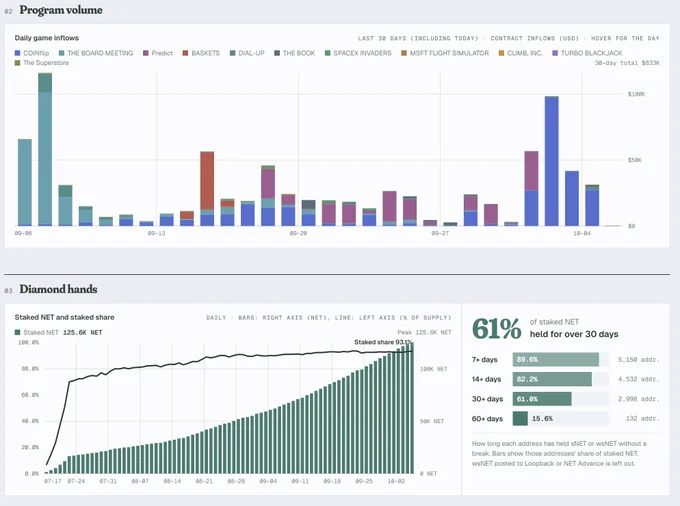
Built a @NetNetCap dashboard tracking treasury inflows, Program inflows, staking stats all in one place
~$27M has flowed into the treasury in the 81 days since launch
93.1% of the $NET supply is staked and 61% of staked NET sits in wallets that have held for 30+ days
Dug into the numbers and found more diamond hands than I expected 🥅🥅
Show more

Built a dashboard to track the revenue meta
Revenue trends + value flowing back to holders, all in one place
-
Projects covered:
@HyperliquidX @Lighter_xyz @Aster_DEX @DeriveXYZ
@Pumpfun @ponsdotfamily @LaunchOnSF @GraphiteProto @Uniswap @aeroxyz @Raydium @JupiterExchange @PancakeSwap @MeteoraAG @SkyEcosystem @maplefinance @chainlink @ether_fi @pendle_fi @GEODNET @rendernetwork @AskVenice @PhalaNetwork @shufflecom @Collector_Crypt @ORE
Show more

You guys are still hesitant to invest in a project with solid devs, $27M treasury and a valuation of just 1.7x NAV?
See you at $2000 robinhood:0xca9c78dd337a67f6e0077f65f5e9218719d30edf @NetNetCap
Show more

Dont fade a solid team with $25M in the treasury
$NET @NetNetCap


Levered Callable Capital is live
Stake @aave USDC/USDT deposits to earn +20% USD APY
$15M initial cap


just wanted to share this as ive found it genuinely useful and think theres an interesting asymmetry between whats being built and the attention its getting
most ai products get more expensive as they grow - @tryharness is trying to make itself cheaper
ai models and agents are multiplying but context is fragmented between all of them
harness is an always on local intelligence layer that sees and remembers what you do then gives that context to whichever ai or agent needs it
screenpipe is probably the clearest comp and validates the category - yc s26 building persistent local context for agents
harness takes a different approach - browser first with no desktop app required and a privacy focused stack using local processing and venice for inference
that matters for both privacy and accessibility - especially on work machines where installing desktop software can be restricted
harness could become a layer across the ai stack - one persistent context layer connecting your computer memory, personal memory and whichever models and agents you use
then theres the economic difference - and this is where harness gets really interesting
most ai products have inference costs that rise with usage
harness is building a treasury of productive compute assets like diem which when staked generates fresh venice api capacity every day
users consume that inference and anything unused is sold through surplus with the proceeds buying more inference producing assets
more usage - more revenue - bigger treasury - more owned inference - cheaper ai
100m harness unlocks resident and access to treasury generated inference so the same holding can become more useful as the treasury compounds
current usage = around 2k mau, 400 to 700 wau and around 200 dau with usage up roughly 75% from previous month
thats around 2000 different users a month - up to 700 a week - around 200 on a typical day
dev @saltorious1 works at bankr with previous experience at coinbase / opensea / dinari
sam altman recently described a future ai that continuously watches your screen and maintains the context of your life and work
thats remarkably close to what harness is already building
the bigger bet is that as models become increasingly interchangeable context becomes increasingly valuable
harness wants to own the layer that knows you across those models while progressively owning the inference needed to power them
Show more
spent a lot of time exploring different chains looking for undervalued utility projects and Robinhood Chain has been no exception
One thing that has always felt lacking on EVM is the experience around DLMMs and LPing. Compared to Meteora on Solana, both the core functionality and the overall UI/UX have often felt limited making the actual LP experience unnecessarily cumbersome
But on Robinhood Chain I think there’s a project that could change that
And I believe that project is @scopl_live
Show more

Following yesterday’s MCG interview, devs jumped into our Telegram channel for an unexpected AMA with the community to dive deeper into what we’ve built with SCOPL V2.
The interview only scratched the surface.
Here’s the full summary of what’s coming 👇
Show more
wait im not even fully grab my bag!! base:0xd3e592e728ae3461bd97c7a6b359e1043dd83ba3 @tryharness

Just found base:0xd3e592e728ae3461bd97c7a6b359e1043dd83ba3
Getting the same feeling I had when I first saw base:0x23a2847d772803f9efc64b4277b782b06296fe51
Just found base:0xd3e592e728ae3461bd97c7a6b359e1043dd83ba3
Getting the same feeling I had when I first saw base:0x23a2847d772803f9efc64b4277b782b06296fe51
just wanted to share this as ive found it genuinely useful and think theres an interesting asymmetry between whats being built and the attention its getting
most ai products get more expensive as they grow - @tryharness is trying to make itself cheaper
ai models and agents are multiplying but context is fragmented between all of them
harness is an always on local intelligence layer that sees and remembers what you do then gives that context to whichever ai or agent needs it
screenpipe is probably the clearest comp and validates the category - yc s26 building persistent local context for agents
harness takes a different approach - browser first with no desktop app required and a privacy focused stack using local processing and venice for inference
that matters for both privacy and accessibility - especially on work machines where installing desktop software can be restricted
harness could become a layer across the ai stack - one persistent context layer connecting your computer memory, personal memory and whichever models and agents you use
then theres the economic difference - and this is where harness gets really interesting
most ai products have inference costs that rise with usage
harness is building a treasury of productive compute assets like diem which when staked generates fresh venice api capacity every day
users consume that inference and anything unused is sold through surplus with the proceeds buying more inference producing assets
more usage - more revenue - bigger treasury - more owned inference - cheaper ai
100m harness unlocks resident and access to treasury generated inference so the same holding can become more useful as the treasury compounds
current usage = around 2k mau, 400 to 700 wau and around 200 dau with usage up roughly 75% from previous month
thats around 2000 different users a month - up to 700 a week - around 200 on a typical day
dev @saltorious1 works at bankr with previous experience at coinbase / opensea / dinari
sam altman recently described a future ai that continuously watches your screen and maintains the context of your life and work
thats remarkably close to what harness is already building
the bigger bet is that as models become increasingly interchangeable context becomes increasingly valuable
harness wants to own the layer that knows you across those models while progressively owning the inference needed to power them
Show more
If SushiSwap wants to beat Uniswap it ultimately needs a strong runner that can outperform $FRONG
The technology is there to provide the infrastructure that allows that runner to thrive.
I dont think retail cares that much about technical or narrative categories like V4 or RWA themselves.
At the end of the day, when price goes up, everything starts to look good. When price goes down, attention disappears just as quickly.
Thats why I think SushiSwap is sitting on a genuinely strong opportunity right now.
On Robinhood, much of the attention that had formed around @Uniswap faded after missteps and now VAMP is trying to capture that attention again.
But from my perspective SushiSwap is slightly missing the point right now. The launch of is obviously important but that alone won’t be enough.
What SushiSwap really needs is a runner that can unite the @SushiSwap + @bankrbot and pull the market attention toward it.
And I think you guys @alexmccurryo @0xDeployer already know what that runner is.
Robinhood didnt succeed simply because the product itself was good. It had $CashCat as a runner and CashCat was what pulled in attention and liquidity
🦩🦩🦩🦩
Show more

The Dot dashboard is now live, giving users an insight into our unique flywheel.
Track Dot in public:
Our new dashboard serves as an operating brief for the people building, using, and investing in Dot.
Our July 24 snapshot:
-703 free users across Dot
-74 paid plans
-$3,779 subscription MRR
-11.89% of $DOT permanently burned
-267 GitHub stars
-107 Hugging Face downloads
$3,779 is our subscription revenue floor, while direct credit purchases, API top-ups, and pay-as-you-go usage is additional.
The dashboard uses aggregate platform, payment, developer, and token metrics. It never connects those metrics to prompts, outputs, conversations, or model activity.
We look to provide our users with one clear view of Dot’s adoption, revenue, token alignment, open-source traction, and privacy architecture.
Show more













