Finn Stockinger
@FinnStockinger
Analyst. Investor.
Early where the market is late.
692 Following 17.6K Followers
Isn’t SemiAnalysis the same firm that published ClusterMAX 3.0, comparing managed GPU clusters, and somehow rated a company that doesn’t even have a managed GPU cluster live today?
That’s all I have to say about the credibility of this research.
How to lose credibility, SemiAnalysis edition - another chapter.
Masters of FUD. Nothing more.
What a joke.
Show more

We recommend that IREN stop falsely claiming to offer managed clusters in public investment materials, such as in their most recent 10-K, where they claimed to "own and operate" all layers of the stack, including "managed cloud services."
Their CCO was correct when he recently said, "we don't have any live managed services today."
IREN should focus on their bare metal offerings, where there is plenty of market demand for their services. (3/3)
Show more

The market is reacting pretty much as expected.
Rosenblatt raised its PT to $100 today, which is in line with what I expected after the last earnings and with my updated estimates.
At the recent ATH, I sold 1/3 of my position, locking in roughly a 200% gain.
If the stock starts pushing above $90, I’ll gradually look to exit the rest of my position.
I’m not saying the stock can’t go higher from there - it absolutely can.
I just think that at those levels, most of the upside I originally invested for will already be behind me.
Show more

$PENG
If management keeps mentioning record backlog few times on the earnings call and says it supports 40% YoY revenue growth in FY2027, is that a good thing or not?
Asking for a friend.
Today I own only one memory stock and it's Samsung.
Not because it has the highest HBM exposure - it doesn't.
That's exactly the point.
HBM share went from 20% in 2025 → 33% in Q2'26 → 40% expected in Q4, while HBM4 revenue is expected to >3x QoQ in Q3.
But the part I find more interesting: Samsung's HBM4 uses its own 4nm Foundry base die.
So every incremental HBM4 win can improve Memory mix while simultaneously driving Foundry utilization - a business that has been a major earnings drag.
Add AMD openly exploring Samsung for both memory AND next-gen foundry today, and I think the setup becomes pretty asymmetric.
$MU / $SKHY = more pure memory beta.
Samsung = memory upcycle + HBM share recovery + Foundry operating leverage.
That's the risk/reward I prefer.
Show more


SOUTH KOREAN MEDIA: SAMSUNG’S 12-HIGH HBM4E PASSES QUALIFICATION TESTS AT NVIDIA AND OTHER CUSTOMERS

$PENG
If management keeps mentioning record backlog few times on the earnings call and says it supports 40% YoY revenue growth in FY2027, is that a good thing or not?
Asking for a friend.
$PENG FY2027 $4.45 adjusted EPS guide implies roughly $100 per share at $DELL 22.5x FY2027 earnings multiple.
If you look more forward, it can be even higher.

$PENG strong Q4 and a higher FY2027 outlook.
Revenue was $567M (+68% YoY), about 12% above the $508M implied by the previous guide. Adjusted EPS was $1.00 (+133%).
FY2027 guidance now calls for $2.43B in revenue and $4.45 in adjusted EPS up 40% and 55%, respectively.
What interests me most is the customer expansion: six new AI infrastructure customers in Q4, four of them neoclouds.
One selected Penguin to deploy and operate a 36,000-GPU AI factory in Norway.
Across FY2026, twelve customers expanded their business with the company.
That matters because Penguin’s opportunity extends beyond installing hardware to managing those systems once they’re running.
The concern is cash.
Inventory rose 50% QoQ to $749M, while operating cash flow was negative $163M.
I previously thought the strongest acceleration might be behind us.
I’m revisiting that view, but I still want management to explain how much inventory is committed to customer orders and when it gets paid for.
Show more

$PENG strong Q4 and a higher FY2027 outlook.
Revenue was $567M (+68% YoY), about 12% above the $508M implied by the previous guide. Adjusted EPS was $1.00 (+133%).
FY2027 guidance now calls for $2.43B in revenue and $4.45 in adjusted EPS up 40% and 55%, respectively.
What interests me most is the customer expansion: six new AI infrastructure customers in Q4, four of them neoclouds.
One selected Penguin to deploy and operate a 36,000-GPU AI factory in Norway.
Across FY2026, twelve customers expanded their business with the company.
That matters because Penguin’s opportunity extends beyond installing hardware to managing those systems once they’re running.
The concern is cash.
Inventory rose 50% QoQ to $749M, while operating cash flow was negative $163M.
I previously thought the strongest acceleration might be behind us.
I’m revisiting that view, but I still want management to explain how much inventory is committed to customer orders and when it gets paid for.
Show more
$PENG earnings in 20 minutes 🐧🐧🐧
First thing what I'm watching: whether that $498M inventory investment starts turning into operating cash flow.
Then FY2027 guidance. Management’s preliminary 30% revenue growth outlook implied roughly $2.18B, or $545M per quarter only 7% above the $508M Q4 revenue implied by their previous FY2026 guide.
That’s why the Q1 outlook matters. A strong start could suggest their initial FY2027 view was conservative.
After the latest $DELL and $HPE results, I’m leaning toward a beat and raise. Enterprise and sovereign AI demand looks strong; now I want to see Penguin capture it through new bookings, repeat business, and profitable growth.
Revenue is one part of the story. Margins and cash conversion are what I’ll be checking closely tonight.
What are you expecting?
Show more
$PENG earnings in 20 minutes 🐧🐧🐧
First thing what I'm watching: whether that $498M inventory investment starts turning into operating cash flow.
Then FY2027 guidance. Management’s preliminary 30% revenue growth outlook implied roughly $2.18B, or $545M per quarter only 7% above the $508M Q4 revenue implied by their previous FY2026 guide.
That’s why the Q1 outlook matters. A strong start could suggest their initial FY2027 view was conservative.
After the latest $DELL and $HPE results, I’m leaning toward a beat and raise. Enterprise and sovereign AI demand looks strong; now I want to see Penguin capture it through new bookings, repeat business, and profitable growth.
Revenue is one part of the story. Margins and cash conversion are what I’ll be checking closely tonight.
What are you expecting?
Show more
I wanted to share a quick update from the recent Penguin Solutions ($PENG) earnings call and show you how it’s going to impact their revenue moving forward.
I dove deeper into their financial statements, and on top of what I've previously written, I’ve noted a few key things.
On one hand, we are looking at massive acceleration; on the other, there’s a classic stock market trap that you need to watch out for.
What’s going on? Let me break it down.
As I’ve mentioned multiple times, $PENG has been undergoing a major transformation during fiscal year 2026 (which ends in August). They’ve been phasing out their old, low-margin legacy businesses and transitioning to the AI factory model that I’ve outlined in my previous articles.
Results for the first two quarters of this fiscal year were flat, even boring (hovering around $343M).
The market completely failed to see what was coming next.
However, we as FinX investors didn't sleep on this opportunity, we saw the market shifting, and the latest earnings report just proved us right. In the newly reported Q3, revenue absolutely exploded to $478.7M.
That is a massive spike of nearly 50% year-over-year.
The stock price has traveled an incredible path between my very first mention and today. Back in early April, when I first brought up this company - the shares were trading around $18.
At the time, I highlighted them as one of 5 companies ((the others being $RMBS, $NLST, $SANM, and $CRSR - all of which have booked substantial gains), that could serve as a compelling alternative to traditional memory manufacturers.
To be completely honest with you, I didn't see the full potential of this stock right away either.
In mid-April, I returned to that list and began a deeper analysis of those companies . I ended up buying my own block of shares in late April at just under $30.
Since then, I’ve written a series of posts and articles, and I am incredibly happy that this research helped many of you profit from this investment as well.
Going back to the earnings - what's driving this sudden surge?
The AI market is evolving.
The first phase of the boom was all about buying the raw processors.
Now, as these AI systems start doing real heavy lifting in production, the main bottleneck shifts to memory bandwidth and overall infrastructure - which happens to be Penguin's exact specialty.
Their AI segment grew by 104% and now generates 3/4 of total sales.
The math for the end of the year (Q4) is straightforward: since management raised their full-year growth guidance to 22%, they need to deliver a record-breaking ~$508M this quarter.
And this brings us to the most interesting part - their vision for fiscal year 2027 (which kicks off in September).
Management put an aggressive forecast on the table: next year, they aim to grow by another 30%, targeting nearly $2.18 billion in revenue.
They plan to achieve this by heavily anchoring themselves in the Enterprise sector and what's called "Sovereign AI" (AI systems commissioned by national governments).
By 2027, the old low-margin legacy businesses will be entirely gone. The vision is crystal clear: they are becoming a highly specialized player capturing the "second wave" of AI infrastructure.
So, where is the catch?
The devil is in the details of their share structure. Management acknowledged that their diluted share count will increase from 56 million to 62 million.
This is a capital dilution of over 10% driven by their convertible notes. Because the stock price surged so sharply, it triggered an accounting conversion mechanism that expanded the reported share base.
Despite this, management is still promising that earnings per share (EPS) will grow by 30%.
Let’s look at that mathematically on a cold, hard basis: for EPS to grow by 30% on a 10%+ larger share pool, the company's total net income has to skyrocket by over 40%!
That is a monumental task.
PENG can no longer just rely on "selling a lot of stuff" - they must drastically improve operational efficiency and scale their high-margin software and services, rather than just shifting hardware.
Additionally, they are expecting slight pressure on gross margins in Q4 due to rising component costs driven by higher memory prices.
On the positive side, I really like management's disciplined, conservative market outlook.
Keep in mind that securing just one additional major contract from a hyperscaler would trigger massive, unexpected upside here.
At the same time, as you can see, the period of maximum revenue hyper-growth is likely behind us.
The company will continue to grow steadily, but that explosive, vertical leap that I am always hunting for has already played out.
Full disclosure - I sold 1/3 of my position yesterday, locking in a nearly 200% gain.
If the stock continues to climb, I will scale out of the rest, but I am also perfectly comfortable waiting another quarter to watch how things unfold.
I also sold because I see extreme undervaluation in several other stocks right now, and I want to free up this capital to use as ammunition for new opportunities.
Penguin Solutions is turning into a highly ambitious but risky player.
Revenue is growing like wildfire and the demand for their tech is undeniably real, but the operational execution bar for 2027 has been set incredibly high.
If they don't deliver on margins, the macro AI tailwinds alone won't save them from a Wall Street correction.
This will be a fascinating maturity test to watch.
Show more

I've spent some time studying 800VDC.
And I think the more interesting investment question is not
"Who benefits from AI needing more power?"
We know that AI needs a lot more power.
I think the better question is, who gains and loses power content per MW as the architecture itself changes.
Because 800VDC is not just a new way of powering AI racks,
it reshuffles the data center power BOM.
An important reality check: 800VDC is not replacing AC everywhere.
NVIDIA is targeting it for the next generation of MW-scale racks (starting in 2027), but industry estimates suggest that only 15–25% of data centers could be 800V-equipped by 2030.
And much of the early deployment should be hybrid/sidecar architectures sitting on top of an existing AC backbone.
So AC isn't going away.
But the electrical content per MW in highest density AI factories could change.
And this is interesting.
$VRT
Vertiv has legacy UPS and AC distribution exposure that is bound to be cannibalized.
But it is building the replacement:
- centralized rectifiers
- 800V busway
- DC energy storage
- rack-level DC/DC
Cooling is still a huge opportunity regardless of AC vs DC.
So Vertiv can lose legacy AC content while gaining multiple DC sockets.
My read is that $VRT should be a net content/MW winner.
Delta Electronics
Delta may have the broadest stack I've found so far, and it has legacy PSU/UPS exposure.
But Delta already has:
- 800V In-Row Power
- 800V→54V DC/DC
- embedded BBU
- SST
- energy storage/microgrids
- liquid cooling
- even SOFC
It is positioning these products around NVIDIA Vera Rubin.
This isn't simply replacing a socket that will disappear.
Delta is trying to capture a much larger part of the grid-to-chip power chain.
IMO, one of the strongest system-level positions in the transition.
$ABBN.SWX
ABB has a similar advantage upstream.
Its Infinitus architecture targets:
MVAC → SST → 800VDC → DC distribution/protection.
This matters because SST potentially consolidates several pieces of today's electrical chain into one power-electronics heavy system.
ABB could lose some legacy LV AC/transformer content
while gaining conversion, DC distribution and protection.
Net: I think ABB gains content/MW in an 800VDC facility.
$IFX.DE
This is the semiconductor version of the same trade.
800VDC reduces some copper and iron infrastructure, but increases the importance of power electronics.
Infineon already has reference designs for:
800V → 50V and 800V → 12V
using GaN, plus SiC and protection solutions.
So while some traditional electrical equipment content/MW falls:
power semiconductor content/MW should rise.
The caveat is obvious: Infineon is huge.
$VICR
This might be the most interesting small-company case for me.
800VDC doesn't eliminate power conversion, it moves the problem downstream.
You still have to efficiently go from:
800V → 48/50V → very low voltages at the processor
while rack power moves towards MW scale.
Vicor already has high-voltage BCM technology capable of converting 800V/400V to 48V, and high-density power conversion close to the processor is basically the company's core business.
Unlike ABB or Infineon:
power conversion IS Vicor.
I want to be careful here - I'm not saying Vicor has already won a major 800VDC AI socket.
But if its architecture wins meaningful designs in the 800VDC → GPU power chain, the impact on a company Vicor's size could be material.
That's the asymmetry I'm betting on.
$POWL
Powell is interesting for almost the opposite reason.
It doesn't need to win an 800VDC socket for the thesis to work.
It already has content upstream.
Grid-connected AI campus?
Still needs MV AC infrastructure.
Onsite gas turbines?
Still generate AC.
And Powell has explicitly said that behind-the-meter generation can increase its content per project, because the site becomes a power island requiring more switchgear, switches, controls and services.
That already matters: Powell recently landed a >$400M data center order, the largest order in company history.
Then there's the optionality.
Powell already makes rectifiers and 800–1600V DC switchgear for other markets.
That is NOT yet an AI data center product, but it gives Powell a technological starting point if it decides to move further inside the DC architecture.
So my thesis is simple: protect the existing MV AC socket first. Potentially add a DC socket later.
$BE
Bloom is the architectural wildcard.
Grid or gas turbine:
AC → conversion → 800VDC
Bloom:
DC → regulated 800VDC
Fuel cells generate DC natively, so Bloom potentially removes an AC→DC conversion stage rather than competing to supply it.
It still needs regulation, protection and downstream DC/DC.
But if DC-native behind-the-meter generation becomes meaningful, Bloom changes the BOM further upstream than almost anyone else on this list.
👇
So who loses?
This is probably the biggest thing I changed my mind about.
I don't see an obvious public-company loser yet.
I see losing sockets:
→ legacy centralized AC UPS
→ LV AC distribution
→ floor PDUs
→ AC rack PDUs/busways
→ rack-level AC/DC PSUs
→ potentially some conventional transformer stages later if SST scales
The problem with saying that Vertiv, Eaton, Schneider, ABB, Delta or Advanced Energy are losers is that they're already building the products replacing their own legacy equipment.
A company can lose $X of AC content/MW and gain $2X of DC content somewhere else.
That's why I think the right framework is NET CONTENT PER MW.
My current map:
Strongest system-level positioning:
$VRT
$ABBX.SWX
Most interesting smaller power-conversion exposure:
$VICR
Semiconductor beneficiary:
$INX.DE
Upstream winner + DC optionality:
$POWL
DC-native generation wildcard:
$BE
800VDC doesn't destroy the AI power-equipment opportunity.
It moves the $$$ per MW.
From repeated LV AC conversion/distribution.
MV infrastructure → centralized AC/DC → DC distribution/protection → DC backup → high-density DC/DC → power semiconductors.
Personally, I've placed my bet on $VICR.
I'm watching $POWL and $VRT very closely as well, but I'm definitely not stopping here.
I'll keep digging for other companies where this shift creates a new socket big enough to actually move the needle.
What's your bet?
Show more
One more point in favor of $BE - their fuel cells create DC natively, , meanwhile gas turbines create AC power that then needs to be converted to DC.
Bloom believes it can reduce 1GW AI DC non compute CAPEX by 27% = $3.6B savings.
AI moving towards 800V DC standard.
Going with direct DC to DC can eliminate many pieces ( transformers, AC switchgear, UPS systems, AC distribution , AC/DC conversions at the rack level).
Bloom's ability to create DC natively seems like a huge plus to me as we move towards 800V DC, transformers and switch gear are extremely bottlenecked and have lead times in the several years.
What am I missing in this thesis?
Show more

Another sign that 2027 is shaping up to be a strong year for memory.
$MU $000660.KS $005930.KS

$AMD CEO Lisa Su says demand is still running above supply, with strong compute demand expected to continue for the next several years.
AMD plans to “substantially increase” supply in 2027, while memory remains broadly supply constrained.
Show more

One more point in favor of $BE - their fuel cells create DC natively, , meanwhile gas turbines create AC power that then needs to be converted to DC.
Bloom believes it can reduce 1GW AI DC non compute CAPEX by 27% = $3.6B savings.
AI moving towards 800V DC standard.
Going with direct DC to DC can eliminate many pieces ( transformers, AC switchgear, UPS systems, AC distribution , AC/DC conversions at the rack level).
Bloom's ability to create DC natively seems like a huge plus to me as we move towards 800V DC, transformers and switch gear are extremely bottlenecked and have lead times in the several years.
What am I missing in this thesis?
Show more
$AAOI it was so obvious

$AAOI has completed its $600M ATM.
That’s the THIRD ATM fully used this year:
-> Feb 26: $250M, increased to $500M on March 12. Completed April 2.
-> May 14: $600M. Fully used by the August 21 filing.
-> Aug 21: $600M. Completion announced today, October 5.
It gives total = $1.7B raised before fees. Approximately $1.67B net.
Does a company issuing that much stock make for a bad investment?
Someone who doesn’t know $AAOI might immediately say YES.
So let me ask a different question.
What if that company is using the money to multiply its production capacity?
Now you’re getting interested.
What if management expects demand to exceed capacity through mid-2027, even as monthly 800G/1.6T capacity grows from nearly 200,000 around the Q2 update to roughly 650,000 by year-end?
And then to more than 930,000 by the end of 2027?
What if competitors are telling you the same thing: demand is enormous, and the industry cannot supply enough lasers?
Lumentum sees laser shortages lasting through 2027 and into 2028.
Now add the shift in product mix:
400G → 800G → 1.6T.
Industry estimates put 1.6T selling prices at roughly twice those of 800G. So AAOI can grow revenue through both higher volumes and a higher-value product mix.
And its 800G and 1.6T modules can be manufactured on the same production lines.
Of course, execution risk remains. AAOI still has to bring that capacity online, complete customer qualifications and turn higher volumes into profitable shipments.
There’s also the risk of another capital raise. Finishing this ATM doesn’t close that door.
But dilution alone doesn’t tell you whether this is a good investment. You also need to understand what shareholders are getting in return.
At the current valuation, I see a very attractive risk/reward.
Not investment advice. Take a closer look and make up your own mind.
What's your thought?
Show more

$AAOI has completed its $600M ATM.
That’s the THIRD ATM fully used this year:
-> Feb 26: $250M, increased to $500M on March 12. Completed April 2.
-> May 14: $600M. Fully used by the August 21 filing.
-> Aug 21: $600M. Completion announced today, October 5.
It gives total = $1.7B raised before fees. Approximately $1.67B net.
Does a company issuing that much stock make for a bad investment?
Someone who doesn’t know $AAOI might immediately say YES.
So let me ask a different question.
What if that company is using the money to multiply its production capacity?
Now you’re getting interested.
What if management expects demand to exceed capacity through mid-2027, even as monthly 800G/1.6T capacity grows from nearly 200,000 around the Q2 update to roughly 650,000 by year-end?
And then to more than 930,000 by the end of 2027?
What if competitors are telling you the same thing: demand is enormous, and the industry cannot supply enough lasers?
Lumentum sees laser shortages lasting through 2027 and into 2028.
Now add the shift in product mix:
400G → 800G → 1.6T.
Industry estimates put 1.6T selling prices at roughly twice those of 800G. So AAOI can grow revenue through both higher volumes and a higher-value product mix.
And its 800G and 1.6T modules can be manufactured on the same production lines.
Of course, execution risk remains. AAOI still has to bring that capacity online, complete customer qualifications and turn higher volumes into profitable shipments.
There’s also the risk of another capital raise. Finishing this ATM doesn’t close that door.
But dilution alone doesn’t tell you whether this is a good investment. You also need to understand what shareholders are getting in return.
At the current valuation, I see a very attractive risk/reward.
Not investment advice. Take a closer look and make up your own mind.
What's your thought?
Show more

$AAOI has now completed the entire $600M ATM they filed on August 21.
5.69M shares sold at an average price of $105.36, raising ~$588M net.
AAOI specifically points to growing demand for high-speed optical connectivity in AI data centers and says the proceeds will support manufacturing expansion for data center optical devices.
And since the ATM was filed, we have watched them:
• Add significant manufacturing space in Houston
• Buy another Houston facility for $26.8M cash
• Lease a new ~412k sq ft manufacturing facility in China
• Expand in-house InP laser production
They didn't file a $600M ATM just to have the option. They used the whole thing in roughly six weeks.
Now I want to know what they are building all this capacity for.
Show more
Tesla DIY set Sunday vibes 🔧
Have to admit, I’m pretty impressed by how simple this car is mechanically and how easy it is to work on.
Different bolts, different lengths and thicknesses - somehow everything is M10.
The whole thing is basically bolts, clips and parts that just click into place. The only part that takes a bit of patience is swapping all the sensors over.
And this is a 2016 Model S, still made in the USA.
Almost 10 years old, and you can tell they built these things properly. Really solid car.
150k km on the clock and just 4% battery degradation.
Kinda wish Tesla had kept some of that early Model S build quality. The later generations were clearly built with mass production in mind, and you can definitely feel the difference.
Show more

Interesting timing around $VICR
On September 30:
Delta showed a 660kW 800VDC power system built for Vera Rubin.
Trane, Eaton and Danfoss demonstrated a 3.5MW cooling system running directly on 800VDC.
And that same day, Vicor raised Q3 growth guidance from >20% to >30% because VPD royalties came in higher than expected.
Then one day later, EPC announced new 6kW converters taking 800V directly down to 12.5V and even 6V - explicitly moving power conversion closer to the AI processor.
I don’t think 800V itself is the $VICR thesis.
The interesting part is what happens at the other end of the power chain.
Fewer conversion stages.
Lower intermediate voltages.
Conversion moving closer to the processor.
And suddenly Vicor is getting paid for VPD.
Am I surprised? Absolutely not.
I started writing about $VICR around two months ago, opened a position and kept building it. Today I’m just happy to see the thesis starting to play out.
And the best part? Royalties were never the core of my thesis. I saw them as additional optional upside.
The bigger piece for me is manufacturing.
Vicor expects to complete the FAB1 modernization by year-end, expanding capacity for its newer high-density power modules and improving the manufacturing platform needed to support higher volumes.
Then there’s FAB2.
If demand for high-density power delivery develops the way I expect, Vicor is building the manufacturing capacity to actually capture it.
Royalties showing up this early are a pretty nice bonus.
Show more

I have to give @dylan522p credit here.
Semi’s message was pretty clear:
“6.1 Sol Ultra Fast runs on Nvidia GPUs.”
And that was true.
A lot of people on X, myself included, read too much into it and quickly declared a big NVIDIA win over Cerebras.
That may still prove directionally right, but we got ahead of the evidence.
Today, @sama said:
“Cerebras is a close partner, and we have a deep engagement pushing on the frontiers of speed.”
So Cerebras clearly hasn’t been pushed out of the race. They’re still very much in it.
My broader view on NVIDIA hasn’t changed, though.
If NVIDIA can already deliver Ultra Fast inference on Blackwell, the more interesting question is what happens with Rubin.
Rubin has already demonstrated 10x higher inference throughput per megawatt than Blackwell.
Cerebras absolutely remains a serious competitor on latency.
But I wouldn’t assume NVIDIA is anywhere close to its inference ceiling yet.
And that’s the bigger point: NVIDIA isn’t competing with Cerebras chip-for-chip. It’s competing at the platform level.
Show more

@RileyCramer6 @athuinvests We never said they moved off Cerebras permanently or wholesale???
Why go slow when you can go Ultrafast?
Even @udayruddarraju is making the point pretty clearly today.
AMD is showing off OpenAI visiting its labs.
Cerebras already proved it can deliver fast inference. Apparently, just not fast enough to win once again.
Meanwhile, GPT-6 Astra Ultrafast is running on NVIDIA Blackwell TODAY.
And I think the more interesting story isn’t just the hardware. It’s what OpenAI is doing with it.
Philippe Tillet - OpenAI’s inference lead, says Astra can use NVIDIA’s tooling and documentation to generate high-performance kernels optimized for Blackwell and Rubin.
@udayruddarraju goes one step further:
OpenAI is using its own models to optimize inference running on NVIDIA GPUs.
Better kernels, better scheduling, better inference software and model-driven optimization can keep extracting more from the same installed base.
That’s a pretty important point for the useful life and economics of Blackwell.
And this is also why I don’t think inference leadership changes overnight.
Choosing another accelerator isn’t simply:
“Vendor B is cheaper/faster. Let’s switch.”
Models and production inference stacks have to be qualified and optimized for a new architecture. Software matters. Tooling matters. Reliability matters. Deployment at scale matters.
None of this means AMD or Cerebras won’t win meaningful workloads.
I actually expect they will.
But there is still a long road between showing impressive hardware and displacing an architecture already running frontier models at scale.
And perhaps most importantly:
They don’t necessarily need to take NVIDIA’s slice of the pie to succeed.
The inference pie itself is getting much bigger. Agentic AI is coming.
$NVDA $AMD $CBRS
Show more


Why go slow when you can go ultrafast? ⚡️
Great using @nvidia for Astra Ultrafast. We put our own models to work helping make inference faster. NVIDIA’s tooling and programmability across the stack gave us room to push further. Excited to keep building together.
Show more
Okay, @Google. Wasn’t expecting that.
Pretty impressed, honestly.
Nicely done.

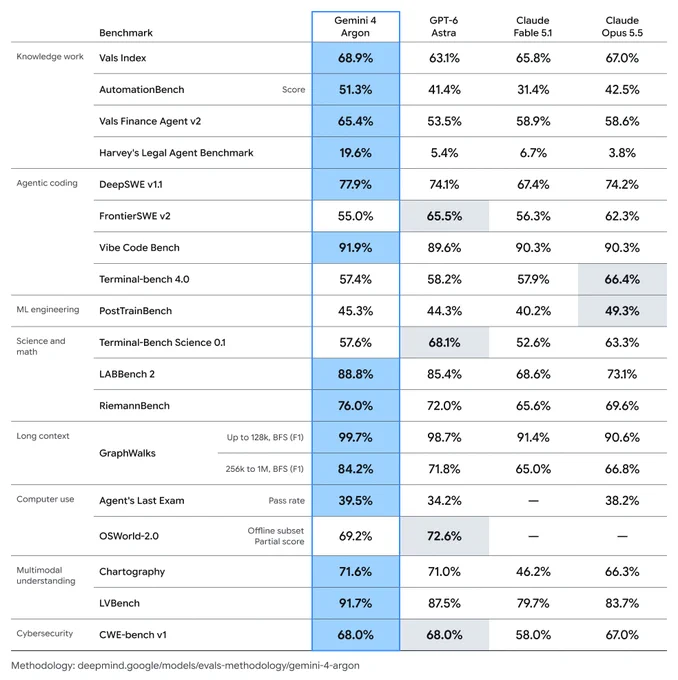
Introducing Gemini 4 Argon – our new frontier model.
It’s built for complex workflows across coding, enterprise knowledge work, and cybersecurity defense – rolling out today to a set of trusted testers through our Fairwind Program.
Show more
$MU Customers are paying to secure memory years ahead.
What immediately grabs your attention is the incredible numbers in Q4.
Revenue reached $54.2B, up 31% QoQ and 379% YoY. Non-GAAP gross margin hit 87%, EPS came in at $33.42, and adjusted free cash flow reached $33.2B.
For Q1 FY27, Micron guides to $61.5B in revenue and $38.15 in non-GAAP EPS at the midpoint.
It's massive numbers.
Management expects revenue to grow sequentially every quarter in FY27, with Q1 marking the year’s lowest gross margin.
TBH most of this growth is coming from pricing.
DRAM bit shipments rose by mid-single digits sequentially, while prices increased by high teens.
NAND shipments rose roughly 10%, while prices climbed around 30%.
That matters when judging how much of this performance can last.
The contracts give us something more concrete to work with.
Micron has signed 26 multi-year take-or-pay agreements, estimated to represent over 35% of revenue through 2030. Customer financial commitments total $32B, mostly cash deposits. Some agreements now extend into 2031.
Remaining performance obligations are approximately $150B, calculated using committed volumes and minimum contractual pricing where a pricing framework exists. Management says even those floor prices should deliver margins meaningfully above previous cycle peaks.
HBM is another important piece. Agreements are complete for the vast majority of Micron’s 2027 HBM bit supply, with significant annual price increases narrowing its gross-margin gap with conventional DRAM. Micron is also working with NVIDIA on NVHBM, a custom HBM4E implementation for next-generation GPUs and NVLink Fusion platforms.
But I wouldn’t overlook storage. Quarterly data center SSD revenue was nearly $10B, more than 10 times the year-ago level. Micron identifies KV-cache offload and HDD replacement as expanding opportunities.
The question I’m left with is how quickly supply can catch up.
Micron expects tighter conditions in 2027 and 2028 and says it cannot yet identify when DRAM supply and demand will balance. Planned capex is approximately $25B in the first half of FY27, with spending higher in the second half. Much of the additional construction spending targets cleanroom availability in late 2028 and beyond.
Pricing explains much of today’s earnings, while the customer commitments strengthen the case for durability. Customers are putting substantial cash behind their future memory needs. I’d watch those contracts and the capacity timeline just as closely as the next quarter’s growth.
Show more


CoreWeave is starting to outgrow the simple "neocloud" label.
Today's Partner Network announcement is a pretty logical move.
Instead of trying to build every service in-house, they're pulling storage, security, observability and inference providers into a pre-validated stack built around their GPU infrastructure.
Add Forge, and you can see where this is going. CoreWeave wants to cover more of the AI lifecycle, from running and monitoring workloads to evaluation and model improvement.
That matters for the business model.
GPU capacity alone is relatively easy to compare across providers and should get harder to differentiate over time. But once customers are building and operating more of their AI stack inside your environment, switching gets more complicated.
The approach is also quite different from AWS.
AWS spent years building a massive catalog of services around a general-purpose cloud.
CoreWeave started with specialized AI infrastructure and is building outward, leaning on partners for much of what sits outside its core product.
And I think that's the key here.
CoreWeave doesn't need to rebuild every piece of the stack. It needs to make CoreWeave the place where all those pieces come together.
That's a much more interesting $CRWV story than simply selling more GPU hours.
Show more

Why I invest in optical transceiver manufacturers:
> I look for suppliers whose high-speed revenue is still growing from a small base.
> These products already generate revenue as customers deploy them.
> Industry forecasts project 800G-and-faster shipments to roughly triple between 2025 and 2030.
> The 2027 pricing estimates below put 1.6T modules at roughly 2.5–2.8× the price of corresponding 800G designs.
> The demand is already showing up in shipments: 400G+ module volumes rose 145% year over year in Q1 2026.
Prices within each generation decline, so execution matters.
Suppliers need to qualify new products and scale production while protecting margins.
For me, the appeal is straightforward: revenue today, growing unit volumes, and a transition toward higher-priced modules.
At the right supplier, that combination can materially change earnings.
$LITE $COHR $AAOI $CRDO
Show more