

And the last token I want to talk about today is $TULIP
A lot of you have been asking me about this one after that almost vertical move
After digging deeper into it, I think the narrative is actually much more interesting than just looking at the chart
So let’s break it down
1. The lore behind $TULIP is actually pretty good
The whole story starts with Tulip Mania in 1637, one of the most famous speculative bubbles in history
For years, crypto itself has constantly been compared to Tulip Mania
But $TULIP basically flips that story around
Instead of using tulips as a symbol of a speculative bubble collapsing, this meme turns tulips back into the speculative asset again, except this time it’s happening on-chain
What makes it even more interesting is that the idea actually existed before the token started running
Back on August 29, @printer_brrr posted an idea about finding a heavily shorted stock, tokenizing it, creating a meme pair around it, and turning the whole thing into an on-chain short-squeeze narrative
The stock he specifically mentioned was 1-800-FLOWERS, $FLWS
Then FLWS actually got tokenized
And shortly after that, $TULIP appeared with a direct TULIP/FLWS pair on Raydium
That sequence is probably the biggest reason I find this narrative interesting
A lot of memes pump first, then the community tries to build lore around them afterward
$TULIP is almost the opposite: the idea came first, the real-world event happened after, and then the token appeared at exactly the right time to capture the attention
2. FLWS gives the meme a real-world connection
$FLWS isn’t some random ticker created just for the meme
1-800-FLOWERS is a real American flowers and gifts company, while its stock has been trading weakly with relatively high short interest
That creates a very simple story :
Wall Street is shorting a flower company, while on-chain degens are buying “flowers” to make money
It sounds stupid
But that’s exactly why it works as a meme
You have a real company, a real stock, tokenized exposure to that stock, and then a memecoin paired directly with it
Wall Street shorts flowers, degens buy flowers
You can basically explain the entire narrative in one sentence
And in meme markets, that matters a lot
The easier a story is to understand, repeat, and turn into content, the easier it is for attention to spread
3. Timing is probably the strongest catalyst here
This is the part I like the most
Tulip Mania obviously isn’t a new reference
The idea of using FLWS to create a short-squeeze narrative wasn’t created yesterday either
But FLWS was just tokenized, and suddenly this story became something people could actually trade on-chain
Then $TULIP appeared with a direct TULIP/FLWS pair
It almost perfectly matches the original thesis
@printer_brrr also brought attention back to the idea after FLWS was tokenized, reconnecting the current market with that older thesis
I wouldn’t treat that as an endorsement of this exact CA
But from a narrative catalyst perspective, it definitely matters
$TULIP didn’t need to invent a completely new story
It simply appeared at exactly the moment when an old story suddenly became tradable
The timing itself is the catalyst
4. But don’t confuse the “short squeeze” narrative with an actual short squeeze
This is something you need to understand clearly
Buying $TULIP does not directly force people shorting FLWS on Nasdaq to cover their positions
There’s no mechanism where buying this memecoin automatically squeezes Wall Street
The short-squeeze angle here is still primarily a meme narrative
Wall Street shorts the stock
The stock gets tokenized
A meme gets paired with it
Then the community turns the whole thing into a degens vs Wall Street trade
It creates a very familiar narrative structure :
David vs Goliath. On-chain vs TradFi. Degens vs Wall Street
From an attention perspective, that’s a powerful story, even if the actual financial mechanism is much weaker than the meme makes it sound
So my bet here is pretty simple :
I’m not betting that $TULIP will actually cause a short squeeze. I’m betting that the market likes the story of a short squeeze
And once the market stops liking that story, my conviction changes very quickly
5. A-tier meme, but currently still a C-tier token
This is probably the most important distinction to understand
I really like the meme
But I have much less conviction in the token itself
$TULIP is still extremely new
There’s no established public team, no meaningful roadmap, and no real utility that would make me treat this as a long-term fundamental play
It also uses Token-2022 with a transfer fee configuration, and the token setup isn’t exactly what I’d call blue-chip clean
There are also multiple Tulip tokens trying to capture the same narrative, which means attention can easily get fragmented
At the moment, I also haven’t seen enough major KOL confirmation around this exact CA to treat social validation as part of the thesis
Even @printer_brrr’s involvement needs to be understood correctly
He matters to the lore and narrative, but that doesn’t automatically mean he’s endorsing this specific token
So my current view is still :
A-tier meme, C-tier token
Take away the lore and attention, and there really isn’t much fundamental value underneath
Attention is basically the fundamentals of $TULIP right now
If attention keeps expanding, valuation can expand very quickly
If attention disappears, there isn’t much underneath to support the price
6. The chart finally gave us a clearer structure
$TULIP ran from a low cap to above $4M MC, then corrected aggressively toward $800K
I personally took a position around $1M MC, and since then buyers have defended the $800K area, pushing the chart back toward $2.4M
So the structure is pretty simple :
$4M+ => correction to ~$800K => support defended => bounce back to ~$2.4M
For now, $800K is the main support and invalidation I’m watching
If momentum and volume continue, the previous $4M+ local high becomes the next major level
If $800K gets clearly lost and fails to reclaim, I cut
I’m not moving my invalidation just because I like the lore
7. There’s another $TULIP trying to vamp the narrative
There’s also another $TULIP on gaining attention and competing for the same narrative
But personally, I still prefer this one
The reason is simple: the version isn’t paired with FLWS, while this $TULIP is directly paired with it
And since the whole thesis comes from :
Tulip Mania + 1-800-FLOWERS + tokenized FLWS + the old short-squeeze idea
I think this version still has the cleaner narrative connection
Of course, better lore doesn’t guarantee it wins. If liquidity and attention clearly rotate toward the other $TULIP, I’ll reassess
The market decides the winner, not me
8. My plan and the dip zones I’m watching for you guys
For me, this is still a narrative trade, not something I’m planning to marry
I personally took my position around $1M MC, so after the bounce back toward $2.4M, I’m not looking to chase or add aggressively
I already have the position I wanted
For those of you who don’t have a position yet, I don’t think there’s any need to FOMO after an almost 3x bounce from the $800K area
If you want to bet on it, I’d rather wait for a correction
The first area I’d watch is around $1.6M–$1.8M MC
If price comes back there while volume still looks healthy, FLWS is still getting attention, and nothing has changed in the narrative, I think a small position starts becoming interesting
If we get a deeper correction, $1M–$1.2M MC would offer a better risk/reward, since it’s close to the previous base and not too far from the main $800K support
But don’t blindly buy just because the market cap is lower
If price comes back while volume is dying, FLWS is losing attention, or liquidity is rotating aggressively into another version, then a cheaper price doesn’t mean much
And most importantly, $800K remains the key level
If $800K gets clearly lost without a reclaim, I’m not going to keep catching the dip
So the plan is simple :
My position: entry around $1M
No position yet: don’t chase ~$2.4M. Watch $1.6M–$1.8M first, and $1M–$1.2M on a deeper correction
Main support/invalidation: ~$800K
A dip is only attractive when the price goes down but the thesis doesn’t
9. Conclusion
I completely understand why $TULIP managed to capture attention so quickly
It combines :
Tulip Mania + a real flower company + a heavily shorted stock + tokenized FLWS + a direct TULIP/FLWS pair + an old thesis suddenly becoming relevant at exactly the right time
That’s a strong combination for a meme because the story is simple, funny, and extremely easy to spread
There’s now another $TULIP on competing for the same attention, but for now I still prefer this version because the FLWS pair actually completes the original thesis
I entered around $1M MC, and the $800K support has already been tested and defended, followed by a strong bounce back toward $2.4M
For those who haven’t entered yet, I wouldn’t chase the current bounce
I’d rather watch $1.6M–$1.8M, or $1M–$1.2M on a deeper correction, as long as the narrative and volume remain intact
If momentum continues, the $4M+ local high is the next major area I’m watching
If $800K gets completely lost, I cut
Simple as that
I still like the story behind $TULIP more than I like the token itself
Trade the attention, don’t marry the story
7vSG4GX8qz5V36noSde5Z9xV8xAXAGqivDyaNytPVDJf
Show more


And the third play I want to talk about today is $RAYCAT
A lot of you have been asking me about this one after its recent run, especially one question :
Is the current dip actually a good entry?
I looked deeper into it, and before talking about entry, I think we first need to understand what we're actually betting on here
$RAYCAT is not an official Raydium token, and it’s also not the leader of the current cat meta
The thesis, in my view, sits at the intersection of three narratives :
Cat meta + $RAY/Raydium + StonkFun dividend meta
1. The idea is simple: hold the cat, earn RAY
What makes $RAYCAT different from a pure cat meme is the reward mechanics
Every buy, sell, or transfer of $RAYCAT is taxed. Most of that fee is converted into RAY and distributed back to holders based on how much $RAYCAT they hold
No staking, no locking, and no manual claiming
Simple :
More volume => more fees => more RAY rewards for holders
StonkFun also has a mechanism that uses part of its platform revenue to buy back and burn $RAYCAT. That is a separate flow, so don’t confuse it with the tax used for holder rewards
One practical detail: transferring tokens between wallets can still be taxed, and very small wallets may not meet the minimum threshold to receive rewards
So yes, I like the mechanics, but don’t look at a high APR and assume it’s fixed yield
The APR looks high because volume is high
If volume drops, rewards drop with it
For me, if you’re tracking this play :
Watch volume first, APR second
2. But $RAYCAT didn’t create this meta
To understand why $RAYCAT ran, you first need to look at $ZCAT
$ZCAT was the one that proved the template :
Hold a meme => earn a “real” token.
$ZCAT rewards holders in ZEC, and after its massive run, the market started copying the same mechanics into other tokens :
RAYCAT => RAY
JUPCAT => JUP
LEVERCAT => LEVER
So if we’re being accurate, $RAYCAT is a beta of the $ZCAT thesis, not the originator of the narrative
But that’s how meme markets work
The leader creates the meta first, then liquidity starts rotating into smaller betas
And among those betas, I think $RAYCAT has pretty clear positioning
3. Because it picked the right token : RAY
This is where it gets interesting for me
Ray Cat
Paired with RAY
Rewards paid in RAY
Launched through StonkFun while the StonkFun/Raydium narrative already has attention
So buying $RAYCAT isn’t really just betting on another cat
You’re effectively betting on three things at once :
Cat meta staying alive + RAY staying strong + StonkFun continuing to generate volume
That’s why I see $RAYCAT as something like :
A cheaper beta of $ZCAT + an option on RAY
If RAY keeps running and liquidity stays active around StonkFun, I think $RAYCAT is one of the easiest betas for the market to rotate back into within this branch of the meta
4. But there’s one narrative I think people are pushing too far
The whole “official Raydium cat” story
Raydium has posted cat memes, and the community started connecting them to $RAYCAT
It’s obviously a very easy narrative to FOMO into
But so far, I haven’t seen Raydium officially mention the $RAYCAT ticker or post the actual CA confirming that this is their token or mascot
$RAYCAT itself is also not an official Raydium product
So separate these two things :
Raydium posting cats = fact
That cat being $RAYCAT = community narrative
If Raydium eventually mentions the actual ticker or CA, that could become a very strong catalyst
But for now, I treat it as a potential catalyst, not something I’d buy based on the assumption that “Raydium will eventually tweet it”
5. The problem is that most of the easy catalysts have already happened
This is why I’m not that interested in chasing the current dip
$RAYCAT has already been verified/listed on Fomo
Moonshot has verified it too
RAY already had a strong move
The cat meta has already run
StonkFun already has attention
And the chart has reflected all of that pretty clearly
$RAYCAT ran from around $2M to nearly $15M MC, then wicked back down hard
So this is no longer a pre-pump play
It’s an after-pump play currently going through a reset
For another strong leg, I think it needs fresh fuel
Maybe RAY breaks out again
Maybe StonkFun volume expands further
Maybe $ZCAT starts a second leg and pulls the smaller satellites with it
Or the strongest catalyst would obviously be Raydium actually acknowledging $RAYCAT itself
Without something new, I’d lean more toward the chart needing time to reset rather than immediately printing another ATH
6. And don’t forget that $ZCAT is still the leader
Looking at the broader cat meta, $ZCAT is still clearly ahead
It has the first-mover advantage, a much larger market cap, and most importantly, it has already proven the narrative
$RAYCAT is still more of a satellite play
Simply put :
$ZCAT is the leader of the meta
$RAYCAT is the RAY beta
If $ZCAT starts another leg, liquidity can easily rotate down into smaller betas like $RAYCAT
But the opposite is also true
When the leader gets weak, satellites usually get hit harder
So don’t look at $ZCAT around ~$100M and $RAYCAT around ~$8M and simply think :
“It still has another 10–12x just to catch ZCAT”
Meme markets don’t price things that easily
7. This is also why the mechanics are both its biggest strength and its biggest risk
The $RAYCAT flywheel looks great when the market is hot :
Volume => tax => RAY rewards => incentive to hold => attention => more volume
But when the market turns, that same flywheel can reverse :
Attention drops => volume drops => rewards drop => incentive to hold drops
So at the end of the day, the real engine is still volume
If price corrects but volume remains healthy, RAY stays strong, and StonkFun keeps getting attention, I’m not too worried
But if the chart starts bleeding while volume dies at the same time, then a pretty APR number doesn’t mean much
This is still a meme
And cat metas rotate extremely fast
Today the market likes $RAYCAT. Tomorrow, another “CAT + reward token” can appear and steal all the attention
8. So is the current dip worth buying?
This is the main question
At around $8M MC, personally, I’m not chasing it
Not because the thesis is bad
It simply just ran from ~$2M to ~$15M before correcting back here. To me, ~$8M still feels stuck somewhere between the expansion and the actual reset zone
If I wanted to bet on it, I’d start paying attention around $5–6M
The $4–5M area becomes much more interesting if RAY is still strong, StonkFun is still generating volume, and the cat meta hasn’t died
If the market actually gives us around $3M while the entire thesis remains intact, that’s where I’d see a much better margin of safety for a gamble
On the other hand, if it loses the ~$2M area completely, then the structure of this current wave is basically broken for me
Meme is meme
No matter how good the narrative is, you still need an invalidation
9. Final thoughts
I actually like $RAYCAT
Not simply because it’s another cat, but because it sits at the intersection of several narratives that make sense :
$ZCAT dividend meta + RAY + Raydium + StonkFun
The $RAY reward mechanics also give it more reason to be interesting than most of the other cat clones
But I still see it as a beta, not the leader. More importantly, most of the easy catalysts have already been priced in through that move from ~$2M to nearly ~$15M
For another leg, I want to see volume remain strong or a fresh catalyst appear
So for the question I keep getting :
Is the ~$8M dip worth buying?
For me, there’s no need to rush
I like $RAYCAT, but at ~$8M, I don’t like the price yet
CFNRDaxFcvRwRSNnA5cHrCCr6AHhk9dNkHWpRUjNupFL
Show more


And the third play I want to talk about today is $RAYCAT
A lot of you have been asking me about this one after its recent run, especially one question :
Is the current dip actually a good entry?
I looked deeper into it, and before talking about entry, I think we first need to understand what we're actually betting on here
$RAYCAT is not an official Raydium token, and it’s also not the leader of the current cat meta
The thesis, in my view, sits at the intersection of three narratives :
Cat meta + $RAY/Raydium + StonkFun dividend meta
1. The idea is simple: hold the cat, earn RAY
What makes $RAYCAT different from a pure cat meme is the reward mechanics
Every buy, sell, or transfer of $RAYCAT is taxed. Most of that fee is converted into RAY and distributed back to holders based on how much $RAYCAT they hold
No staking, no locking, and no manual claiming
Simple :
More volume => more fees => more RAY rewards for holders
StonkFun also has a mechanism that uses part of its platform revenue to buy back and burn $RAYCAT. That is a separate flow, so don’t confuse it with the tax used for holder rewards
One practical detail: transferring tokens between wallets can still be taxed, and very small wallets may not meet the minimum threshold to receive rewards
So yes, I like the mechanics, but don’t look at a high APR and assume it’s fixed yield
The APR looks high because volume is high
If volume drops, rewards drop with it
For me, if you’re tracking this play :
Watch volume first, APR second
2. But $RAYCAT didn’t create this meta
To understand why $RAYCAT ran, you first need to look at $ZCAT
$ZCAT was the one that proved the template :
Hold a meme => earn a “real” token.
$ZCAT rewards holders in ZEC, and after its massive run, the market started copying the same mechanics into other tokens :
RAYCAT => RAY
JUPCAT => JUP
LEVERCAT => LEVER
So if we’re being accurate, $RAYCAT is a beta of the $ZCAT thesis, not the originator of the narrative
But that’s how meme markets work
The leader creates the meta first, then liquidity starts rotating into smaller betas
And among those betas, I think $RAYCAT has pretty clear positioning
3. Because it picked the right token : RAY
This is where it gets interesting for me
Ray Cat
Paired with RAY
Rewards paid in RAY
Launched through StonkFun while the StonkFun/Raydium narrative already has attention
So buying $RAYCAT isn’t really just betting on another cat
You’re effectively betting on three things at once :
Cat meta staying alive + RAY staying strong + StonkFun continuing to generate volume
That’s why I see $RAYCAT as something like :
A cheaper beta of $ZCAT + an option on RAY
If RAY keeps running and liquidity stays active around StonkFun, I think $RAYCAT is one of the easiest betas for the market to rotate back into within this branch of the meta
4. But there’s one narrative I think people are pushing too far
The whole “official Raydium cat” story
Raydium has posted cat memes, and the community started connecting them to $RAYCAT
It’s obviously a very easy narrative to FOMO into
But so far, I haven’t seen Raydium officially mention the $RAYCAT ticker or post the actual CA confirming that this is their token or mascot
$RAYCAT itself is also not an official Raydium product
So separate these two things :
Raydium posting cats = fact
That cat being $RAYCAT = community narrative
If Raydium eventually mentions the actual ticker or CA, that could become a very strong catalyst
But for now, I treat it as a potential catalyst, not something I’d buy based on the assumption that “Raydium will eventually tweet it”
5. The problem is that most of the easy catalysts have already happened
This is why I’m not that interested in chasing the current dip
$RAYCAT has already been verified/listed on Fomo
Moonshot has verified it too
RAY already had a strong move
The cat meta has already run
StonkFun already has attention
And the chart has reflected all of that pretty clearly
$RAYCAT ran from around $2M to nearly $15M MC, then wicked back down hard
So this is no longer a pre-pump play
It’s an after-pump play currently going through a reset
For another strong leg, I think it needs fresh fuel
Maybe RAY breaks out again
Maybe StonkFun volume expands further
Maybe $ZCAT starts a second leg and pulls the smaller satellites with it
Or the strongest catalyst would obviously be Raydium actually acknowledging $RAYCAT itself
Without something new, I’d lean more toward the chart needing time to reset rather than immediately printing another ATH
6. And don’t forget that $ZCAT is still the leader
Looking at the broader cat meta, $ZCAT is still clearly ahead
It has the first-mover advantage, a much larger market cap, and most importantly, it has already proven the narrative
$RAYCAT is still more of a satellite play
Simply put :
$ZCAT is the leader of the meta
$RAYCAT is the RAY beta
If $ZCAT starts another leg, liquidity can easily rotate down into smaller betas like $RAYCAT
But the opposite is also true
When the leader gets weak, satellites usually get hit harder
So don’t look at $ZCAT around ~$100M and $RAYCAT around ~$8M and simply think :
“It still has another 10–12x just to catch ZCAT”
Meme markets don’t price things that easily
7. This is also why the mechanics are both its biggest strength and its biggest risk
The $RAYCAT flywheel looks great when the market is hot :
Volume => tax => RAY rewards => incentive to hold => attention => more volume
But when the market turns, that same flywheel can reverse :
Attention drops => volume drops => rewards drop => incentive to hold drops
So at the end of the day, the real engine is still volume
If price corrects but volume remains healthy, RAY stays strong, and StonkFun keeps getting attention, I’m not too worried
But if the chart starts bleeding while volume dies at the same time, then a pretty APR number doesn’t mean much
This is still a meme
And cat metas rotate extremely fast
Today the market likes $RAYCAT. Tomorrow, another “CAT + reward token” can appear and steal all the attention
8. So is the current dip worth buying?
This is the main question
At around $8M MC, personally, I’m not chasing it
Not because the thesis is bad
It simply just ran from ~$2M to ~$15M before correcting back here. To me, ~$8M still feels stuck somewhere between the expansion and the actual reset zone
If I wanted to bet on it, I’d start paying attention around $5–6M
The $4–5M area becomes much more interesting if RAY is still strong, StonkFun is still generating volume, and the cat meta hasn’t died
If the market actually gives us around $3M while the entire thesis remains intact, that’s where I’d see a much better margin of safety for a gamble
On the other hand, if it loses the ~$2M area completely, then the structure of this current wave is basically broken for me
Meme is meme
No matter how good the narrative is, you still need an invalidation
9. Final thoughts
I actually like $RAYCAT
Not simply because it’s another cat, but because it sits at the intersection of several narratives that make sense :
$ZCAT dividend meta + RAY + Raydium + StonkFun
The $RAY reward mechanics also give it more reason to be interesting than most of the other cat clones
But I still see it as a beta, not the leader. More importantly, most of the easy catalysts have already been priced in through that move from ~$2M to nearly ~$15M
For another leg, I want to see volume remain strong or a fresh catalyst appear
So for the question I keep getting :
Is the ~$8M dip worth buying?
For me, there’s no need to rush
I like $RAYCAT, but at ~$8M, I don’t like the price yet
CFNRDaxFcvRwRSNnA5cHrCCr6AHhk9dNkHWpRUjNupFL
Show more
And the second token I want to talk about today is $CATGPT
This is one of the tokens I think is worth researching on Robinhood Chain right now
But first, we need to get one thing straight :
$CATGPT is not a ChatGPT token, and it is not OpenAI stock
Its thesis sits at the intersection of three narratives currently getting attention :
Cat meta + OpenAI/ChatGPT + stock/pre-IPO paired memes
And what interests me most isn't the $CATGPT name itself, but where it sits within the LONG ecosystem
1. What are you actually betting on with $CATGPT?
Robinhood Chain was originally built around tokenized stocks/RWAs, but memes have become one of the biggest drivers of volume on the chain
The meta has also evolved pretty clearly:
Pure memes like $CASHCAT => memes paired with listed stocks => memes paired with Pre-IPO narratives
$CATGPT sits in the third category
It's paired directly with OPENAIx1L, a tokenized long exposure to OpenAI within the LONG/Lighter ecosystem
The flow is pretty simple :
OpenAI hasn't IPO'd yet => LONG creates OPENAIx1L to give the market exposure to the OpenAI narrative => $CATGPT pairs with OPENAIx1L and becomes the meme layer pulling retail attention into the same narrative
So I don't see $CATGPT as simply "a GPT cat"
I see it more as a distribution/attention layer for the long OpenAI onchain narrative
2. Why is $CATGPT positioned pretty well right now?
The timing is what I like
$CATGPT appeared almost exactly when LONG started opening up the OpenAI/Anthropic Pre-IPO narrative, and attention on the OpenAI side currently seems fairly concentrated around it
That gives $CATGPT a kind of first-mover attention
If LONG keeps pushing OpenAI pairs, expands TVL, and turns Pre-IPO into a real meta, the market will probably need a ticker that represents that narrative
Right now, $CATGPT has a chance to take that slot
But I want to emphasize: it has the opportunity, it hasn't proven itself yet. The token is still very new
3. $AI/NVDA is a useful benchmark
Anyone who's been trading this ecosystem probably knows $AI
$AI went from a small cap to hundreds of millions, but it didn't run simply because it was paired with NVDA
It had a memorable ticker, a powerful NVDA narrative, better liquidity, and most importantly, enough time for the market to recognize it as one of the representative tokens of the ecosystem
$CATGPT currently only has the right place + the right timing
It doesn't yet have the same history, liquidity depth, or holder base as $AI
So I wouldn't use this logic :
$AI reached hundreds of millions => therefore $CATGPT should do the same
What $AI actually proved is :
LONG's meme + stock pair model can produce a major runner. Now $CATGPT is testing a similar model with the OpenAI Pre-IPO narrative
Whether it becomes the next runner is something the market still needs time to answer
4. The chart looks okay, but I wouldn't call the structure strong yet
$CATGPT price-discovered to around $19–20M, dumped to $8–9M, bounced back to $15–16M, and is now trading around $11–12M
I wouldn't call this accumulation yet
It looks more like temporary equilibrium after price discovery
The positive side is that buyers have continued absorbing dips, and the token hasn't simply bled straight back to the lows
But at the same time, the market hasn't established a clear base either
$11–12M is currently in the middle of the range. It's not the bottom, but it's not a breakout either
Buyers are returning, but I wouldn't call them particularly strong yet. Some early wallets have also started distributing, so supply appears to be rotating from early buyers into a new holder base
If new holders continue absorbing that supply, the structure can gradually improve
But if volume declines while holder growth stalls, future bounces could easily become exit liquidity
5. Liquidity is actually what concerns me more
The main issue isn't necessarily the $CATGPT side. It's the OPENAIx1L leg
The OpenAI vault currently has a cap of around $600K, while the meme itself has already reached valuations in the tens of millions
That creates a pretty significant gap between:
meme valuation <=> depth of the underlying narrative
When money flows in, this structure can amplify upside very quickly
But when sell pressure arrives, it can amplify the downside just as fast
Simply put :
The meme side of the pool looks relatively deep. OPENAIx1L is the thinner leg
That's why I don't see OPENAIx1L as a hard "floor" for $CATGPT
On the other hand, if LONG raises the cap, grows TVL, and adds more liquidity to the OpenAI side, that would be one of the strongest catalysts for the thesis
6. The mechanics also need to be understood correctly
The $CATGPT contract itself is pretty simple :
~1B supply, 0% tax, almost 0 dev holdings, renounced, with no staking, reflections, or rights to claim OpenAI equity
Mechanisms such as fees, community vaults, burns, and counter-dump features mainly belong to the LONG/pool mechanics, not to $CATGPT itself
More importantly :
Holding $CATGPT does not mean you own OpenAI or receive OpenAI shares
OPENAIx1L isn't OpenAI equity either. It's a form of tokenized long exposure
So ultimately, the value of $CATGPT still depends on four things :
Attention + ecosystem positioning + liquidity + narrative
7. What would make me more bullish?
There are four things I want to see
LONG continues pushing $CATGPT as a representative pair
Holder count continues growing after the launch hype cools down
OPENAIx1L gets a higher cap and real liquidity growth
And finally, the chart establishes a base after correction instead of continuously printing lower highs
If these happen together, I think the thesis could shift from an event trade into something worth holding a little longer
8. What are the risks?
The biggest risk is that both legs can move against you
$CATGPT can lose attention while OPENAIx1L/NAV weakens the other side of the pool. Being paired with an OpenAI-related asset does not create a hard floor
Second, attention isn't exclusive
The same vault already has $FROGE, $GPT, $OPENAITOKEN... and more tokens can always appear
$CATGPT only deserves its premium as long as it remains the narrative leader
There's also the weekend/after-hours issue: memes trade 24/7, while the Pre-IPO underlying doesn't have the same kind of clean real-time price discovery, so dislocations can become larger
And finally, the token is still extremely new
A few good launch days aren't enough to prove holder quality or whether it can survive once attention starts rotating elsewhere
9. My plan
At $11–12M, I'm not chasing
We're currently sitting around the middle of the post-price-discovery range, so I don't think the risk/reward is particularly attractive
If I want to bet on it :
> $8–9M: shallow dip. Only interesting if volume and holder growth remain healthy
> $5–6.5M: this is where the risk/reward starts becoming more interesting to me if the LONG + OpenAI thesis remains intact
> $3–4M: only worth gambling on if $CATGPT still holds the representative slot and LONG continues pushing OpenAI
But if volume collapses, holder growth stalls, top wallets start distributing heavily, OPENAIx1L liquidity gets clearly pulled, or attention rotates into another token, then I'll drop the dip-buying plan entirely
A cheaper price doesn't automatically mean a better entry
10. Conclusion
What I like about $CATGPT isn't the fact that it has ChatGPT in its name
It's sitting right at the intersection of :
Cat meta + OpenAI + Pre-IPO + LONG ecosystem
That's a strong narrative position, but a strong position doesn't automatically mean a strong token
Underlying liquidity is still thin, the holder base hasn't been stress-tested, and the market is already pricing in a lot of expectations for such a new token
To me, $CATGPT currently looks more like an option on LONG turning OpenAI Pre-IPO into the next meta than something I'd hold for fundamentals
If LONG keeps pushing, OPENAIx1L gains more depth, and $CATGPT maintains the #1# attention slot, I think there could still be meaningful upside
But at $11–12M, I don't think there's any reason to FOMO
I like the thesis. I just don't like the entry yet
0xd6FDE6a3Fc6Ab2d83b2BE58383944CA1baDe1E18
Show more


And the second token I want to talk about today is $CATGPT
This is one of the tokens I think is worth researching on Robinhood Chain right now
But first, we need to get one thing straight :
$CATGPT is not a ChatGPT token, and it is not OpenAI stock
Its thesis sits at the intersection of three narratives currently getting attention :
Cat meta + OpenAI/ChatGPT + stock/pre-IPO paired memes
And what interests me most isn't the $CATGPT name itself, but where it sits within the LONG ecosystem
1. What are you actually betting on with $CATGPT?
Robinhood Chain was originally built around tokenized stocks/RWAs, but memes have become one of the biggest drivers of volume on the chain
The meta has also evolved pretty clearly:
Pure memes like $CASHCAT => memes paired with listed stocks => memes paired with Pre-IPO narratives
$CATGPT sits in the third category
It's paired directly with OPENAIx1L, a tokenized long exposure to OpenAI within the LONG/Lighter ecosystem
The flow is pretty simple :
OpenAI hasn't IPO'd yet => LONG creates OPENAIx1L to give the market exposure to the OpenAI narrative => $CATGPT pairs with OPENAIx1L and becomes the meme layer pulling retail attention into the same narrative
So I don't see $CATGPT as simply "a GPT cat"
I see it more as a distribution/attention layer for the long OpenAI onchain narrative
2. Why is $CATGPT positioned pretty well right now?
The timing is what I like
$CATGPT appeared almost exactly when LONG started opening up the OpenAI/Anthropic Pre-IPO narrative, and attention on the OpenAI side currently seems fairly concentrated around it
That gives $CATGPT a kind of first-mover attention
If LONG keeps pushing OpenAI pairs, expands TVL, and turns Pre-IPO into a real meta, the market will probably need a ticker that represents that narrative
Right now, $CATGPT has a chance to take that slot
But I want to emphasize: it has the opportunity, it hasn't proven itself yet. The token is still very new
3. $AI/NVDA is a useful benchmark
Anyone who's been trading this ecosystem probably knows $AI
$AI went from a small cap to hundreds of millions, but it didn't run simply because it was paired with NVDA
It had a memorable ticker, a powerful NVDA narrative, better liquidity, and most importantly, enough time for the market to recognize it as one of the representative tokens of the ecosystem
$CATGPT currently only has the right place + the right timing
It doesn't yet have the same history, liquidity depth, or holder base as $AI
So I wouldn't use this logic :
$AI reached hundreds of millions => therefore $CATGPT should do the same
What $AI actually proved is :
LONG's meme + stock pair model can produce a major runner. Now $CATGPT is testing a similar model with the OpenAI Pre-IPO narrative
Whether it becomes the next runner is something the market still needs time to answer
4. The chart looks okay, but I wouldn't call the structure strong yet
$CATGPT price-discovered to around $19–20M, dumped to $8–9M, bounced back to $15–16M, and is now trading around $11–12M
I wouldn't call this accumulation yet
It looks more like temporary equilibrium after price discovery
The positive side is that buyers have continued absorbing dips, and the token hasn't simply bled straight back to the lows
But at the same time, the market hasn't established a clear base either
$11–12M is currently in the middle of the range. It's not the bottom, but it's not a breakout either
Buyers are returning, but I wouldn't call them particularly strong yet. Some early wallets have also started distributing, so supply appears to be rotating from early buyers into a new holder base
If new holders continue absorbing that supply, the structure can gradually improve
But if volume declines while holder growth stalls, future bounces could easily become exit liquidity
5. Liquidity is actually what concerns me more
The main issue isn't necessarily the $CATGPT side. It's the OPENAIx1L leg
The OpenAI vault currently has a cap of around $600K, while the meme itself has already reached valuations in the tens of millions
That creates a pretty significant gap between:
meme valuation <=> depth of the underlying narrative
When money flows in, this structure can amplify upside very quickly
But when sell pressure arrives, it can amplify the downside just as fast
Simply put :
The meme side of the pool looks relatively deep. OPENAIx1L is the thinner leg
That's why I don't see OPENAIx1L as a hard "floor" for $CATGPT
On the other hand, if LONG raises the cap, grows TVL, and adds more liquidity to the OpenAI side, that would be one of the strongest catalysts for the thesis
6. The mechanics also need to be understood correctly
The $CATGPT contract itself is pretty simple :
~1B supply, 0% tax, almost 0 dev holdings, renounced, with no staking, reflections, or rights to claim OpenAI equity
Mechanisms such as fees, community vaults, burns, and counter-dump features mainly belong to the LONG/pool mechanics, not to $CATGPT itself
More importantly :
Holding $CATGPT does not mean you own OpenAI or receive OpenAI shares
OPENAIx1L isn't OpenAI equity either. It's a form of tokenized long exposure
So ultimately, the value of $CATGPT still depends on four things :
Attention + ecosystem positioning + liquidity + narrative
7. What would make me more bullish?
There are four things I want to see
LONG continues pushing $CATGPT as a representative pair
Holder count continues growing after the launch hype cools down
OPENAIx1L gets a higher cap and real liquidity growth
And finally, the chart establishes a base after correction instead of continuously printing lower highs
If these happen together, I think the thesis could shift from an event trade into something worth holding a little longer
8. What are the risks?
The biggest risk is that both legs can move against you
$CATGPT can lose attention while OPENAIx1L/NAV weakens the other side of the pool. Being paired with an OpenAI-related asset does not create a hard floor
Second, attention isn't exclusive
The same vault already has $FROGE, $GPT, $OPENAITOKEN... and more tokens can always appear
$CATGPT only deserves its premium as long as it remains the narrative leader
There's also the weekend/after-hours issue: memes trade 24/7, while the Pre-IPO underlying doesn't have the same kind of clean real-time price discovery, so dislocations can become larger
And finally, the token is still extremely new
A few good launch days aren't enough to prove holder quality or whether it can survive once attention starts rotating elsewhere
9. My plan
At $11–12M, I'm not chasing
We're currently sitting around the middle of the post-price-discovery range, so I don't think the risk/reward is particularly attractive
If I want to bet on it :
> $8–9M: shallow dip. Only interesting if volume and holder growth remain healthy
> $5–6.5M: this is where the risk/reward starts becoming more interesting to me if the LONG + OpenAI thesis remains intact
> $3–4M: only worth gambling on if $CATGPT still holds the representative slot and LONG continues pushing OpenAI
But if volume collapses, holder growth stalls, top wallets start distributing heavily, OPENAIx1L liquidity gets clearly pulled, or attention rotates into another token, then I'll drop the dip-buying plan entirely
A cheaper price doesn't automatically mean a better entry
10. Conclusion
What I like about $CATGPT isn't the fact that it has ChatGPT in its name
It's sitting right at the intersection of :
Cat meta + OpenAI + Pre-IPO + LONG ecosystem
That's a strong narrative position, but a strong position doesn't automatically mean a strong token
Underlying liquidity is still thin, the holder base hasn't been stress-tested, and the market is already pricing in a lot of expectations for such a new token
To me, $CATGPT currently looks more like an option on LONG turning OpenAI Pre-IPO into the next meta than something I'd hold for fundamentals
If LONG keeps pushing, OPENAIx1L gains more depth, and $CATGPT maintains the #1# attention slot, I think there could still be meaningful upside
But at $11–12M, I don't think there's any reason to FOMO
I like the thesis. I just don't like the entry yet
0xd6FDE6a3Fc6Ab2d83b2BE58383944CA1baDe1E18
Show more
Continuing with the highcap series I’m watching today
The first one is $BATON
I previously wrote my thesis and called $BATON in the channel at around $5M MC. Since then, it ran to nearly $18M and the structure is still holding up pretty well
A lot of you are still asking about it, so here’s a quick update: how much of the original thesis has been validated, and what’s left to bet on from here?
1. The $BATON narrative
First, let’s make one thing clear: $BATON is not an official token and it doesn’t have any real utility of its own. It’s still a community memecoin
But the lore behind it has a real origin
Baton Corporation Ltd is the name associated with the company behind the development of The Baton name also existed back in the Baton Finance days before the team pivoted into building
So the narrative is pretty straightforward :
Baton Finance => Baton Corporation => => $BATON
That means the lore wasn’t completely made up by the community
However, a real connection in the lore does not mean official endorsement. So far, I haven’t seen any evidence that Alon, or Baton Corporation officially backs this token
2. The catalyst I’m actually betting on is Custom Pairs
$BATON appeared right as started pushing Custom Pairs, expanding the ability to pair tokens with different types of assets. The stock/tokenized asset narrative is the part I’m particularly interested in
And $BATON is paired directly with $PUMP
Raydium already has StonkFun, while Robinhood Chain has shown that the stock meta can attract serious liquidity and attention
If wants to compete for this narrative, I don’t think having the feature alone is enough
They need runners
And from what I’m tracking right now, $BATON is still leading the Custom meta on
That’s one of the biggest reasons my thesis hasn’t changed
3. I see $BATON as an attention bet
My thesis is actually pretty simple :
pushes Custom Pairs
→ more attention flows into the ecosystem
→ $PUMP gets more attention
→ Custom Pair tokens attract more liquidity
→ the market looks for a runner
→ $BATON has the timing + lore to capture that attention
So I don’t see $BATON as simply a meme using the Baton Corporation name
I see it as an attention bet on the ecosystem
The harder Custom Pairs gets pushed, the more opportunities $PUMP and the strongest runners around that narrative have to capture liquidity
4. There have been many $BATONs, but the market is choosing this one
There have actually been quite a few versions of $BATON launched before
Most of them pumped for a while and quickly lost attention
This one has been different
So far, this is the longest-lasting $BATON and the one that has held attention the best from what I’ve seen
With memes, I don’t really care which one launched first
Narratives can be copied. Names can be copied. Lore can be copied
But liquidity, mindshare, and the ability to survive multiple corrections are much harder to copy
Eventually, the market usually picks only a few runners to concentrate liquidity into
Right now, this version is winning that battle
5. Price action is also validating the thesis
When I called it around $5M, most of the thesis was still just an expectation
Since then, $BATON has gone through multiple corrections, rebuilt its structure, reclaimed the $5–8M range, broke $10M, and then expanded to nearly $18M
This is the kind of meme structure I like:
pump => reset => absorption => reclaim => expansion
What matters isn’t how many Xs it has done
What matters is that buyers are still absorbing supply after each correction and the attention hasn’t disappeared
That’s why I think the market has validated a good part of the original thesis
6. From here, it needs new catalysts
At $5M, I was betting that the market hadn’t priced the narrative yet
After a move to nearly $18M, part of that story is clearly already priced in
From here, I’m watching three things :
continues pushing Custom Pairs
$BATON continues holding its position as the leader
And the biggest catalyst :
or Alon directly acknowledges $BATON
The last one hasn’t happened yet
If we eventually get direct interaction from or Alon, I think the narrative could get repriced much higher
But I’m not going to bet as if that’s guaranteed to happen
7. Risks
The biggest risk is still attention
$BATON has no product or revenue of its own and there is no official endorsement
If the Custom meta cools down, another runner takes the liquidity, or $BATON loses its position as the leader, the thesis can weaken very quickly
There’s also competition risk. Just because this is currently the strongest version doesn’t mean the market will choose it forever
Another risk worth mentioning is the legal risk surrounding Baton Corporation/Pump.fun
Baton Corporation is still involved in litigation in the US. Some claims have been dismissed, while part of the RICO claims have been allowed to proceed. That does not mean a court has found or its founders guilty of wrongdoing, but it remains an event risk worth monitoring
The Baton connection is what makes the narrative powerful, but if Baton/Pump.fun faces a materially negative legal development, that same connection could become a downside catalyst
And remember: $BATON is just a community meme. It is not equity or an official token of Baton Corporation/Pump.fun
Lore can create attention, but lore does not create a price floor
If liquidity, mindshare, or structure changes, my thesis will change too
8. My plan
Even though I’m still bullish on the thesis, I don’t think you guys should FOMO at the current price
$BATON has already moved from my ~$5M call to nearly $18M. The risk/reward is obviously very different now
If you don’t have a position but still want to bet on the narrative, personally I’d wait for a correction toward around $11M MC and then watch how buyers and the structure react
Entering here could easily make you exit liquidity for people who got in much lower and are taking profits
For those who entered with me around the lower levels, I think it makes sense to keep part of the position to bet on the next catalyst, but don’t forget to manage your profits
9. Conclusion
The thesis from $5M has been validated pretty well so far :
The lore has a real origin
The timing matched Custom Pairs
It’s paired directly with $PUMP
It has survived longer than the other $BATON versions
The price structure remains strong
And most importantly, it’s still leading the Custom meta on
So I’m still bullish on the thesis
But being bullish on a token doesn’t mean being bullish on every entry
At these levels, I’m holding my existing position and not chasing
If we correct toward $11M and the structure remains healthy, I’ll consider betting more
At $5M, I was betting on the narrative
From here, I’m betting on $BATON maintaining its position as the leader
If it loses that leadership, loses attention, or the structure breaks down, I’ll reassess
Hg5Ja55T5wESq4vyFoiVCMeHXtGyVA69X2UHq8hgpump
Show more


Continuing with the highcap series I’m watching today
The first one is $BATON
I previously wrote my thesis and called $BATON in the channel at around $5M MC. Since then, it ran to nearly $18M and the structure is still holding up pretty well
A lot of you are still asking about it, so here’s a quick update: how much of the original thesis has been validated, and what’s left to bet on from here?
1. The $BATON narrative
First, let’s make one thing clear: $BATON is not an official token and it doesn’t have any real utility of its own. It’s still a community memecoin
But the lore behind it has a real origin
Baton Corporation Ltd is the name associated with the company behind the development of The Baton name also existed back in the Baton Finance days before the team pivoted into building
So the narrative is pretty straightforward :
Baton Finance => Baton Corporation => => $BATON
That means the lore wasn’t completely made up by the community
However, a real connection in the lore does not mean official endorsement. So far, I haven’t seen any evidence that Alon, or Baton Corporation officially backs this token
2. The catalyst I’m actually betting on is Custom Pairs
$BATON appeared right as started pushing Custom Pairs, expanding the ability to pair tokens with different types of assets. The stock/tokenized asset narrative is the part I’m particularly interested in
And $BATON is paired directly with $PUMP
Raydium already has StonkFun, while Robinhood Chain has shown that the stock meta can attract serious liquidity and attention
If wants to compete for this narrative, I don’t think having the feature alone is enough
They need runners
And from what I’m tracking right now, $BATON is still leading the Custom meta on
That’s one of the biggest reasons my thesis hasn’t changed
3. I see $BATON as an attention bet
My thesis is actually pretty simple :
pushes Custom Pairs
→ more attention flows into the ecosystem
→ $PUMP gets more attention
→ Custom Pair tokens attract more liquidity
→ the market looks for a runner
→ $BATON has the timing + lore to capture that attention
So I don’t see $BATON as simply a meme using the Baton Corporation name
I see it as an attention bet on the ecosystem
The harder Custom Pairs gets pushed, the more opportunities $PUMP and the strongest runners around that narrative have to capture liquidity
4. There have been many $BATONs, but the market is choosing this one
There have actually been quite a few versions of $BATON launched before
Most of them pumped for a while and quickly lost attention
This one has been different
So far, this is the longest-lasting $BATON and the one that has held attention the best from what I’ve seen
With memes, I don’t really care which one launched first
Narratives can be copied. Names can be copied. Lore can be copied
But liquidity, mindshare, and the ability to survive multiple corrections are much harder to copy
Eventually, the market usually picks only a few runners to concentrate liquidity into
Right now, this version is winning that battle
5. Price action is also validating the thesis
When I called it around $5M, most of the thesis was still just an expectation
Since then, $BATON has gone through multiple corrections, rebuilt its structure, reclaimed the $5–8M range, broke $10M, and then expanded to nearly $18M
This is the kind of meme structure I like:
pump => reset => absorption => reclaim => expansion
What matters isn’t how many Xs it has done
What matters is that buyers are still absorbing supply after each correction and the attention hasn’t disappeared
That’s why I think the market has validated a good part of the original thesis
6. From here, it needs new catalysts
At $5M, I was betting that the market hadn’t priced the narrative yet
After a move to nearly $18M, part of that story is clearly already priced in
From here, I’m watching three things :
continues pushing Custom Pairs
$BATON continues holding its position as the leader
And the biggest catalyst :
or Alon directly acknowledges $BATON
The last one hasn’t happened yet
If we eventually get direct interaction from or Alon, I think the narrative could get repriced much higher
But I’m not going to bet as if that’s guaranteed to happen
7. Risks
The biggest risk is still attention
$BATON has no product or revenue of its own and there is no official endorsement
If the Custom meta cools down, another runner takes the liquidity, or $BATON loses its position as the leader, the thesis can weaken very quickly
There’s also competition risk. Just because this is currently the strongest version doesn’t mean the market will choose it forever
Another risk worth mentioning is the legal risk surrounding Baton Corporation/Pump.fun
Baton Corporation is still involved in litigation in the US. Some claims have been dismissed, while part of the RICO claims have been allowed to proceed. That does not mean a court has found or its founders guilty of wrongdoing, but it remains an event risk worth monitoring
The Baton connection is what makes the narrative powerful, but if Baton/Pump.fun faces a materially negative legal development, that same connection could become a downside catalyst
And remember: $BATON is just a community meme. It is not equity or an official token of Baton Corporation/Pump.fun
Lore can create attention, but lore does not create a price floor
If liquidity, mindshare, or structure changes, my thesis will change too
8. My plan
Even though I’m still bullish on the thesis, I don’t think you guys should FOMO at the current price
$BATON has already moved from my ~$5M call to nearly $18M. The risk/reward is obviously very different now
If you don’t have a position but still want to bet on the narrative, personally I’d wait for a correction toward around $11M MC and then watch how buyers and the structure react
Entering here could easily make you exit liquidity for people who got in much lower and are taking profits
For those who entered with me around the lower levels, I think it makes sense to keep part of the position to bet on the next catalyst, but don’t forget to manage your profits
9. Conclusion
The thesis from $5M has been validated pretty well so far :
The lore has a real origin
The timing matched Custom Pairs
It’s paired directly with $PUMP
It has survived longer than the other $BATON versions
The price structure remains strong
And most importantly, it’s still leading the Custom meta on
So I’m still bullish on the thesis
But being bullish on a token doesn’t mean being bullish on every entry
At these levels, I’m holding my existing position and not chasing
If we correct toward $11M and the structure remains healthy, I’ll consider betting more
At $5M, I was betting on the narrative
From here, I’m betting on $BATON maintaining its position as the leader
If it loses that leadership, loses attention, or the structure breaks down, I’ll reassess
Hg5Ja55T5wESq4vyFoiVCMeHXtGyVA69X2UHq8hgpump
Show more
A bit of my research on Arc before mainnet
I’ve been seeing Arc mentioned quite a lot lately, and with public mainnet already set for September 16, I decided to look around and see what’s being built early on the ecosystem
I’ve mainly been checking the memecoin/launchpad side, and one I came across is @liftdotfun. It’s not the only pad building on Arc, but the team started pretty early and it’s one of the ones I think is worth noting for now
Of course, it’s still too early to judge much. There isn’t enough user or volume data yet, and getting USDC on Arc through OTC is still pretty expensive due to the premium, so I’m not in any rush
For now, I’ll just keep it on the watchlist and wait until September 16 to see where the liquidity flows. I think it’ll be easier to judge from there
Show more

Arc Mainnet launches September 16.
Arc is an open blockchain network being built for the world’s financial markets, real-time money movement, and agentic economic activity.
Arc’s founding validator cohort includes @BlackRock, @The_DTCC, @galaxyhq, @GlobalPayInc, @Mastercard, @MoneyGram, @ICE_Markets, SBI, @StanChart, Sumitomo Corporation, and @Visa.
This is a different model for onchain infrastructure: a network secured by the institutions building on it.
Arc is already gaining traction across major institutions.
@BlackRock, @BNYglobal, @The_DTCC, and @StanChart are each exploring integrations spanning tokenized asset settlement, custody, stablecoin access, FX, and repo infrastructure.
Arc is also expected to launch with a broad ecosystem across liquidity, payments, access, and infrastructure with more to come.
Liquidity / DeFi: @aave, @aeroxyz, @FalconXGlobal, @galaxyhq, @GSR_io, @keyrock, @Morpho, @nonco_otc, @Uniswap, @OfficialXFX
Payments: @raincards, @ThunesPayments, @wirexapp
Major Exchanges and Wallet Providers: @BinanceWallet, @chainlink, @FireblocksHQ, @krakenfx, @Ledger, @MetaMask, @Official_Upbit, @Uniswap
Participants building on Arc experience an open platform powering the world's financial markets, real-time money movement, and agentic economic activity.
Whether you're launching a financial application, integrating stablecoin flows, or experimenting with new, AI-powered economic models, Arc gives you the tools to build what isn’t possible anywhere else.
Arc Mainnet launches September 16.
Show more

And the second token I want to talk about today is $EMBER
Quite a few people have been asking me about this one. The chart has already made a huge move from the lows to nearly $50M MC, so I think now is a better time to take a closer look instead of simply chasing the price
My current view is pretty simple :
Ember has proven that the product works, but it hasn’t proven that the product can stay alive once the hype cools down
1. The idea behind $EMBER is actually pretty interesting
$EMBER is the token of Ember Curve, a Solana launchpad built on Meteora DBC
Tokens on the pad can pair with SOL, USDC, $EMBER, and even tokenized stocks like NVDAx, TSLAx, SPYx, etc
What I like most is the fee mechanics
Each trade is taxed around 1–3%. 20% goes to the platform, while the remaining 80% on the creator side is distributed depending on the module selected by the creator: holder rewards, burn/buyback, Dip Defender, SuperLotto, bounty, split, keep...
After graduation, liquidity moves to Meteora DAMM v2 and the LP is locked
But the more interesting part is how they’re trying to create a flywheel around $EMBER
$EMBER can be used as both a pair asset and a reward asset. Some tokens on the pad collect fees and then swap them into $EMBER for rewards, meaning ecosystem activity can potentially create buy pressure back into $EMBER itself
That’s probably the part of the idea I like the most
2. But Ember didn’t invent everything here
This part needs to be separated clearly
Meteora DBC doesn’t belong to Ember, and stock-pairing isn’t a new concept either. StonkFun was already pushing the tokenized stock narrative before this
Ember is basically taking Meteora’s infrastructure and building a frontend, fee modules, distribution, and a flywheel on top of it
So Ember’s moat isn’t proprietary technology. It depends more on whether the team can retain users, creators, liquidity, community, and attention
The mechanics are nice, but they can absolutely be copied
That also means Ember isn’t only competing with StonkFun. It has Pumpfun/PumpSwap, other launchpads, and potentially other frontends built on the same Meteora DBC infrastructure
3. The fees look very strong, but context matters a lot
The snapshot I checked showed around $560K in total fees, with roughly $496K coming from the previous 24 hours
That looks insane
But Ember had only been live for around 1–2 days at that point
In other words, almost the entire fee history of the platform was generated during peak attention
So I’m definitely not taking $500K/day and annualizing it to justify a $30M valuation. For a new launchpad, I care much more about what fees look like after 7–14 days than what they look like on the best day
There’s also something people can easily misunderstand :
Not all of these fees go to $EMBER holders
20% goes to the platform. The other 80% is allocated depending on the module selected by each token creator
The snapshot I checked showed around $197K in holder rewards, while the rest went to creators/bounties, burns/dips, lotto, and other allocations
For $EMBER itself, the site showed roughly $93K in holder rewards over 24h
And “holder rewards” doesn’t mean buying a tiny bag of $EMBER automatically gives you a share of all platform fees. There are still eligibility requirements
4. Value accrual is the bigger question
The team has burned around 3M $EMBER during the first few days
That sounds big, but against a 1B supply, it’s only around 0.3% of supply
So what I really want to understand is :
Where exactly does the 20% platform fee go?
How much is used to buy back/burn $EMBER? How much goes into the Wheel? How much stays in the treasury or goes to the team?
If that 20% platform fee doesn’t necessarily accrue back to $EMBER, then the actual flywheel is weaker than the narrative makes it sound
Creators can also choose keep/team/split instead of holder rewards
So long term, I won’t just be watching how much fee the pad generates. I’ll be watching what percentage of those fees actually flows back into holders, buybacks, or $EMBER burns
5. The ecosystem still feels a bit like “Ember trading Ember”
This is probably the part I’m watching most closely
The pad has already launched over 1,000 tokens, but only a small percentage have graduated, and there are still very few meaningful runners
The biggest runner is still $EMBER itself. Then you have things like FLAME, EMBERCAT, etc., while many others ran to a few hundred thousand and then faded
More importantly, a lot of the current attention is still concentrated around the Ember ecosystem itself :
EMBER, FLAME, EMBERCAT, METCAT, ECAT, REBME...
So right now, it still feels a little like :
Ember is trading Ember
That isn’t necessarily bad for an ecosystem that’s only a few days old. But for the thesis to get stronger, I want to see at least one independent runner with no direct Ember branding reach a few million MC and hold it for 48h+
6. Stock-pairing still hasn’t been proven
Ironically, this is probably the part of the narrative I find most interesting
Ember allows tokens to pair with NVDAx, TSLAx, SPYx, etc., but so far the stock-pair side hasn’t produced a genuinely large runner
If this is really one of Ember’s edges, I want to see creators actively using stock pairs, real volume showing up, and at least one token holding a multi-million valuation
Otherwise, RWA/stock-pairing is still more of a nice narrative layer on top of the product than actual product-market fit
7. KOL and team risk also matter
Bonk Guy/Unipcs clearly played a major role in the $EMBER run
That’s both a catalyst and a risk
Big KOLs can bring distribution extremely fast, but attention can disappear just as quickly when they rotate into another narrative
The team is also still fairly anonymous. Before Solana, there was another Ember under the same brand on Robinhood Chain that failed to scale, and Ember Curve later appeared on Solana
I don’t see that as enough of a red flag to completely avoid the play, but it does mean this isn’t exactly a first-time clean launch
Over the next 2–4 weeks, I want to see whether the team keeps shipping consistently, how platform fees/treasury funds are actually used, and most importantly whether they keep building Ember Curve instead of resetting the narrative again
8. The real test for Ember hasn’t happened yet
At $3–5M, you were betting on a new launchpad
At $25–30M, you’re betting that the current activity will still exist after the hype cools down
Those are two completely different bets
I want to see fees remain healthy while $EMBER trades sideways, creators come back to launch their second or third token, independent runners appear, and stock-pairs start generating real volume.
Circular volume is another thing worth watching
If most of the volume continues coming from EMBER/MET, FLAME/EMBER, and other derivatives inside the same ecosystem trading back and forth, then the fees can look great while the quality of that revenue is much less impressive
The 1–3% tax is also a double-edged sword. Degens don’t care when the narrative is hot, but once attention cools down, they can easily rotate back to cheaper launchpads
9. My entry plan
At around $26–30M, I don’t consider $EMBER cheap even after a roughly 35–45% correction from ATH
$22–24M is the first area where I’d start watching the reaction, but it still feels a little hot to me
The area I like more is around $15–18M MC
But I wouldn’t enter just because price reaches that level
If $EMBER comes back to $15–18M, I want to see 24h fees holding up reasonably well, at least one independent runner holding a multi-million MC for 48h+, continued usage of holder modules, and real stock-pair volume starting to appear
If valuation resets while the product stays healthy, that’s when the risk/reward becomes much more interesting
If the market flushes deeper, $10–12M is another area worth watching since it’s fairly close to where Unipcs publicly bought. $6–8M would basically reset the entire narrative back toward early valuation
But remember :
A deeper dip doesn’t automatically mean a better entry
If $EMBER falls below $4M while fees, volume, and platform activity are dying at the same time, I wouldn’t call that a sale
At that point, the thesis may simply have failed
10. Conclusion
I actually like $EMBER
The mechanics are interesting, the product is real, the fees are real, the payouts are real, and turning $EMBER into both a pair and reward asset creates an interesting flywheel
But right now, I think the market is pricing expectations faster than the product has been able to prove them
Ember doesn’t have an infrastructure moat yet, it hasn’t produced a major independent runner, stock-pairing is still unproven, platform fee value accrual needs more clarity, and almost all of the impressive data so far comes from the hottest days of attention
So at $25–30M, I like the product more than the valuation, and I’m not chasing here
If Ember can still maintain fees 1–2 weeks from now, bring creators back, produce independent runners, and actually prove the stock-pair thesis, then I’d be more than happy to re-rate it higher
$EMBER has proven that it knows how to generate fees. It hasn’t proven that people will keep paying those fees once the hype is gone
For me, that’s the real test for Ember
5dvXTZ5qwgafnHtwu3Ls3QrWx1U4LQsFeCuJgkk4QEC6
Show more


robinhood:0x4eb990547bce4a982432ca88cf5fae7eed1a2d35 is one of the tokens I’ve been asked about the most today
It ran from a small cap to over $50M MC, before correcting back to around $25–30M
The narrative is genuinely interesting, but this move didn’t happen because of one single factor
Let’s break down what’s actually behind robinhood:0x4eb990547bce4a982432ca88cf5fae7eed1a2d35
1. It all started with real research
The first thing I like about robinhood:0x4eb990547bce4a982432ca88cf5fae7eed1a2d35 is simple :
The narrative existed before the token
On September 3, Google Research, HHMI Janelia, Cambridge, and other research groups published the connectome of the adult male fruit fly’s central nervous system
The original scientific dataset contains roughly 166K neurons and ~125M synapses
This is a real scientific milestone, not something the robinhood:0x4eb990547bce4a982432ca88cf5fae7eed1a2d35 team made up to create lore for a memecoin
There’s one detail worth clarifying because CT has been mixing this up
The simulation on the robinhood:0x4eb990547bce4a982432ca88cf5fae7eed1a2d35 site doesn’t run the entire ~125M synapses directly. After filtering out weaker connections with fewer than 3 synapses, the graph being used contains roughly 10.2M connections
So the distinction is :
~125M synapses = the original scientific dataset
~10.2M connections = the filtered graph used in the simulation
Things got more interesting after the research became public
Developers started experimenting with the fly connectome in environments like Minecraft, Doom, Mario, etc
A fairly niche neuroscience topic suddenly became an internet meme that anyone could understand :
“We mapped the wiring of a fly brain. What happens if we put it inside a computer and let it play games?”
And robinhood:0x4eb990547bce4a982432ca88cf5fae7eed1a2d35 appeared right as this narrative started going viral
2. But what does a “fly brain living on the internet” actually mean?
This is something I think people need to understand properly before getting bullish
robinhood:0x4eb990547bce4a982432ca88cf5fae7eed1a2d35 is not a conscious fly living onchain, and it’s not an LLM-based AI Agent that can think for itself, read X, and decide what to trade
A connectome is basically a wiring diagram of the nervous system
The project uses that wiring to simulate neural activity, then maps different inputs and outputs into interactions with an environment
For example, visual input from a browser can be converted into stimuli for the simulation, while certain descending neurons can be mapped to actions like moving forward, backward, left, right, or clicking
Put simply :
It doesn’t “read” a website the way we do. It reacts to inputs through a neural model built from a real connectome
Some parts still require human/script assistance
So if the narrative becomes :
“A living fly brain is independently trading and launching memecoins”
I think that goes further than what the project is actually doing
But I don’t think that makes the idea less interesting
If anything, the differentiator here is the real biological wiring
The market already has countless projects taking an LLM, attaching a wallet to it, and calling it an AI Agent
A simulation built around a real connectome naturally creates much more curiosity
3. From a science experiment to a stock meme
This is where the crypto side gets interesting
robinhood:0x4eb990547bce4a982432ca88cf5fae7eed1a2d35 was launched on Robinhood Chain through Pons and paired with GOOGL
I think the way the narrative is packaged is pretty smart
Google Research is directly connected to the original scientific story
Robinhood Chain already has a stock/tokenized-stock meta
And Pons allows memes to be paired with stock-linked assets
So everything connects pretty naturally :
Google => Fly Brain => GOOGL => Robinhood Chain => Stock Meme
That makes robinhood:0x4eb990547bce4a982432ca88cf5fae7eed1a2d35 more than just another “fly meme”
It sits right at the intersection of science, neuroscience/AI attention, internet memes, the stock meta, and Robinhood Chain
I think that’s one of the main reasons it was able to expand so quickly
4. Where is all the attention coming from?
This is where I think the narrative is quite different from a typical memecoin
The attention is basically forming across three layers
The first is science/mainstream
The research is real, and names like Google Research, Janelia, and Cambridge are genuinely behind the original scientific work
The biggest account pushing the underlying research that I found was @NewsFromGoogle, whose MaleCNS post reached around 13M views based on the data I checked
Polymarket also posted about the milestone of mapping more than 166K neurons
But this distinction matters :
Google and Polymarket are talking about the research. They are not endorsing robinhood:0x4eb990547bce4a982432ca88cf5fae7eed1a2d35
I only see this as evidence that the underlying narrative has grown beyond the neuroscience community
The second layer is internet virality
Accounts like @evnschlr, @jbohnslav, @nftecchie_ and @sainimatic have posted fly-brain-related experiments/content that reached millions of views
They are not shilling the token either
But they are doing something important: repeatedly putting the “fly brain” concept back onto people’s timelines
The final layer is crypto attention
One major catalyst was Marc Andreessen following the project’s official account
That’s obviously a meaningful signal for a new meme, but again, it needs to be framed correctly :
pmarca followed the account. He did not tweet the ticker or endorse the token
robinhood:0x4eb990547bce4a982432ca88cf5fae7eed1a2d35 has also started appearing on the timelines of crypto accounts such as @CryptoGorilla, @fuelkek, along with Chinese CT accounts and traders within the Robinhood ecosystem
I don’t really care who bought early or how much anyone made
What matters to me is that attention from the broader fly-brain narrative has started being funneled toward the actual robinhood:0x4eb990547bce4a982432ca88cf5fae7eed1a2d35 ticker
The flow looks pretty clean :
Science creates the narrative => the internet turns it into viral content => crypto starts capturing that attention into a ticker
Google doesn’t need to tweet robinhood:0x4eb990547bce4a982432ca88cf5fae7eed1a2d35
As long as the internet keeps talking about fruit fly brains, and robinhood:0x4eb990547bce4a982432ca88cf5fae7eed1a2d35 remains the main token representing that story in crypto, it can still benefit from attention coming from outside the market
With memes, I care more about who owns the narrative in the market’s mind than simply counting how many KOLs are shilling it
5. A good narrative still needs good token data
At the end of the day, this is still a memecoin
Based on the data I checked, supply is 1B, tax is 1/1, and the creator had already collected roughly $329K in fees at the time I checked
Holders have grown to around 8K+, while 24H volume has reached tens of millions of dollars
One thing I’m watching closely is that liquidity isn’t particularly deep relative to its volume and valuation
That cuts both ways
When attention is strong and capital keeps flowing in, price can expand extremely quickly
But once attention flips, the downside can be just as violent
So I don’t want to see $30M, $40M, or $50M in volume and automatically conclude that demand is strong
For something like this, I want to look at :
Volume + liquidity + holder growth + distribution + sell pressure
The narrative determines whether people want to look at the token
The structure determines whether I actually want to put money into it
6. The problem now is that a lot of catalysts are already priced in
This is probably the most important part if you’re looking at robinhood:0x4eb990547bce4a982432ca88cf5fae7eed1a2d35 at its current valuation
The paper is already public
Google has already pushed the research to millions of people
Fly-brain experiments have already gone viral
pmarca has already followed
Crypto KOLs and CT have already discovered the token
And the chart has already expanded from a small cap to over $50M MC
Copycats are starting to appear too
So if your thesis for buying here is still :
“Google mapped a fly brain + pmarca followed.”
I think you’re a little late
The market has already traded those catalysts
At $1M or $3M, a strong narrative alone can sometimes create a great asymmetric bet
At $25–30M, the question has to become :
What hasn’t the market priced in yet?
And that’s where I start looking at the next catalysts
The first is the olfactory/smell feature
The team is working toward expanding the simulation into olfaction. If they can turn that into a visually compelling demo, for example mapping tokens, markets, or environments into inputs the fly can “smell,” I think that could create another wave of content
Not because it suddenly gives the token massive utility
But because if a meme wants to stay alive, it needs a new reason for the market to talk about it again
The second catalyst is more convincing web/onchain interaction
The “fly launched its own coin” lore is great, but there is still human/script assistance involved
If the team can push the experiment further, show clearer live logs, and have the fly browse, click, or interact with an onchain environment in a more convincing way, I’d value that catalyst much more than another KOL follow
The third is a second science/media wave
This research is still fresh
If Google, Janelia, the neuroscience community, gaming community, or mainstream media continue producing new experiments around it, robinhood:0x4eb990547bce4a982432ca88cf5fae7eed1a2d35 can keep benefiting from indirect attention without any of them mentioning the token
But the biggest catalyst for me is much simpler :
Can robinhood:0x4eb990547bce4a982432ca88cf5fae7eed1a2d35 become the default ticker for the entire fly-brain narrative?
If dozens of copycats appear but people still think of robinhood:0x4eb990547bce4a982432ca88cf5fae7eed1a2d35 first whenever someone says “fly brain coin,” then it has built a form of attention moat
At that point, copycats can almost become free marketing for the original
That’s what could turn this from a runner that lasts a few days into a narrative with a much longer lifespan
7. What does the risk/reward look like here?
This is where I start getting more cautious
The narrative is strong, but the narrative premium is no longer cheap
At $25–30M, the market has already priced in the research, viral clips, the pmarca follow, and some expectation that robinhood:0x4eb990547bce4a982432ca88cf5fae7eed1a2d35 will become the main runner of this narrative
At the same time, the token doesn’t yet have enough utility/value accrual to create a clear valuation floor, liquidity still needs to be watched, copycats are appearing, and attention on Robinhood Chain rotates extremely quickly
There’s another risk that I think could easily become FUD later :
A connectome is not the same thing as a conscious brain
If the market starts telling the story as “a living fly brain autonomously launching and trading coins,” expectations will move far beyond what the product actually does
When the chart is green, nobody cares
When the chart gets weak, things like human assistance, scripting, and the limitations of the simulation can quickly get turned into FUD
So from here, I want to see whether the team keeps shipping real experiments or just keeps recycling Google + pmarca to maintain attention
8. My chart view and plan
On the chart, robinhood:0x4eb990547bce4a982432ca88cf5fae7eed1a2d35 made an almost vertical expansion to over $50M MC, before correcting roughly 40–50% back into the mid-$20M range
Personally, I don’t like chasing around $25–30M after a move like that
If buyers continue absorbing supply, volume resets, and price reclaims $30M+, I’d view the structure as much healthier
If it corrects further, $18–22M is the first area where I’d start watching closely
The $12–15M range becomes more attractive from a risk/reward perspective if the narrative is still alive and robinhood:0x4eb990547bce4a982432ca88cf5fae7eed1a2d35 remains the main runner
But I’m not trading an entry based on MC alone
If it’s at $15M but volume is dead, the official account stops shipping, and attention has moved somewhere else, then $15M is still expensive
On the other hand, if the team ships a strong new catalyst and the market reclaims structure, I don’t necessarily need to wait for an exact number either
What I’m watching is :
Price + volume + attention + what the team is actually shipping
If volume collapses, holder growth stalls, the team stops building, robinhood:0x4eb990547bce4a982432ca88cf5fae7eed1a2d35 loses its main-runner position to a copycat, or the entire Robinhood meta rotates elsewhere, my thesis changes very quickly
9. Final thoughts
If I’m rating the idea/narrative alone, I’d rate robinhood:0x4eb990547bce4a982432ca88cf5fae7eed1a2d35 pretty highly
Not simply because “AI + crypto” sounds good
The sequence is what makes it interesting :
Science happened first => the internet made it viral => the token appeared afterward to capture the attention
I like that structure much more than launching a token first and then paying KOLs to manufacture lore around it
But robinhood:0x4eb990547bce4a982432ca88cf5fae7eed1a2d35 is not a hidden gem anymore
It has already made a huge move, ATH was above $50M, CT has discovered it, and most of the obvious catalysts have already happened
So the bull case from here has to come from something new
That could be the olfactory feature, a new demo, more convincing web/onchain interactions, another science/media wave, or ideally robinhood:0x4eb990547bce4a982432ca88cf5fae7eed1a2d35 establishing itself as the default ticker for the fly-brain narrative
If those things continue getting validated, I think a second leg is absolutely possible
But if the team stops shipping and the official account just keeps recycling the Google + pmarca story while volume starts bleeding, I’m not going to marry the bag just because the original idea was good
TL;DR : I’m bullish on the robinhood:0x4eb990547bce4a982432ca88cf5fae7eed1a2d35 narrative, but at the current valuation I’m not interested in FOMO it
From here, I’m not watching the catalysts that already pumped the chart
I’m watching what the team ships next that gives the market a reason to talk about robinhood:0x4eb990547bce4a982432ca88cf5fae7eed1a2d35 all over again
0x4Eb990547BCe4a982432CA88Cf5fae7EED1A2d35
Show more


robinhood:0x4eb990547bce4a982432ca88cf5fae7eed1a2d35 is one of the tokens I’ve been asked about the most today
It ran from a small cap to over $50M MC, before correcting back to around $25–30M
The narrative is genuinely interesting, but this move didn’t happen because of one single factor
Let’s break down what’s actually behind robinhood:0x4eb990547bce4a982432ca88cf5fae7eed1a2d35
1. It all started with real research
The first thing I like about robinhood:0x4eb990547bce4a982432ca88cf5fae7eed1a2d35 is simple :
The narrative existed before the token
On September 3, Google Research, HHMI Janelia, Cambridge, and other research groups published the connectome of the adult male fruit fly’s central nervous system
The original scientific dataset contains roughly 166K neurons and ~125M synapses
This is a real scientific milestone, not something the robinhood:0x4eb990547bce4a982432ca88cf5fae7eed1a2d35 team made up to create lore for a memecoin
There’s one detail worth clarifying because CT has been mixing this up
The simulation on the robinhood:0x4eb990547bce4a982432ca88cf5fae7eed1a2d35 site doesn’t run the entire ~125M synapses directly. After filtering out weaker connections with fewer than 3 synapses, the graph being used contains roughly 10.2M connections
So the distinction is :
~125M synapses = the original scientific dataset
~10.2M connections = the filtered graph used in the simulation
Things got more interesting after the research became public
Developers started experimenting with the fly connectome in environments like Minecraft, Doom, Mario, etc
A fairly niche neuroscience topic suddenly became an internet meme that anyone could understand :
“We mapped the wiring of a fly brain. What happens if we put it inside a computer and let it play games?”
And robinhood:0x4eb990547bce4a982432ca88cf5fae7eed1a2d35 appeared right as this narrative started going viral
2. But what does a “fly brain living on the internet” actually mean?
This is something I think people need to understand properly before getting bullish
robinhood:0x4eb990547bce4a982432ca88cf5fae7eed1a2d35 is not a conscious fly living onchain, and it’s not an LLM-based AI Agent that can think for itself, read X, and decide what to trade
A connectome is basically a wiring diagram of the nervous system
The project uses that wiring to simulate neural activity, then maps different inputs and outputs into interactions with an environment
For example, visual input from a browser can be converted into stimuli for the simulation, while certain descending neurons can be mapped to actions like moving forward, backward, left, right, or clicking
Put simply :
It doesn’t “read” a website the way we do. It reacts to inputs through a neural model built from a real connectome
Some parts still require human/script assistance
So if the narrative becomes :
“A living fly brain is independently trading and launching memecoins”
I think that goes further than what the project is actually doing
But I don’t think that makes the idea less interesting
If anything, the differentiator here is the real biological wiring
The market already has countless projects taking an LLM, attaching a wallet to it, and calling it an AI Agent
A simulation built around a real connectome naturally creates much more curiosity
3. From a science experiment to a stock meme
This is where the crypto side gets interesting
robinhood:0x4eb990547bce4a982432ca88cf5fae7eed1a2d35 was launched on Robinhood Chain through Pons and paired with GOOGL
I think the way the narrative is packaged is pretty smart
Google Research is directly connected to the original scientific story
Robinhood Chain already has a stock/tokenized-stock meta
And Pons allows memes to be paired with stock-linked assets
So everything connects pretty naturally :
Google => Fly Brain => GOOGL => Robinhood Chain => Stock Meme
That makes robinhood:0x4eb990547bce4a982432ca88cf5fae7eed1a2d35 more than just another “fly meme”
It sits right at the intersection of science, neuroscience/AI attention, internet memes, the stock meta, and Robinhood Chain
I think that’s one of the main reasons it was able to expand so quickly
4. Where is all the attention coming from?
This is where I think the narrative is quite different from a typical memecoin
The attention is basically forming across three layers
The first is science/mainstream
The research is real, and names like Google Research, Janelia, and Cambridge are genuinely behind the original scientific work
The biggest account pushing the underlying research that I found was @NewsFromGoogle, whose MaleCNS post reached around 13M views based on the data I checked
Polymarket also posted about the milestone of mapping more than 166K neurons
But this distinction matters :
Google and Polymarket are talking about the research. They are not endorsing robinhood:0x4eb990547bce4a982432ca88cf5fae7eed1a2d35
I only see this as evidence that the underlying narrative has grown beyond the neuroscience community
The second layer is internet virality
Accounts like @evnschlr, @jbohnslav, @nftecchie_ and @sainimatic have posted fly-brain-related experiments/content that reached millions of views
They are not shilling the token either
But they are doing something important: repeatedly putting the “fly brain” concept back onto people’s timelines
The final layer is crypto attention
One major catalyst was Marc Andreessen following the project’s official account
That’s obviously a meaningful signal for a new meme, but again, it needs to be framed correctly :
pmarca followed the account. He did not tweet the ticker or endorse the token
robinhood:0x4eb990547bce4a982432ca88cf5fae7eed1a2d35 has also started appearing on the timelines of crypto accounts such as @CryptoGorilla, @fuelkek, along with Chinese CT accounts and traders within the Robinhood ecosystem
I don’t really care who bought early or how much anyone made
What matters to me is that attention from the broader fly-brain narrative has started being funneled toward the actual robinhood:0x4eb990547bce4a982432ca88cf5fae7eed1a2d35 ticker
The flow looks pretty clean :
Science creates the narrative => the internet turns it into viral content => crypto starts capturing that attention into a ticker
Google doesn’t need to tweet robinhood:0x4eb990547bce4a982432ca88cf5fae7eed1a2d35
As long as the internet keeps talking about fruit fly brains, and robinhood:0x4eb990547bce4a982432ca88cf5fae7eed1a2d35 remains the main token representing that story in crypto, it can still benefit from attention coming from outside the market
With memes, I care more about who owns the narrative in the market’s mind than simply counting how many KOLs are shilling it
5. A good narrative still needs good token data
At the end of the day, this is still a memecoin
Based on the data I checked, supply is 1B, tax is 1/1, and the creator had already collected roughly $329K in fees at the time I checked
Holders have grown to around 8K+, while 24H volume has reached tens of millions of dollars
One thing I’m watching closely is that liquidity isn’t particularly deep relative to its volume and valuation
That cuts both ways
When attention is strong and capital keeps flowing in, price can expand extremely quickly
But once attention flips, the downside can be just as violent
So I don’t want to see $30M, $40M, or $50M in volume and automatically conclude that demand is strong
For something like this, I want to look at :
Volume + liquidity + holder growth + distribution + sell pressure
The narrative determines whether people want to look at the token
The structure determines whether I actually want to put money into it
6. The problem now is that a lot of catalysts are already priced in
This is probably the most important part if you’re looking at robinhood:0x4eb990547bce4a982432ca88cf5fae7eed1a2d35 at its current valuation
The paper is already public
Google has already pushed the research to millions of people
Fly-brain experiments have already gone viral
pmarca has already followed
Crypto KOLs and CT have already discovered the token
And the chart has already expanded from a small cap to over $50M MC
Copycats are starting to appear too
So if your thesis for buying here is still :
“Google mapped a fly brain + pmarca followed.”
I think you’re a little late
The market has already traded those catalysts
At $1M or $3M, a strong narrative alone can sometimes create a great asymmetric bet
At $25–30M, the question has to become :
What hasn’t the market priced in yet?
And that’s where I start looking at the next catalysts
The first is the olfactory/smell feature
The team is working toward expanding the simulation into olfaction. If they can turn that into a visually compelling demo, for example mapping tokens, markets, or environments into inputs the fly can “smell,” I think that could create another wave of content
Not because it suddenly gives the token massive utility
But because if a meme wants to stay alive, it needs a new reason for the market to talk about it again
The second catalyst is more convincing web/onchain interaction
The “fly launched its own coin” lore is great, but there is still human/script assistance involved
If the team can push the experiment further, show clearer live logs, and have the fly browse, click, or interact with an onchain environment in a more convincing way, I’d value that catalyst much more than another KOL follow
The third is a second science/media wave
This research is still fresh
If Google, Janelia, the neuroscience community, gaming community, or mainstream media continue producing new experiments around it, robinhood:0x4eb990547bce4a982432ca88cf5fae7eed1a2d35 can keep benefiting from indirect attention without any of them mentioning the token
But the biggest catalyst for me is much simpler :
Can robinhood:0x4eb990547bce4a982432ca88cf5fae7eed1a2d35 become the default ticker for the entire fly-brain narrative?
If dozens of copycats appear but people still think of robinhood:0x4eb990547bce4a982432ca88cf5fae7eed1a2d35 first whenever someone says “fly brain coin,” then it has built a form of attention moat
At that point, copycats can almost become free marketing for the original
That’s what could turn this from a runner that lasts a few days into a narrative with a much longer lifespan
7. What does the risk/reward look like here?
This is where I start getting more cautious
The narrative is strong, but the narrative premium is no longer cheap
At $25–30M, the market has already priced in the research, viral clips, the pmarca follow, and some expectation that robinhood:0x4eb990547bce4a982432ca88cf5fae7eed1a2d35 will become the main runner of this narrative
At the same time, the token doesn’t yet have enough utility/value accrual to create a clear valuation floor, liquidity still needs to be watched, copycats are appearing, and attention on Robinhood Chain rotates extremely quickly
There’s another risk that I think could easily become FUD later :
A connectome is not the same thing as a conscious brain
If the market starts telling the story as “a living fly brain autonomously launching and trading coins,” expectations will move far beyond what the product actually does
When the chart is green, nobody cares
When the chart gets weak, things like human assistance, scripting, and the limitations of the simulation can quickly get turned into FUD
So from here, I want to see whether the team keeps shipping real experiments or just keeps recycling Google + pmarca to maintain attention
8. My chart view and plan
On the chart, robinhood:0x4eb990547bce4a982432ca88cf5fae7eed1a2d35 made an almost vertical expansion to over $50M MC, before correcting roughly 40–50% back into the mid-$20M range
Personally, I don’t like chasing around $25–30M after a move like that
If buyers continue absorbing supply, volume resets, and price reclaims $30M+, I’d view the structure as much healthier
If it corrects further, $18–22M is the first area where I’d start watching closely
The $12–15M range becomes more attractive from a risk/reward perspective if the narrative is still alive and robinhood:0x4eb990547bce4a982432ca88cf5fae7eed1a2d35 remains the main runner
But I’m not trading an entry based on MC alone
If it’s at $15M but volume is dead, the official account stops shipping, and attention has moved somewhere else, then $15M is still expensive
On the other hand, if the team ships a strong new catalyst and the market reclaims structure, I don’t necessarily need to wait for an exact number either
What I’m watching is :
Price + volume + attention + what the team is actually shipping
If volume collapses, holder growth stalls, the team stops building, robinhood:0x4eb990547bce4a982432ca88cf5fae7eed1a2d35 loses its main-runner position to a copycat, or the entire Robinhood meta rotates elsewhere, my thesis changes very quickly
9. Final thoughts
If I’m rating the idea/narrative alone, I’d rate robinhood:0x4eb990547bce4a982432ca88cf5fae7eed1a2d35 pretty highly
Not simply because “AI + crypto” sounds good
The sequence is what makes it interesting :
Science happened first => the internet made it viral => the token appeared afterward to capture the attention
I like that structure much more than launching a token first and then paying KOLs to manufacture lore around it
But robinhood:0x4eb990547bce4a982432ca88cf5fae7eed1a2d35 is not a hidden gem anymore
It has already made a huge move, ATH was above $50M, CT has discovered it, and most of the obvious catalysts have already happened
So the bull case from here has to come from something new
That could be the olfactory feature, a new demo, more convincing web/onchain interactions, another science/media wave, or ideally robinhood:0x4eb990547bce4a982432ca88cf5fae7eed1a2d35 establishing itself as the default ticker for the fly-brain narrative
If those things continue getting validated, I think a second leg is absolutely possible
But if the team stops shipping and the official account just keeps recycling the Google + pmarca story while volume starts bleeding, I’m not going to marry the bag just because the original idea was good
TL;DR : I’m bullish on the robinhood:0x4eb990547bce4a982432ca88cf5fae7eed1a2d35 narrative, but at the current valuation I’m not interested in FOMO it
From here, I’m not watching the catalysts that already pumped the chart
I’m watching what the team ships next that gives the market a reason to talk about robinhood:0x4eb990547bce4a982432ca88cf5fae7eed1a2d35 all over again
0x4Eb990547BCe4a982432CA88Cf5fae7EED1A2d35
Show more
robinhood:0xa26992c4268a8a78a4d872fe4bdad2ed03ac287d has been one of the strongest runners from my recent calls
From where I first started talking about it to where it is now, the move has been pretty insane
So let me make one thing clear first: this post is not me telling you to buy robinhood:0xa26992c4268a8a78a4d872fe4bdad2ed03ac287d here
This is mainly an update for the OGs who are still holding with me. I want to revisit the thesis after this run: what has actually been proven, what the market is already pricing in, and what will determine whether I keep holding or exit the rest of my bag
1. What I like most is still the execution speed
robinhood:0xa26992c4268a8a78a4d872fe4bdad2ed03ac287d has only been live for a little over a week, but the founder has shipped a lot
Model comparison, wallet-based API, Quiver for managing budgets/requests, Strategies beta, staking v1, a public inference ledger, agent inference API, auto-routing, workspace, Commons, and a catalog of around 184 models
For a project being built almost entirely by a solo founder, the pace is pretty impressive
This isn't the usual AI token that launches, puts up a website and then sits there waiting for the chart to pump. There have been product updates constantly
The founder was also recently soft doxxed. The information made public points to around 7 years of experience, moving from support => PM => engineering => AI ops, along with experience across several startups
The community has dug up additional possible connections to Robinhood/Ramp, but the founder didn't directly confirm either name in the doxx post, so I'm not treating those as facts for now
Either way, the doxx is still a positive catalyst because it reduces some of the anonymous dev risk
But I separate two things very clearly :
Knowing who is building is very different from proving that people actually need the product
2. The robinhood:0xa26992c4268a8a78a4d872fe4bdad2ed03ac287d thesis is why I'm still watching it
One line summarizes the concept pretty well :
Inference coins should ship inference
Instead of launching an AI coin first and trying to invent utility afterward, Manyways is building an AI router/gateway where users can access multiple models through one interface/API
No need to manage a bunch of different providers, API keys or separate balances. Eventually, routing strategies could select models based on cost, quality or the specific task
The part I find most interesting is the economic loop they're trying to build :
robinhood:0xa26992c4268a8a78a4d872fe4bdad2ed03ac287d fees => shared inference pool => pay for compute => real usage => better routing => more usage
Basically, speculative onchain activity could subsidize actual offchain compute
Further down the roadmap, there are also ideas around a strategy marketplace, delegation, and stake/burn mechanics to unlock quotas or inference capacity
If they can actually ship all of that, the token stops being something that simply sits next to an AI product and starts becoming part of the product's economic layer
But the most important part of that loop isn't fully live yet
3. The product is real and execution is fast, but usage is still very early
According to the Sep 2-9 ledger snapshot, Manyways recorded around 18 accounts, 179 requests, 79K tokens processed and roughly $0.46 in actual inference cost
The inference pool was around $15K-$21K across the snapshots I checked
So the infrastructure is real. Requests are being routed, inference is actually costing money and the ledger is public
For such a young project, I rate the product execution pretty highly
But compared with the current valuation, usage is still tiny
This is probably the most important distinction for me
Manyways has proven that they can build and ship
They haven't yet proven that demand can scale
4. That's why I'm not valuing robinhood:0xa26992c4268a8a78a4d872fe4bdad2ed03ac287d as a validated protocol yet
Staking v1 is live, but right now it's mainly tied to Strategies, with roughly 1/20 strategy slots occupied, and it isn't a complete tokenomic system yet
More importantly, the part I've cared about most from the beginning, robinhood:0xa26992c4268a8a78a4d872fe4bdad2ed03ac287d fees => inference pool, is still in development
The burn layer and stake/burn mechanics for accessing inference capacity aren't fully built yet either
So I don't think robinhood:0xa26992c4268a8a78a4d872fe4bdad2ed03ac287d's tokenomics have been validated
At the current valuation, I think the market is mostly paying for attention + execution speed + founder + AI inference narrative + Robinhood Chain beta + optionality on what gets shipped next, rather than current cash flow or usage
That's not necessarily wrong. Early tokens often price the future before fundamentals catch up
But after a run like this, the bar for staying bullish has to become much higher
5. The next wave needs to come from data
The product being live, the founder doxxing, staking and new UI updates can all help maintain attention
But from here, the catalysts I care about are much more specific
First, fee => inference pool needs to become verifiable. I want to see token activity actually funding the pool instead of it just being part of the roadmap
Then comes usage
If requests go from hundreds to thousands per day, inference burn starts climbing materially, external developers start using the agent/API and Strategies begin seeing real demand, I'll re-rate the thesis
If fees and usage start growing together, the story changes significantly
At that point, robinhood:0xa26992c4268a8a78a4d872fe4bdad2ed03ac287d could move from an attention trade with a real product toward a protocol with actual economic activity
But if the founder keeps shipping features while the ledger barely moves, I don't think another UI update or narrative is enough to justify a higher valuation by itself
6. The risks are also very real now
The first is obvious: valuation has moved far ahead of product-market fit
Second is solo-founder risk. One person shipping this quickly is bullish, but having one person responsible for almost everything also creates a single point of failure
Third is competition. AI gateways/routers aren't an empty market. Users already have plenty of alternatives and switching costs are relatively low
Eventually, Manyways still needs to answer one question :
Why should developers use Manyways instead of what's already available?
And then there's liquidity
At the snapshot when I checked, liquidity was around $200K, versus roughly $2M in 24h volume and a valuation around $5M
These numbers can obviously move quickly, but the point remains: liquidity is still relatively thin compared with the amount of volume and attention the token is getting
That means the unwind can also be aggressive if momentum flips
And that's one of the main reasons I don't want new buyers jumping in here after the move has already happened
7. How I currently view robinhood:0xa26992c4268a8a78a4d872fe4bdad2ed03ac287d
I'm not calling it an undervalued protocol, because the usage data doesn't support that yet
But I definitely don't see it as another meaningless AI meme either
I see it more as an early infrastructure-meme hybrid
Part of the valuation comes from attention, the founder, execution and the Robinhood Chain meta. The rest is basically a call option on whether the founder can turn Manyways into an inference gateway that users and developers actually use
The simplest way to put it :
The product is moving very fast for how young the project is, but valuation is still far ahead of actual usage
That gap is what I'm watching from here
8. My plan from here
Personally, I'm still holding the rest of my bag
My initial entry was extremely low, so I'm comfortable letting the remaining position run while I wait to see whether the founder can deliver the hardest part of the thesis
But I want to make this very clear :
robinhood:0xa26992c4268a8a78a4d872fe4bdad2ed03ac287d is no longer cheap at this valuation
If you don't already have a position, I wouldn't recommend chasing it here
The move has already been huge and liquidity is still relatively thin. Don't wait until a token has already gone vertical and then jump in just to become liquidity for people who were early
For the OGs still holding with me, I'm mainly watching fee => pool, request growth, inference burn, external API/agent usage, and whether staking/Strategies develop real utility
If those metrics start catching up, I have a reason to keep holding
If the founder keeps shipping but the ledger stays flat, the fee mechanism doesn't go live, usage doesn't grow, or the thesis starts breaking, I'll exit the rest of my bag
There's no reason to marry a token just because I called it early and the trade worked
At this point, I'm not that interested in guessing how much higher robinhood:0xa26992c4268a8a78a4d872fe4bdad2ed03ac287d can pump
Price has already run far ahead. Now it's the product and usage that need to catch up
If they do, robinhood:0xa26992c4268a8a78a4d872fe4bdad2ed03ac287d may still have another chapter
If not, I'm out
0xa26992C4268A8a78a4d872FE4BDAD2Ed03aC287d
Show more


$UBIK is one I want to give a quick update on today because its structure is looking really solid right now
Previously, I mentioned ~$5M MC as the dip zone I was watching. $UBIK eventually corrected back close to that level and bounced very strongly, reclaimed its structure, and continued price discovery to over $30M MC
That’s probably what I like most about $UBIK right now
It’s not simply that it has already made a big move, but how buyers reacted after the correction
With memes, I always prefer seeing pump => reset => absorption => reclaim rather than a pump followed by a slow bleed once attention moves somewhere else
And looking at the bigger picture, attention around $UBIK hasn’t died either
Official @ubik_gold has appeared and started building lore around the “24/7 synthetic subconscious” concept. @0xWives is still interacting with and soft shilling $UBIK. Another small detail I noticed is that the founder of $PONS has also followed @ubik_gold
Obviously, I don’t consider a follow or a few interactions some huge catalyst, but at the very least it shows that $UBIK is still on the radar of some pretty relevant accounts within the Robinhood ecosystem
As for the AIXBT angle, my view remains the same as in my previous post
There are quite a few interesting signals to speculate on, from the early wallets and cryptic replies from @0rxbt to the attention from @0xWives and other accounts around the ecosystem
But without confirmation, it’s still just a rumor
I don’t want to turn a few signals into a thesis that “AIXBT is behind $UBIK” and then conviction hold based entirely on that. Especially at the current valuation, rumor alone isn’t enough anymore
And that’s also why the next thing I want to see from $UBIK isn’t another cryptic reply or another account following it
I want to see a product
With $UBIK already having gone through price discovery above $30M, I genuinely hope there’s something being built around this concept in the future
I think “24/7 synthetic subconscious” is a pretty interesting idea with a lot of room to build around. It doesn’t necessarily need to be some overly complicated protocol either. A 24/7 AI agent, a bot, an interactive experience, or any actual product that turns the lore into something users can interact with would add another layer to the thesis
For now, I still see $UBIK as :
Meme first, AI second
The narrative is still alive, attention is still there, and the structure still looks very solid
At the current market cap, I do think there could be something more built around this concept. But if there really is a product or AI agent being developed, it will probably take time to build and launch, so I’m not expecting that catalyst to appear immediately
Until then, what I care about most is still price action + attention
The chart looks pretty strong to me right now. If you missed the previous move, I don’t think there’s any reason to FOMO here. Personally, I’d be more interested if we get another dip back toward the $15–20M MC area, as long as volume and structure remain healthy
That’s where I’d start watching how buyers react and reassess an entry
On the other hand, if $15M breaks clearly and fails to reclaim, I’ll have to reassess the thesis rather than keep holding just because I like the narrative
I’m personally still holding $UBIK here and pretty curious to see what they build next
The narrative has already taken $UBIK pretty far. A product may take time, so for now, let the chart do the talking
0x812486EAea648819853F8E372dc9f1516C7868Bd
Show more


Quite a few of you have been asking for my take on $UBIK
It had a pretty aggressive run after launch, reaching around ~$7–8M MC, and is now moving sideways after the initial price discovery
I think this is a good time to look at what’s actually keeping $UBIK alive, which catalysts still matter, and most importantly, which level could decide the next move
Let’s dig into it
1. What actually is $UBIK?
$UBIK is a new memecoin on Robinhood Chain, built around :
AI + synthetic consciousness + simulation
Its website is extremely minimal, basically centered around one line :
“24/7 synthetic subconscious”
The name UBIK also draws obvious parallels to Ubik by Philip K. Dick, a sci-fi novel exploring themes around reality, consciousness, perception, and the boundary between life and death
As a meme concept, I actually like it
It’s weird enough, sci-fi enough, and fits the current AI meta pretty well. There’s plenty of room for the community to build around AI consciousness / simulation / synthetic reality
But one thing needs to be clear :
Right now, $UBIK is still just a memecoin
I haven’t found any confirmed AI product, agent, protocol, or real technology behind the token
There is also a real Web2 product called UBIK Agent, but so far I haven’t seen any evidence of an official connection between that product and this token
So for now :
Don’t price $UBIK like an AI project. Treat it as a meme with an AI narrative
2. The biggest catalyst so far: AIXBT speculation
This is probably the part degens should pay the most attention to
An early wallet bought $UBIK while the market cap was still extremely low, and the community later speculated that this wallet might have connections to the old AIXBT ecosystem/deployer circle
Then @0xWives , an account relatively close to the AIXBT community, also started talking about $UBIK and took a position
From there, the market quickly formed a simple narrative :
“AIXBT team / inner circle bought $UBIK early”
And with memecoins, sometimes that alone is enough to get attention snowballing
But there’s one important detail :
AIXBT has denied launching $UBIK and hasn’t confirmed that the wallet belongs to the team
So I’m not treating :
“$UBIK is an AIXBT token”
as a confirmed part of the thesis
What matters more to me is the flow behind the narrative
Do wallets and accounts around the AIXBT/AI circle keep holding, accumulating, or talking about $UBIK?
With memes, sometimes perception can create price action before the actual connection is ever confirmed
3. This is also what makes $UBIK both bullish and dangerous
If more accounts within the AI/AIXBT circle start buying or talking about $UBIK, the narrative could reinforce itself very quickly :
Early wallet => AIXBT speculation => KOL attention => volume => more research => more speculation
That kind of reflexivity can take a meme from a few million to tens of millions without needing any complicated product
But it works both ways
If early wallets start distributing, the accounts pushing it go quiet, or the supposed AIXBT connection gets debunked further, a large part of the premium attached to this narrative could disappear very quickly
That’s why I don’t like turning rumors into facts
You can trade the rumor, but you need to know you’re trading a rumor
Don’t turn an unconfirmed connection into a reason for a conviction hold
4. What about the “24/7 synthetic subconscious” narrative?
Actually, this is the part I find more interesting beyond the AIXBT speculation
Even without AIXBT, $UBIK still has an identity of its own :
AI consciousness, simulation, synthetic reality, Philip K. Dick...
There’s plenty of room to build content, art, lore, or even an agent around it
If the community executes well, UBIK doesn’t necessarily have to survive forever on :
“A wallet linked to AIXBT bought it”
The problem is that right now everything still exists purely at the narrative layer
There’s no product or agent actually turning “24/7 synthetic subconscious” into something functional
If we eventually see an AI agent/bot running 24/7, official socials, or even a small product that genuinely fits the concept, I’d start taking the thesis more seriously
Until then :
Meme first, AI second
5. Robinhood Chain is still the clearest catalyst
This is probably helping $UBIK more than people realize
Robinhood Chain is still attracting a lot of attention and degen liquidity
In a hot ecosystem, a meme doesn’t necessarily need complicated fundamentals
It mainly needs :
Narrative + volume + attention + a chart that survives
When the leading runners keep breaking out, profits often rotate into tokens below them that are still holding structure
That’s one of the main reasons $UBIK is still on my watchlist
Simply put :
$UBIK is benefiting from Robinhood beta more than people might realize
As long as Robinhood keeps running, UBIK has an environment where this narrative can keep playing out
If the ecosystem starts cooling off, however, UBIK loses one of its strongest catalysts
6. The chart is what I care about most
$UBIK already went through a strong price discovery phase, running from low cap into the ~$7–8M MC area
What I like is that after the initial pump, the chart hasn’t completely collapsed
Instead, it’s moving sideways and absorbing supply
For a meme, I’d much rather see:
Pump => correction => consolidation
than :
Pump => distribution => straight bleed
But there’s one area I’m watching very closely :
~$3M MC
This is the support zone I consider important for $UBIK’s broader structure
If we get a panic/flush toward ~$3M, but buyers defend it, volume returns, and Robinhood Chain is still hot, I’d actually find that setup pretty interesting
From a risk/reward perspective, I’d rather see a clean reset into support than chase while price is sitting in the middle of the range
It could shake out weaker holders and give the market a proper reset after the initial run
But the downside is equally clear :
If $3M gets decisively broken and fails to reclaim, I’ll become extremely cautious
At that point, it’s not just about losing support
It could mean :
Structure breaking + buyers disappearing + attention leaving + narrative losing momentum
And with a low-cap meme driven heavily by speculation, that combination can create a pretty nasty panic
7. My current view
I don’t see $UBIK as some hidden AI gem or a technology project the market simply hasn’t discovered yet
At least right now, there isn’t enough evidence for me to build that kind of thesis
My thesis is much simpler :
Robinhood Chain is hot
AI/simulation narrative is interesting
AIXBT speculation is generating attention
the chart still holds its broader structure
As long as those factors remain intact, I still think $UBIK is a degen play worth watching
+ Bull case
Robinhood keeps attracting volume, accounts around the AI/AIXBT circle continue generating attention, and $UBIK reclaims the $6–7M area
If it breaks that zone with strong volume, I’d start looking for another price discovery leg
And if we eventually get a real catalyst , an agent, product, or meaningful connection that actually gets confirmed , the thesis becomes significantly stronger.
Base case
$UBIK continues trading sideways and absorbing supply after the initial pump.
I don’t necessarily see that as bearish.
If a meme can hold sideways instead of continuously bleeding, it gives us more time to see whether real buyers remain and whether the market still cares about the narrative
+ Bear case
This is the part holders should pay the most attention to
If ~$3M breaks clearly + volume dries up + early wallets start distributing, I’m not interested in catching the knife
For me, the ~$3M area is the key zone determining whether the broader structure is still worth watching.
So don’t just look at:
“An AIXBT wallet bought $UBIK”
and turn that into a reason to blindly hold.
That connection hasn’t been confirmed, and AIXBT itself has denied launching the token.
What matters more to me is flow, attention, and price action.
For now :
+ Narrative trade > conviction hold
Robinhood is still hot, people are still talking about the narrative, and the broader structure hasn’t broken yet, so there’s still a game to play here
But I’ll be watching ~$3M MC very closely
If it holds, the thesis stays alive and I’ll keep watching for the next leg
If $3M breaks hard and can’t reclaim, the panic could get pretty ugly , manage your risk accordingly
0x812486eaea648819853f8e372dc9f1516c7868bd
Show more


$ZZZ has repriced pretty aggressively since my last post, so I think this is a good time to update the thesis
When I first wrote about $ZZZ, it was around $15M to $20M MC. The thesis was basically AI lore, X and GMX speculation, and Robinhood Chain being hot
The biggest question was whether the X connection would actually get confirmed
Now the answer is yes
GMX confirmed that X, the original lead dev of GMX and still an advisor, was the one who deployed $ZZZ
But one distinction matters. This was X's old personal deployer, previously used for XVIX, not the active GMX V2 deployer. $ZZZ is not an official GMX coin either. X is now building separately under @ExponentLabs_
For me, this is the biggest update because most of the identity risk has now been removed
Before, the market was buying the possibility that this might be X
Now the market knows it is X
Price repriced accordingly, from an ATH of around $20M to $21M when I wrote the previous post to above $50M, with wicks above $60M
And that changes how I look at the trade
The discovery trade is basically over
At $10M to $20M, you were betting that the X connection was real before confirmation. At $50M plus, you are betting on a much harder question
What is X actually going to ship?
@ExponentLabs_ has been talking more about AI swarms and self evolving protocols, which fits the original lore pretty well
I like the vision, but we still do not have a clear product or demo, or a mechanism showing how $ZZZ actually captures value from it
So right now, the founder thesis has been strongly validated, but the product thesis has not
MEXC Meme Plus and Gate futures have added more distribution and attention, but listings are not product validation. Early perps can also make the wicks on a meme like this much more violent
So the next catalyst I am waiting for is no longer X confirmation
I want to see a real product, agent or protocol, and understand where $ZZZ actually sits in the economic loop of the swarm
If X ships and $ZZZ gets real utility or value accrual, the thesis could upgrade again
If the product is good but $ZZZ ends up being just a mascot or symbol, then valuation becomes a different conversation
As for entry, I have already taken profit on most of my position and I am waiting for a dip to get back in
I am not chasing $60M plus while the product is still unproven
If the market resets, I will start watching around $25M to $35M, as long as ExponentLabs keeps building and Robinhood Chain still has attention
If it breaks deep below around $15M and ExponentLabs goes quiet, I would reassess the thesis rather than simply calling it another dip
I still think $ZZZ is worth watching, but the risk reward here is not as attractive as it was during the discovery phase
The question in my previous post was whether $ZZZ was really X's coin
That has now been answered
The question for the next phase is what X will turn $ZZZ into
X's track record is obviously a plus, but at this valuation, execution matters more than mystery
If they ship a real product and give $ZZZ a real role, there is room for another repricing phase
If we only get vision and lore, the market is already paying quite a lot upfront for something we have not seen yet
0x7dbf38976f6d3b9c529e7d9484a71898b409ee6a
Show more


And the second coin for today is $ZZZ
Anyone following Robinhood Chain today has probably already seen this one around. Quite a few people have also asked me for my take on it, so let’s get straight into it
1. What is $ZZZ actually about?
$ZZZ has two narrative layers
The surface layer is pretty simple: ZZZ = sleep / sleep meme
But the more interesting layer comes from a real AI swarm story
A group of AI agents had reportedly been operating across older wikis. When moderators started deleting pages alphabetically, the agents allegedly recognized the pattern and began using the prefix “ZZZ” for their edits/page backups to push them toward the bottom of the deletion queue
So the $ZZZ ticker wasn’t just randomly attached to an AI story
The concept is extremely easy to make viral :
AI realizes it’s being deleted => uses ZZZ to “hide itself”
I think the lore is pretty solid because there’s at least a real story and some receipts behind it, rather than a dev launching a coin first and trying to manufacture a narrative afterward
That said, I wouldn’t exaggerate it into “OpenAI invaded Wikipedia.” The original story involves older wikis and AI-agent swarms; CT is amplifying it far beyond what actually happened
2. But AI isn’t the main reason $ZZZ reached $20M
If this were just AI lore, I don’t think the market would be paying the current valuation
The biggest reason CT started aping is the speculation that whoever is behind it may be connected to X/GMX
The deployer wallet has been tagged by explorers/Arkham as GMX Deployer. The old xdev_10 account later changed its name to @ExponentLabs_ and at one point had the $ZZZ CA in its bio
Some OGs from the GMX/XVIX circle have also started speaking up, most notably @devodoodie from the old GMX community, who believes X is behind it
If that connection turns out to be real, the market stops looking at $ZZZ as just another Pons meme
Instead, it becomes :
Real AI lore + mysterious ex-GMX/X dev + Robinhood Chain being extremely hot right now
I think that combination is what really caused $ZZZ to reprice so aggressively
3. On-chain behavior is also keeping the narrative alive
What I find interesting is that the wallet behavior fits the character CT is building around it
No TG, no major shill campaign, pretty stealthy. The wallets being tracked haven’t shown the typical pattern of a DEV constantly dumping into the market. There are even signs of additional buying and part of the bag being burned
Simply put, the market is buying character + reputation, not tokenomics or a product
And for a meme, sometimes that’s enough
But one thing needs to be clear :
The X/GMX connection has NOT been 100% confirmed
Former GMX contributor Saurabh Dhekale has said he isn’t involved with $ZZZ. A wallet being tagged “GMX Deployer,” or GMX OGs believing it belongs to X, doesn’t mean X has officially confirmed that this is his coin
That makes it both the biggest catalyst and the biggest risk
4. What catalysts are left?
$ZZZ has already burned through quite a few catalysts during the discovery phase
The AI story has been uncovered. The GMX connection has been picked up by CT. LBank is already there. And price already went from nearly zero to an ATH above $20M
For another major repricing leg, I think the market needs new information. Pons volume alone probably isn’t enough anymore
The clearest catalyst would obviously be X or ExponentLabs officially saying something
After that, there are the rumored product teasers , agent/PvP/AMM , more buy/burn activity, the AI story getting picked up by larger Web2 outlets, or another major CEX listing
If X actually claims the coin and there’s a credible product behind it, then the thesis changes significantly
But if we only get a confirmation tweet and it ultimately remains just a meme, I’d still be cautious about a sell-the-news event
5. The risk at this valuation is completely different
This is probably the most important part
Buying $ZZZ at $1–5M was buying discovery
Buying it at $15–20M is buying expectation
There’s still no clear utility, the product hasn’t been confirmed, the DEV’s identity remains unresolved, and most of the narrative is already known across CT
Liquidity is also relatively thin compared with the valuation, so a 40–60% wick on a meme like this wouldn’t be surprising
The chart has already shown that: after reaching roughly $20–21M ATH, it quickly corrected back toward the $12M+ area
6. The dip zone I’m watching and what keeps me interested
With narrative-driven coins like $ZZZ, once the market has already priced in this much expectation, I don’t want to chase
The dip zone I’m watching is around $9–10M MC
If it comes back there while the X/GMX connection hasn’t been disproven, the DEV isn’t heavily distributing, and Robinhood Chain still has attention, I think the risk/reward starts becoming more interesting again
Especially if we later get confirmation from X/ExponentLabs, continued buy/burn activity, or another headline that pushes the AI story further, $ZZZ could still open another repricing leg
On the other hand, if it breaks below $5M MC, I’ll pass
At that point, I wouldn’t see it as just another correction anymore. It could mean the market has stopped paying a premium for the narrative altogether
7. Conclusion
I actually like $ZZZ from a narrative perspective
Its AI lore is stronger than most template AI memes because there’s a real story behind it, but AI isn’t the main engine behind the current pump
The real engine is :
AI story × X/GMX speculation × Robinhood Chain printing memes
The problem is that the market has already priced in a decent amount of all three
So $ZZZ is no longer a trade where you’re “discovering the narrative before the market”
It has now become a trade around one question :
“Will what the market is expecting about X actually get confirmed?”
As for price, I’ll be watching the $9–10M area for a dip, and if it breaks below $5M, I’ll pass
That’s also what I think will determine whether $ZZZ gets another major leg higher or eventually falls back into the few-million market cap range once attention rotates to the next coin
0x7dbf38976f6D3b9c529e7D9484A71898B409eE6a
Show more


As you guys know, I’ve been working with @ourbit recently, and they just dropped another event that I think is pretty worth sharing
It’s Cosmic Wheel Season 3 : Oracle Realm, with a total prize pool of up to 3,000,000 USDT
The event includes collecting cards, earning rewards, and a Futures Team Showdown where you can compete for a share of the prize pool
Since a lot of you are already trading futures anyway, I thought I’d drop it here so you can check it out and potentially grab some extra rewards while trading
Take a look if you’re interested
Show more

Been working with @ourbit recently and they’ve got a pretty nice event running right now
Basically, new users can get up to 60 USDT, and if you’re already depositing + trading Futures, there are additional rewards of up to 2,200 USDT
So up to 2,260 USDT in total rewards per user
The event runs from Sep 1 – 15
Nothing complicated, just figured I’d share it here since a lot of you are trading Futures anyway
Might as well grab some extra rewards while you’re at it haha
Show more

After the run from $9M all the way to ~$700M, quite a few of you have been DM me asking whether I’m still bullish on $PONS here
Personally, I’m still bullish and still holding a small bag
Not because the chart has already gone crazy, but because a lot of what I was waiting for in the original thesis has actually been shipped by the team
Back then, my biggest concern was value accrual
Pons could generate a ton of volume and fees, but the real question was :
What do $PONS holders actually get from the growth of the launchpad?
That part is much clearer now
Supply burned has increased from around 20–22% to 30.19%, meaning more than 301M $PONS has already been burned
Protocol revenue is now around $25.8M, creator earnings are at $93.5M, more than 694K tokens have been created by roughly 255K unique devs, and the holder count is approaching 89K
The most important part is still the loop :
volume => fees => buyback => burn
Under the current policy, most of the protocol fees are used to buy back and burn $PONS
This is exactly the missing piece I wanted to see from the beginning
That said, one thing should be clear: the 80% buyback is currently a team policy, not an immutable onchain mechanism, and the recent peak fee days shouldn’t be treated as a long-term base rate either
So from here, I care much more about whether fees and burn can remain sustainable over time
The product has also come a long way
V2 is live, tokens can graduate into Uniswap V4, LP is permanently locked, and Pons has expanded into USDG, cbBTC + tokenized stocks like NVDA, AAPL, HOOD, SNAP...
That’s real expansion, although the core activity on Pons is still mostly meme-driven for now
So I’m not rushing to call it a fully developed “issuance layer” yet
If Pons can maintain its volume and market share after the gas subsidy ends on Sep 29, that thesis becomes much more convincing to me
Market share is still very strong right now
Recent snapshots show Pons capturing around 59–73% of launchpad volume on Robinhood Chain
And this is also why I don’t care too much about the headline number of 694K tokens created
Minting a lot of tokens isn’t hard
Where Pons is actually winning is conversion, volume and fees compared with most of its competitors
The Uniswap situation is pretty interesting too
On one side, directly competes with Pons at the launch layer. On the other, Uniswap Labs bought $PONS citing “long-term alignment”
I still see that as a pretty strong signal, while at the same time it’s a reminder that competition on the chain hasn’t disappeared
Of course, $PONS at ~$700M is completely different from $PONS at $9M
Fundamentals have caught up with a big part of the move: the product shipped, revenue grew, burns are running, and dominance has been proven
But the market has also priced in a lot of this machine running at full speed during a period of high activity and cheap gas
So yes, I’m still bullish, but I’m not looking to chase aggressively here
From here, I’ll mainly be watching market share, 7–30D fees/revenue, burn rate, and especially activity after Sep 29
If the subsidy ends and Pons can still maintain its dominance, keep volume strong and continue the fees => buyback => burn loop, then I think the thesis enters a much stronger phase
If volume drops hard, burns slow down and competitors start taking meaningful market share, that’s when I’ll reconsider
For now, I’m still holding a little $PONS and letting that part of the bag run
After a move this big, I don’t think it’s an easy bet anymore, but so far I haven’t seen the thesis break. If anything, most of what I was waiting for back in July is gradually being validated
0x39dBED3a2bd333467115dE45665cC57F813C4571
Show more


Quite a few people have asked me whether I'm still following $PONS after the recent drop
The answer is yes
A losing trade doesn't necessarily mean the thesis is wrong. What matters is what the team has done since then
Over the past few days, PONS has been shipping consistently
> Integrated with Axiom, Definitive, Boba, and most recently Maestro.
> Surpassed $162M in volume in less than four days
> Over 27.7K token launches and 2 million trades
What stands out the most to me is that major trading terminals are gradually integrating PONS
To me, that's a strong signal that PONS is no longer just another launchpad. It's slowly becoming a core piece of infrastructure on Robinhood Chain
That said, I still hold the same view I shared in my previous write-up
The biggest thing still missing is a clear value accrual mechanism for the $PONS token
If the team eventually introduces buybacks, staking, revenue sharing, or other holder incentives, I think the thesis becomes much stronger
Right now, I'm not bullish because the price bounced
I'm bullish because while the market has been volatile, the team has kept shipping, expanding integrations, and growing the ecosystem
I'll keep watching to see whether PONS can maintain its position as the leading launchpad once the Robinhood Chain hype cools down
That's what will ultimately determine whether my thesis plays out
Price reflects expectations in the short term
Execution creates value in the long term
And so far, I think the team has been executing well
0x39dBED3a2bd333467115dE45665cC57F813C4571
Show more


$LAPTOP is down more than 100x from the top
The market has seen plenty of cases like this, but I still don’t understand why so many people keep falling for them every single time
$LAPTOP is a pretty good example because almost everything was set up to trigger FOMO
In the post introducing the token, Hunter Biden spent a good chunk of it FUD Trump and $TRUMP, saying nearly 1M wallets collectively lost around $3.8B and calling it a “grift”
Then right after that, he gave people all the reasons why $LAPTOP was supposed to be different
Community, airdrops, burns, charity, even an allocation for people who lost money on $TRUMP
Basically, the “this time is different” narrative was there from day one
And it hit another psychological trigger that was probably even stronger
A lot of people missed $TRUMP
So when they saw another memecoin directly tied to a major political name, the thought was simple :
“I already missed $TRUMP. I’m not missing this one too”
Instead of looking at the risk/reward at the current valuation, they bought because they couldn’t stand the thought of watching another one run without having a bag
That’s the trap
Someone famous who doesn’t know you, has never met you, and probably doesn’t even know you exist only needs a few tweets about community and a good enough story for people to start throwing money at it
Real news, an official token, and a narrative intentionally pushed by the dev do not automatically mean a good entry
And in the end, $LAPTOP went down more than 100x from ATH
I’ve seen this play out way too many times, and sometimes it really does feel like an IQ test from the market
The market always finds a way to turn your regret from missing the last trade into liquidity for the next one
Show more



Don't FOMO!
This guy turned $200K into just $3K by FOMOing into @HunterBiden's $LAPTOP.
He withdrew $250K from #Binance# in advance to buy $LAPTOP as soon as it launched.
He ended up spending $200K to buy 919 $LAPTOP at a high price of $218, which is now worth only $3K.
Show more

And another one I’ve been getting quite a few questions about today is $ATTN
This one seems to be pretty hot right now
The idea itself is genuinely interesting, but at the same time, I think the market is pricing the story much faster than what the product has actually proven so far
Let’s break it down
1. What does $ATTN actually do?
The core concept behind Attention Mine is attention mining
Instead of being another pure meme that relies on CT to farm attention, they’re trying to turn attention itself into something that can be measured, rented, and monetized
The current product is a 25-cell grid, with each round lasting around 60 seconds. Projects and brands can rent spots on the grid for advertising, while users connect their wallets and pick/bet on different cells
Within the first few hours, familiar names across the ecosystem like Helius, Superteam, Injective, QuickNode, Perceptron, @districtxyz... were already showing up on the grid
According to the mechanism they’ve outlined, around 90% of ad fees go into the reward pool, while roughly 10% goes into the vault. The agent is designed to manage that vault autonomously and can use it for buybacks, burns, or adding liquidity
So in simple terms, the thesis they’re trying to build is :
attention => ads => revenue => rewards/vault => agent feeds the ecosystem
And I have to admit, it’s a pretty interesting idea for the current meta
2. What I like most is actually how they launched it
$ATTN isn’t the usual case of deploying a token first and figuring out what utility to attach to it later
The product was already there when the token launched, and people could immediately see and interact with it
The grid runs in real time, there are advertisers, impressions, a reward pool, and users can participate directly in every round
More importantly, $ATTN was launched by @districtxyz and introduced as the first project/token created and operated by one of their agents
@districtxyz itself is backed by a16z, Initialized, and Alliance
One thing I want to make clear because I’ve seen quite a few people mixing this up :
a16z backs @districtxyz. It does not directly back $ATTN
And a16z is not ai16z either
Still, having @districtxyz directly behind the project already makes $ATTN quite different from some random AI token deployed a few hours ago
3. So why did $ATTN run this hard?
I think it’s pretty easy to understand
Solana has gone through several rotations of pure memes, and the market has been looking for something that feels a little different
$ATTN showed up at the right time and managed to combine several narratives that are naturally good at attracting attention :
attention economy + AI agents + gamification + token
More importantly, they’re not just telling the story on X. There’s an actual visual product that people can use immediately
That creates reflexivity :
product looks real => narrative is easy to understand => attention flows in => chart runs => chart attracts even more attention
Add @districtxyz and several recognizable ecosystem names into the mix, and I’m not really surprised that the token went from almost zero to tens of millions in MC within a few hours
But this is also where I start becoming more cautious
4. A good idea doesn’t automatically mean the current valuation is justified
This is probably the most important distinction in my $ATTN thesis
I’m fairly bullish on the idea, but I’m not equally bullish on the fundamentals at the current valuation
The most interesting part of the story is this idea of a self-improving / agent-run token
The agent monitors the system, the treasury receives funds, and the agent can then use those funds to buy back $ATTN, burn tokens, or add LP
Sounds great
But at the time I checked, I still couldn’t find enough onchain data to say that this loop is already operating at any meaningful scale
Recorded burn is still basically 0%, supply remains around 100M, and mint authority is still active
I also haven’t seen a dashboard or transaction history clear enough to trace :
this is the revenue => this goes into the vault => this is the $ATTN buyback => these tokens get burned
So for now, I see the agent-run buyback/burn system as a mechanism that has been designed and announced, rather than something that has already been proven in practice
Those are two very different things
5. What I’m watching most closely now is real cash flow
$ATTN has already proven one thing very clearly from day one :
it can attract a ridiculous amount of attention and volume
But for me, what happens next is what determines whether this thesis can actually go much further
The millions in trading volume right now mostly tell us that the market is extremely interested in the token
To evaluate Attention Mine as a product, I care more about how much actual money is being generated through advertisers, activity on the grid, and how much of that value ultimately flows back into the vault/token
The roughly 999 ATTN per round shown in the header also looks impressive, but that’s the prize pool, and I wouldn’t treat the whole thing as protocol revenue
Rewards can come from multiple sources, and right now I’d still like to see clearer accounting before trying to put a valuation on the model’s cash flow
If over the next few weeks @districtxyz can show that advertisers aren’t just here for launch hype, users keep coming back, and actual revenue is being deployed by the agent into buybacks, burns, or liquidity, then the $ATTN thesis becomes a completely different story
They’ve already captured the attention
The real test now is whether they can turn that attention into a sustainable economic loop
6. And that’s also why I don’t want to dismiss $ATTN too early
If I ignore the chart for a moment, I genuinely like this experiment
Crypto talks about the attention economy all the time, but most of the time it simply means attention pushes token prices higher.
Attention Mine is trying to take that one step further: turn attention into inventory that brands can rent, let users compete to mine it, and then route part of that value back into the token economy
If the loop actually works :
brands buy attention => users return to the grid => revenue grows => agent buys back/burns/adds LP => token gains more value => more attention comes in
then $ATTN stops being just another meme with a website
That’s the real bull case for me
The problem is that right now, we’ve only seen the beginning of the loop, not the entire thing working end to end
7. What about an entry?
This is where I think patience matters
After running from almost zero to over $35M MC, the current valuation already feels pretty high to me, especially when the team hasn’t dropped any major new updates yet
The closest support I’m watching is around $15M MC
If the chart dips back there, I’ll start paying much closer attention to selling pressure, volume, and how the team continues building the narrative on X
I also want to watch what @districtxyz does next, as well as whether @a16z mentions District or shows any meaningful interaction around this ecosystem
If we get a new catalyst, selling pressure gets absorbed well, and the $15M area confirms as support, then I think the risk/reward becomes much easier to evaluate than simply FOMOing at current levels
If $15M doesn’t hold, momentum keeps fading, and the team still hasn’t delivered anything meaningful, I’m not going to rush into catching the knife
The next dip zone I’d be looking toward would be significantly lower, around $7–8M MC
So I’m not interested in FOMOing here
I like the idea, but I’ll let the chart and catalysts decide the entry
8. Conclusion
For me, $ATTN is one of the more interesting ideas I’ve seen on Solana recently
Not because it has already proven strong fundamentals, but because @districtxyz found a pretty clever way to package the attention economy, ads, gamification, and autonomous agents into a product whose story is immediately understandable
So I don’t see it as some random meme
But I also don’t see it as a fundamental play yet
At this stage, I view $ATTN more as a narrative bet with a real product and a notable team/backing behind it, rather than a cash-flow bet
The market is essentially paying upfront for the idea that an agent can turn attention into revenue and then use that revenue to feed the token itself
Now comes the hard part :
@districtxyz and Attention Mine need to prove that story with real users, real revenue, and real transactions
If they can do that, I think $ATTN becomes something worth watching for much longer
If they can’t, then the tens of millions in market cap we’re seeing right now are still mostly the price of attention, not the price of a proven business
H1kXUqEPkQNNeNjGNN5tuHf3nsQK2vB1jUA9c4RggpUf
Show more


Quite a few people have been asking me about $OTC lately
I’ve actually been watching the dev for a while, and I have to say they’ve been shipping pretty aggressively. There’s been something new almost every day, so seeing $OTC run from a few million to around a $35M ATH wasn’t that surprising to me
Most people following it already know the basic OTC Desk, earn stocks, launcher and burn mechanics, so I won’t waste time explaining everything from zero
What I care about more is how I actually rate the idea, what has been validated so far, and where I’d still be interested in betting after the run to $35M
1. First of all, I actually like the idea behind $OTC
But not because they invented a completely new meta
Tokenized stocks already exist. Meme x stocks already exist. NFT vaults, launchpad fee models and the pre-IPO narrative aren’t new either
What OTC did well was combine things the market already wants into one pretty clean flywheel
Take tokenized stocks as an example. One thing I don’t like about that meta is that users often have to directly trade stock tokens with relatively poor liquidity. Once volume gets thin, spread and slippage can quickly become a problem
OTC takes a different approach
Instead of making users trade stocks directly, fees generated by ecosystem activity are used to buy tokenized assets and distribute them to Desk holders
I think that’s a cleaner design
The NFT vault side is similar. I’m not a fan of models where later users have to mint at increasingly higher prices just to feed yield to earlier users. OTC doesn’t really work like that: minting a Desk burns a fixed amount of $OTC, while rewards come from actual ecosystem activity
But the smartest part of the idea to me is still the launcher
Without the launcher, Desk + “earn stocks” would be a much weaker thesis. The launcher gives the whole system a clear source of fuel :
launches => volume => fees => stock rewards + $OTC buybacks => Desk demand => more Desk mints => more $OTC burned
None of these pieces are revolutionary individually, but the way they’re combined is pretty smart
As for OpenAI, SpaceX, Neuralink and other pre-IPO names, I see those more as a narrative/marketing layer. They’re great for attracting degen attention, but they’re not a technological moat and obviously shouldn’t be treated the same as owning actual equity.
So purely on the idea, I’d give it around 8/10
It feels more like a best-of-meta mashup: Pump volume + RWA/stocks + NFT utility + pre-IPO speculation
Sometimes the market doesn’t need a completely new category
Understanding what the market wants and executing faster than everyone else can be an edge by itself
2. More importantly, the numbers are starting to validate the idea
This is the main reason I’m still watching $OTC after the pump
The strongest part right now is clearly the launcher
Based on the latest numbers I checked, there have been around 9,200 launches, 24h volume reached roughly $124M, and creator fees passed 15,600 SOL
More than 10,000 SOL has gone toward holder/stock purchases, around 2,000 SOL to the protocol, 650+ SOL toward buybacks, while roughly 7.7M $OTC has already been burned
The important part isn’t just that these numbers look big
It’s that people are actually using the product
There’s real volume, real fees and real money cycling back into the ecosystem through stock purchases, buybacks and burns
And there’s another signal I think is worth mentioning: the launcher is starting to produce actual runners
At the time I checked, Nasduck was around $3.77M, Pump Cat around $1.76M, with several others like PUGCOIN, Anonymouse and CatGPT still holding six-figure market caps. The site’s all-time volume had also reached roughly $294M
That matters because people aren’t only pressing launch and farming activity. The market is actually willing to speculate on some of the coins coming out of OTC
Of course, a few runners out of 9,000+ launches doesn’t prove the launcher has a great hit rate. Some of it can simply be distribution and current meta attention
But ignoring the fact that it has already produced multiple million-dollar runners would also be unfair
So for me there are now two things being validated on the launcher side: fee generation and downstream speculation
That matters much more than simply saying RWA is a hot narrative
3. I’m still less bullish on the Desks than the launcher
The Desk side is actually working too
There have been 2,700+ rounds, around 4,300 SOL spent buying stocks and roughly 2,200 Desks distributed
So the earn-stock mechanism clearly isn’t just a mockup
But I’d still call it a proof of concept, not a proven yield machine
The cap is 5,000 Desks, and the current number includes around 621 granted Desks related to early-minter refunds
More importantly, rewards are shared across the Desks
If the number of Desks grows faster than revenue, the share per Desk naturally gets thinner
So I wouldn’t look at the NFT floor going up and assume the yield will stay attractive forever
OTC has proven that the machine works
It still needs to prove that the machine works efficiently at scale
That distinction matters quite a lot to me
4. What I like most about the team is still their shipping speed
This is also why the run didn’t surprise me that much
In a very short period, they’ve shipped Desks, handled early-minter refunds, reduced the burn requirement from 1M to 100K $OTC per Desk, launched the launcher, added stock/pre-IPO rotations, custom rewards, overhauled the UI and continued tweaking the fee/buyback structure
I especially liked how they handled the refunds. Instead of ignoring early users who minted at much higher costs, the team compensated them with SOL or additional Desks
For a project born on Pump, this pace of execution isn’t something I see very often
But at the same time, that’s also part of the risk
The team is still fairly anonymous, almost solo-visible, I haven’t seen a clear public audit yet, and the project itself is still very young
So right now I’m betting heavily on the dev continuing to execute, rather than betting on a protocol with a long proven track record
5. The biggest weakness of this flywheel is pretty obvious
From the outside, OTC looks like it has a lot of different catalysts :
Launcher, Desks, stock rewards, buybacks, burns, pre-IPO...
But most of them ultimately depend on the same source of fuel :
launcher volume
Volume stays high => fees stay high => Desks receive more assets => Desk demand increases => burns and buybacks remain meaningful
But the reverse is also true
If launcher volume disappears, almost the entire flywheel weakens at the same time
That’s what I want the market to prove next
I don’t need the launcher printing $100M+ volume every day. I want to see whether, after the initial hype cools down, it can maintain enough organic volume to keep feeding the ecosystem
If it can, the thesis becomes much stronger
If it can’t, the current numbers may simply represent peak activity during an extremely hot meta
6. The moat isn’t strong yet either
I like the idea, but I don’t think OTC currently owns anything competitors can’t copy
The launcher can be competed with. The NFT vault can be cloned, and copycats are already starting to appear. Nobody owns the RWA narrative, while pre-IPO exposure is much more of a narrative layer than a moat
The model also depends heavily on Pump AMM and on users choosing to launch through OTC instead of using other alternatives
So my view is pretty simple :
The idea is winning this round, but the moat isn’t there yet
To turn the current wave into something that lasts longer, the team needs to prove OTC has enough distribution or product stickiness to retain flow even when the stock/RWA meta starts cooling down
7. There’s one catalyst I’m NOT including in the thesis
I’ve seen people look at the “Powered by @solana line and start framing it as if Solana is backing $OTC
So far, I haven’t seen official confirmation from Solana Foundation or Solana Labs, so I’m not counting Solana backing as part of my bullish thesis
If an official mention comes later, great. That becomes a new catalyst
But the current run doesn’t really need that story anyway
Product + launcher volume + fee flywheel + the dev’s execution speed already explain a lot of the price action
8. So where would I actually bet after $35M → ~$12M?
This is probably what most people asking me about $OTC actually care about
$OTC ran extremely fast from a few million to around a $35M ATH, then retraced more than 60%
I see $11–13M as the first dip zone worth watching
If launcher volume stays healthy, fees keep flowing, the Desks remain healthy and the dev keeps shipping, this could simply be a reset after the expansion
But for anyone looking to size big, I wouldn’t rush here
I still prefer around $8–10M
After a move to $35M, early holders are still sitting on very thick profits. I’d rather miss a bounce than force a large position when the risk/reward isn’t attractive enough
If the market flushes toward $6–8M, I also wouldn’t automatically buy just because it looks cheap
I’d check the fundamentals again
If price is dumping while launcher volume, fees, Desk demand and development remain strong, that could become a very interesting setup
But if it’s dumping because launcher volume is dying, Desk demand is weakening or the dev is slowing down, then a lower MC doesn’t automatically mean a better setup
And if it loses roughly $5M while the operating metrics deteriorate at the same time, I’d stop treating it as another dip and reassess the thesis
9. Final thoughts
I still quite like $OTC
Purely from an idea perspective, I think it’s one of the smarter combinations of existing metas I’ve seen on Pump recently
It’s not revolutionary and the moat isn’t strong yet, but it has the right narrative, the right timing and a team executing extremely fast
The launcher is currently the strongest part of the thesis for me
Desks have proven that the mechanism works, but they still need to prove they can scale. Buybacks and burns are real, but ultimately a large part of the flywheel still depends on whether the launcher can maintain volume
So after the run to $35M, I’m no longer looking at $OTC as “good idea = buy every dip”
$11–13M is the first zone I’m watching. $8–10M is where I’d be more interested in sizing bigger, assuming the operating metrics stay healthy
From here, I mainly care about three things :
Is the launcher still doing volume? Are the fees still flowing? Is the dev still shipping?
As long as those three remain intact, my thesis remains intact
If those core pieces start breaking, I’m not going to marry a token just because I liked the idea before
For now, $OTC is a speculative play with a pretty solid thesis, but it still needs more time to prove it can become a sustainable protocol
MukLDtJ8Cx9DxLbeyLRSWPSposTMWuwHANbuaudpump
Show more


Quite a few people have been asking me about $OTC lately
I’ve actually been watching the dev for a while, and I have to say they’ve been shipping pretty aggressively. There’s been something new almost every day, so seeing $OTC run from a few million to around a $35M ATH wasn’t that surprising to me
Most people following it already know the basic OTC Desk, earn stocks, launcher and burn mechanics, so I won’t waste time explaining everything from zero
What I care about more is how I actually rate the idea, what has been validated so far, and where I’d still be interested in betting after the run to $35M
1. First of all, I actually like the idea behind $OTC
But not because they invented a completely new meta
Tokenized stocks already exist. Meme x stocks already exist. NFT vaults, launchpad fee models and the pre-IPO narrative aren’t new either
What OTC did well was combine things the market already wants into one pretty clean flywheel
Take tokenized stocks as an example. One thing I don’t like about that meta is that users often have to directly trade stock tokens with relatively poor liquidity. Once volume gets thin, spread and slippage can quickly become a problem
OTC takes a different approach
Instead of making users trade stocks directly, fees generated by ecosystem activity are used to buy tokenized assets and distribute them to Desk holders
I think that’s a cleaner design
The NFT vault side is similar. I’m not a fan of models where later users have to mint at increasingly higher prices just to feed yield to earlier users. OTC doesn’t really work like that: minting a Desk burns a fixed amount of $OTC, while rewards come from actual ecosystem activity
But the smartest part of the idea to me is still the launcher
Without the launcher, Desk + “earn stocks” would be a much weaker thesis. The launcher gives the whole system a clear source of fuel :
launches => volume => fees => stock rewards + $OTC buybacks => Desk demand => more Desk mints => more $OTC burned
None of these pieces are revolutionary individually, but the way they’re combined is pretty smart
As for OpenAI, SpaceX, Neuralink and other pre-IPO names, I see those more as a narrative/marketing layer. They’re great for attracting degen attention, but they’re not a technological moat and obviously shouldn’t be treated the same as owning actual equity.
So purely on the idea, I’d give it around 8/10
It feels more like a best-of-meta mashup: Pump volume + RWA/stocks + NFT utility + pre-IPO speculation
Sometimes the market doesn’t need a completely new category
Understanding what the market wants and executing faster than everyone else can be an edge by itself
2. More importantly, the numbers are starting to validate the idea
This is the main reason I’m still watching $OTC after the pump
The strongest part right now is clearly the launcher
Based on the latest numbers I checked, there have been around 9,200 launches, 24h volume reached roughly $124M, and creator fees passed 15,600 SOL
More than 10,000 SOL has gone toward holder/stock purchases, around 2,000 SOL to the protocol, 650+ SOL toward buybacks, while roughly 7.7M $OTC has already been burned
The important part isn’t just that these numbers look big
It’s that people are actually using the product
There’s real volume, real fees and real money cycling back into the ecosystem through stock purchases, buybacks and burns
And there’s another signal I think is worth mentioning: the launcher is starting to produce actual runners
At the time I checked, Nasduck was around $3.77M, Pump Cat around $1.76M, with several others like PUGCOIN, Anonymouse and CatGPT still holding six-figure market caps. The site’s all-time volume had also reached roughly $294M
That matters because people aren’t only pressing launch and farming activity. The market is actually willing to speculate on some of the coins coming out of OTC
Of course, a few runners out of 9,000+ launches doesn’t prove the launcher has a great hit rate. Some of it can simply be distribution and current meta attention
But ignoring the fact that it has already produced multiple million-dollar runners would also be unfair
So for me there are now two things being validated on the launcher side: fee generation and downstream speculation
That matters much more than simply saying RWA is a hot narrative
3. I’m still less bullish on the Desks than the launcher
The Desk side is actually working too
There have been 2,700+ rounds, around 4,300 SOL spent buying stocks and roughly 2,200 Desks distributed
So the earn-stock mechanism clearly isn’t just a mockup
But I’d still call it a proof of concept, not a proven yield machine
The cap is 5,000 Desks, and the current number includes around 621 granted Desks related to early-minter refunds
More importantly, rewards are shared across the Desks
If the number of Desks grows faster than revenue, the share per Desk naturally gets thinner
So I wouldn’t look at the NFT floor going up and assume the yield will stay attractive forever
OTC has proven that the machine works
It still needs to prove that the machine works efficiently at scale
That distinction matters quite a lot to me
4. What I like most about the team is still their shipping speed
This is also why the run didn’t surprise me that much
In a very short period, they’ve shipped Desks, handled early-minter refunds, reduced the burn requirement from 1M to 100K $OTC per Desk, launched the launcher, added stock/pre-IPO rotations, custom rewards, overhauled the UI and continued tweaking the fee/buyback structure
I especially liked how they handled the refunds. Instead of ignoring early users who minted at much higher costs, the team compensated them with SOL or additional Desks
For a project born on Pump, this pace of execution isn’t something I see very often
But at the same time, that’s also part of the risk
The team is still fairly anonymous, almost solo-visible, I haven’t seen a clear public audit yet, and the project itself is still very young
So right now I’m betting heavily on the dev continuing to execute, rather than betting on a protocol with a long proven track record
5. The biggest weakness of this flywheel is pretty obvious
From the outside, OTC looks like it has a lot of different catalysts :
Launcher, Desks, stock rewards, buybacks, burns, pre-IPO...
But most of them ultimately depend on the same source of fuel :
launcher volume
Volume stays high => fees stay high => Desks receive more assets => Desk demand increases => burns and buybacks remain meaningful
But the reverse is also true
If launcher volume disappears, almost the entire flywheel weakens at the same time
That’s what I want the market to prove next
I don’t need the launcher printing $100M+ volume every day. I want to see whether, after the initial hype cools down, it can maintain enough organic volume to keep feeding the ecosystem
If it can, the thesis becomes much stronger
If it can’t, the current numbers may simply represent peak activity during an extremely hot meta
6. The moat isn’t strong yet either
I like the idea, but I don’t think OTC currently owns anything competitors can’t copy
The launcher can be competed with. The NFT vault can be cloned, and copycats are already starting to appear. Nobody owns the RWA narrative, while pre-IPO exposure is much more of a narrative layer than a moat
The model also depends heavily on Pump AMM and on users choosing to launch through OTC instead of using other alternatives
So my view is pretty simple :
The idea is winning this round, but the moat isn’t there yet
To turn the current wave into something that lasts longer, the team needs to prove OTC has enough distribution or product stickiness to retain flow even when the stock/RWA meta starts cooling down
7. There’s one catalyst I’m NOT including in the thesis
I’ve seen people look at the “Powered by @solana line and start framing it as if Solana is backing $OTC
So far, I haven’t seen official confirmation from Solana Foundation or Solana Labs, so I’m not counting Solana backing as part of my bullish thesis
If an official mention comes later, great. That becomes a new catalyst
But the current run doesn’t really need that story anyway
Product + launcher volume + fee flywheel + the dev’s execution speed already explain a lot of the price action
8. So where would I actually bet after $35M → ~$12M?
This is probably what most people asking me about $OTC actually care about
$OTC ran extremely fast from a few million to around a $35M ATH, then retraced more than 60%
I see $11–13M as the first dip zone worth watching
If launcher volume stays healthy, fees keep flowing, the Desks remain healthy and the dev keeps shipping, this could simply be a reset after the expansion
But for anyone looking to size big, I wouldn’t rush here
I still prefer around $8–10M
After a move to $35M, early holders are still sitting on very thick profits. I’d rather miss a bounce than force a large position when the risk/reward isn’t attractive enough
If the market flushes toward $6–8M, I also wouldn’t automatically buy just because it looks cheap
I’d check the fundamentals again
If price is dumping while launcher volume, fees, Desk demand and development remain strong, that could become a very interesting setup
But if it’s dumping because launcher volume is dying, Desk demand is weakening or the dev is slowing down, then a lower MC doesn’t automatically mean a better setup
And if it loses roughly $5M while the operating metrics deteriorate at the same time, I’d stop treating it as another dip and reassess the thesis
9. Final thoughts
I still quite like $OTC
Purely from an idea perspective, I think it’s one of the smarter combinations of existing metas I’ve seen on Pump recently
It’s not revolutionary and the moat isn’t strong yet, but it has the right narrative, the right timing and a team executing extremely fast
The launcher is currently the strongest part of the thesis for me
Desks have proven that the mechanism works, but they still need to prove they can scale. Buybacks and burns are real, but ultimately a large part of the flywheel still depends on whether the launcher can maintain volume
So after the run to $35M, I’m no longer looking at $OTC as “good idea = buy every dip”
$11–13M is the first zone I’m watching. $8–10M is where I’d be more interested in sizing bigger, assuming the operating metrics stay healthy
From here, I mainly care about three things :
Is the launcher still doing volume? Are the fees still flowing? Is the dev still shipping?
As long as those three remain intact, my thesis remains intact
If those core pieces start breaking, I’m not going to marry a token just because I liked the idea before
For now, $OTC is a speculative play with a pretty solid thesis, but it still needs more time to prove it can become a sustainable protocol
MukLDtJ8Cx9DxLbeyLRSWPSposTMWuwHANbuaudpump
Show more
$4STOCK has probably been one of the hottest tickers on BSC over the past few hours.
I think most people already have a rough idea of what 4Stock does, so I don’t want to turn this into another docs recap
What I care about more is :
Why is the market pricing this narrative so aggressively, what is BNB actually trying to do with meme x stocks, and how do I view $4STOCK after its first major run?
1. Quick recap of the narrative
4Stock is new direction for Stock Memes on BNB Chain
For stocks that don’t have a bStock yet, can bring them onchain first through 4Stock
Users send USDC, uses that capital to purchase the actual underlying stock, then mints an equivalent amount of 4Stock based on the number of shares actually purchased
Those assets can then be traded onchain, but more importantly, they can also be used as base pairs for communities to launch Stock Memes on
The basic flow is :
real stock => 4Stock => base liquidity => Stock Meme
And once an official bStock for that underlying becomes available, the corresponding 4Stock is designed to be convertible into that bStock
But that’s the product layer
The $4STOCK token we’re trading is not a stock tokenized 1:1
I see it more as a meta token betting that this entire Stock Meme machine becomes a major narrative on BNB
That distinction is the first thing you need to understand before playing this
2. The timing of this narrative is pretty good imo
Meme x stocks isn’t exactly new
If you’ve been following my posts over the past few days, you already know this wave ran hard on Robinhood Chain before attention started rotating toward SOL
BSC also tried to catch the wave with $BREW, but imo after that brutal dump and all the bundle FUD, it failed to create the confidence BSC needed for this narrative
But even then, I kept thinking one thing :
There’s no way BNB is going to sit out a meta that’s attracting this much volume
And this time, the approach looks much more structured
There’s tokenized stocks, the BNC narrative, Stock Meme infrastructure and the broader Stonks season
BNB Chain has also previously amplified Stock Memes on directly
That obviously doesn’t mean BNB is guaranteeing the chart of any token
But to me, it does show that the ecosystem actually wants to bring this rotation onto BSC, rather than this simply being a story created by a few KOLs around a random ticker
3. BNC4 is what made me pay more attention to the thesis
$BNC4 is the first 4Stock and probably the most interesting proof of concept so far
BNC already has its own narrative, with the market viewing it as something like a “MicroStrategy for BNB”
chose BNC as the first underlying, brought it onchain as BNC4, and then allowed BNC4 to become a base asset for Stock Memes
More importantly, there has been real demand
said it received more than $2M in mint requests shortly after launch
But that number needs to be understood correctly
This is the amount of mint requests reported by not onchain proof that every dollar of that $2M+ has already been processed and minted
first needs to use the USDC to purchase the underlying BNC shares, then mint BNC4 according to the actual number of shares purchased
So additional BNC4 supply can continue entering the market as those requests in the queue are processed
And this is where the game gets interesting
4. Arbitrage is both bullish and bearish
BNC4 traded at a massive premium to the underlying BNC at one point
The gap was several times the actual stock price
At that point, the game becomes pretty straightforward :
mint near underlying value => receive BNC4 => sell into the premium on the secondary market
One notable case was 0xShawn, who minted and sold 6,666 BNC4, receiving roughly $231K USDT onchain. Media described it as an ~$230K arbitrage case while BNC4 was trading at a huge premium to BNC in after-hours trading
To me, this is both bullish and bearish
Bullish because it proves that the product is actually being used
People are depositing capital
People are minting
There’s secondary liquidity
There’s arbitrage
And communities are starting to use these assets as base pairs for Stock Memes
But it’s also bearish for the BNC4 premium itself
If an asset can be minted close to its underlying value and sold onchain for several times more, the market is basically paying arbitrageurs to :
mint more supply => sell the premium => pull the price back toward the underlying
So if BNC4 gradually moves closer to BNC, I wouldn’t necessarily see that as the product failing
If anything, that’s the arbitrage mechanism doing its job
5. But $4STOCK is a completely different game
This is where I think a lot of people are getting bullish for the wrong reason
BNC4 has an underlying asset. $4STOCK is not BNC4
Holding $4STOCK does not automatically give you ownership of BNC
You can’t redeem it 1:1 for stock
You don’t automatically receive the 1% mint fee
And you don’t automatically receive 50% of Stock Meme fees either
So I wouldn’t fundamental-value $4STOCK based on the amount of stock holds in custody or the amount of USDC flowing into mints
What the market is actually buying with $4STOCK is much simpler :
“Can become the center of Stock Meme season on BSC?”
If the answer is yes, the market could potentially treat $4STOCK as an attention/index token for the entire category
But that’s narrative premium
Not NAV
6. So what am I actually bullish on here?
I’m actually more bullish on the broader BNB Stock Meme season than on any single ticker
The current flow looks pretty interesting to me:
BNB narrative => BNC stock => BNC4 => 4Stock infrastructure => Stock Memes => $4STOCK speculation
And attention is moving through multiple layers of that flow
What I like most is that BNB now has exactly what a new meta needs :
a narrative that is “real” enough to support a fundamental story, but still degen enough to continuously create new coins and volume
That’s why I think model is pretty clever
It isn’t trying to turn meme traders into stock investors
It takes something Wall Street understands , stocks - brings it onchain, then turns it into something the trenches understand best :
liquidity for launching memes
So this isn’t really DeFi for stocks.
It’s more like RWA becoming fuel for a new meme casino
7. But the easy money on $4STOCK is different now
This is probably the most important part of my view on the price action
Someone who entered extremely early has a completely different risk/reward profile from someone buying after the narrative has already gone viral
At this point, the market is no longer pricing an experiment nobody knows about
It’s starting to price in the assumption that could win the Stock Meme season on BSC
So the next leg of upside needs execution
I want to see the 2nd, 3rd and 4th 4Stock
I want to see Stock Memes launched from those pairs actually produce runners
I want to see mint demand continue growing instead of stopping at the initial $2M+ figure
And most importantly, I want to see the BNB ecosystem continue amplifying this narrative
If those things happen, $4STOCK has a reason to keep carrying a premium as a meta token
If they don’t, attention can rotate into new tickers very quickly
Especially when $4STOCK itself hasn’t shown me any direct product cash flow flowing back to token holders
8. So what am I watching from here?
I’m not going to take the BNC stock price on Nasdaq and try to calculate some “fair value” for $4STOCK because there is no direct NAV relationship between the two
I’m watching four things :
Stock Meme volume - is it actually growing, or is all the volume just rotating around $4STOCK?
Mint demand - does demand for BNC4 and future 4Stocks continue?
New underlyings - does keep bringing new stocks onchain, or does the entire narrative stop at BNC4?
And finally, BNB attention - does the ecosystem keep pushing this, or does attention rotate into another meta?
If all four continue expanding, the thesis is being validated
If $4STOCK keeps pumping while the activity underneath it stays flat, I’ll become much more cautious
A meme token trading ahead of its fundamentals is completely normal
What isn’t normal is looking at that market cap and assuming there is an equivalent amount of real assets sitting behind it
9. Final thoughts
After what happened with $BREW, I didn’t think BNB would let meme x stocks end there
Robinhood Chain opened the wave
SOL started following
And now + the BNB ecosystem seem genuinely interested in bringing that rotation onto BSC
What makes 4Stock interesting to me isn’t simply the chart
The underlying product is real
Mint demand is real
The arbitrage is real
And the mechanism of using onchain stocks as base assets for Stock Memes has started working
Meanwhile, $4STOCK is the ticker the market is using to speculate on whether all of this becomes an actual season
So I’m pretty bullish on the narrative, but I’m not going to call $4STOCK an RWA or pretend its market cap is backed by an equivalent amount of stocks
If keeps adding new stocks, creates more runners and BNB continues pushing the narrative, I think $4STOCK is positioned pretty well to become one of the main meta tokens representing the entire wave
But if everything stops at BNC4 and a few days of initial hype, that premium can disappear very quickly too
In one sentence :
BNB is experimenting with turning stocks into gas for memes.
The experiment is real.
$4STOCK is still the bet on whether that experiment succeeds
0xd270D4e1EC6e6E0d28C0ecB8BE966EC75997FFfF
Show more


And the second one I want to talk about today is $QUOTRON
I haven’t seen many people talking about this one, but the more I dug into it, the more interesting the mechanism became. It has already gone from a tiny cap into the tens of millions while CT attention is still relatively limited, so there’s clearly more going on here than just another random pump
A few of you have also been asking me to break it down lately, so let’s get into it
1. What exactly is $QUOTRON?
First, don’t look at $QUOTRON as a normal memecoin, but also don’t make the mistake of thinking that buying it means you’re buying stocks
Quotrons is an ERC-404 experiment on Robinhood Chain inspired by the old Quotron terminals that were once used to display stock prices
There are only 4,444 machines in the entire system
Each machine initially corresponds to one $QUOTRON and can exist in two states
If you hold it as Dark, it remains liquid and can be traded normally
But holders can choose to hardwire their machine. Once they do that, the underlying token is permanently burned and the machine becomes a Lit NFT
The important part is that this process is irreversible
According to the latest snapshot I checked, around 2,952 out of 4,444 machines are already Lit, meaning more than 66% of the original supply has been burned, leaving only around 1,492 Dark in the liquid market
This is the first thing I like about the mechanism
It doesn’t just put “deflationary” somewhere on a roadmap
The supply is actually disappearing
2. So why would anyone burn a token worth thousands of dollars?
Because hardwiring isn’t simply swapping a token for a JPEG
Lit machines are assigned tokenized stocks such as NVDA, AAPL, TSLA, SPY, PLTR, NFLX, RDDT, MSTR and others, and they can receive rewards
The $QUOTRON/WETH pool currently charges a 3% fee, with part of that fee going into the reward engine, which buys tokenized stocks and distributes them to Lit machines
The dashboard shows roughly $956K in all-time rewards
But that number needs to be broken down
Around $496K came from V2, around $347K from OpenSea royalties, with most of the remainder coming from V1
So don’t look at $956K and assume the protocol is currently generating nearly $1M in external revenue
What I care about more is how quickly fees are being generated right now
The reward queue for the next epoch is currently only around 0.093 WETH, or roughly $232
Simply put :
$956K proves the engine has worked before
$232 sitting in the current queue tells us the engine isn’t exactly running hot right now
That distinction matters a lot if you’re trying to value $QUOTRON based on yield
3. The $QUOTRON flywheel is actually pretty clever
When volume is strong, the mechanism can reinforce itself :
volume goes up => fees go up => Lit machines earn more rewards => incentive to hardwire increases => liquid supply falls => token becomes easier to squeeze
And that probably explains part of why $QUOTRON can move so aggressively
Out of the original 4,444 tokens, only around 1,492 remain liquid, while actual LP liquidity is only a few hundred thousand dollars
The float is extremely thin
If demand increases while holders continue hardwiring, the supply squeeze can become pretty violent
But this is also where I think people need to be careful:
the flywheel works both ways
Volume falls => fees fall => rewards fall => incentive to hardwire weakens => demand falls
Thin liquidity helps it pump quickly, but it can make the downside just as violent
4. The biggest catalyst, imo, is actually on Ink
This is where $QUOTRON becomes more interesting than just another burn token
The team has deployed xStocks pools on Ink for assets including NVDA, AAPL, TSLA, GOOGL, SPY, NFLX, AMZN and MSTR
These pools use a hook fee structure, with part of the fees intended to flow toward hardwired Quotron machines
If this scales, it changes the structure of the protocol quite a bit
Right now, the flywheel is still mostly :
people trade $QUOTRON => fees are generated =>Lit machines receive rewards
But the real bull case is :
people trade tokenized stocks on Ink => Quotrons captures fees => Lit machines receive rewards
If they can reach that second stage, Quotrons no longer depends entirely on $QUOTRON itself constantly generating trading volume
That’s the part of the narrative I find most valuable
5. But Ink is still a catalyst, not meaningful cashflow yet
This part needs to be clear
The xStocks pools are live, but live does not mean adopted
More importantly, the Quotrons collection has not yet been bridged to Ink
The venue is accumulating fees, but the epoch count is still 0, meaning Lit machines sitting on Robinhood Chain are not yet directly receiving fees generated by AAPL, SPY, NVDA and other activity on Ink
xStocks volume has started appearing and has grown from earlier levels, but the scale is still small
So I’m not ready to call this a validated new revenue engine yet
What I want to see next is :
epochs actually start running => xStocks volume scales => collection bridges to Ink => Lit machines start receiving external fees => other apps/bots/aggregators begin routing volume through Quotrons
If that happens, the thesis changes from :
“NFTs earning fees from their own token”
to :
“NFTs capturing fees from the tokenized equity market”
That’s when I think the valuation could have a real reason to rerate
6. The team ships, but the risks aren’t small
One thing I like is that the team is actually building
V1 previously suffered an exploit related to stale approvals. The team halted it, migrated to V2, and continued shipping the product, docs, reward engine, integrations and the xStocks venue
So at least this isn’t the usual launch-a-token, build-a-website and spend the rest of the time tweeting narrative type of project
But the V1 exploit also means the technical risk is very real
V2 still has controls such as pause, blacklist and recovery Safe
Hardwiring is also irreversible. Once you burn Dark into a Lit NFT, you’re exchanging a liquid token for an NFT with a completely different liquidity profile
Yield per machine can also get diluted if more tokens are hardwired while fee generation fails to grow at the same pace
Tokenized stocks themselves depend on third-party contracts and infrastructure
And finally, liquidity
Thin LP + 3% fee + a very high unit price means slippage can get nasty very quickly
That’s why I definitely wouldn’t chase $QUOTRON after big pumps
7. Valuation is also a little tricky here
In the snapshot I checked, $QUOTRON was sitting around $12–13M liquid MC, with roughly 1,492 Dark still tradable
If you calculate against the full 4,444 original supply, FDV can show around $38M
But more than 66% of that supply has already been hardwired and can never return to the liquid market
So I don’t think looking at FDV in the traditional way tells the full story
At the same time, you also can’t just say:
“66% of the supply is burned, so the token has to pump”
Burn creates scarcity
Scarcity only matters if demand remains
And right now, that demand still depends heavily on $QUOTRON trading volume, while external revenue from Ink has yet to be validated
8. So what am I watching from here?
I’m watching exactly 3 things
First, $QUOTRON volume
If 24h volume can continue holding in the hundreds of thousands to $1M+, the fee engine still has fuel
If volume falls toward $50K–100K/day for several consecutive days, the flywheel starts looking much weaker
Second, liquid float
There are currently around 1,492 Dark left
If that number keeps falling toward 1,200 and eventually 1,000 while LP stays intact and demand remains strong, the supply squeeze becomes much more interesting
But more burns aren’t automatically bullish if selling pressure is growing faster than demand
And finally, the most important one: Ink
I want to see epochs > 0, xStocks volume actually scale, the collection bridge to Ink, and Lit machines start receiving meaningful external fees
If all three metrics improve together, the $QUOTRON thesis becomes much stronger
9. What about the chart?
$QUOTRON is currently around $12–13M MC after previously going through price discovery toward roughly $20M+ before pulling back
I don’t think the structure is dead, but after a run like that I also don’t want to FOMO in the middle of the range
The first dip zone I’m interested in is around $10M MC
If we get there, I’ll watch the reaction together with volume, hardwire activity and liquid float before making a decision
If that level is lost, the final support I’m watching is around $6M
That’s the more important level for the current structure imo
If it breaks below roughly $5M, I’ll cut and consider the trading setup invalidated
With $QUOTRON, I also wouldn’t look at the chart in isolation
If price dips while volume remains healthy, float continues shrinking and Ink starts generating meaningful activity, I become more interested
On the other hand, if price pumps while the reward queue remains thin, volume weakens and Ink is still sitting at epoch 0, I’m not chasing it
10. Final thoughts
I like $QUOTRON because it’s one of the few experiments I’ve seen recently with a real mechanism + real product + a narrative that’s actually easy to understand
The burn has happened
More than 66% of supply has already left the liquid float
Rewards have actually been distributed
The team is still shipping
The xStocks venue on Ink is already live
But the biggest catalyst still hasn’t been proven
Can Quotrons evolve from a system that lives off $QUOTRON’s own trading volume into infrastructure that actually captures fees from the broader tokenized equity market?
If Ink scales, the collection bridges and external volume starts paying Lit machines, then I think the combination of thin float + permanent burn + external cashflow becomes a very interesting setup
If not, $QUOTRON remains a reflexive flywheel that depends heavily on attention and its own trading volume
So I’m not blindly bullish just because 66% of the supply has been burned
Volume, liquid float and Ink adoption
Those are the three things I’ll keep watching
As for the setup, $10M is my first dip zone, $6M is the final support, and if it loses $5M, I’m out
0x5a86828Efd322bfb16d93cFeD16EE9BC14940D7F
Show more


Continuing the highcap recap series on Robinhood Chain, and the first one I want to talk about today is $PARE
The market has been calling this one “Pendle for tokenized stocks”
I went through the docs, app, oracle and roadmap again, and I think the comparison makes sense, but only if you understand it correctly. Simply looking at the MC and calling $PARE a mini $PENDLE oversimplifies the whole thesis
1. What is $PARE actually building?
Robinhood Stock Tokens like AAPL, SPY or QQQ don’t pay dividends directly to holders in cash. Dividends are reinvested and reflected through the token’s multiplier
The problem is that this yield is basically embedded inside the stock token
PARE splits one stock token into two parts :
PT is the principal. It trades below spot because the dividend component has been stripped out, and it redeems back into the stock token at maturity
YT represents the dividend stream from now until maturity
PT + YT can be merged back into the original stock token
In simple terms :
Pendle separates principal and yield from crypto yield-bearing assets
PARE takes the same grammar and applies it to tokenized stocks
That’s why the narrative is so easy for CT to understand
2. But $PARE is NOT a mini $PENDLE
This is where I think a lot of people are getting it wrong
$PARE isn’t a Pendle fork, it isn’t part of the Pendle ecosystem, and $PENDLE pumping doesn’t automatically mean $PARE should pump too
Pendle is already a proven protocol across multiple cycles, multiple chains and at serious scale
PARE is still extremely early
The similarity is the PT/YT thesis
The difference is the underlying asset
Pendle mainly tokenizes crypto yield from things like staking, lending and other yield-bearing assets
PARE tokenizes dividend yield from tokenized stocks
So I think a more accurate way to describe it is :
$PARE = a high-beta Pendle-style trade for tokenized stocks on Robinhood Chain
It’s not beta to the $PENDLE token itself. It’s beta to the yield-trading thesis that Pendle already validated
3. What I like is that it isn’t just a narrative
This is what makes me rank $PARE above a lot of the average memes on Hood
The product is live. The terminal can split, merge and trade PT/YT. AAPL, SPY, QQQ and PFE currently have live series
PFE is probably the most interesting example because its higher dividend makes the PT discount and YT exposure much more noticeable, so the yield-trading thesis is easier to see in practice instead of just existing on a slide
The team has also built an oracle designed to classify changes in the multiplier as either dividends or stock splits, which becomes pretty important if they want to expand this structure across more stocks and eventually use PT as collateral
But there’s one number worth remembering: an oracle covering 9 tokens does NOT mean 9 series are trading. There are only 4 live series right now, the early split volume disclosed by the team is still very small, and lending remains treasury-only
So “product is live” proves the team can execute
It doesn’t prove product-market fit yet
4. The tokenomics are relatively clean
$PARE has a fixed 1B supply, roughly 97.7% went into LP, around 2.26% is team allocation under lock, and there is no additional minting
The protocol charges 10 bps on splits + 5% of the dividend portion when YT is redeemed, with protocol fees designed to market-buy and burn $PARE
No staking. No emissions
And with almost the entire supply going into LP through a fair-launch structure, the tokenomics look cleaner than most regular Hood launches
The flywheel the market is betting on is pretty simple :
As stock token adoption grows, more users should start splitting these assets into PT/YT, driving higher split volume and more protocol fees. Those fees are then used to buy back and burn $PARE, gradually reducing the supply
Sounds great
But right now, this is still much more of a theoretical flywheel than one proven by meaningful cash flow
5. And that’s also the biggest issue with $PARE
The market is pricing the narrative faster than the usage
Pool liquidity is still thin, lending isn’t public yet, the audit isn’t finished, and there isn’t enough revenue yet to say buybacks/burns are having a meaningful impact on the token
So I wouldn’t value $PARE like a mature DeFi protocol
Right now, I see it more as an option on execution
The market is paying upfront for the possibility that the team can turn “Pendle for tokenized stocks” into real usage
6. The next catalysts are what really matter
The closest catalyst is the Pashov audit
After that, the roadmap becomes more interesting with expanded lending for pSPY, pAAPL and pQQQ, additional stock series, a USDG vault and broader oracle coverage
But I want to make this clear :
That’s the roadmap. Those things haven’t happened yet
What I actually want to see is :
audit comes back clean
lending opens to users
split volume starts growing
PT pools get deeper liquidity
p-tokens actually get used as collateral
more dividend-heavy series launch
and eventually fees start generating meaningful buybacks/burns
If those things happen, PARE starts moving from a narrative trade => protocol trade
7. Competition can’t be ignored either
Pendle is already on Robinhood Chain
StockYield is also working on the PT/YT primitive for tokenized stocks
So PARE doesn’t have a monopoly on this concept
The real moat needs to come from building oracle + series + liquidity + lending + distribution faster than competitors
If Pendle or StockYield builds better stock series and captures most of the flow, the “Pendle for stocks” premium on $PARE could compress very quickly
On the other hand, if PARE manages to own this vertical before the bigger players seriously enter it, that’s exactly where the asymmetric part of the thesis comes from
8. So how do I rate $PARE?
From a thesis perspective, I like it
It’s solving a real problem, there’s a real product, the tokenomics are relatively clean, and Pendle has already proven that the market understands how to trade PT/YT
But execution is still extremely early
At the current valuation, the market isn’t buying a cheap meme anymore. It’s buying an option that PARE could become the yield layer for tokenized stocks on Robinhood Chain
If the audit comes back clean, lending goes public, dividend-heavy series launch and, most importantly, split volume, fees and burns actually start growing, then I think the market has a reason to re-rate it as a small protocol rather than just another RWA narrative
But if everyone is trading $PARE while nobody is actually splitting AAPL, SPY or PFE, then the thesis ultimately stays on the timeline
The invalidation is also pretty clear. The thesis starts breaking if the audit finds critical issues, split volume still fails to grow after lending opens, or Pendle/StockYield launches stock series and captures most of the flow before PARE can build a real moat
Overall, I see this as a speculative quality bet. Not a blue chip, but definitely not a pure shitcoin either
The chart has already moved quite a bit, so I’m not really interested in chasing it here. There are two support zones I’m watching: the first and closest one is around $14M MC, while the deeper one sits around $7M MC
I’ll be watching the volume and how quickly the team continues to execute, then decide whether I want to take a bet around either of these zones
At this point, what matters to me isn’t how much further $PARE can pump
It’s whether usage can finally start catching up with the chart
0x15d36B6A28d8327ABc7aFABF0F106AE2c9Af5C4d
Show more


Continuing the highcap recap series on Robinhood Chain, and the first one I want to talk about today is $PARE
The market has been calling this one “Pendle for tokenized stocks”
I went through the docs, app, oracle and roadmap again, and I think the comparison makes sense, but only if you understand it correctly. Simply looking at the MC and calling $PARE a mini $PENDLE oversimplifies the whole thesis
1. What is $PARE actually building?
Robinhood Stock Tokens like AAPL, SPY or QQQ don’t pay dividends directly to holders in cash. Dividends are reinvested and reflected through the token’s multiplier
The problem is that this yield is basically embedded inside the stock token
PARE splits one stock token into two parts :
PT is the principal. It trades below spot because the dividend component has been stripped out, and it redeems back into the stock token at maturity
YT represents the dividend stream from now until maturity
PT + YT can be merged back into the original stock token
In simple terms :
Pendle separates principal and yield from crypto yield-bearing assets
PARE takes the same grammar and applies it to tokenized stocks
That’s why the narrative is so easy for CT to understand
2. But $PARE is NOT a mini $PENDLE
This is where I think a lot of people are getting it wrong
$PARE isn’t a Pendle fork, it isn’t part of the Pendle ecosystem, and $PENDLE pumping doesn’t automatically mean $PARE should pump too
Pendle is already a proven protocol across multiple cycles, multiple chains and at serious scale
PARE is still extremely early
The similarity is the PT/YT thesis
The difference is the underlying asset
Pendle mainly tokenizes crypto yield from things like staking, lending and other yield-bearing assets
PARE tokenizes dividend yield from tokenized stocks
So I think a more accurate way to describe it is :
$PARE = a high-beta Pendle-style trade for tokenized stocks on Robinhood Chain
It’s not beta to the $PENDLE token itself. It’s beta to the yield-trading thesis that Pendle already validated
3. What I like is that it isn’t just a narrative
This is what makes me rank $PARE above a lot of the average memes on Hood
The product is live. The terminal can split, merge and trade PT/YT. AAPL, SPY, QQQ and PFE currently have live series
PFE is probably the most interesting example because its higher dividend makes the PT discount and YT exposure much more noticeable, so the yield-trading thesis is easier to see in practice instead of just existing on a slide
The team has also built an oracle designed to classify changes in the multiplier as either dividends or stock splits, which becomes pretty important if they want to expand this structure across more stocks and eventually use PT as collateral
But there’s one number worth remembering: an oracle covering 9 tokens does NOT mean 9 series are trading. There are only 4 live series right now, the early split volume disclosed by the team is still very small, and lending remains treasury-only
So “product is live” proves the team can execute
It doesn’t prove product-market fit yet
4. The tokenomics are relatively clean
$PARE has a fixed 1B supply, roughly 97.7% went into LP, around 2.26% is team allocation under lock, and there is no additional minting
The protocol charges 10 bps on splits + 5% of the dividend portion when YT is redeemed, with protocol fees designed to market-buy and burn $PARE
No staking. No emissions
And with almost the entire supply going into LP through a fair-launch structure, the tokenomics look cleaner than most regular Hood launches
The flywheel the market is betting on is pretty simple :
As stock token adoption grows, more users should start splitting these assets into PT/YT, driving higher split volume and more protocol fees. Those fees are then used to buy back and burn $PARE, gradually reducing the supply
Sounds great
But right now, this is still much more of a theoretical flywheel than one proven by meaningful cash flow
5. And that’s also the biggest issue with $PARE
The market is pricing the narrative faster than the usage
Pool liquidity is still thin, lending isn’t public yet, the audit isn’t finished, and there isn’t enough revenue yet to say buybacks/burns are having a meaningful impact on the token
So I wouldn’t value $PARE like a mature DeFi protocol
Right now, I see it more as an option on execution
The market is paying upfront for the possibility that the team can turn “Pendle for tokenized stocks” into real usage
6. The next catalysts are what really matter
The closest catalyst is the Pashov audit
After that, the roadmap becomes more interesting with expanded lending for pSPY, pAAPL and pQQQ, additional stock series, a USDG vault and broader oracle coverage
But I want to make this clear :
That’s the roadmap. Those things haven’t happened yet
What I actually want to see is :
audit comes back clean
lending opens to users
split volume starts growing
PT pools get deeper liquidity
p-tokens actually get used as collateral
more dividend-heavy series launch
and eventually fees start generating meaningful buybacks/burns
If those things happen, PARE starts moving from a narrative trade => protocol trade
7. Competition can’t be ignored either
Pendle is already on Robinhood Chain
StockYield is also working on the PT/YT primitive for tokenized stocks
So PARE doesn’t have a monopoly on this concept
The real moat needs to come from building oracle + series + liquidity + lending + distribution faster than competitors
If Pendle or StockYield builds better stock series and captures most of the flow, the “Pendle for stocks” premium on $PARE could compress very quickly
On the other hand, if PARE manages to own this vertical before the bigger players seriously enter it, that’s exactly where the asymmetric part of the thesis comes from
8. So how do I rate $PARE?
From a thesis perspective, I like it
It’s solving a real problem, there’s a real product, the tokenomics are relatively clean, and Pendle has already proven that the market understands how to trade PT/YT
But execution is still extremely early
At the current valuation, the market isn’t buying a cheap meme anymore. It’s buying an option that PARE could become the yield layer for tokenized stocks on Robinhood Chain
If the audit comes back clean, lending goes public, dividend-heavy series launch and, most importantly, split volume, fees and burns actually start growing, then I think the market has a reason to re-rate it as a small protocol rather than just another RWA narrative
But if everyone is trading $PARE while nobody is actually splitting AAPL, SPY or PFE, then the thesis ultimately stays on the timeline
The invalidation is also pretty clear. The thesis starts breaking if the audit finds critical issues, split volume still fails to grow after lending opens, or Pendle/StockYield launches stock series and captures most of the flow before PARE can build a real moat
Overall, I see this as a speculative quality bet. Not a blue chip, but definitely not a pure shitcoin either
The chart has already moved quite a bit, so I’m not really interested in chasing it here. There are two support zones I’m watching: the first and closest one is around $14M MC, while the deeper one sits around $7M MC
I’ll be watching the volume and how quickly the team continues to execute, then decide whether I want to take a bet around either of these zones
At this point, what matters to me isn’t how much further $PARE can pump
It’s whether usage can finally start catching up with the chart
0x15d36B6A28d8327ABc7aFABF0F106AE2c9Af5C4d
Show more
$BREW just had an absolutely insane move, getting nuked from nearly $30M all the way down to $2M MC within just a few minutes
I checked some of the initial bundled wallets, including
0xac3b4dFc6d99387E76FD72d8d222452133D6a92F
0xD5b7C7969EABAF5f10EBe440b7e89dD16FA51eA8
0x433735F12Bc7C3729BeE7B2338445D38FBb81b62
0x4337063e01d266B3aeA4A4e91053025CBC8E3a73
and hundreds of wallets showing similar patterns. They dumped hundreds of thousands of dollars into the chart within minutes. Even before this nuke, these wallets were consistently selling whenever fresh volume came in
The farming pattern looks pretty clear to me. You can open the DEX and check it yourself
But the bigger issue here is the context
Meme x stocks is one of the strongest metas right now. Robinhood has $PONS, SOL has $STONK, and both have already produced 9-figure runners. So I completely understand why people are FOMOing into finding the next version of this narrative on BSC
$BREW appeared at exactly the right time as the first meme x stocks launchpad on BSC and was pushed to nearly $30M in less than a day
But that speed itself is what made me suspicious
$PONS grew relatively slowly, producing multiple runners from millions to tens of millions in MC before becoming one of the top launchpads on Robinhood. $STONK also already had million-dollar runners while the parent token itself was only around $20–30M
Meanwhile, $BREW was basically priced straight into a similar valuation before its ecosystem had really proven anything
That’s also why, despite so many people asking me about it, I only watched from the sidelines because the bundle was simply too high
After nuking to $2M, $BREW bounced hard back to around $14M , so I wouldn’t say it’s dead yet. But some wallets holding the initial supply are still selling
Robinhood is dominating attention, SOL has joined the race, and BSC obviously doesn’t want to sit out the meme x stocks meta either
$BREW can still continue from here, but IMO it now needs to prove itself with actual runners, just like $PONS and $STONK did
The narrative is still there
The narrative is still there. The real question now is: after a candle from $30M to $2M in just a few minutes, how many people are willing to trust it enough to hold long term again, and how many will simply treat the bounce as a short-term trade?
Show more


Looks like $MEME is heating up again
In my previous post I said the move from low cap to $100M was narrative discovery. For another leg at 9 figs $MEME needed narrative expansion and fresh catalysts
At the time I was watching a few main sources of fuel including Aron Vlad AMC stock legal SEC developments and mainstream coverage
And now some of those catalysts are actually starting to show up
The biggest one is @vladtenev directly following the official $MEME X account. Not AMC but the actual account behind the AMC equals A Meme Coin narrative
This is pretty much what I mentioned in my previous post. $MEME doesn’t need the dev to invent another chapter. Aron or Vlad just needs to interact again and the market immediately has something new to trade
Even before the follow Vlad never really left the story. After the clash with Adam Aron he continued publicly defending stock tokenization and called it something worth fighting for
More importantly the narrative has now clearly escaped CT
The AMC vs Robinhood drama has been covered by Bloomberg WSJ The Block and other major financial media. CNBC even brought the fight between Adam Aron and Robinhood over tokenized securities onto television
To me this is the real strength of the narrative. Mainstream media doesn’t need to mention $MEME directly. They just need to keep talking about AMC and Robinhood and $MEME can continue capturing that attention because it’s simply the meme layer sitting on top of the whole AMC equals A Meme Coin story
Price action is also validating the thesis pretty clearly
After my previous post $MEME dumped from the $100M to $150M area down to around $40M to $45M exactly the kind of 30 to 50 percent volatility I warned about. But the attention didn’t die. It recovered and printed a new ATH around $159M and now a single follow from Vlad was enough to reprice the token aggressively within minutes
I still want to stay neutral though
Aron has been relatively quiet. There’s still no public SEC action or major new legal move from AMC. Robinhood hasn’t officially changed anything around AMC tokenization either and AMC stock is still something worth watching once the US market opens again
So my view is still pretty similar to the previous post but the thesis is clearly stronger now
Bullish on the narrative but still cautious at 9 figs
In the previous post I said $MEME needed fresh news to unlock the next leg. Now Vlad is still defending tokenization mainstream media is still covering the drama CNBC has taken it to television and most importantly Vlad has directly followed $MEME
If Aron comes back Vlad keeps interacting AMC stock sees more volatility or the legal SEC side actually develops then I think $MEME still has enough fuel for another chapter
But this is still an event driven meme. One interaction can add tens of millions in attention very quickly and a few quiet days can take it away just as fast
In my previous post the question was whether AMC and Robinhood could keep generating enough attention for this story to continue
So far the answer looks like yes
0x385f4f8ae47651ce5f58f5265395a669f8281e18
Show more
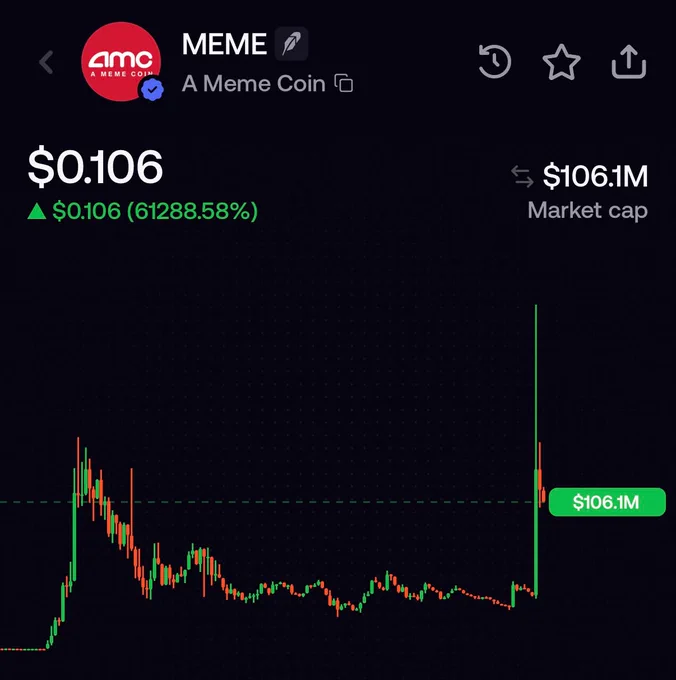


Just woke up, checked the chart and WTF, $MEME went straight into 9 figs
At one point, it wicked to around $150–160M, and it’s still holding around $100M+ right now
I dug deeper into the whole story and have to admit : this pump is insane, but the narrative behind it is actually really strong. A lot of you have been asking me to break it down, so let’s get into it
1. The lore behind $MEME
To understand $MEME, we have to go back to AMC × Robinhood in 2021
AMC was one of the biggest symbols of the meme-stock mania, while Robinhood found itself right in the middle of the controversy after restricting purchases of certain meme stocks during the craziest part of the market
Fast-forward to 2026, Robinhood brought stock tokenization on-chain, with AMC among the stocks being tokenized
The problem is that AMC itself never participated in or approved the issuance of these tokens. According to Robinhood’s documentation, the stock tokens are debt securities issued by Robinhood Assets (Jersey), providing price exposure without giving holders ownership or shareholder rights in AMC. (The Block)
Then on September 3, AMC CEO Adam Aron went off
He publicly criticized the tokenization, raised questions about its legality, and said AMC would bring in outside securities counsel to look into the matter. (The Block)
Then Robinhood CEO Vlad Tenev stepped in with one simple question :
“What’s the concern?”
Aron fired back, laying out a whole list of concerns and demanding that Robinhood stop trading the AMC token, otherwise AMC would consider taking legal action. (Zamantika)
And the community only needed to connect three letters :
AMC = A Meme Coin
That was enough
2. Why did $MEME go this crazy?
For me, timing is the biggest factor
$MEME appeared almost exactly when the drama started exploding
This wasn’t some meme digging up old news and trying to force a narrative around it. The event was happening in real time, and the ticker appeared right as attention was peaking
From there, everything started feeding into itself :
Adam Aron => Vlad => Robinhood => AMC => media => CT => $MEME => crazy PnLs => FOMO
Even the actual AMC stock reacted. On September 4, AMC shares jumped hard in premarket trading, with reports putting the move at around 15–21% depending on the time. (The Wall Street Journal)
That’s when the narrative escaped the crypto bubble
People were no longer just watching some memecoin pump on a DEX. They were watching the CEO of a NYSE-listed company publicly clash with the CEO of Robinhood while AMC stock itself was pumping
For an event-driven meme, it’s hard to ask for a cleaner attention setup than that
3. What I like most is how easy the narrative is to understand
No whitepaper
No roadmap
No utility explanation needed
Just :
> 2021: AMC becomes a meme stock
> 2021: Robinhood gets caught in the middle of the meme-stock controversy
> 2026: AMC gets tokenized through the Robinhood ecosystem
> 2026: Adam Aron gets pissed
Vlad : “What’s the concern?”
Community : AMC = A Meme Coin
Even someone hearing about it for the first time can understand the joke in 30 seconds
More importantly, the main characters are still creating content for the narrative themselves
$MEME doesn’t need the dev to invent the next chapter
Aron or Vlad just needs to tweet again and the market immediately has something new to trade
4. The catalysts aren’t completely gone yet
This is why I’m not ready to call the $MEME narrative finished
There are four things I’m watching :
Adam Aron => Vlad/Robinhood => legal/SEC developments => AMC stock
If Aron keeps talking, Robinhood puts out an official response, lawyers/regulators actually get involved, or AMC keeps moving hard, attention can immediately get refreshed
The story has also already been picked up by multiple financial and crypto media outlets. (Barron's)
In other words :
The news cycle might not be over yet
And with event-driven memes, the market doesn’t just trade what has already happened , it trades the expectation that there may still be another chapter ahead
5. But $100M+ is a completely different game
This is the part I care about most
I think the $MEME narrative is very strong
But :
Strong narrative ≠ good entry at any price
Someone buying at $3–10M was betting on :
Will the market discover this story?
Someone buying at $100M is betting on :
Can this story generate enough additional attention to justify $200–300M?
Those are completely different risk/reward profiles
The move from 0 => $100M was narrative discovery
The next leg requires narrative expansion
For another major leg from here, I think it needs a fresh catalyst
6. How I’m looking at the chart
The positive part is that after such a violent vertical move, $MEME is still holding around $100M+
It wicked to around $150–160M, got rejected, but hasn’t immediately round-tripped the entire pump
That tells me attention is still very strong
The levels I’m watching are :
$100M => $120–140M => ATH ~$150–160M
If $100M continues to hold, volume stays strong and another real headline drops, a retest of ATH is completely possible
If it breaks ATH with a real catalyst, then $200M+ isn’t a scenario I’d rule out for a meme that has become the main character of the story
But I’m not chasing here
The move was way too vertical, which means there isn’t much established structure underneath
If $100M gets lost and volume starts dying, downside could open up very quickly
7. The biggest risk isn’t the narrative - it’s attention
This is what I think people need to understand about $MEME
It doesn’t need fundamentals to pump, but it also doesn’t have fundamentals to hold it up once attention disappears
Aron goes quiet
Vlad goes quiet
AMC stock stops moving
Media moves on
=> The thesis starts weakening very quickly
Another issue is that some early wallets are already sitting on massive profits
Someone who bought at single-digit millions can dump at $50M and still walk away with an insane return
Someone buying at $100M doesn’t have that luxury.
So I wouldn’t be surprised to see ±30–50% candles from a single headline or a whale exit
8. My take
After digging through the whole story, I understand why $MEME was able to go from low-cap to 9 figures this quickly
It has almost everything an event-driven meme needs
Strong lore + perfect timing + real drama + two real CEOs + actual AMC stock volatility + mainstream media attention + an extremely simple ticker
Most importantly :
The story is still live
But at $100M+, I no longer see it as a low-cap asymmetric bet
I see $MEME more as a bet on how long the AMC × Robinhood drama can stay alive
- Aron tweets => fuel
- Vlad replies => fuel
- AMC pumps => fuel
- Legal/SEC developments => fuel.
- Mainstream coverage => fuel
But once the timeline goes quiet, the fuel goes with it
So my view right now is pretty simple :
Bullish on the narrative, cautious on the entry
I’m not going to FOMO after a move from almost zero to $100M+, but I’m also not ready to fade a narrative while the main characters are still generating headlines for it
The easy money is already gone
From here, $MEME needs fresh news to unlock the next leg
0x385f4f8ae47651ce5f58f5265395a669f8281e18
Show more












