

The Humanoid Hub
@TheHumanoidHub
Humanoid Robots: Tech, Business, and Social Dynamics.
Click the “𝕊𝕦𝕓𝕤𝕔𝕣𝕚𝕓𝕖” button on the profile to support.
Run by @dev_and_
1.2K Following 117.6K Followers
Branded water bottles are nice. We've got something better.
Going out in a daily raffle at the Humanoid Hub Conference:
- 2x NVIDIA Jetson Thor
- 2x NVIDIA Jetson Orin Nano
Thanks to @SkildAI & @NVIDIARobotics for sponsoring this.
Oct 15-16, SF - Registration link ⏬
Show more


Nils Pihl (@broodsugar) is keynoting the Humanoid Hub Conference.
The web made information addressable. Nothing has done that for physical space.
His keynote is about the missing layer: shared context that lets robots, AI and people reason about the same world.
Show more

Deepak Pathak @deepakpathak (Co-founder & CEO, Skild AI) joins the Humanoid Hub Conference as a keynote speaker.
One general-purpose brain, many robot bodies. He'll be unpacking how @SkildAI is getting there.
Oct 15-16, SF
Show more

"Hey Alexa... uh, I mean Atlas, hand me the drill."
Boston Dynamics has a new CEO: Rohit Prasad, the man who built Alexa. And it's a notable break from BD's past.
BD's first two CEOs were hardcore roboticists who helped pioneer the field. Founder Marc Raibert built the legendary MIT Leg Lab and basically invented modern legged locomotion. Robert Playter spent decades deep in the dynamics and control behind Atlas. Robotics people, through and through.
Prasad is an AI leader, not a roboticist. At Amazon he was SVP and Head Scientist for Alexa and AGI, and led the Nova foundation models. Before that, 14 years of ML research at Raytheon BBN.
He's only BD's 3rd CEO ever. The mandate: push their "Physical AI" bet, fusing AI with the robots for industrial deployment, backed by owner Hyundai.
For 30+ years BD led on mechanics and classical control. Now it's betting the next era is won on AI. Big shift.
Show more


Astribot brought its T1 humanoid to its North America debut at IROS 2026: a humanoid developers can actually put to work, starting around $18k.
~1.55m, 23 DOF, 5kg payload per arm, teleoperable out of the box for data collection and training, with an open SDK.
The robot comes with the AI stack. Astribot builds its own models (the Lumo family) that run on the robots.
They’ve showed S1 autonomously performing a backpack-packing demo: deformable objects, occlusion, multi-step, no teleoperation.
Show more


10 million humanoid robots is enough physical labor to build New York City in 5 months and the first Optimus factory will manufacture that many robots in a single year
The Optimus factory construction at Giga Texas is progressing rapidly.
It'll be a massive 7 million sq ft facility with a targeted capacity of 10 million Optimus per year. Initial production is planned to begin in 2027.
The Fremont facility, planned for 1 million per year, is expected to begin production this year.
Show more

. @IlirAliu_ is in SF for couple of more days.
Who wants to show us their robots?

The Optimus factory construction at Giga Texas is progressing rapidly.
It'll be a massive 7 million sq ft facility with a targeted capacity of 10 million Optimus per year. Initial production is planned to begin in 2027.
The Fremont facility, planned for 1 million per year, is expected to begin production this year.
Show more
Incredible piece of engineering.
Boston Dynamics has optimized for simulatability and ease of manufacturing over exact human-likeness.
New four-finger hand unlock a huge range of dexterous behavior. Now it's AI's turn to explore the hardware limits.
Show more

Regulation steps into the cage.
The California State Athletic Commission has ordered REK to stop holding unsanctioned human-vs-humanoid robot cage fights, because staging a bout involving a human without the commission's license or approval violates the State Athletic Commission Act
Show more
I was there Friday night in San Francisco for the @REK event, and this is something you had be in the room to get it, but I’ll try to describe it.
It hit completely differently from robot-versus-robot fights. Those are entertaining, sure, but after a while they start to feel strange. You’re empathizing with machines that aren’t conscious, don’t feel pain, and don’t feel anything. Robot versus human hits different and raw, it was an emotional rollercoaster. I felt real fear for the human fighter, and real excitement, mostly fear, and when it ended there was a huge wave of relief.
The robots were remote-controlled, of course, but the kicks were genuinely powerful. We know how power-dense those actuators are, and the human fighter took real hits to his body. The kicks from the six-foot-tall EngineAI T800 seemed nearly impossible to dodge when they were hurled in the right direction. The Unitree H1 was even harder to deal with because its dynamic balance is so good that it just refused to go down.
This could be the start of a genuinely new entertainment genre. But I can tell you this: if someone wants to fight a robot with a real AI brain and real perception, you’d need robots that are far less powerful, throttled down, and compliant. Otherwise it ends in serious injury or worse.
This is the beginning of something different in robotics and entertainment, and we need to think seriously about it before regulators use moments like this as fearmongering fodder to throttle the entire humanoid frontier.
Show more

Last of Clone's anatomical hand designs.
For the next-gen torso launching in November, Clone is doing a major ground-up redesign to make their humanoid more controllable and simulatable.
Show more


We just achieved a major breakthrough in humanoid labor and physical intelligence. Enjoy almost 2 hours of “boring work”. We worked very hard to make it this boring!
You can see how our humanoid worker is doing real factory work:
Uncut!
We’re now regularly running 4-6 hour shifts, with the robot carrying out a complete job from start to finish.
Publishing an uncut run this long takes some guts. Every hesitation and every intervention is visible. There’s plenty in here that we want to improve (this is the worst it will ever be!).
Getting a robot demo to work in a real factory is hard. Making it reliably do useful work, hour after hour, is brutal. That’s the next big hurdle for the entire industry.
And it is why “boring work” is suddenly so amazing.
I think we’ve all seen enough robot kung fu.
I want to see a robot finish its job and come back tomorrow to do it again.
This is a big milestone.
And I’m incredibly proud of the team that got us here!
Watch more videos here:
Okay... now back to work.
Show more

Boston Dynamics unveiled a new hand for Atlas.
13 DOF, 4 fingers, directly actuated. The old 7-DOF hand was built to grasp objects; this one is built to manipulate them, in-hand reorientation, slip recovery, and pulling tool triggers (drills, grinders, nail guns).
No pinky, on purpose. The CTO had the team tape their pinky and ring fingers together for a day, and the verdict was: you don't need it. "The best part is no part."
Built for sim-to-real RL: backdrivable, cleanly simulatable actuators, plus tactile sensing on fingertips and palm. Human-hand sized to shrink the gap to human demo data.
Show more

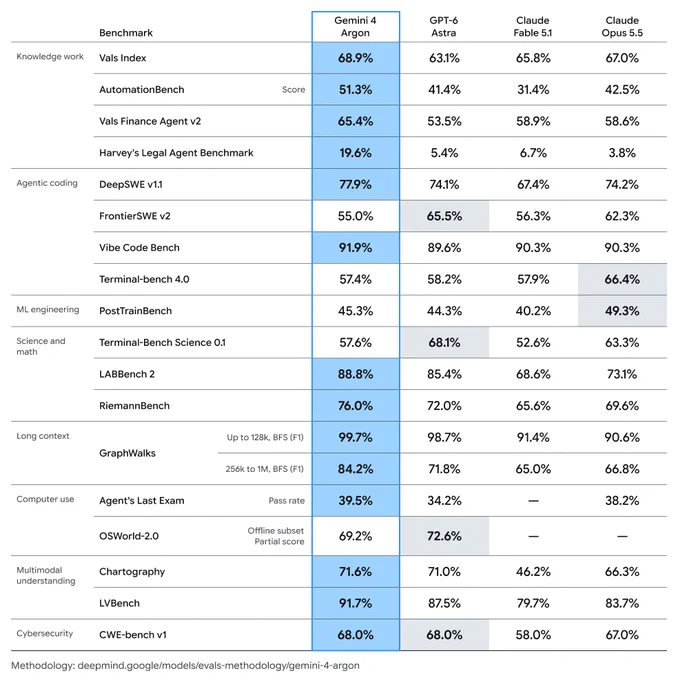
Google’s track record says don’t count Gemini Robotics out.

Introducing Gemini 4 Argon – our new frontier model.
It’s built for complex workflows across coding, enterprise knowledge work, and cybersecurity defense – rolling out today to a set of trusted testers through our Fairwind Program.
Show more
After 16K+ homes served by its floor cleaning robots, Matic teases a small humanoid.


After 9 years. 16K+ family homes. 500M sqft inside real homes covered, we know home robots are being built in wrong order.
So we built Matic the way nature grows a child.
Finally, sharing our vision:
1. Why robots get stuck at the demo
2. Why labs can't ship robots
3. Why we started with eyes, not hands
4. The 99.999% rule in robotics
5. Where Matic is going next
1. Why most robots get stuck at demos
Robot demos look brilliant in a room arranged around its limitations: familiar lighting, predictable furniture, nothing troublesome on the floor.
A family’s home makes no such accommodations. There are cables, toys, shifting rugs and, occasionally, dog poop. Yes, humanoids will need to avoid that too.
Repeating a task under familiar conditions of uncluttered floors is not the same as handling an unfamiliar home with all its chaos.
2. Why labs can't ship robots
SLAM (Simultaneous Localization and Mapping) is how a robot maps its surroundings and locates itself within them. Ask most academics and they'll tell you it's a solved problem.
But real homes are the most chaotic spaces that exist.
There are glass doors that look like open doorways, mirrors, stairs, rugs, charging cables, and Legos placed all around.
So ask yourself: if indoor mapping and navigation is "solved," where are the robots? Why aren't airports, hotels and grocery stores full of them?
Calling it “solved” misses the question families actually care about: can I leave this thing alone and trust it?
3. Why we started with eyes, not hands
Nature doesn't give birth to a fully working human. We took our cue from how nature develops humans: capabilities built on one another.
Children learn to see before they learn to grab, and to grab before they learn to plan and handle the unexpected.
Perception comes first. Manipulation follows. More complex responsibilities come after that. At every stage, the robot must earn the next job by doing its current one well enough.
Before asking a robot to pick up a sock, we wanted it to understand where it was, where the sock was, and how to reach it.
Most of the industry started at the top, with humanoids. We started at the bottom, with a robot whose job is to see and move through a home precisely with 1cm accuracy in any lighting condition.
Floor cleaning gave that foundation an immediately useful job. It forced us to confront navigation, clutter, privacy and everyday reliability before reaching for more complex chores.
The floor cleaner isn’t a detour from our larger ambition. It is how we’re building toward it.
4. The 99.999% rule in robotics
At 90%, one in ten decisions is wrong, and a robot makes thousands in a single clean. That's the robot that bumps, gets lost, and falls down the stairs.
Every extra nine is a new mountain. The failures get rarer, harder to find, and exponentially harder to fix. They barely even happen until they happen in your home.
Matic's visual SLAM runs at 99.999% in 16K+ homes. We’re the ONLY unsupervised home robot at scale with pure vision-only full autonomy. If you ask us, the gap between 80% and 99.999% is where our 9 years of engineering went.
We close that gap inside real homes. When Matic handles something imperfectly, it saves a short clip and keeps it on the device. It only leaves if the family chooses to share it. If they do, it gets labeled, fed back into the model, and every Matic gets smarter, including theirs.
Families control what leaves their homes. We do the work of making the product better.
Better robots earn trust > trust brings more homes > and more homes teach the robot more.
5. Where Matic is going next
Phase one was perception and it's nearly done. Matic has covered 500 million square feet, 400K miles in thousands of real lived-in homes.
Now phase two is going to be about manipulation. And our idea is to build a robot that doesn't just move through your home, but acts in it to eliminate even more chores.
Each step must be useful today, not justified by something we promise tomorrow. The evolution of Matic is the revolution.
The goal isn’t to put the most impressive humanoid in your living room.
It’s giving your family time and energy back through robots that earn your trust, protect your privacy, and help without becoming another responsibility.
More time for each other. Less work getting in the way.
That’s Matic.
Get yours today at
Show more

Dyna just announced two things at once: a new brain and a new body.
The brain: Dyna-2.1, which they call the world's first "physical agent" that runs an entire workflow on its own, not just a task. Customers don't buy tasks, they buy a whole AI-employee. A robot that folds for hours but needs a human to refill and reset it is just a "robot babysitter."
The body: Taku, a semi-humanoid with a wheeled base, human-shaped upper body, and folding torso, so it can grab a dropped towel off the floor, reach into a washer, and stack high and low shelves in one flow.
Under the hood: RL whole-body control (100Hz), the DYNA-2 policy learned from human video, and a VLM orchestrator that reasons, remembers, and picks the next step.
The new bar isn't what a robot does in a clip. It's how long it does the job without intervention.
The demo: an uncut 1-hour hotel laundry shift, fully autonomous:
Show more

Home Depot needs this today. A robot assistant in every aisle that can guide and help customers.
AGIBOT is deploying 100+ X2 humanoids across 100 ASD stores, and running a three-day livestream of them helping shoppers.
While we wait for general manipulation AI, this is a smart way to make people familiar with the future and refine the interaction skills in the meantime.
Show more


Humanoid robots are starting to show up in places you might not expect, including livestreams.
AGIBOT X2 humanoid robots jooined ASD’s livestream, interacting with the host, introducing products and taking part in cooking demonstrations.
It’s another example of robots moving into everyday, customer-facing environments, not just performing a preset demo, but interacting and working alongside people.
#AGIBOT# #HumanoidRobots#
Show more

Soccer skills with onboard vision, unlike many recent learning-based systems that rely on motion capture or external cameras to track the ball.
Next year's RoboCup is going to be on a whole different level.
Show more


Introducing Joga, a full-stack humanoid soccer system with active vision.
Agile dribbling. Tight direction changes. Receive → dribble → shoot/pass.
An actuated neck enables ball tracking with onboard vision.
Residual models for perception + actuation close the sim-to-real gap.
Paper coming soon!
Work done in collaboration with @Avi_Narula14 @khai_ngx @venki1899 @JohnMarangola @martinpeticco @pulkitology
Show more

Who deserves the valuation: Figure at $39B or World Labs at $8.2B?
AMD is buying World Labs, Fei-Fei Li's spatial-intelligence startup, for $8.2B in all stock.
Some context on how wild this is:
- World Labs is barely 2 years old (founded 2024) and essentially pre-revenue. It just raised $1B earlier this year.
- It's AMD's second-biggest acquisition ever, behind only the ~$50B Xilinx deal.
- Fei-Fei Li joins AMD as EVP and Chief Scientist, reporting straight to Lisa Su.
The why: AMD is buying into "physical AI", 3D world models for robotics and simulation, to chase Nvidia beyond chips.
Show more

UMI, but for humanoid hands.
UMI-style capture already works great for simple grippers. For a high-DOF hand, where the action space is huge and contact force carries the important signal, matching the data collector to the hand matters even more.
Chestnut just announced that pair:
Aero Hand, an 18-DOF human-sized dexterous hand (tendon/linkage hybrid, tested for 3M+ cycles), and
Aero UMI, a wearable exoskeleton whose kinematics exactly matches the robotic hand, with direct per-joint angle sensing accurate to 0.1°.
Zero embodiment gap for human data collection. Doubles as a teleop rig.
Show more












