
Adam Thierer
@AdamThierer
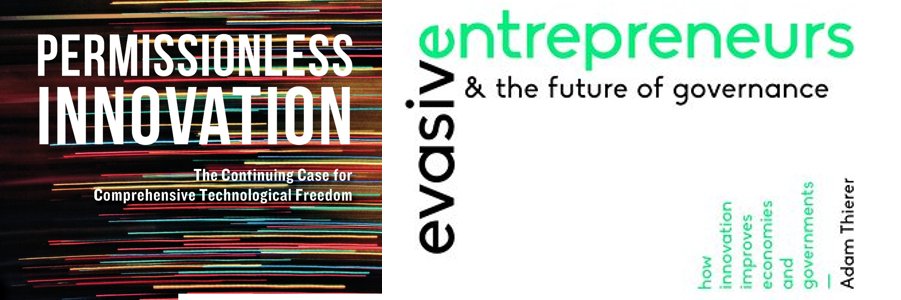
innovation policy analyst at @RSI & senior fellow with @TheFIREorg. Latest books: Permissionless Innovation (2016) & Evasive Entrepreneurs (2020).
1.9K Following 13.2K Followers
The new Sanders-Casar “Ban Artificial Superintelligence Act” is the perfect embodiment of authoritarian thinking. Jail time for innovators, corporate death penalties, flat innovation bans, an unprecedented general-purpose technology regulator, ambiguous threats against “rogue actors,” and even hints of hostile actions against foreign governments who continue to develop advanced AI systems.
If America followed this techno-totalitarian script, it would represent one of the greatest expansions of government power in our nation’s history and a de facto declaration of technological surrender in the AI and robotics revolution as China races ahead on both fronts.
The ramifications for our national security are horrifying.
Show more

Caveman Issues Dire Warning That The Wheel Is Going To Eliminate Countless Jobs


WATCH: Professor @pmddomingos: "Europe actually passed this AI Act some years ago that puts draconian restrictions on AI.... Europe is now out of the AI race. I hope we're not gonna let the same thing happen in America."
Show more

Panic produces stupid policy, such as this from the NYT. "Once a federal Artificial Intelligence Commission exists, it should require companies to obtain a federal license, a grant of permission like those allowing broadcasters and phone companies to use the public airwaves."
No.
Show more


What AI has done so far:
MEDICINE
• Helped paralysed people speak again. (Brain implants turn intended speech into words, even recreating their own voice.)
• Helped a paralysed man stand and walk again. (A brain–spine interface let him control his legs by thinking.)
• Helped blind people read and understand the world around them. (Describing surroundings, reading labels and identifying objects through a phone camera.)
• Uncovered cancers doctors would otherwise have missed. (29% higher breast cancer detection in a major study.)
• Identified antibiotic candidates that kill drug-resistant bacteria. (Abaucin targeted a dangerous superbug in lab and animal tests.)
LEARNING
• Made personalised learning available on demand. (An ‘Einstein’ as your personal tutor whenever you want to learn.)
• Helped students learn twice as much in less time. (A custom AI tutor outperformed an active-learning Harvard physics class.)
• Helped people write, code, design and build without years of specialist training.
SCIENTIFIC DISCOVERY
• Predicted the structures of over 200 million proteins. (Opening new paths to understanding disease and developing medicines.)
• Discovered planets hidden in telescope data. (Including Kepler-90i, the eighth planet in a distant solar system.)
• Recovered ancient writing buried by Vesuvius nearly 2,000 years ago. (Reading inside carbonised scrolls too fragile to unroll.)
• Begun unlocking how animals communicate. (Patterns in whale calls. Evidence that elephants use individual, name-like calls.)
• Produced a proposed solution to one of mathematics’ hardest problems. (Navier–Stokes: 10,000 AI agents, 88 hours, according to OpenAI.)
ENVIRONMENT
• Predicted where a hurricane would strike nine days before landfall. (GraphCast forecast Hurricane Lee’s Nova Scotia landfall about three days ahead of conventional forecasts.)
• Engineered enzymes that break down plastic in hours rather than centuries.
• Detected wildfires before the first emergency call. (Spotting smoke and alerting firefighters earlier.)
• Slashed the weedkiller farmers need by targeting weeds individually. (35% less herbicide in sugarcane trials, with nearly the same weed control.)
ENERGY
• Advanced the science of clean fusion energy. (Controlling and shaping superheated plasma inside an experimental fusion machine.)
• Driven a generational wave of investment in carbon-free energy, from nuclear power to solar and wind. (Microsoft’s Brookfield deal alone targets over 10.5 GW of new renewable capacity by 2030.)
TRANSPORT
• Delivered dramatically safer driverless journeys. (Waymo: 81% fewer injury crashes per mile than human drivers in the areas studied.)
• Given people who cannot drive a new way to travel independently. (Including blind passengers and older people who cannot drive.)
JOBS AND GROWTH
• Fuelled an investment boom. (AI-related investment categories accounted for an estimated 37% of U.S. growth in the first nine months of 2025.)
• Driven demand for the skilled trades building AI infrastructure. (Electricians, welders, construction crews and cooling specialists.)
WHAT AI HAS NOT DONE
• Replaced all the radiologists. Guess what? We still need more of them.
• Used a community’s water. Golf courses use more. (U.S. golf irrigation: roughly 550bn gallons in 2020. Data centres’ direct consumption: 17bn in 2023. Microsoft’s next-generation designs consume zero water for cooling.)
• Raised everyone’s household electricity bills. (Oregon’s PGE: residential bills cut 1.3% after shifting costs to data centres. Indiana’s I&M: proposed household savings of roughly $100 a year, supported by large-customer growth.)
• Demonstrated that it wants to kill us all.
Show more

This is what it’s all about.
We can’t let fear keep us from the extraordinary future within reach. Trying to pace the frontier through government regulation risks giving us fewer breakthroughs—and fewer beautiful moments—like this.
Chase the frontier! Don’t pace it.
Show more

Today @RachKBarkley and I are out with a short piece in @realDailyWire on the ways that digital technologies are bringing family economic activity back home. It’s a return to the historical norm and something we and our kids really appreciate.
Show more


I really don't think I've seen any of these media outlets inviting experts/leaders that disagree with Daniel, Jacob Coxon, etc. to give their takes. They should - it wouldn't be boring, I promise!

A former researcher at OpenAI tells @ErinBurnett he sees a 70% chance of globally catastrophic outcomes from AI: “If the AIs and robots don't actually care about humans and go rogue, then there's numerous ways that that could end very poorly for us.”
Show more


This is a terrific example of AI expanding economic opportunity.
A text-to-speech tool for deaf and hard-of-hearing delivery workers made them faster, improved ratings, increased labor supply and retention, boosted profits, and closed one-third of the disability pay gap.
Show more

Insurance as a mechanism is underrated. Good to see this:

The First Amendment starts with a pretty radical bet: people can be trusted with ideas, even bad ones.
That experiment has worked out pretty well.
Happy Constitution Day to the amendment built on the unfashionable idea that nobody gets the final word on what may be said!
Show more

The AI safety crowd think they're going to convince China to sign and live up to the terms of a global "pacing" treaty, but they're not even going to be able to get THE FRENCH to go along!
Or maybe France signs, ignores it, and Mistral AI becomes the new global leader!
Show more

French finance minister Roland Lescure suggested today that calls to slow down development of AI are a ploy by U.S. AI labs so they can stay in first place, and that France and Europe should ignore them and accelerate instead.
Show more

Reminds me of a great scene from the movie "Reds".
Reactionaries always turn on each other before too long.


Two radically different projects operate under the banner of “AI safety.”
Pro-Human Safety is not Effective Altruist Lab Safety.

Thank you @RepGuthrie for speaking truth!

“We absolutely can’t surrender,” GOP @RepGuthrie said. “That’s what it would be if we stopped AI development.”
Guthrie warned against adopting the kinds of strict regulations that he argues have depressed tech advances in Europe.
More from @POLITICOLive's Decoded Summit👇
Show more


My mom’s stage IV cancer diagnosis made an underappreciated consideration in treatment soberingly apparent: location.
In @ComputeOptimist’s debut piece, I write about how an experimental breakthrough in AI-powered robotics could vastly expand access to specialized surgical care
Show more


“Meta delayed shipping Muse for several months to focus on safety and security. We didn't call for everyone else to do this before we would.”

here is a list of ways in which bernie sanders has "influenced" AI:
1 - drafted a proposal for the government to literally seize every major AI company in the country, without compensation
2 - now seeking to ban it
that's it. that's the list.
Show more

Indiana & Michigan Power (I&M) has asked Indiana's state gov if they can lower rates because they're making so much money from data centers and they want to pass savings on
If the state approves, customers will see $100 cut from annual bills, which they'll freeze for three years
Show more


Data centers are ‘tremendous opportunities’ for upper middle-class employment: Union leader

What if some of the ideas meant to make students feel safer are actually making them more anxious, depressed, and helpless?
@theFIREorg data from more than 55,000 students reveals an ideological mental health gap.
I break it down on ERI with Andrea Honeycutt:
Show more












