
10 Spicy Takes After Talking to 50 Friends at the Frontier of Robotics 🤖🔥
1/ Astra IS robotics' GPT-3 moment. Ironically, now that it's finally here, some in robotics seem reluctant to acknowledge it. Perhaps because it (sadly) didn't come from a robotics company?
2/ Robotics is becoming just another vertical for frontier labs. Not so different from coding in some respects. Why reinvent general intelligence for every industry?
3/ Robotics was too hard to underwrite until now. No convincing pretraining scaling law, no convergence on models, data, or hardware. No wonder some critics dismissed it as a fragmented industry playing an expensive "demo game". Astra may finally offer a credible path to scale.
4/ Robotics foundation-model startups have a case. But how strong is it? The argument: Astra handles System 2 (reasoning), while specialized models retain System 1 (skills) and System 0 (motor control). Fair. But isn't that already a narrower value proposition? And who says the boundary stops there?
5/ Follow the talent. Word is OpenAI reorganized its 30–40-person robotics team around the core Astra model. Hearing similar moves toward general models at @Tesla_Optimus. Org charts may tell us more than any demo.
6/ The robotics data gold rush is real. Million-hour procurement programs, some potentially reaching tens of millions of hours. Talk of budgets approaching $1B per frontier lab.
7/ Bullish on robotics hardware volumes. As intelligence becomes more accessible, the barriers to building useful robots could fall dramatically. The moat shifts toward reliability, dexterity, integration, and deployment.
8/ Robotics could fuel the next semiconductor and memory supercycle. A 100B-parameter model running on the edge requires ~50GB just for 4-bit weights. Now multiply that by millions of robots. Why do you think @JensenHuang is so obsessed with robotics? @elonmusk saw it coming:
9/ Is self-driving immune to the general-model threat? After coding and robotics, why assume self-driving remains the exclusive domain of proprietary, vertical models? Robotaxi increasingly feels like a solved problem to me. But if and when frontier labs move into self-driving, we could see an Apple vs. Android dynamic. Think about the implications for $TSLA, Waymo, and other OEMs.
10/ The next bottleneck may not be intelligence. It's deployment. Models are improving faster than our ability to deploy robots in the messy real world. Integration, hardware variance, failure recovery, and economics remain brutally hard. The real moat may be turning intelligence into reliable, profitable physical work.
--
I realize some of these takes may rub people the wrong way, especially those who have spent years doing the hard work of advancing robotics. That's not my intention.
I'm sharing them to spark debate, not to declare winners and losers. Astra has only been out for a month or so, and it's far too early to draw definitive conclusions. More importantly, when the TAM is this enormous - potentially the largest in tech - there should be plenty of room for different approaches and many winners.
++
Full diligence report:
Show more
The Trillion-Dollar Question Nobody Really Has a Good Answer To - Where Is the ROI?
We spend a lot of time debating how many GW of AI compute will come online. But the bigger question is: who ultimately pays for all of it, and can the economics justify trillions of dollars in investment?
I find it helpful to think about AI economics as a chain:
CapEx → Compute / Inference Revenue → Model / API Revenue → End Demand
One important nuance: the market often uses model company revenue (@OpenAI , @AnthropicAI , etc.) as a proxy for AI demand. But outside direct consumer subscriptions, much of that isn't necessarily ultimate end demand.
A company paying for Claude Code is still an intermediate customer in the economic chain. The real economic value comes when that company uses AI to generate incremental reve or reduce costs.
---
Let's put some numbers around 2027.
1. CapEx: US$2.5-3.0T
Assuming ~50GW of new global AI compute capacity, we're looking at roughly US$2.5-3.0T of total infrastructure investment. ~70% goes toward chips and related compute equipment, with the rest covering buildings, cooling, power and supporting infra.
Importantly, this is much broader than the often-quoted ~US$1.2T of hyperscaler CapEx. Neoclouds, colocation providers, private developers and others are also funding the buildout.
2. Compute / Inference Layer: US$1T+ Revenue Potential
If all 50GW were deployed and commercially utilized, the capacity could theoretically support over US$1T in annualized compute infrastructure revenue.
For context, combined CSP cloud rev = sub US$600B on consensus est.
3. Model / API Layer: How Much Revenue Do We Actually Need?
@OpenAI and @AnthropicAI are rumored to be approaching US$200B of combined ARR by YE26 (source: public data).
My instinct is that we need to see something closer to US$400B+ by FYE27 to begin supporting the scale of investment we're talking about.
Rough sanity checks: 1) US$2.5-3.0T of CapEx implies roughly US$400-480B in annual depreciation. 2) Total GW online grows +70% in FY27E, hence ARR needs to grow at least 70% (to $350B)?
---
So, was the ROI ever a slam dunk?
Never, really. And I think we should be intellectually honest about that.
Don't get me wrong. I believe AI is one of the biggest technology supercycles we've ever seen. But when it comes to justifying trillions of $$$$ of CapEx, even the bull case rests on extrapolating the early success of AI rev.
Some extrapolate linearly. Others exponentially or logarithmically. The resulting forecasts can be wildly different.
And that's precisely why the market tends to overshoot in both directions. It is not really backed by a solid set of numbers, but rather, extrapolations.
---
Which brings me to how I think about trading this cycle.
The market isn't necessarily trading the absolute level of AI CapEx or revenue. It's trading the rate of change, particularly revisions to expectations.
Think of it as two cars racing:
🏎️Car 1: AI Infrastructure Investment
How quickly are CapEx expectations being revised upward?
For example, since the beginning of 2026, CSP CapEx expectations have been revised upward by roughly 40-50%.
🏎️Car 2: AI Monetization
How quickly are AI rev expectations being revised upward? How quickly is actual end demand catching up?
The market wants to see 🏎️Car 2 outpacing 🏎️Car 1.
If CapEx estimates keep moving higher while AI monetization fails to keep pace, investors will increasingly question incremental returns, even if absolute AI revenue is still growing rapidly.
AI can be the biggest technology supercycle of our lifetime, and investors can still overpay for the infrastructure along the way. Both can be true imho.
Show more

I got a lot of thoughtful feedback after publishing the original post - thank you to everyone who took the time to read it, challenge the assumptions, and share data points. A few of the pushbacks changed how I think about the framework, so I wanted to write a short follow-up and lay out the main areas of disagreement.
Where the feedback roughly landed
Most clustered around ~0.2–0.3GW for standalone/agent CPU at 100M DAU, versus ~0.1GW in my original estimate.
Inference demand is all over the place.
---
1/ My CPU scope was too narrow.
My original CPU estimate focused mainly on the agent sandbox/VM. Separately, my inference estimate modeled GPUs, but did not include the head-node CPUs that support the GPU fleet.
One clarification: tool execution is not necessarily a separate CPU bucket. Browsers, code, and tools often run inside the sandbox itself; orchestration may run in a separate backend or share other CPU infrastructure.
So I now think about CPU demand as two main pieces:
Standalone / agent-execution CPU
Sandbox + the actual work happening inside it + some orchestration
Head-node CPU
CPU required alongside the GPU/XPU fleet ≈ GPU/XPU fleet × CPU attach rate
2/ The sandbox itself may need more CPU than I assumed.
The original estimate used the 2 vCPU environment exposed by Muse as a starting point. But provisioning a lightweight VM is different from the physical CPU consumed once agents are actively running browsers, code, tools, and multiple tasks.
The bigger long-term question is also whether one human request continues to map to one agent. A request could increasingly spawn 4–8 sub-agents, or eventually become agent → agent → agent. Usage will likely be highly skewed toward power users, and infrastructure also needs to be provisioned for peaks rather than averages.
A more complete framework is:
Standalone CPU demand
users
× tasks/user/day
× agents/task
× active time/agent
× physical CPU per active agent
× peak factor
There are a lot of moving pieces here, but I suspect agents per task is one of the biggest long-term swing factors.
3/ Inference may also be understated, but for a different reason.
The relevant unit probably isn’t simply “human messages per day.”
A consumer might only initiate 5–10 meaningful tasks per day, but one agent task could require dozens of model calls as the agent reasons, uses a tool, observes the result, reasons again, etc. So a better framework is:
GPU inference demand
users
× tasks/user/day
× agents/task
× model steps/agent
× tokens/step
This is also where the feedback was most dispersed. Some people think 50+ model steps for a meaningful agent task is completely reasonable; others think an assumption of 50 consumer-initiated events per day is far too high. Those aren’t necessarily contradictory - tasks/day and model steps/task are different assumptions.
---
How this compares with sell-side CPU math
The sell-side approach is generally much more top-down.
Using BofA as one example - they estimate total data-center systems TAM growing from roughly $506B in 2025 to $2.56T in 2030, while assuming CPUs remain around 7–8% of total system value. That gets them to roughly $211B of server CPU TAM in 2030.
Their CPU bull case is essentially:
AI infrastructure spending gets much larger
× AI becomes more CPU-intensive relative to GPUs
× agents create a new standalone CPU compute layer
× AI CPUs get more expensive / higher-spec
BofA splits the 2030 number into roughly $90B of GPU-attached/head-node CPUs, $90B of standalone agentic CPUs, and ~$30B of traditional server CPUs.
++
Better formatted version:
++
Thank you again to everyone who challenged the assumptions and shared thoughtful feedback - I learned a lot from it!
Show more


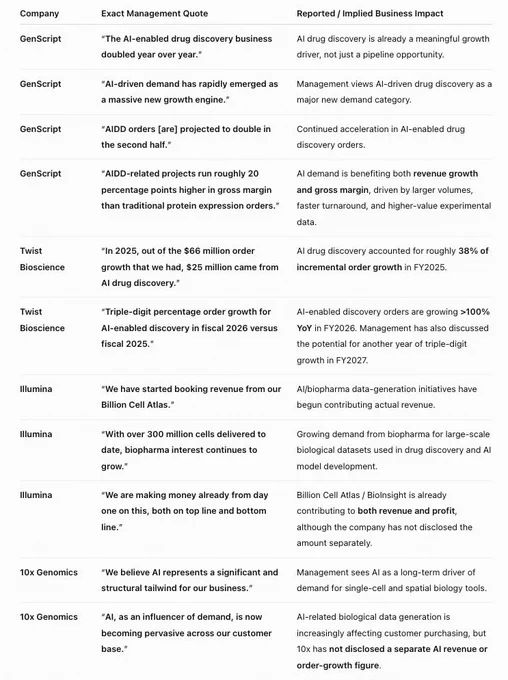
AI Drug Discovery Is Becoming a Bottleneck Trade
I get excited when an industry starts going through a real regime change. AI drug discovery (“AIDD”) increasingly looks like one of those moments.
Two things are happening:
1/ Upstream: the frontier AI labs are piling in.
2/ Downstream: The supply chain is clearly moving.
Supply-chain checks suggest the upstream picks-and-shovels of discovery and early preclinical R&D are starting to feel the increase in experimental volume.
DNA → protein → assays → sequencing → automation → preclinical testing
Names across that stack include $TWST , @GenScript , $ILMN , $TXG , lab-automation vendors and CROs.
$TWST expects triple-digit percentage growth in AI-enabled drug-discovery orders in FY26, and another year of triple-digit order growth in FY27.
@GenScript's AIDD business doubled YoY in 1H26. Its current platform advertises industrial-scale validation of 4,000+ designs/day, with integrated sequence-to-data workflows. Our channel checks suggest the ramp is moving even faster: roughly 8,000 designs/day currently, with a path toward ~16,000/day by YE26.
---
Why does AI drive more wet-lab demand?
1/ AI makes hypothesis generation almost free → way more shots on goal.
The bottleneck is moving from expert-driven design to biological validation.
2/ AI models need continuous experimental feedback — and both good and bad data are useful.
Traditionally, only the highest-conviction A+ candidates might get pushed into expensive validation. With AI, even the B/C candidates can be valuable because failed experiments generate training data.
@GenScript has said its sequence-to-binding workflow can return data in 4–7 days, and that faster cycle times matter because AI models depend on continuous experimental feedback.
@Anthropic is a clean example. @claudeai designed 1,320 protein binders. @adaptyvbio converted those digital sequences into DNA, expressed the proteins and tested binding. Only 354 actually bound. And the 966 failures are not wasted. They are useful negative labels: what does not express, what does not bind, what has poor affinity. Those results help train the next model iteration.
3/ Wet labs are no longer just making drugs. They are making training data.
$TWST / @GenScript increasingly look like biological data foundries.
$TWST explicitly talks about generating model-ready data from AI-designed sequences. In some workflows, the customer may care less about receiving the physical protein than about getting structured experimental results back into the model.
Traditional drug discovery asks: “Does candidate X work?”
AI drug discovery also asks: “What can this experiment teach the model?”
---
TAM of AIDD
If AI is simply a better R&D tool, the relevant spending pool is the $300–400B of annual global pharma R&D. If AI meaningfully increases the number of viable drug programs, the opportunity is larger because it expands downstream demand for DNA synthesis, protein production, assays, and preclinical work.
Near term, we can also size demand from AI-company spending. If Anthropic reaches $80B of ARR in 2026 and spends just 1% on AIDD, that alone would imply ~$800M of annual investment.
---
Trade setup
This is a trade that could have long legs. It’s hard to really stop working until PhaseI/II results (2028+)
It smells a lot like the bottleneck trade we just saw in semis: GPUs → HBM → networking → power/cooling. In biology, It basically follows the drug discovery process downstream: AI models → designs → DNA/protein → assays → preclinical capacity.
After the upstream picks-and-shovels, animal testing could become the next bottleneck. Monkey prices are already near prior highs and CRO capacity is tight. AIDD pushing more candidates into preclinical development would only add demand.
?? But clinical trials are still the bottleneck?
This is the biggest pushback I keep coming back to. No matter how fast discovery becomes, drugs still need to go through preclinical → Phase I → Phase II → Phase III → approval. You still need patients, time and capital.
But that doesn’t mean the bottleneck trade won’t work. More viable candidates — especially with higher success rates — still means more demand throughout the development process.
And who knows: clinical trials themselves may eventually be optimized by AI.
?? What breaks the trade?
Near term, the picks-and-shovels trade breaks if experimental budgets stop growing, AI-generated designs don’t translate into useful wet-lab hits, or capacity catches up too quickly.
Longer term, the thesis breaks if AI drugs look great in discovery / Phase I but fail at normal rates in Phase II/III. That is why Phase II matters so much.
?? Milestones
Late 2026–2027: first Isomorphic-designed drugs enter human trials; more AI-native programs move into IND-enabling work / tox.
2028–2030: clinical trial results start telling us whether AI-designed drugs actually perform better than conventional drugs.
Calling all the "bottleneck bros". :) @jukan05 @zephyr_z9 @aleabitoreddit @ParadisLabs
+++
More comprehensive analysis:
Show more

A humble attempt to est. the infra required to serve 100M DAU @Muse
Rough conclusion is:
1 GW of power to serve 100M DAU in the base case, of which only ~0.1 GW comes from the CPU/VM layer. Depending on the # of reasoning-equivalent model calls one Muse DAU generates per day, 3-4GW is entirely plausible. Maybe that’s why @Meta is rumored to be adding 7-10GW of compute next year.
The sandbox layer = sub $1B of CPU content and ~$2B of DRAM content, which is much smaller than many expected.
Lot of moving assumptions. Welcome all feedbacks/ pushbacks.
------
Two very different pieces of infrastructure behind Muse.
1. Muse VM / sandbox infrastructure
2 vCPUs, ~8 GB of RAM and ~100 GB of persistent logical storage per user.
2. Muse Spark inference
Model inference goes out through Meta's external inference infrastructure.
------
1/ Sandbox infrastructure
A. CPU
The first mistake is assuming that 100M DAU means 100M VMs are actively consuming compute at the same time.
Suppose the average Muse DAU has an agent actively working for two hours per day.
100M users * 2 hours / 24 hours = ~8M average simultaneous active VMs
Meta obviously cannot provision only for the daily average. Usage will be concentrated during waking hours and bursty.
Assume a 2.5x peak-to-average ratio:
8M * 2.5 = ~20M peak active VMs
Then add roughly 20% capacity headroom: ~25M provisioned live VMs. So the base assumption is effectively that Meta needs enough infrastructure to support roughly 25% of DAU being live simultaneously.
The next important distinction is between virtual CPU allocation and physical CPU demand. Agent sandboxes are particularly well suited to CPU oversubscription. They spend a lot of time waiting. During those periods, the VM may still be alive, but it is barely using CPU.
DeepSeek’s recently published DSec infrastructure provides a useful benchmark. Its production agent sandbox platform runs approximately 30,000 physical CPU cores and 250TB of DRAM across ~160 nodes, with peak concurrency above 380,000 sandboxes. DSec also demonstrates stable operation at around: 800 microVMs per node. With roughly 188 physical cores per node: 188 physical cores / 800 microVMs = ~0.23 physical cores per live VM.
DeepSeek is obviously the King of efficiency. The number for Muse might be at 0.3-0.75 physical cores per live VM, or assume 0.5 physical cores per live VM as the base case. That is equivalent to roughly two simultaneously live Muse VMs per physical CPU core.
Using the base assumptions: 25M live VMs * 0.5 physical cores per VM = 12.5M physical CPU cores.
On a 256-core CPU: 12.5M cores / 256 cores per CPU = ~50K CPUs; Or on a 192-core CPU that would be 65K CPUs.
At the current public pricing, that is ~$800M.
B. DRAM
CPU can be aggressively oversubscribed because a VM that is waiting may consume almost no CPU. Memory is harder to oversubscribe because a live VM still needs to retain its working state.
Muse exposes roughly 8GB of RAM to the user environment, but one observed instance was actually using only around 3GB at the time of measurement.
25M live VMs * 3GB = 75PB of physical DRAM, call it ~75-100PB of physical DRAM feels like a reasonable base range.
At the current public pricing, that is ~$2B.
C. Sandbox power
~0.1 GW for the entire Muse sandbox / VM layer at 100M DAU.
------
2/ Inference
Muse’s personal computer executes tools and stores state locally, but the actual model runs on separate inference infrastructure. Meta’s Muse architecture
Energy per inference event
Microsoft’s 2026 study estimates that optimized frontier-scale inference consumes a median of approximately: 0.31Wh per normal query
But a long reasoning query with roughly 15x the token count consumes approximately 13x as much energy, or around: 4Wh per long reasoning query
The study specifically highlights reasoning and agentic workloads as significantly more energy intensive.
Sensitivity analysis on # reasoning-equivalent events per DAU per day
Suppose each active @Muse user generates the equivalent of 50 heavy inference events per day.
At 5Wh each:
100M users * 50 events/day * 5Wh = 25GWh/day
25GWh/day / 24 hours = ~1.0GW average power
So inference alone could require: ~1-2GW of average power
A 3-4GW Muse is entirely plausible. Maybe that’s why @Meta is rumored to be adding 7-10GW of compute next year.
------
The popular framing around Muse is that giving every user 2 vCPUs and 8GB of RAM creates an enormous CPU requirement. But the naive calculation materially exaggerates the CPU requirement because it treats logical VM allocation as dedicated physical infrastructure.
The more interesting conclusion is: Consumer agents may be a meaningful new demand driver for CPUs and conventional DRAM, but inference remains the real compute bottleneck. And as agents do more work, run longer trajectories and increasingly spawn other agents, inference demand can scale much faster than the number of users itself.
+++
Calling my peer review group: @bubbleboi @damnang2 @Midnight_Captl @FundaAI @fi56622380 . Feedback/ Pushbacks pls :).
++
Better formatted:
Show more


Largely agree.
1/ Agentic commerce's impact on $AMZN
Ads rev ($100B rev, or est. 50% of operating profit): real disintermediation risk.
GMV: depends. If $AMZN is truly "cheaper, faster, better", an objective agent should send more GMV to $AMZN. But I personally doubt $AMZN’s GMV share grows meaningfully in an agentic world. Just look at the $50B in marketing exp. $AMZN throws out today - large platforms have an "unfair advantage" bc they can afford higher CAC.
Long-term value / customer ownership: intrinsic value should go down if $AMZN loses the top of the funnel. You may still get the trx and the buyer’s info, but you lose browsing behavior, retargeting, cross-sell opps, and ultimately the customer relationship.
Potential upside: $AMZN can open up its best-in-class logistics backbone to other merchants = new rev stream (which it is already doing a little).
The risk feels more skewed to the downside, imho: top of funnel → infrastructure layer.
2/ What happens to ads as an industry
Under agentic commerce, ad spend and take rate - which ppl historically think of as distinct business models - will converge.
In a fully agentic world, ads as an industry could theoretically "disappear." But that doesn’t mean the ad dollars (~$300B in the US) disappear. Sellers will still need (and want) to pay digital tax on distribution. Whether that comes in the form of ads or a take rate is largely semantic.
Take OTAs ($BKNG $EXPE) as an example. Say half of their bookings and traffic are direct, and the other half indirect, mostly through $Google. For the indirect portion, the companies basically break even given the high CPCs they pay $Google. Take rate on the direct portion is ~15%. So even though the cost is paid in the form of ads, the equivalent take rate OTAs pay Google is effectively ~15%.
An agent charging 2%, 5%, or eventually 10%+ of GMV is therefore not necessarily introducing a new cost. It may simply be repackaging an existing acquisition cost from CPC into CPA / take rate. And agents @Muse will probably start cheap.
3/ What holds true no matter what (pre- or post-agentic world):
A. Owning top-of-funnel customer intent = pricing power. Losing direct traffic means losing much more than the immediate transaction.
B. Commerce winning formula (is always) = cheaper, faster, better.
++
A more verbose version:
Show more
Being able to create iterative games in under [5-10] minutes, all seamlessly within the app, is impressive. Truly a great product! @Muse @alexandr_wang Can only imagine token usage going explosive from here…
Show more











