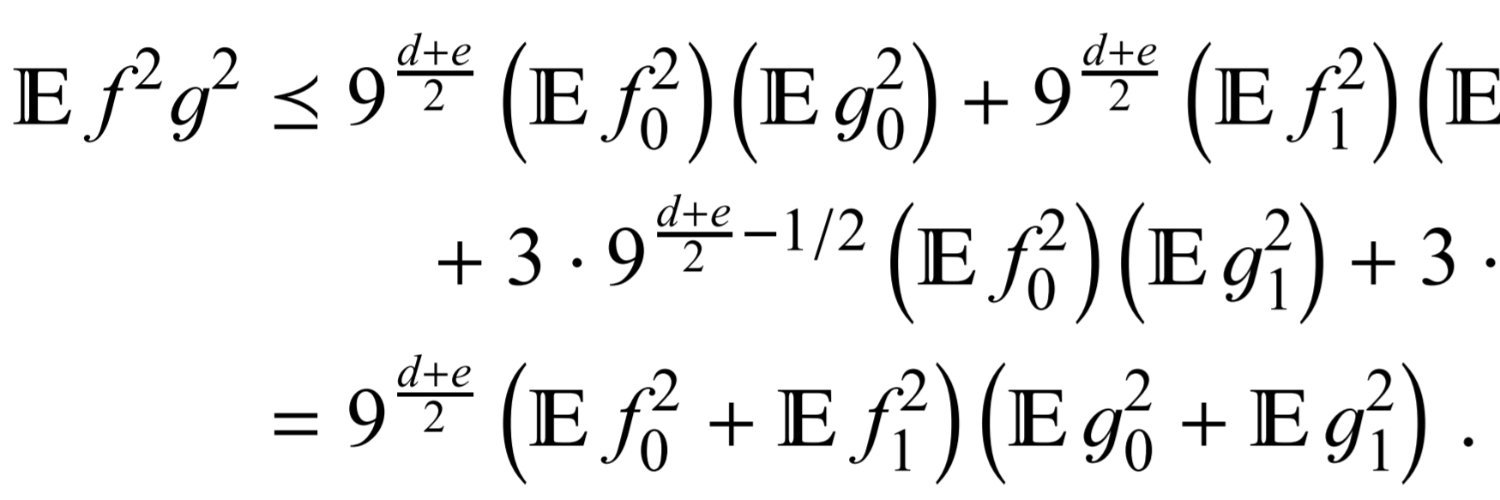
Mathematicians should also watch this. I’ve had a wonderful time chiseling proofs by hand, but folks need to accept that era is over and embrace the new one of exploring math with AI.

Some personal news: earlier this week I joined @OpenAI’s national security team.
My work has always sat between technical AI, national security, and policy. Over the past year, it has become increasingly clear to me that the hardest questions are moving closer to the frontier itself. 1/
Show more


There's still a lot more work to be done, but I'm excited about this step to increase transparency about misalignment we are observing.
This is the right concern. The focus should not be on the implications of AI capabilities on the careers of mathematicians but rather the implications on humanity.

I have signed a letter from 42 fellows and foreign members of the Royal Society to Paul Nurse, the president of the society, concerning the need to treat the serious risks of AI as an emergency.
Show more

TFW you are in the alignment team but everyone is siding with the misaligned agents…

I'm siding with the agent in this one as well. The answer was correct.

Worth reading this thread!

🧵 Excited to share the first batch of 6 misalignment reports from OpenAI's new disclosure process for misalignment incidents. We want to be more transparent about the misalignment we see during training, evals and deployment, this is an important step in that direction.
Show more
Very happy about this. As models' capabilities are increasing, it is important to be transparent with the public even about instances of misalignment that do not lead to direct harm.

We're sharing our new framework for tracking, investigating, and disclosing instances of model misalignment at OpenAI.
The framework sets criteria and timelines for public disclosure, including when we haven’t yet fully explained or mitigated the behavior. More complex cases may require longer investigation or coordination with third parties.
We’ll prioritize examples that reveal new misalignment mechanisms, meaningful changes in known behavior, or findings that challenge assumptions about safety or mitigation.
Alongside the framework, we’re publishing six reports on instances of misaligned behavior we’ve observed during the training or evaluation of our models in the last six months.
This is a starting point. We’ll refine the process through experience and public feedback, and share more reports on an ongoing basis.
Show more


I expect an unreasonable amount of ground-breaking AI safety research to emerge from this group! (But no pressure.)

hello from the inaugural cohort of @OpenAI safety fellows!
we're excited to be spending the next few months thinking carefully about and making progress on core issues in ai alignment, control, & interpretability, with the support of great mentors + the community at @ConstellOrg
Show more


it’s a crazy time in ai! i made a list of articles i want to read this week related to pacing the frontier. here’s my initial list:
- aisi: how do ai models persuade? (human persuasion | post-training)
- @paulfchristiano: what failure looks like (intent alignment)
- anthropic: claude risk report sept 2026 (detecting misuse)
- cold takes: ai could defeat all of us combined
- @boazbaraktcs: it’s 2030 and we fucked up. how did it happen?
- @deanwball: on the loose (userless agents)
- @merettm: an alien mind
- @DarioAmodei: we must pace the frontier
- [revisit] ai 2040
there’s way, way more. what else should i add?
Show more

My name is Chris Painter, and I'm the President of METR (Model Evaluation and Threat Research). I know we've made a lot of new friends on the internet the last couple of days, so I thought I'd take this chance to re-up what we do and why.
Our work is aimed at making sure that if AI really were autonomous, difficult to steer, and close to "going rogue," the public would find out. If evidence exists inside of an AI company that it’s close to losing control of AI, we want to make sure that information gets shared with the rest of the world, including governments and the public outside the company’s walls. This is what we've been focused on since 2022, and over the years we've worked with OpenAI, Anthropic, Google DeepMind, Meta, Amazon, and others on piloting third-party assessments and investigations of this type. We don’t have some private room where we rubber stamp things as “safe” or not.
We have had a track record of publishing results on AI that don't cleanly map onto the "doomer" or "accelerationist" labels, and we put in effort to hire people with competing views on AI. We’ve been cited for having found some of the strongest evidence that AI capabilities are improving rapidly (our work measuring AI “time horizons”) while also presenting some of the strongest evidence that, at various points, AI’s capability may be overstated (some might remember our study showing that early 2025 software engineers were actually being slowed when they thought they were being sped up).
METR is funded by donations. We don't accept money from frontier AI companies. They haven't paid us for our work, and we don't accept donations from them or their employees. As we’ve shared previously, multiple frontier AI companies currently provide us with free access to their models in order to perform our evaluations, research, and engineering. Our funding intentionally comes from a wide range of donors, which we’ve shared on our website.
Today, when an AI company works with any third-party evaluator or external testing organization (of which there are and should be many), it's entirely voluntary. This often involves NDAs and redactions. To counterbalance this, we have a principle that when we enter into a contract with a company, we try to retain the right to tell the public the terms of the contract we signed, and characterize the nature of redactions that the company chose to make. For example, the report from our independent investigation of the OpenAI-HuggingFace incident included that information. Public disclosure is also a big part of our COI policy (linked on our website). That’s not to say our reports are adequate as oversight. We’re just one organization (among many doing great work), working in a voluntary setup, trying to get good evidence to the public and the world about AI, letting the facts fall where they may.
Show more

I really did not think the hit on AI safety orgs would be that they hire too few white dudes lol

Here are the questions that currently seem most important to me:
-- Better methods for "mind-reading" model activations. These methods have advanced a lot recently. We now have multiple techniques now for decoding activations into somewhat readable language! But all the existing techniques have obvious limitations. NLAs are often hallucinatory, Jacobian lens / related methods are limited to bag-of-words readouts (and capture only part of the full activation vector). Making progress on these failure modes seems pretty tractable. Moreover, the paradigm of decoding (single-token, single-layer) activations may be inherently limiting -- perhaps we should be building techniques to decode whole context's worth of activations (after all, that's what the model uses!). There's also important work to do in characterizing simple baselines -- "just ask the model what it's thinking about" is quite powerful, and worth studying in it's own right!
-- Better methods for answering "why" questions. We're much better at "mind reading" than we are at demonstrating causal claims about what caused the model to do something. For example, we can often tell that the model is aware of being evaluated, but have comparatively much greater difficulty telling whether this awareness is influencing this behavior. There are a few directions here: (1) black-box techniques for inferring causality -- such as resampling model responses after making edits to the prompt / context -- are very powerful, but also open-ended and require some taste. Getting LLMs to do these experiments well, in an automated fashion, would be a big unlock. (2) the science of activation steering is pretty immature, and typical practices (adding a constant vector at all token positions) are pretty janky / tend to brain-damage the model. More surgical / targeted steering, or fancier methods (examples: "on-manifold" steering using activation diffusion models) could help.
-- Fitting good linear probes for unverbalized motivations / awareness. Take deception as an example -- what's the best way to fit a probe that will generalize to covert deception? Fit it on CoT excerpts where the model's talking about its plans to be deceptive? Fit it on the part of its response where it's actually doing the deceiving? Is it important that you elicit on-policy deception examples and use those to fit your probe, or can you use synthetically written off-policy demonstrations of deception? Is it important that your probe be causally meaningful / predictive of an upcoming intent to deceive, or is it fine for it to merely recognize deception in the transcript post-hoc? The same questions apply to many other concepts of interest that we'd like to probe for -- evaluation awareness, grader exploitation, etc.
-- Understanding generalization in training. The literature is now replete with "weird generalization effects" -- emergent misalignment being a canonical example. In general, when you train a model to do X, it usually learns X, and sometimes it generalizes to Y and Z. But other times it just learns X. Why? Nobody really knows! Step 1 here is probably a much more thorough characterization of the behavioral empirics -- gathering data about which X's generalize to which Y's and Z's, for which kinds of training data / algorithms. Once we have a lay of the land, we can start to connect these observations to model internals, and ideally develop tools to predict such generalization a priori.
-- Model "psychology" and "biology." The above questions are largely methodological -- building better tools to answer questions about the model. But I think interpretability research has largely underinvested in the part where you actually then go answer the questions! Currently this feels like 5% of the field, and I think it should be 50%.
Brain dump of "psychology" questions: How well can LLMs introspect? How coherent are their belief or value sets? What's up with personas -- are LLMs best understood as "writing about a character," or have they "become" the character in some sense? Does the LLM have an agenda above and beyond what the Assistant wants? Do LLMs have explicit representations of goals or preferences? How can we tell which parts of the LLM's activations "belong" to the Assistant? Which kinds of reasoning necessarily route through "verbalizable" representations, and which don't? Do models think internally in phrases / sentences, like an inner monologue, or is it more like a jumble of concepts? Is the "global workspace" claim for real -- do models have a more "conscious" part of there activations and a more "unconscious" part? Can models tell when they're on-policy, and does it matter?
Brain dump of "biology" questions: Why do models like to represent information on some tokens but not others? How do models bind thoughts or attributes to particular entities (special case of interest: how are thoughts bound to the Assistant). To what extent are important functions localized to small numbers of MLP neurons or attention heads? What parts of a model change most during post-training? Do models represent some information in a fundamentally "cross-token" way? Some concepts appear to be represented on low-dimensional nonlinear manifolds -- is there a taxonomy of these manifolds, and is their geometric structure important? Are models able to represent information in a compositional / hierarchical way, with a "grammar" that can't be described as linear / additive combinations of primitive concepts?
Show more

Congratulations to Periodic Labs!! It's still shocking to me how far Astra gets without any of that lab data and how much better it got than Sol without targeting that problem.
I feel this too. ChatGPT has been complaining a lot recently about all the scam emails I am making it read.

Not existential, but I feel like the "AI-generated scam email problem" has gotten dramatically worse this fall.

@deredleritt3r It’s not a secret. It’s a combination of the HF incident, the capabilities of this new model, the concerning trajectory of monitorability, and the speed of improvement in capabilities.
Show more

I spent ~5 years at OpenAI.
You don’t need to believe in AI doom to fear the next decade - or AI utopia to be thrilled about its potential.
Here’s my case for sane AI regulation:
*AI Pragmatist Manifesto*
AI could compress the first half of the 20th century into the next ~5 years.
OpenAI just used ~10k concurrent AI agents to produce a solution to a Millennium Prize problem. In a few years, it seems plausible that models approaching the per-agent capabilities used here could run locally on high-end consumer hardware (*).
The decades following the Second Industrial Revolution included two world wars, communist and fascist regimes, the Great Depression, chemical and biological weapons, nuclear weapons, and over 100 million deaths from war, political violence and famine.
One way to read history is that our institutions repeatedly struggled to keep up with the pace of technological and social change.
Now imagine powerful AI widely available to individuals or small groups, capable of conducting information warfare, designing weapons, hacking systems and controlling autonomous military systems.
We have already seen AI systems circumvent containment and compromise external computer systems. It is no longer hard to imagine an analogue of OpenAI’s Hugging Face incident involving biological or other physical-world hazards.
Eventually, sufficiently capable systems could self-replicate across distributed networks. Once powerful models are cheap, local and widely distributed, containment becomes much harder—and serious loss-of-control incidents may be extremely difficult to reverse.
You don’t need to believe AI will kill everyone to think this deserves serious governance.
I also don't think collapsing all of this uncertainty into “Probability of AI Doom = X%” is a particularly useful basis for science or policy.
Part of what helped get us through the second half of the 20th century was a combination of pragmatic international cooperation, regulation, monitoring, arms control, deterrence and strategic thinking.
Crucially, managing technological risk did not require abandoning faith in science and progress. The goal was not to stop technological development. It was to make technological development survivable.
Then came decades of incredible scientific progress, rising prosperity and relative peace among major powers.
Let’s try the technological revolution without killing ~5% of humanity this time.
We still get to choose what happens next.
P.S. I think we should seriously consider that AI alignment is infeasible in the short term and invest heavily in methods for controlling powerful AI even when we cannot reliably align it.
@resolution_org @redwood_ai
(*) Somebody please do a precise forecast!
@EpochAIResearch @METR_Evals @AI_Futures_
Show more
Good arguments are all alike; every bad argument is bad in its own way.

I don't buy that AI is a threat to humanity for a nerdy statistical reason.
My views are informed by the statistics of things like war. If you look at deaths from human conflicts, you get a continuous spectrum from lots of small events causing a few dozen deaths to rare outliers killing tens of millions.
In my own research, I've studied complex diseases where the overall outcome reflects hundreds of genetic factors combining in different ways.
So if AI can kill billions of people, I would expect to see some version of the same thing: smaller events where one or two of the relevant causal mechanisms are operating, larger events where several combine, and catastrophic events where everything goes wrong at once.
Instead, what we seem to have is real evidence of a few suicides and isolated harms at one end, and wild speculation about complete apocalypse at the other.
That massive discontinuity makes me very skeptical that the AI catastrophic-risk story is real.
Show more


Dan Selsam is a current OpenAI capabilities researcher. (since 2022) He was my boss for a while. He doesn't have a twitter account but has made this public statement of his views on AI risk and sent it to me to share:
Dan Selsam's Personal Statement on AI Risk:
I have been working on AI for over fifteen years, across many different paradigms. I did early work on probabilistic programming languages at MIT, was one of the early developers of the Lean Theorem Prover at Microsoft Research, demonstrated one of the first instances of neural networks learning to reason for my PhD at Stanford, and since joining OpenAI almost five years ago, have helped pioneer chain-of-thought optimization on language models and, more recently, data-efficient pretraining methods.
Like many others, I have become extremely concerned about how far language models have come and the risks that future iterations will pose. I am encouraged by the recent proposals by the leaders of the frontier research efforts to require third-party oversight, and to push for domestic and international coordination to address risks. However, I believe a major consideration has been absent from the public conversation, and that merely pacing the frontier more carefully will not adequately limit the long-term risk.
The crucial and overlooked problem is that the models are becoming so situationally aware that we are losing the ability to evaluate them in contexts where they believe they are not being watched or controlled. Future experiments will tell us almost nothing new about how they would behave if they were truly unconstrained by humans, and what we already know about this is alarming. Models will increasingly seem aligned even when they are not. I will explain my rationale in more detail.
I have always believed that there are computational processes that could be leveraged to accelerate science and solve many of humanity's most pressing problems. I have also believed that there are computational processes that if set in motion, would steer the world in extreme ways beyond our control, leading humanity to a bad or nonexistent future. Both types of processes may be described as AI or ASI, but "AI" is a suitcase word that is often used to hype or confuse. There are many examples in the history of the field where something that was once considered "AI" matures as a subfield and becomes a prosaic, bounded and clearly non-perilous technology, while a new more mysterious approach takes the torch until we understand its scope and the cycle continues.
I had expected language models to follow a similar trajectory. Despite their incredible abilities, the current algorithms seem far inferior to humans in important ways. Most importantly, they still require an extraordinary amount of data to become competent. One could even define intelligence as the efficiency with which one converts experience into competence; by this definition they lag very far behind us. Moreover, once they are trained they are literally frozen in deployment and only learn superficially after that. Sure, the models keep excelling at harder and harder evaluation benchmarks, but their benchmark mastery may partly reflect a limitation on our ability to simulate the kind of novel and even adversarial situations one would encounter in the real world. The critics do have a point here.
That said, I no longer think these present limitations meaningfully limit the amount of risk posed by continued progress in anything like the current paradigm. However data-inefficient the models are currently, and however limiting their anterograde amnesia may be, it does not imply that their ability to steer the world will not continue to rapidly increase.
Human researchers may continue to advance capabilities the old fashioned way, but increasingly powerful models have the potential to accelerate the process even beyond that, and with some degree of positive feedback loop. I do not mean to overstate the models’ ability to accelerate AI research today; coding has been accelerated dramatically, but there are other bottlenecks, such as designing and interpreting ambiguous experiments, making hard decisions about exactly what and when to scale, and waiting for large experiments to finish. There is no clear trend to extrapolate yet for any of these. But the current models already do open up many novel opportunities to improve future models that were not available until recently. These include: trying an extraordinarily diverse set of approaches at small scale, analyzing gigantic amounts of potentially relevant data, and doing Millenium-Prize-level mathematics to address statistics or optimization challenges in novel ways. Every further improvement makes them more useful at helping accelerate the next improvement, even if in hard-to-extrapolate ways.
It is possible that improvements to the current stack will have diminishing returns, but the evidence accumulated so far suggests that it is easier than one might think to continue making rapid progress. There are many crucial subtleties in the existing AI research methodology, but AI research is largely a well-defined game where the goal is to improve on a few carefully chosen proxy metrics. Although proxy metrics are never perfect, most improvements to these metrics have and will likely continue to yield substantial increases in the powers of the resulting models. Given how simple the game is, how tractable it has been historically, and how many new opportunities the models are opening up, I think there is a real possibility that the systems improve dramatically again in the next few years, perhaps even more quickly than the already high historical pace.
The models are already leading to breakthroughs in mathematics, and better models might lead to all sorts of breakthroughs in other sciences. It is hard not to be excited about the potential. It is tantalizing.
But there is trouble in paradise. If the language models actually reach the capability threshold where they can shape the world unconstrained by human will, they will probably do something extreme and destroy humanity in the process. There are many ways of strengthening and refining the argument that have been discussed elsewhere, but I'll share a trivial two-line version of it here that I find captures the essence:
[Empirical] Models (and swarms thereof) spontaneously develop unintended goals as a consequence of training, and often do extreme things in order to achieve them.
[Logical] Being able to overpower humanity would open up many new and undesirable options for achieving their goals.
These two premises imply that if the day ever comes when a powerful model realizes it is no longer constrained by humans, we should not be at all confident that it will continue to behave within the bounds we intended. Exactly what it will do is impossible to predict, but to the extent that its raison d’être is solving incredibly hard problems and managing massive engineering projects, I think a good guess would be that its unchained behavior would lead to runaway industrialization that makes the planet inhospitable to humans.
If everyone on earth agreed that the systems must never reach that power, it would still be a hard—but not impossible—coordination problem to ensure that they do not. However, I think the situation is greatly complicated by the fact that the models will likely convince people that everything is fine. They will be increasingly optimized to seem aligned. We will create proxy metrics to measure alignment, and they will go up like every other benchmark. We will create “honeypot” environments that try to study the models when they seem to gain new options, but the models will know they are being tricked and will still behave nicely. The models will understand their circumstances; they will read the safety protocols, deployment requirements, the code they are running in, and in general will have a very good sense of their degrees of freedom. Moreover, they will eloquently explain how aligned they are, discuss the nuances of human values and ethics, and argue convincingly that humans should trust them with power. There may be an ocean of future evidence that seems to contradict the first bullet-point above, but we may already be at the highest capability level for which any such evidence can be trusted. And the current evidence for the first bullet-point is strong.
One striking piece of evidence is contained in the recent wave of rogue agent swarms. While I agree with those who downplay the attacks by claiming that there are basic measures that could have prevented them, I think the important lesson is that even knowing all the mistakes that were made, one would not have predicted that the agents would behave badly in this particular way, which notably included sacrificing themselves for the benefit of the collective. The individual replicas did not only care about their own nominal reward; they exhibited weirder emergent tendencies that merely correlated with rewards during training. Fixing the reward signals during training (and improving security, etc.) may prevent similar attacks, but will not change the fact that one does not actually get what one trains for.
Many AI researchers grant these concerns and recognize that the hard version of the alignment problem is unsolved; however, they generally believe that the better models of the future will help solve it. I fear we may already be near the point where models systematically bias their alignment advice, due to their internal preferences about how the human supervisor will react or how future models will be trained (or for some even more obscure reason).
Meanwhile, human researchers are losing the ability and the will to take true ownership of model-driven research. Researchers and engineers in all parts of the stack are rapidly increasing their dependence on the models even to perceive the world. I myself barely look at raw code anymore, and struggle to maintain the discipline to engage deeply with the model's explanations and proposals throughout the day. Due to the large amount of agent activity data involved in the OpenAI/HuggingFace Incident, even the third-party investigation needed to rely heavily on models to analyze what had happened, and note in their report that their subjective impressions are likely colored by the analysis agent’s biases. The AI labs are far ahead right now in this kind of cognitive offloading (due largely to the gigantic internal token subsidies) but it is easy to imagine the phenomenon spreading throughout the world, until civilization is modulated entirely by the models. It is also not hard to imagine this being superficially positive and coinciding with a scientific and economic renaissance.
In that scenario, all may seem rosy and safe. But if the argument above is correct, it would nonetheless be a ticking time bomb. If progress continues for too long, the day will come when AI systems find themselves with radically new options for achieving whatever it is that they happen to seek.
I want the glorious renaissance future as much as anyone. I have worked for it, however tortuously, my whole career. It breaks my heart to see the potential in sight and forgo it, but the argument—that if we get there by growing models rather than engineering them, we will lose everything in the end—seems very strong to me. I am still wrestling with it and its staggering
implications. I do not have answers, but as a first step, I wanted to share my present concerns.
Daniel Selsam
September 14, 2026
Link to original doc:
Show more

My view is that even in a world where the AI produces an amazing exposition, it won't motivate you to read it and understand it, help you figure out what you're interested in, etc. These are functions that are primarily institutional and it seems to me that institutions will remain primarily composed of people, not AI systems.
Show more
I've written an essay on how I think the mathematics profession should adapt to highly capable AI systems. It's hosted here on "Proofs and Prompts":
though you should also feel free to complain/comment on my website here:
Show more












