
Lawrence Lepard, "fix the money, fix the world"
@LawrenceLepard
Investment Manager, Equity Management Associates,LLC. Sound money advocate. Gold stock fund manager. Austrian economist. Anti-Federalist. CrossFit Athlete. #BTC#
29.4K Following 257.7K Followers

Show me a man who has no enemies and I'll show you a man who's never stood up to anyone in power.

There are some truly mercenary fuckwits in "Bitcoin" media and events. Disgusting lack of integrity. Stand for something, every once in a while.

We are excited to welcome @Jethroe111 as an official Bitcoin Boomer! We’re gonna need a new logo 😁. A great fit with @LawrenceLepard @boomer_btc and @GaryLeland Check out his message at the beginning of this episode directly from the woods while hunting elk. Please welcome George Bodine!
Show more

George finally joined the Boomers.
Then immediately left to go elk hunting.
Bitcoin decoupled from the Nasdaq. Nobody noticed.
Half the miners are underwater. Bob has the receipts.
Bessent needs a bigger boat.
And to everyone still waiting for 40k, Larry has two words.
new bitcoin boomers ep
Show more

OK Fed, what is it? Money is free (ZIRP) or money is more expensive? To suggest that this chart reflects rational policy making is absurd. Like a car driving on an icy road bouncing off the guardrails of deflation and inflation. You guys have no idea what you are doing.🤦♂️
@NickTimiraos
(chart source: WSJ)
Show more


choose wisely
Your Quant Ayatollah’s Quant


Brilliant

2y UST yields (blue) are up 130 bps and counting since the US attacked Iran.
Trump has no one but himself to blame for higher rates.


@LawrenceLepard @thebtcpharaoh Fed has lost all credibility
USD 2Y after Fed hike

Fed hike = the Fed is trying to tighten financial conditions by giving more interest income to the upper leg of the "K" (Boomers) while simultaneously increasing US govt deficits (via higher interest expense).
That's like screwing to try to get your virginity back.
Show more

Meaningfully increasing prospective Federal deficits is a reason to sell bonds, not buy them.
This is true whether you increase deficits by going to war or by the Fed raising rates instead of cutting rates.
Check to you Warsh and Bessent.
Show more

I love this guy! Cut rates, print money until our eyes bleed. 🤣🤣🤣

I argued on CNBC this morning that:
1. The data have been consistent with not hiking rates. Core CPI came in at the lowest level since March 2021, and core PCE is about to be revised and brought closer in line with the less error-prone CPI levels. We are getting the evidence we need that the spring was consistent with a one-off energy shock, as core PCE moving averages slope down and come in line with a forecast to be back at target in the period after monetary policy lags, i.e. in about a year. We know from Trichet that hiking into an oil shock doesn't lead to the best outcomes.
2. If you held in June and July and become more hawkish as the inflation data come down, it speaks to an incoherent reaction function. The market needs to believe there is an economic framework underlying monetary policy decisions and they are not being made randomly. Typically, a central bank becomes more dovish as inflation data and forecasts come down, not more hawkish. If the Fed hikes, when the dust settles, I think this will speak to a larger credibility problem as the reaction function will appear closer to randomness than to a mapping from inflation data to policy outcomes. This would entail the need to specify why hiking was consistent with declining inflation data in an economically coherent framework, which to date has not been done.
3. The oft-repeated argument that the Fed needs to hike "to control the long end" is problematic. The premise is invalid: with term premia and inflation expectations well behaved, the move higher in long yields has been a result of improved growth expectations, i.e. a good increase in yields rather than a bad increase in yields, and not one that needs to be fought (other than in the sense of smoothing volatility as Treasury is doing through buyback liquidity). Moreover, even if one views "controlling the long end" as a valid goal for monetary policy, hiking in this environment will be counterproductive as a) an increase in short-term funding costs is only going to be passed through and raise long yields given the shifting buyer base for Treasurys; b) history doesn't really show that long yields come down with Fed hikes; and c) the incoherence of the reaction function will, when the dust settles and after initial reactions, lead to higher and not lower risk premia.
4. What, then, is the argument for hiking? Atmospherics. Market pricing and not wanting to cause additional volatility given market pricing. With well-anchored inflation expectations and the inflation data on the right path, credibility isn't really at risk here.
The argument "inflation has been high for x months" is backward-looking. Given monetary policy lags, policy has to be set for Q4 of 2027 and Q1 of 2028. Setting policy based on what happened in 2023 or 2024 or even 2026 is the type of thing Milton Friedman's "fool in the shower" would do.
Show more

About as close to a failed auction as we've seen for the 20Y

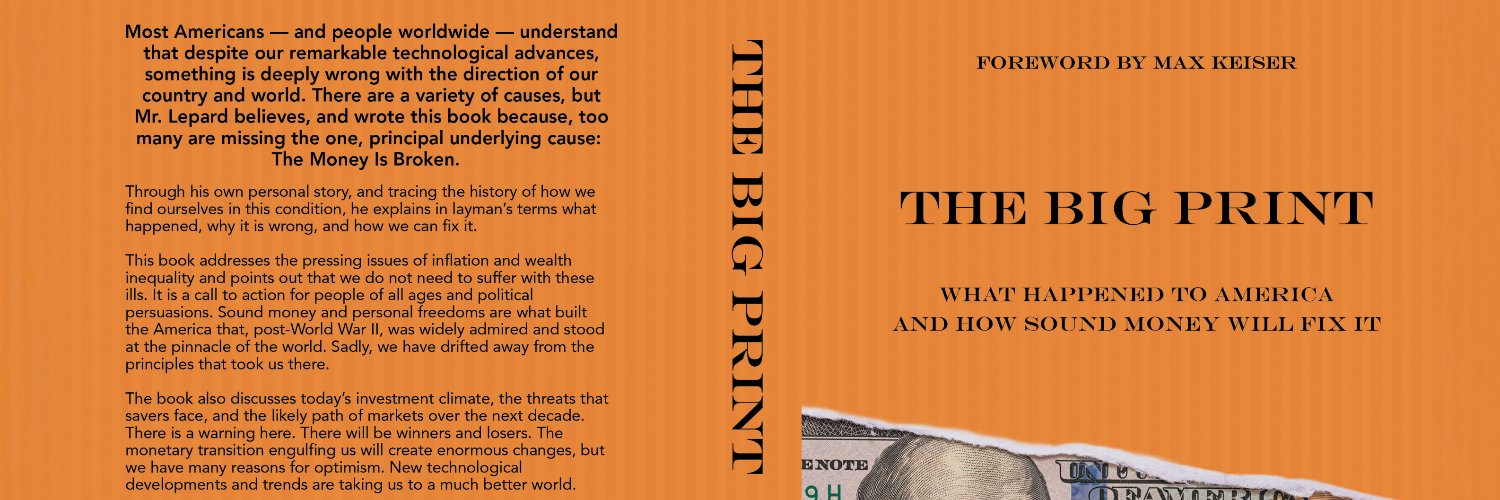
Bond yields are soaring. Sooner or later, The Big Print is coming.
"There are a lot of people really badly hurting... what they can do to stop it is buy Bitcoin."
My conversation with @LawrenceLepard at last year’s @btchistoricosv is now on YouTube.
Show more


@LawrenceLepard Meanwhile:"Money-Supply Growth Accelerated In July To A 59-Month High"

Many don’t realize the Fed creates - and is no different - than a politburo command-and-control Soviet economy.
If the price of money (interest rates) are not market driven, then price discovery across all assets is compromised.
Bitcoin is the escape hatch.
Show more
So tomorrow the Politburo/Gosplan will set the price of grain. Expectations are that they will increase it by 25 bps.

@LawrenceLepard Pocket guide to ‘high-yielding’ annuity rates. (Yes, sarc)
Big position.
I am a Director. DYODD
ZAUIF

News Alert! !📢Zodiac Gold Intersects 58 Metres at 3.15 g/t Au, Including 1 Metre at 158 g/t Au in Trenching at Lewis North
Read more here:
$ZAU.V
#TSXV# #SmallCaps# #MiningNews#
@RonStoeferle
@LawrenceLepard
Show more

All near record highs. Bondpocalypse.
@maxkeiser

@scalzo_david I like that.
Lepard’s Law: There is no limit to the financial theft that some people will pursue.











