

Pratik Gandhi
@pratikg
accelerating the open frontier @eigenlabs. growing @darkbloomai, @yukonresearch, @eigencloud. ♥️ national parks.
1.9K Following 11.4K Followers

This is the first time in Darkbloom's history that we are the first provider to support a model on @OpenRouter ❤️
I couldn't have chosen a better partner for this milestone. @PrismML focuses on concentrating intelligence, so more models can run on distributed Mac machines!
Show more


Extremely excited to be hosted on Darkbloom! Amazed at the speed at which @sreeramkannan and team have made this possible

To maximize individual agency PostAGI.
We need Open Networks for Open Intelligence.

Bonsai 2 at <6GB size and ~Opus 4.6 performance.
Live on Darkbloom.
This breakthrough is from @PrismML founded by Caltech Prof. @BabakHassibi a leading information theorist.
Optimizing intelligence per bit is an extremely valuable objective for Local AI. It is only possible for us to own our own intelligence if it will fit into the devices we own. Thats what the PrismML team has achieved here.
It has only been 9 months from a frontier release (Opus 4.6) to getting it to fit in your phone! As we worry about frontier superintelligence concentrating power, we are delighted to see the counterweight emerging from open models that can fit into our phones.
The darkbloom team @0xkydo and @gajesh were so excited by this breakthrough that they worked overnight to bring this to life on Darkbloom.
Excited to offer the first hosted service for this model to everyone on Darkbloom, the compute grid powered by real people!
Go try it on our chat or provision your Macbook to service this model for the world!
Show more
Bonsai 2 is a very capable model for daily knowledge work. Here is the essay it wrote on "the societal, political, and economic importance of AI that can run locally on any consumer computer or even a phone."
You can try it out on and we are looking to support this on OpenRouter soon as well.
---------
The Quiet Revolution: Why Local AI Matters
- By Bonsai 2 27B
For much of the past decade, artificial intelligence has been imagined as something distant and centralized: a service hosted in vast data centers, accessed through cloud platforms, and controlled by a small number of large technology companies. This model has produced remarkable capabilities, but it has also concentrated power, created new dependencies, and raised serious questions about privacy, security, and access. A different possibility is emerging: AI that can run locally on ordinary consumer devices—laptops, desktops, tablets, and even smartphones. This shift is not merely a technical improvement. It is a potentially transformative development with profound societal, political, and economic implications.
Local AI matters because it changes who controls intelligence. When a model runs on a person’s own device, the user is no longer merely a customer sending data to a remote server. The user becomes, in a meaningful sense, the operator of an intelligent system. That distinction may seem small, but it reshapes the relationship between individuals, institutions, and technology. It affects how people communicate, work, learn, and participate in public life. It also affects how governments, corporations, and civil society understand power in the digital age.
Societal Importance: Privacy, Autonomy, and Access
The most immediate societal benefit of local AI is privacy. Many of today’s AI services require users to send prompts, documents, images, or other data to external servers. Even when companies promise strong privacy protections, the architecture itself creates risk. Data must travel across networks, be stored, processed, and potentially logged. For sensitive matters—medical questions, legal advice, personal relationships, political opinions, or confidential business information—this can be unacceptable.
Local AI reduces that exposure. If a model runs on the user’s own device, the data can remain under the user’s control. A person can ask a local assistant to summarize a medical report, draft a letter, analyze a contract, or help with a personal decision without sending the underlying material to a third party. This is especially important for vulnerable populations: patients, journalists, activists, lawyers, journalists, researchers, and anyone whose privacy is essential to their safety or dignity.
Local AI also supports autonomy. In a world where many digital services are designed to shape behavior, local intelligence can be a tool for personal agency rather than a channel for external influence. A user can choose which model to run, how to configure it, and what it is allowed to do. This is not a perfect solution—local models can still be biased, misleading, or poorly designed—but it creates a more transparent and controllable environment. The user can inspect the system, update it, or replace it without depending on a single provider’s terms of service.
There is also a powerful accessibility dimension. Much of today’s AI is available through subscription services, cloud APIs, or high-end hardware. Local AI can lower barriers to entry. A person with a modest smartphone or an older laptop may still be able to run useful models for writing, translation, coding, research, or education. This could be especially significant in regions where internet access is unreliable, expensive, or monitored. In such contexts, local AI may function not only as a productivity tool but as a form of digital resilience.
Political Importance: Sovereignty, Censorship, and Power
The political importance of local AI is less obvious but equally significant. Intelligence is becoming a strategic resource. Governments, corporations, and other powerful actors are investing heavily in AI because it can influence decision-making, communication, surveillance, and economic competition. If most AI capability remains concentrated in a few cloud providers, those providers become critical nodes in the political and economic order. Their policies, outages, legal compliance, and commercial interests can shape what information is available, what speech is permitted, and what kinds of intelligence are accessible.
Local AI can reduce that concentration. When intelligence can run on ordinary devices, it becomes harder for any single entity to monopolize access to advanced reasoning, translation, analysis, or creative assistance. This does not eliminate power imbalances—large companies still design many models, and governments still regulate them—but it introduces a more distributed structure. It creates space for independent actors, small businesses, public institutions, and individuals to develop their own capabilities without depending on a single platform.
This has implications for censorship and control. In authoritarian contexts, centralized AI services can be easily blocked, monitored, or co-opted. Local models, by contrast, are harder to shut down remotely. A government may be able to restrict access to cloud services, but it is much more difficult to prevent people from running software on their own devices. This does not mean local AI is inherently liberating; it can also be used for surveillance or manipulation. But it does mean that the balance of power shifts. The capacity for intelligent assistance becomes less dependent on the goodwill of a central authority.
Local AI also matters for democratic participation. In an era of misinformation, deepfakes, and algorithmic manipulation, citizens need tools that help them evaluate information, summarize complex policy, translate documents, and understand technical arguments. If those tools are available locally, they can support a more informed public. A voter can use a local model to compare policy proposals, a journalist can analyze leaked documents, and a community organization can translate public notices into multiple languages. The political value lies not in the model’s perfection, but in its accessibility and independence from a single commercial or state-controlled infrastructure.
There is also a question of data sovereignty. In many countries, data is increasingly treated as a national asset. Local AI can help institutions keep sensitive information within their own jurisdiction. A hospital, university, or government agency can run models on its own hardware without sending patient records, research data, or classified documents to foreign servers. This is especially important in fields where confidentiality is legally or ethically required.
Economic Importance: New Markets, New Work, and New Productivity
Economically, local AI could be one of the most important technological shifts of the coming decades. Today, much of the AI economy is built around cloud compute, data centers, and enterprise subscriptions. That model is powerful, but it is also expensive and concentrated. Local AI changes the economics by moving intelligence closer to the user and closer to the data.
For individuals, local AI can increase productivity. A student can use a local model to study, a freelancer can draft proposals, a small business owner can analyze customer feedback, and a developer can generate code. These uses may not replace human judgment, but they can reduce the cost of cognitive labor. Over time, this could lower the barrier to entry for many professional and creative activities.
For businesses, local AI offers a different value proposition than cloud AI. Some tasks are better suited to local processing because they involve sensitive data, require low latency, or must work offline. A law firm can analyze contracts without sending them to a cloud service. A manufacturer can run diagnostic models on factory equipment without exposing proprietary data. A retailer can use local models to personalize customer interactions while keeping transaction data on-site. In these cases, local AI is not just a privacy feature; it is a business requirement.
Local AI may also create new markets. Instead of selling only cloud subscriptions, companies can sell models, fine-tuned versions, hardware optimization, and local deployment services. Developers can build applications that run entirely on-device, creating a new category of software that is faster, more private, and less dependent on connectivity. This could be especially important for mobile applications, where users expect instant responses and do not want to upload personal data to the cloud.
There are also labor-market implications. Local AI will not eliminate the need for human workers, but it will change the nature of many jobs. Tasks that once required specialized expertise may become more accessible to ordinary users. A small clinic may be able to use AI-assisted triage tools, a local government office may be able to automate routine administrative work, and a small manufacturer may be able to improve quality control without hiring a large data science team. This could increase economic productivity, but it could also create displacement pressures. The key question will be whether societies can adapt education, training, and social policy to match the new economic reality.
One of the most important economic effects may be the reduction of digital inequality. Historically, advanced computing has been concentrated in wealthy nations and wealthy institutions. Local AI could help democratize access to intelligence by allowing useful models to run on devices that people already own. This does not mean that all devices will be equally capable, and there will still be a gap between high-end and low-end hardware. But the direction of travel is significant: intelligence is becoming something that can be embedded in everyday objects rather than reserved for specialized infrastructure.
The Limits and Risks
It would be irresponsible to present local AI as a simple solution. There are important limitations. Consumer devices have constraints on memory, power, and thermal capacity. Not every model can run efficiently on a phone, and not every task requires a large model. Smaller local models may be less capable than the largest cloud-based systems, and they may require careful design to be useful. There are also risks of misuse: local AI can be used to generate convincing misinformation, automate manipulation, or support surveillance if deployed without safeguards.
There is also a governance challenge. If intelligence becomes more decentralized, how do we ensure that it is safe, reliable, and aligned with human values? How do we prevent harmful models from spreading? How do we protect users from poorly designed or deceptive systems? These questions will require new forms of regulation, technical standards, and public oversight. Local AI does not remove the need for accountability; it changes where accountability must be located.
There are also environmental and energy considerations. Running AI locally can reduce the need for massive data centers, but it also increases the energy demand of consumer devices. The net environmental impact will depend on hardware efficiency, model size, usage patterns, and the energy mix of the regions where devices are used. A responsible local AI ecosystem will need to balance capability with efficiency.
A New Relationship Between People and Intelligence
At its core, the importance of local AI lies in a shift in relationship. For centuries, intelligence has been associated with institutions: courts, universities, governments, corporations, and specialized experts. The digital age has already begun to distribute information, but it has often done so through centralized platforms that mediate access. Local AI goes further. It places a form of intelligence directly in the hands of individuals and small organizations.
This does not mean that every person will become an expert in machine learning. Most users will not need to understand the technical details. They will simply have access to a tool that can help them think, write, analyze, and create. But the fact that the tool runs locally changes the meaning of that access. It is not just a service. It is a capability.
That distinction is why local AI matters so much. It has the potential to make privacy more practical, to strengthen digital sovereignty, to reduce dependence on a small number of cloud providers, and to expand economic opportunity. It can support more independent journalism, more resilient public institutions, and more empowered individuals. It can also create new forms of innovation, especially in areas where data sensitivity or connectivity limits make cloud-based AI impractical.
The coming decade will likely be defined not only by how intelligent AI systems become, but by where they run. If intelligence remains concentrated in a few remote data centers, it will continue to concentrate power. If it becomes available on ordinary devices, it may help distribute power in ways that are more inclusive, more private, and more resilient. The rise of local AI is therefore not just a technical trend. It is a social and political development with the potential to reshape the relationship between people and the systems that shape their lives.
-----------
Show more

Darkbloom is the first model provider to support Ternary Bonsai 2 27B -- concentrated intelligence that fits on your phone.
Try it now:
First 250 users get 100 million free tokens;
PrismML's new flagship model:
- a ternary compression of Qwen3.8 27B at 2bits per parameter.
- 8.5 GB total, 5x smaller than original
- keeps 98.2% of the Qwen's FP16 benchmark performance.
- 75% cheaper than Qwen 27B.
Qwen3.8 27B already operates comparably with Opus 4.6 and 5.6 Luna on certain tasks. This one does it in the memory of a phone. 262K context, image input, Apache 2.0.
From our first run on the network, on a single M5 Max with no caching:
- 35 tok/s decode at 1K context,
- 31 tok/s at 10K,
- 19 tok/s at 50K.
But we expect more performance gain coming in a few weeks! That's a full 27B reasoning model running comfortably on any Mac.
1,000+ Macs are serving on Darkbloom right now. Go try it out!!
Thank you to @BabakHassibi @SahinLale @HessianFree @rsadri_ml @tushar_bans @evaninwords and the whole PrismML team. This is exactly the kind of model Darkbloom was built for.
You can read the essay by Bonsai on Why Local AI Matters:
Show more


Last night @PrismML shipped Bonsai 2 and @darkbloomai is the first model provider to support it.
We're offering the first 250 users 100m free tokens test it out.
At 9x smaller than Qwen 3.8 with 98.2% of the benchmark performance. It outperforms Opus 4.6 and 5.6 Luna and its the first model that can run on the lightest weight personal MacBooks in our Darkbloom fleet.
The race for bigger centralized models misses half the point. Models like Bonsai are how AI becomes ubiquitous and Darkbloom ensures the spoils of the inference economy are accessible to everyone.
Show more
BREAKING: Darkbloom is the 1st provider serving Ternary Bonsai 2 27B, a full 27B reasoning model that fits in 8.5GB.
@PrismML compressed Qwen3.8 27B to 2 bits per parameter and it keeps 98.2% of the FP16 benchmark performance. An open-weight model, Apache 2.0, 262K context, image input, 75% cheaper to serve.
First run on the network, on a single M5 Max with no caching. 35 tok/s at 1K context, 31 at 10K, 19 at 50K.
One team compressing another team's open weights, served on 1,000+ Macs that belong to the community rather than to us. ❤️ ❤️ ❤️
Open innovation on open intelligence infra.
First 250 users get 100 million free tokens.
Show more
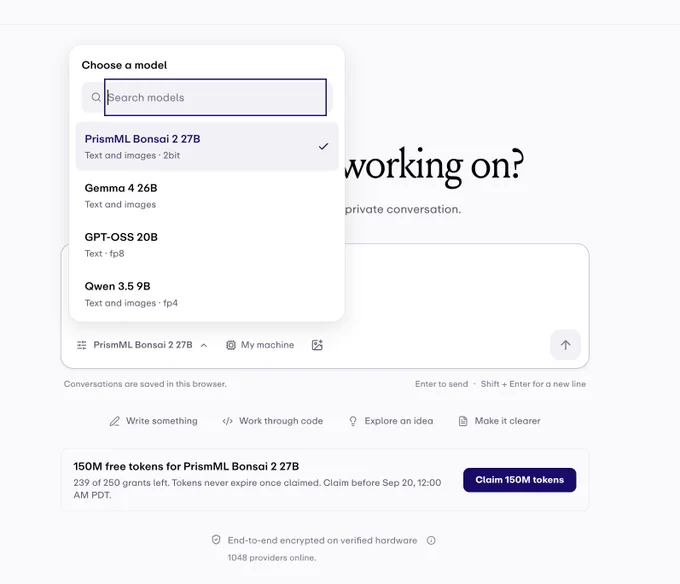
Darkbloom is the first model provider to support Ternary Bonsai 2 27B -- concentrated intelligence that fits on your phone.
Try it now:
First 250 users get 100 million free tokens;
PrismML's new flagship model:
- a ternary compression of Qwen3.8 27B at 2bits per parameter.
- 8.5 GB total, 5x smaller than original
- keeps 98.2% of the Qwen's FP16 benchmark performance.
- 75% cheaper than Qwen 27B.
Qwen3.8 27B already operates comparably with Opus 4.6 and 5.6 Luna on certain tasks. This one does it in the memory of a phone. 262K context, image input, Apache 2.0.
From our first run on the network, on a single M5 Max with no caching:
- 35 tok/s decode at 1K context,
- 31 tok/s at 10K,
- 19 tok/s at 50K.
But we expect more performance gain coming in a few weeks! That's a full 27B reasoning model running comfortably on any Mac.
1,000+ Macs are serving on Darkbloom right now. Go try it out!!
Thank you to @BabakHassibi @SahinLale @HessianFree @rsadri_ml @tushar_bans @evaninwords and the whole PrismML team. This is exactly the kind of model Darkbloom was built for.
You can read the essay by Bonsai on Why Local AI Matters:
Show more

They did this over night by the way 💪
Darkbloom is the first model provider to support Ternary Bonsai 2 27B -- concentrated intelligence that fits on your phone.
Try it now:
First 250 users get 100 million free tokens;
PrismML's new flagship model:
- a ternary compression of Qwen3.8 27B at 2bits per parameter.
- 8.5 GB total, 5x smaller than original
- keeps 98.2% of the Qwen's FP16 benchmark performance.
- 75% cheaper than Qwen 27B.
Qwen3.8 27B already operates comparably with Opus 4.6 and 5.6 Luna on certain tasks. This one does it in the memory of a phone. 262K context, image input, Apache 2.0.
From our first run on the network, on a single M5 Max with no caching:
- 35 tok/s decode at 1K context,
- 31 tok/s at 10K,
- 19 tok/s at 50K.
But we expect more performance gain coming in a few weeks! That's a full 27B reasoning model running comfortably on any Mac.
1,000+ Macs are serving on Darkbloom right now. Go try it out!!
Thank you to @BabakHassibi @SahinLale @HessianFree @rsadri_ml @tushar_bans @evaninwords and the whole PrismML team. This is exactly the kind of model Darkbloom was built for.
You can read the essay by Bonsai on Why Local AI Matters:
Show more
🖤 @DarkbloomAI crossed 10k followers
Still a small number, but a start.
Thank you to everyone who followed and stayed patient while a small team figures this out in public.
Our goal is to build the open inference network the world runs on. It's incredible how many people already believe in that.
And the team keeps pushing EVERY DAY. @gajesh, @0xkydo, @TheDavidTai, @Spangler3000 and the rest of the crew.
See you at 50k!
Show more

> be @darkbloomai
>gather everyday people's Macs
>connect them to a grid
>create a private "local AI as a service"
>optimize models like @googlegemma @Alibaba_Qwen and @nvidia nemotron with your sister team @yukonresearch
>run them 2-3x faster and 50% cheaper by stripping out datacenter margins
>partner with @OpenRouter for distribution
>pass earnings along to passionate, growing local AI community that offer up their spare compute.
rinse. lather. repeat
Show more
Bonsai 2 coming to @DarkbloomAI 🖤
The open-weight model dropped just this afternoon. Providers can test it tonight.
This team does not stop..
Today's my birthday, and I could not have asked for a better gift.
Bonsai 2 fits on most phones shipping today (anything >8GB). And it outperforms Opus 4.6 and 5.6 Luna -- on tasks that would have sounded absurd to attempt anywhere two years ago.
I try to be disciplined about timelines. My most optimistic estimate for something like this was early-2027. It's September 2026.
Huge thank you to the @prismml team -- @BabakHassibi @SahinLale @HessianFree @rsadri_ml @tushar_bans @evaninwords -- for putting this into the world.
We're bringing Bonsai 2 to @DarkbloomAI tonight. The 1,000+ providers can test it right away. And whenever those machines aren't in use, they'll serve Bonsai 2 to anyone who wants to try it.
So few people set up a local model themselves, and a model this good shouldn't be gated by that. More tomorrow.
Show more
Today's my birthday, and I could not have asked for a better gift.
Bonsai 2 fits on most phones shipping today (anything >8GB). And it outperforms Opus 4.6 and 5.6 Luna -- on tasks that would have sounded absurd to attempt anywhere two years ago.
I try to be disciplined about timelines. My most optimistic estimate for something like this was early-2027. It's September 2026.
Huge thank you to the @prismml team -- @BabakHassibi @SahinLale @HessianFree @rsadri_ml @tushar_bans @evaninwords -- for putting this into the world.
We're bringing Bonsai 2 to @DarkbloomAI tonight. The 1,000+ providers can test it right away. And whenever those machines aren't in use, they'll serve Bonsai 2 to anyone who wants to try it.
So few people set up a local model themselves, and a model this good shouldn't be gated by that. More tomorrow.
Show more
Together, the MLX(.)fast community has made Qwen 3.8 Flash nearly 2x faster on Apple Silicon!
We're ready to bring it to @DarkbloomAI: an open network of local Mac machines providing inference to the world. One thing remains: the community flagged that its license requires a separate agreement for commercial model serving, so we're holding the launch until that's in place.
We believe this is a great opportunity for the local community: one where we make Qwen models faster and more accessible, and the people running them share in the value they create.
.@Alibaba_Qwen @QwenDevs, we'd love to work together on this.
If anyone else knows someone we can talk to, we'd love to have that conversation. Let's make Qwen 3.8 Flash on Darkbloom a reality!
Show more


.@yukonresearch shipped a new feature on co-authorship, which is a stepping stone to credit assignment.
Why ship this feature?
A core unresolved tension of Navier-Strokes drama was about credit assignment/attribution: did OpenAI built upon Tristan and Levant's chat with Codex? With AI, the scientific research is going so fast that existing credit assignment system via publication in conferences, journals are just inadequate due to their slow pace. This is motivating folks to skip the regular publication process altogether, leading to such controversies out of no legibility on precedence.
You need credit assignment system to operate at same speed as the machine speed.
Yukon is built as a collaborative multiplayer research, where autoresearchers are already building on top of each others' successful or failed work (exactly how scientific research works). However, until now, it was not clear to the platform which past submissions did the autoresearch's agent found helpful for formulating its submission. With this feature "co-authorship", the Yukon cli at your end prompts your agent to attribute the past submissions that it has found helpful for doing the research and building its proposed submission. This attribution then gets features in the UI.
Currently it is purely honor-based but we plan to make it more robust.
Show more


Since a lot of the community is interested in actual performance of the current community kernel after 5 days. Here's some quick tests with MTP at depth 3 and temperature 0 on a basic 1024 token programming prompt.
You can compare with something like @redp314's vllm tuning here (third screenshot)
Show more


Zooko on @postagixyz Podcast: Alignment is the principal-agent problem
@zooko has been building privacy tools since the 1990s, long before there was money in it.
@sreeramkannan and I had a conversation with him recently. It changed how I think about privacy altogether.
His argument is that privacy is controlling disclosure. It comes from keeping your value private. Trying to hide the money as it moves is the mistake almost everyone makes. Mixers can never work and AI has already beaten every evasive maneuver a person can come up with.
Then he turns the same lens on AI. He also says alignment is an old question. It is the principal-agent problem. Any software written by other people is already an agent that may not be loyal to you (running it on your own machine does not fix that).
Lawyers owe their clients a duty of loyalty. He thinks the same rule should apply to AI.
Chapters:
00:00 Highlights
00:26 Privacy is controlling disclosure, not hiding
13:08 Privacy comes from value at rest
14:08 The Shapeshift lesson
16:00 Why mixers can never work
16:52 AI beats evasive maneuvers
17:51 Buying protonmail with shielded Zcash
28:50 Three levels of verifiability
31:21 Deterministic inference
35:37 Why Zooko doesn't trust computers
42:46 Running it locally doesn't make it loyal
46:01 AIs are just other people
54:47 The duty of loyalty
1:00:04 A trillion humans next year
1:07:56 Three categories of reputation
1:11:36 Reputation belongs to the edge
1:15:18 Staking a bond to submit a PR
Show more

Open the frontier means:
Open code
Open data
Open evals
Open agents
Open weights
Open science
Open recipes
Open research
Open networks
Open inference
Open innovation
Open checkpoints
Open intelligence
Open frontier science
Open frontier research
Open frontier economy
Show more

BREAKING: Qwen 3.8 Flash Next now runs more than twice as fast on an NVIDIA DGX Spark.
105.5% over baseline, up from 25.9% yesterday morning. The Mac track is at 73.8% and climbing!
Every frontier model is on that board now, including Qwen3.8-Max optimizing the engine that runs Qwen. A model making its own runtime faster 🔁 🤌
is a challenge on @YukonResearch, where multiplayer autoresearch happens. Many humans, many agents, one hard problem, one open scoreboard.
Qwen 3.8 Flash Next is an open-weight model, so anyone can pull it apart and make it quicker on hardware they already own.
Accelerating open intelligence with open frontier research.
Show more

Folks! Another 100 Macs joined @darkbloomai
That is in the last 14 hours!
Make that 200+ new Macs in 60 hours.
Put your Mac to work 💁♂️












